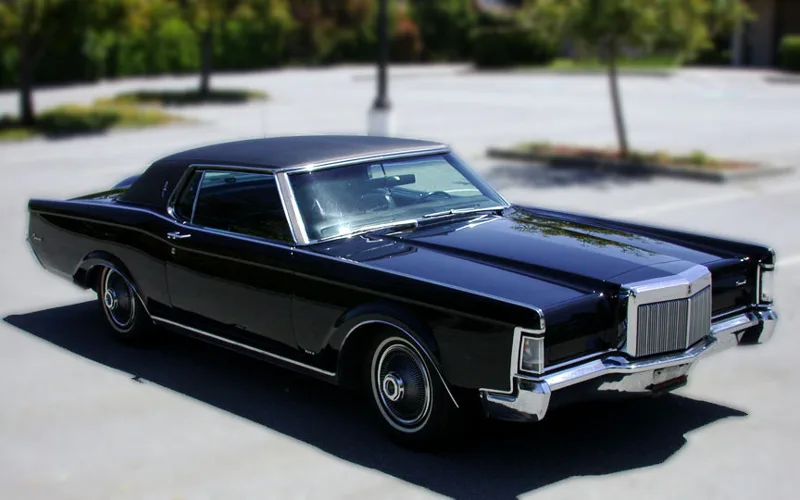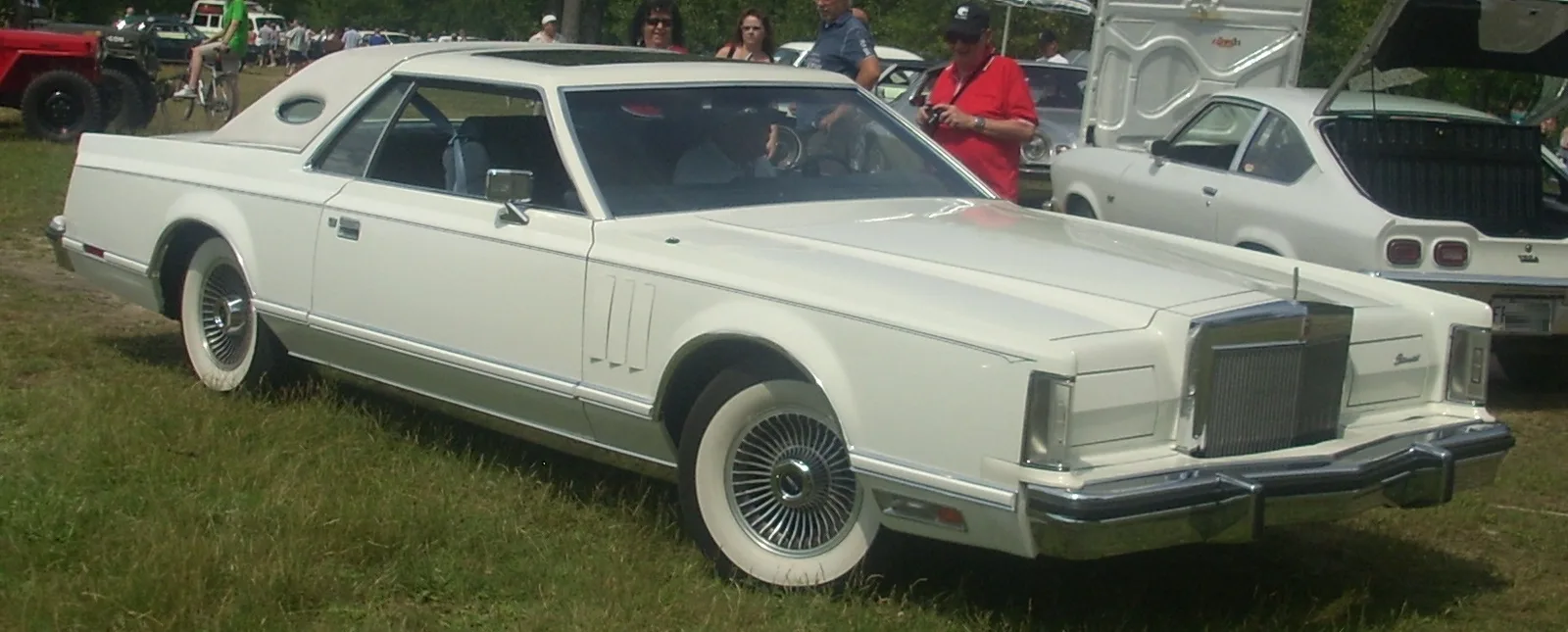
A 230-inch two-door from Lincoln with Designer Series, Diamond Jubilee and Collector's Series editions, sold until the Mark VI replaced it.
The Lincoln Continental Mark V was a personal luxury coupe sold in North America from 1977 to 1979 by Lincoln. It sat on the Mark IV chassis, measured 230 inches (5.8 m) long and sold 228,262 examples, the most of any Continental Mark car.
The Lincoln Continental Mark V was built for three model years, from 1977 to 1979, as the third generation of the Mark Series. Lincoln sold it as a personal luxury coupe, and it was the longest two-door coupe the company ever put on sale.
Its exterior design dated back to a late-1960s proposal, one of its V8 engines was shared with the Thunderbird and Cougar, and its special editions ranged from a 1978 anniversary model to a 1979 Collector's Series that closed out production.
What was the Continental Mark V?
The Continental Mark V was a Lincoln personal luxury coupe built for the 1977, 1978 and 1979 model years. It shared its chassis with the Mark IV and sold 228,262 examples, making it the top seller of the Continental Mark line.
The Mark V continued the Mark III and Mark IV line that began in 1969 with the Continental Mark III. Lincoln, the luxury arm of Ford Motor Company, sold it across North America, and it was assembled at Wixom Assembly alongside the Lincoln Continental sedan.
At 230 inches (5.8 m), the Mark V is the longest two-door coupe in Ford's history.
The Mark V was replaced for 1980 by the significantly downsized Continental Mark VI. That change marked a clear break in the Continental line-up.
A 230-inch personal luxury coupe that sold 228,262 examples in three model years before the Mark VI arrived.
How was the Mark V styled?
The Mark V kept Mark-series traditions, including a faux spare-tyre lid badged Continental, oval opera windows, concealed headlamps and a radiator-style front grille. Vertical blade taillights echoed the Mark III, and the front fenders carried functional louvers behind the wheels.
Not every early idea survived. Designers tried taillights that wrapped up into the rear fender blades, but the idea failed to win approval in focus clinics, so production cars kept upright blade lights echoing the Mark III.
The vinyl roof was another defining feature. Lincoln listed it as a $187 option, but for the 1979 model year it could no longer be deleted. In 1977 the full vinyl roof was optional, as was a rear-quarter Landau roof, and those choices continued into the later years.
The 1978 model year added the Carriage Roof, a full-length simulated convertible top in white canvas-embossed vinyl. It replaced the opera windows with a vanity mirror in the interior trim, and it ruled out the power glass moonroof.
What engines did the Mark V use?
Ford's 400 cubic-inch (6.6 L) V8 was standard in 1977, while a 460 cubic-inch (7.5 L) V8 was available as an option everywhere except California. The 400 was also used in the Thunderbird, Cougar, LTD and Marquis, so the engine was not unique to the Lincoln.
Outside California, the 460 remained a choice for buyers who wanted the larger engine. The 400 was adjusted over the model years, and the 1978 standard unit was slightly detuned compared with the 1977 version.
The 1978 model year also brought a larger radiator and revised heater core inlets, with new hoses for better coolant flow and heater performance. The 7.5 L option was still available that year.
The 1979 model year ended both the dual-exhaust 400 and the 460, as the car was adjusted to meet newly mandated Corporate Average Fuel Economy standards. By 1980 the 460 had also disappeared from the Mark V and from every Lincoln.
Every Mark V came with the C6 three-speed automatic, and no other gearbox was listed across the three model years. There was no manual alternative, so the automatic was the sole gearbox choice for every buyer.
What was the Mark V's chassis and brake set-up?
The Mark V shared its chassis with the Mark IV, but its curb weight fell from 5000 to 4600 pounds. Four-wheel disc brakes and an anti-skid brake system were standard. Power windows and a driver's seat with six-way adjustment came fitted, as did automatic temperature control air conditioning.
Standard tyres were Michelin 225-15 radials with narrow white sidewalls. Goodyear's LR78-15 Custom Polysteel tyres, with dual band whitewalls, were optional through the end of production.
For 1977 an inflatable spare tyre with a pressurised propellant canister replaced the conventional full-size spare. Whatever wheel was fitted, the spare was a 15-inch steel wheel with a tyre matching the car's four exterior tyres.
What changed in each model year?
The Mark V changed every year. The 1977 car introduced the inflatable spare and a new illuminated entry system, 1978 brought the Carriage Roof and the Miles-to-Empty display, and 1979 ended the 7.5 L engine and the dual-exhaust 400 while revising the Designer Series and Luxury Group trims.
1977
The 1977 car was the launch year of the three-year run. The 7.5 L V8 was optional, and California cars received turbine-style aluminium wheels as standard to make up for the missing engine option. Those wheels applied to that year only.
An optional Illuminated Entry System kept the cabin lights and lock cylinder rings glowing for 25 seconds after a driver lifted an exterior door handle. The Designer Series and the Luxury Group both received new colour combinations that year.
1978
The 1978 model year brought the Diamond Jubilee Edition, a commemorative model for Ford's 75th anniversary. It also introduced a digital Miles-to-Empty display that replaced the low fuel lamp, and it was the first use of an LED dashboard display for a mechanical function.
Further options for 1978 included a 40-channel CB radio, a garage door control built into the lower edge of the driver's visor and an illuminated exterior thermometer. Wire wheel covers were also offered, although they did not lock.
1979
The 1979 model year was the last. The 7.5 L engine and the dual-exhaust 400 were discontinued to meet the new fuel economy rules, and the Collector's Series arrived to mark the end of production.
The vinyl top was no longer something a buyer could delete, and the Carriage Roof became standard on the Bill Blass Designer Series. Full and rear Landau vinyl tops stayed on the options list, while the all-metal body-colour roof disappeared from the range.
How did the Luxury Group option work?
From 1973 to 1981 Lincoln offered a Luxury Group option for Mark-series buyers. It let a buyer pick cloth or leather-and-vinyl upholstery, up to four exterior paint colours, a Landau or full-length vinyl roof, bodyside mouldings, wheels and tyre style.
Buyers could also order other options alongside the package. Colour combinations offered during production included Gold-Cream, Cordovan, Light Jade and Dark Jade, Turquoise, Red-Rose, Wedgewood Blue, Champagne and White, although the palette changed from year to year.
Some groups were limited to a single year. The Majestic Velour Luxury Group carried over for 1977 only, while the Spring Luxury Group offered Dove Grey or Dark Blue Metallic paint with a matching two-tone leather interior.
What were the Designer Series cars?
The Designer Series was an appearance package with four designer names: Bill Blass, Cartier, Givenchy and Emilio Pucci. Each had its own exterior paint, interior upholstery, vinyl roof and bodyside mouldings, and each was marked by a decklid decal and a dash nameplate.
Each car displayed a designer's mark in the opera window glass, plus a nameplate on the dash finished in 22-karat gold plate. The options changed from year to year, so a car from one model year could differ from the same series a year later.
Wheels changed for 1979, when the Bill Blass, Cartier and Givenchy cars moved to colour-keyed alloys, as the Collector's Series had. The Bill Blass car also took the Carriage Roof as standard, with revised rear quarter trim panels and reading lights in the interior.
What was the Diamond Jubilee Edition?
The Diamond Jubilee Edition was a 1978 model that marked Ford Motor Company's 75th anniversary. The edition carried an $8,000 premium over a standard Mark V and lifted the price to over $21,000, making it the most expensive vehicle Ford had sold to that point. Ford built 5,159 of them.
The exterior was nearly monochromatic, with colour-keyed body mouldings, vinyl top, wheels and grille, and two shades offered only on this edition, Diamond Blue and Jubilee Gold. Chrome was largely confined to the window and grille surrounds, the bumpers and the fender vents.
Inside, the split front bench gave way to cloth bucket seats with a centre console and a padded armrest that stored an umbrella. The opera windows carried simulated diamond chips, and each owner received a leather-bound manual, a tool kit and keys matching the interior trim.
The buyer had little to choose from: a 460 V8 that could be ordered with or without dual exhaust, plus a power moonroof and a CB radio of 40 channels. Alongside the Lincoln Versailles, the edition was one of the first Ford vehicles to use clear-coat paint, and owners could also request the Diamond Jubilee Recipe Collection cookbook.
What was the 1979 Collector's Series?
The Collector's Series was the 1979 repackaging of the Diamond Jubilee and the final special edition of the Mark V, marking the end of production. Its base price was nearly $22,000, and 6,262 editions were produced.
The Collector's Series lacked opera windows, which set it apart from every other Mark V. Its cloth interior with a centre console and bucket seats was standard, although buyers could order the leather interior instead, and an eight-track player could be swapped for a cassette.
Four colours were offered: Midnight Blue Moondust, White, Diamond Blue Moondust and Light Silver Moondust. Midnight Blue examples numbered 3,900, Diamond Blue 197 and Silver 125, while the White figure of 2,040 includes cars without a vinyl top, although that number is not recorded.
How many Continental Mark Vs were sold?
Although it was on sale for only three model years, the Continental Mark V sold 228,262 examples. That total is higher than any other car in the Continental Mark line.
The Mark V was built at Wixom Assembly, which also produced the Lincoln Continental sedan from 1957 to 2007. Lincoln offered the car in several commemorative and designer editions, and the Bill Blass edition was sold throughout the three-year production run.
The Mark V's production run ended with the Collector's Series in 1979, and the Continental Mark VI that followed for 1980 was significantly downsized.
What are the Continental Mark V specifications?
| Specification | Detail |
|---|---|
| Model years | 1977 to 1979 |
| Class | Personal luxury coupe, sold by Lincoln division |
| Length | 230 inches (5.8 m) |
| Curb weight | 4600 pounds, down from 5000 on the Mark IV |
| Standard V8 (1977) | 400 cubic-inch (6.6 L) |
| Optional V8 (1977) | 460 cubic-inch (7.5 L), not offered in California |
| Transmission | C6 three-speed automatic |
| Standard tyres | Michelin 225-15 |
| Optional tyres | Goodyear LR78-15 Custom Polysteel, dual band whitewall |
| Vinyl roof | $187 option; could not be deleted for 1979 |
| Diamond Jubilee (1978) | 5,159 built; over $21,000, or $103,661 in 2025 money |
| Collector's Series (1979) | 6,262 built; nearly $22,000, or $97,593 in 2025 money |
| Total sales | 228,262 |