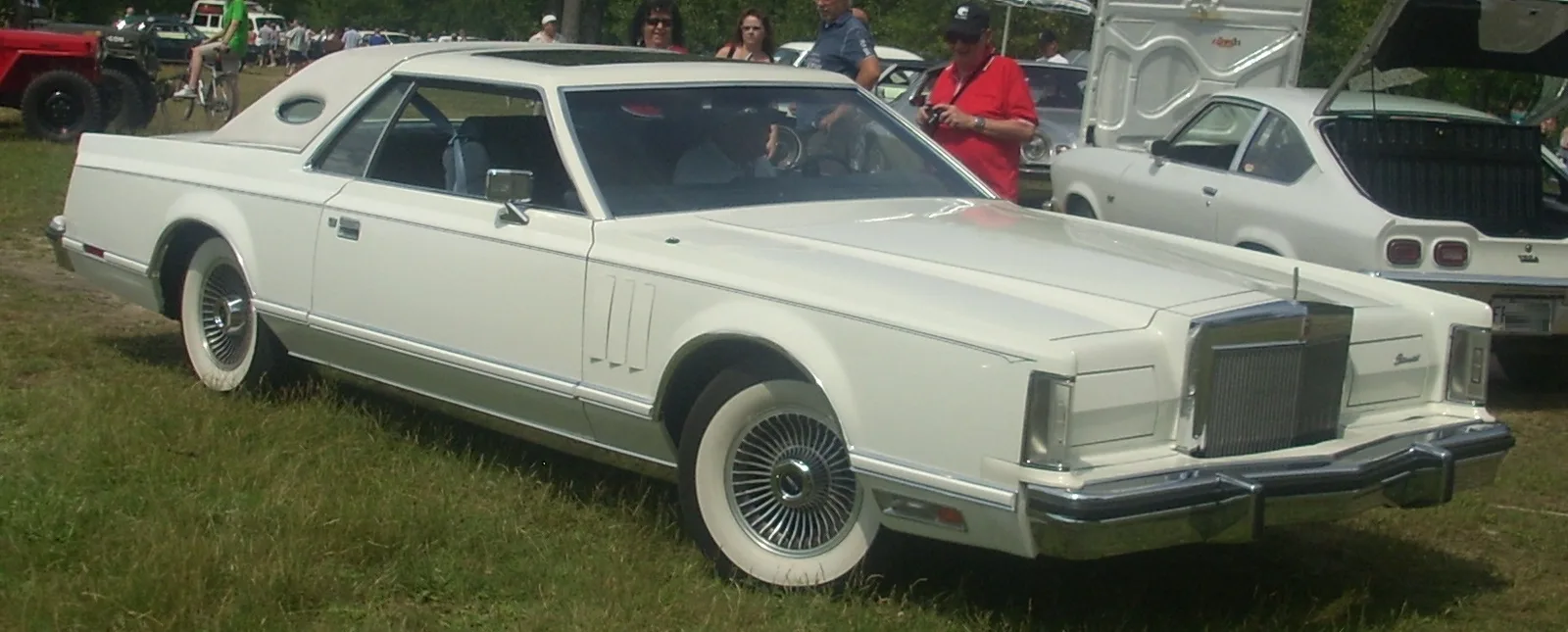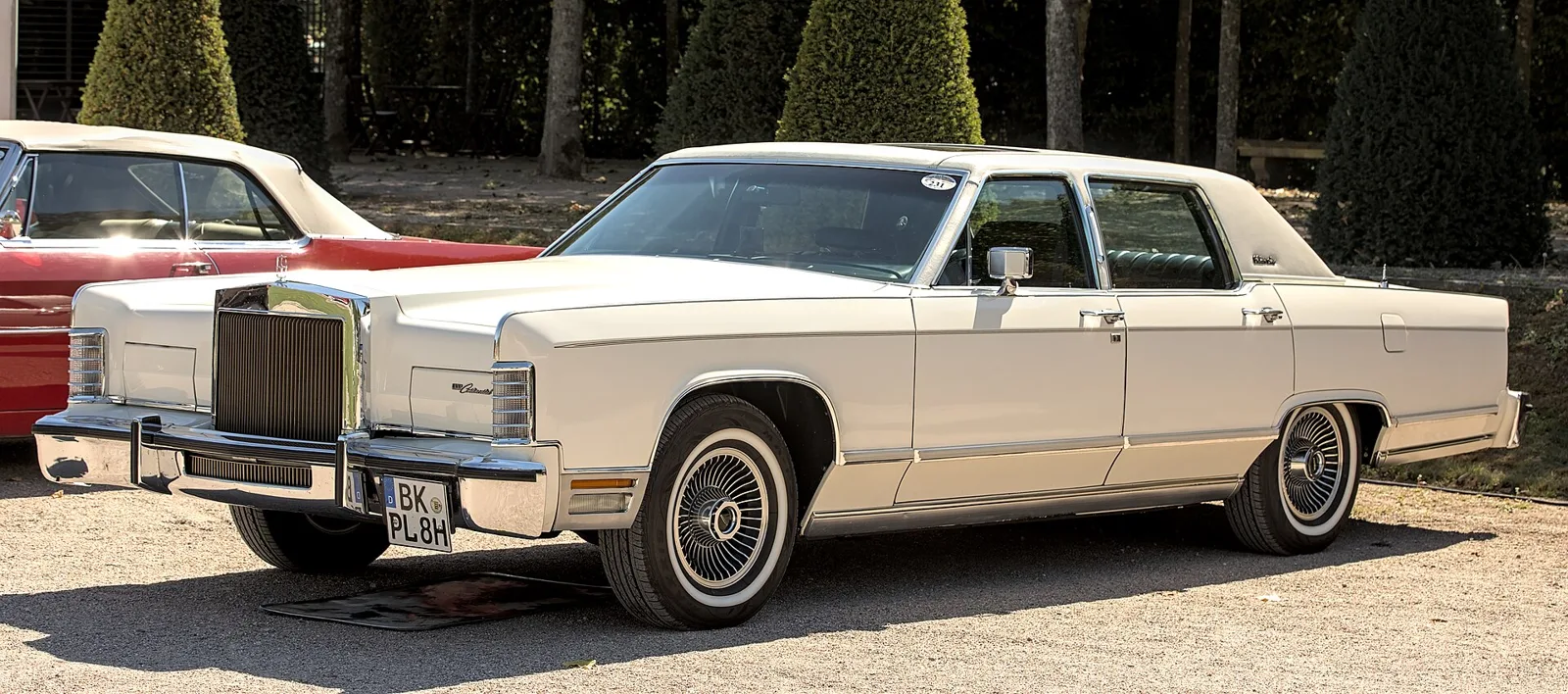
A full-size Lincoln built through the emissions and fuel rules of the 1970s, with V8 engines that shrank as the decade went on.
The Lincoln Continental of the 1970 to 1979 model years was a large luxury car sold with two or four doors by Ford's Lincoln brand. It was the fifth generation of the Continental family, powered only by large V8 engines, and it grew to 5,916 mm (232.9 in) long after its 1975 facelift.
The Lincoln Continental built from 1970 to 1979 was a full-size luxury car from Ford's premium brand, available with two doors or four. Its ten-year run coincided with tougher US fuel economy and emissions rules, and by the 1979 model year it had become the longest production car in the world. Lincoln promoted it as a Traditional Size Car just as rivals were getting smaller.
Where did the Lincoln Continental of 1970 come from?
The fifth Continental generation arrived for the 1970 model year and followed a fourth series that had been built from 1961 to 1969 on a design by Elwood Engel. Lincoln had offered only full-size cars since the Second World War, and the Continental name had been in use since 1958.
Alongside the sedans, the Continental Mark Series arrived in 1969 under a confusing label. These high-priced coupes were technically related to the Continental but styled on their own lines. The Mark III had been the brand's flagship since 1968, and in 1970 it cost almost US$1,000 more than the regular Continental coupe.
Underneath, the fifth generation kept a separate frame with the body mounted on top. Its mechanical family was close to the Ford LTD and its sister car, the Mercury Marquis, both introduced in 1969. The car was therefore a full-size product of the Ford group, dressed in Lincoln's own styling and trim.
A big Lincoln was the only real choice for buyers who wanted size in 1979.
How did emissions and fuel rules change the big Continental?
US authorities set the decade's rules. Corporate Average Fuel Economy limits took effect in 1975 and forced manufacturers to cut the fuel use of their fleets. A January 1973 order also made catalytic converters compulsory on cars registered from 1975, which meant engines had to be adapted to unleaded petrol.
The First Oil Crisis of 1973 added to the pressure, because raw material prices had risen steeply. Makers had to build smaller, lighter and more economical cars in every segment. Cadillac had already shrunk its DeVille for the 1977 model year, but Ford's full-size programme moved more slowly.
Lee Iacocca, a former Ford manager, described the late start as a refusal to face reality. He suspected that Ford chairman Henry Ford II had a basic dislike of smaller cars. Whatever the cause, the Continental stayed in the range while its replacement waited.
The Panther platform was created for the full-size range. It first appeared for the 1979 model year, in the new generation of the Ford LTD and Mercury Marquis, and Lincoln's move to it slipped by a year. The fifth-generation Continental therefore stayed in production until 1979, and some writers called it the 'last of the dinosaurs'.
Design and styling
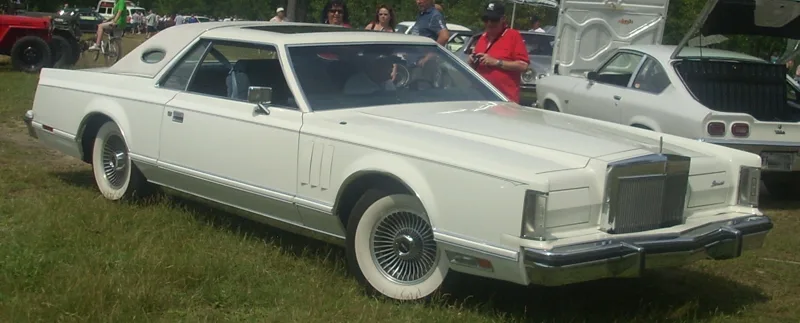
The body was redesigned for 1970 and then changed in detail almost every year. The shape is often described as resolute and boxy. The most distinctive feature is the tall, vertical front fender ends, which were meant to look like sharp knife blades and gave the car the American nickname Knife Blade Fenders.
The four-door cars dropped the portal doors that had marked the Continental since 1961. From 1970 the rear doors were hinged at the front too. The four-door was a pillared hardtop, meaning it kept a B-pillar while the side windows were frameless. The two-door was a hardtop coupe without a B-pillar until the 1975 facelift turned it into a pillared hardtop coupe, a change driven by tighter side-impact rules.
Lincoln offered no two-door convertible, unlike its sister brands, and the four-door convertible that had ended with the 1967 model year was never revived. The concealed headlights were meant to create a visual link with the two-door Mark III, which sat at the top of the brand.
The grille changed several times. The first cars had a metal-trimmed upper section and horizontal bars below, a shape intended to recall the coffin nose of the Cord 810 built in 1936 and 1937. From 1975 vertical bars took over, and in 1977 a large stainless steel grille copied the traditional Rolls-Royce radiator, linking the car with the expensive Continental Mark cars.
Front safety bumpers were required from 1973, and rear bumpers followed in 1974. Those rules reshaped the ends of the car and added length. The 1975 facelift also reworked the flanks, roof and rear, and the second series ended up about 15 cm (5.9 in) longer than the first.
What engines powered the fifth-generation Continental?
Every fifth-generation Continental used a large V8 petrol engine, and Lincoln cut output to meet tougher limits on fuel use and emissions. Between 1970 and 1976 a single 7,538 cc (460 cu in) big-block, drawn from the Lima range, was the sole option. It was rated at 224 SAE-PS (221 hp) in 1972 and 202 SAE-PS (199 hp) in 1976.
Starting in 1977, the base engine became a 6,555 cc (400 cu in) V8 belonging to the Cleveland engine family, rated at 179 SAE-PS (177 hp). Its output fell to 159 SAE-PS (157 hp) by 1979, the year the 6.6-litre engine became the only one offered.
The 7.5-litre engine remained available as a paid option in 1977 and 1978. In 1978 it was rated at 210 PS (207 hp). Lincoln lowered the compression ratio in 1972 so that unleaded petrol could be used, and common measures across the industry included dropping the twin or quad carburettors that had been widespread.
A three-speed automatic from Ford was the transmission in every year of the run.
Specifications at a glance
| Specification | Detail |
|---|---|
| Body styles | Two-door coupe and four-door saloon |
| Overall length, early years | 5,715 mm (225.0 in) |
| Overall length, 1973 | 5,839 mm (229.9 in) |
| Overall length, 1974 | 5,908 mm (232.6 in) |
| Overall length, after 1975 facelift | 5,916 mm (232.9 in) |
| Wheelbase | Lincoln wheelbase 153 mm (6.0 in) longer than the Mercury |
| Curb weight, 1974 | 2,435 kg (5,368 lb) |
| Curb weight, 1979 | 2,104 kg (4,639 lb) |
| Engine, 1970 to 1976 | 7,538 cc (460 cu in) V8 |
| Engine, 1977 to 1979 | 6,555 cc (400 cu in) V8 |
| Top speed, 1979 | 170 km/h (106 mph) |
| Transmission | Three-speed automatic from Ford |
How did the weight and size change through the decade?
Length grew from 5,715 mm (225.0 in) in the early years to 5,916 mm (232.9 in) after the 1975 facelift, and a new front end in 1977 added 2 mm (0.08 in). Curb weight peaked at 2,435 kg (5,368 lb) in 1974 and then fell by more than 400 kg (882 lb) to 2,104 kg (4,639 lb) by 1979.
Safety bumpers drove much of the growth. The front bumpers were moved slightly forward and fitted with impact horns in 1973, and the rear bumpers joined them in 1974. By 1979 the old car, whose engineering dated from 1970, held the title of the world's longest series-built car.
Engineers worked against the trend, trimming mass wherever they could. The 1974 changes did add 150 kg (331 lb) to the kerb weight, but over the run the direction was downward. The 1979 car weighed 2.1 tonnes.
What did the Continental cost over the decade?
List prices moved with the model years and with the equipment fitted. The 1971 base cars cost US$7,172 as a two-door and US$7,419 as a four-door. The 1974 model year pushed prices up by more than 10 per cent, to US$8,053 for the coupe and US$8,238 for the sedan.
The 1972 model year brought cuts of about US$150 on the base two-door and four-door, and the 1973 models rose by about the same amount. In 1975 prices went up by around US$1,200 on the previous year. For 1976 Lincoln held list prices steady by moving some equipment out of the standard specification and into the optional extras.
By 1977 the base coupe listed at US$9,474 and the four-door at US$9,636. Prices rose by about US$500 in 1978 and by about US$2,000 in 1979, when the Continental sedan reached US$12,093 in base form.
What did the 1978 and 1979 cars change?
The 1978 instrument carrier was new. Lincoln adopted the design Mercury used in its Grand Marquis and dressed it with imitation leather and wood, partly to share parts and cut cost. The 1979 car was the largest and heaviest American production car after Chrysler dropped the New Yorker Brougham.
The Mercury carrier was made of plastic and was lighter than the steel-framed Lincoln version it replaced, so the change also saved weight. The 1978 model year also brought a moonroof option, a large fixed glass panel above the front seats. The Continental Mark V had a similar panel, but only about 1,500 Continentals were delivered with the moonroof, which made it one of the least chosen options.
In 1979 the 6.6-litre V8 was the only engine, and its output had dropped by 7 to 159 SAE-PS (157 hp). The 2.1-tonne car reached 170 km/h (106 mph). One figure gave 14 seconds for the sprint to 100 km/h, while a different estimate put it at 15.7 seconds.
How did the Continental sell against the Cadillac DeVille?
Lincoln built 37,695 Continentals in 1970, with 9,000 of them coupes, yet the Cadillac DeVille still found more than 181,000 buyers that year. Lincoln's price matched the DeVille's level, so the gap was a matter of volume rather than price.
The contest changed late in the decade. Cadillac's downsized fifth-generation DeVille, launched for 1977, put off some conservative buyers, and some of them moved to Lincoln. Output rose by almost 40 per cent in 1977 to 95,600 cars, of which 27,400 were two-doors, while Cadillac built 232,000 vehicles of the new DeVille range.
In 1973 Lincoln built 13,348 coupes and 45,288 sedans, more than the year before. In 1974 the totals fell to 7,315 coupes and 29,351 four-doors, a slump generally put down to the oil crisis.
Production then climbed again. The 1975 model year produced 54,698 cars, with 21,185 coupes and 33,513 sedans, and 1976 rose to 68,646 vehicles. The 1978 model year reached 88,000 Continentals in total.
What were the Town Car and special models?
Lincoln introduced a Town Car variant of the sedan for the 1971 model year. It was better equipped than the base cars and stayed in the range until the generation ended. The Town Car Golden Anniversary Edition, offered only in 1971, marked the company's anniversary. Of the 1,575 Town Cars built that year, 1,040 were Golden Anniversary Editions.
A two-door Town Coupe arrived in 1973, the first two-door version of the Town Car. In 1979 the range included the base model, the Town Car, the Williamsburg Town Car and the Collector's Series.
The Mark IV, a sister model introduced for 1972, was completely redesigned and did not change the look of the Continental. Lincoln kept the two ranges apart in appearance. Production of the Mark IV reached 69,437 examples in 1973.
What legacy did the fifth generation leave?
The fifth-generation Continental is seen as a typical product of the Malaise Era, with heavy decoration and modest engine power. Its size turned into a selling point as the decade closed, and the old car sold strongly in the late 1970s on the North American market.
Lincoln advertised the cars as Traditional Size Cars while rivals shrank. Their scale made them unusual by 1979, and buyers who wanted a big luxury car found few alternatives. The 1979 model year then brought 92,600 coupes and sedans sold, more than in almost any other year of this generation.
The Panther platform, first used for the 1979 Ford and Mercury full-size cars, arrived at Lincoln a year later. For readers who want to understand the decade, the 1970 to 1979 Continental shows the trade-offs of the period in one car: a huge body, tighter rules and a shrinking V8 output.