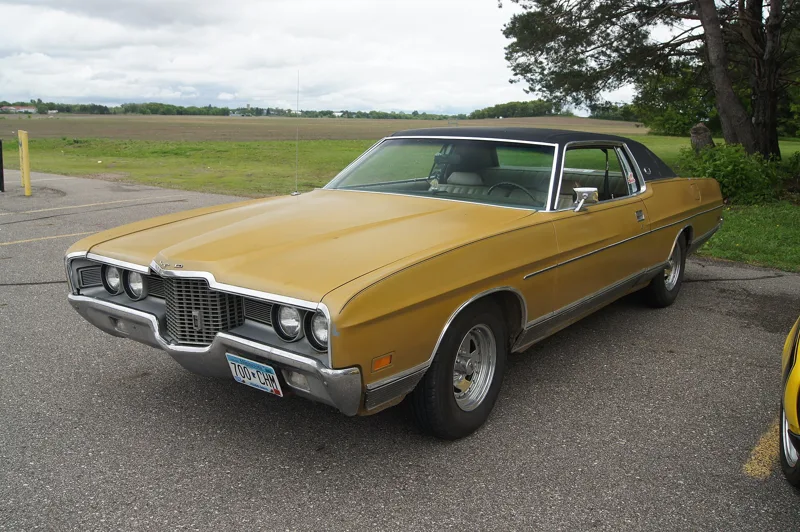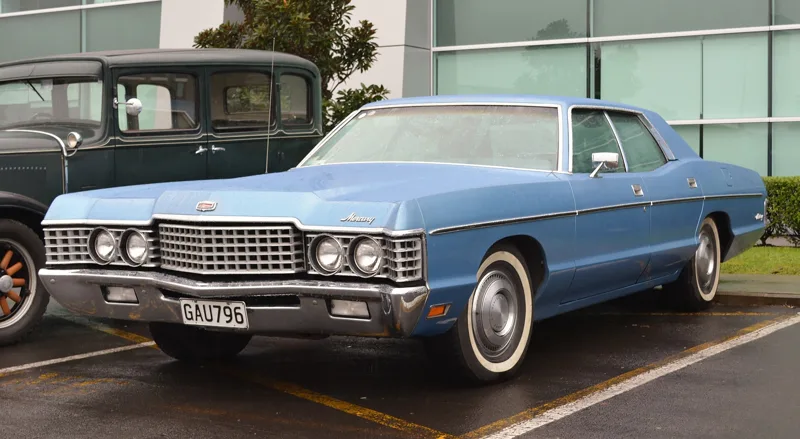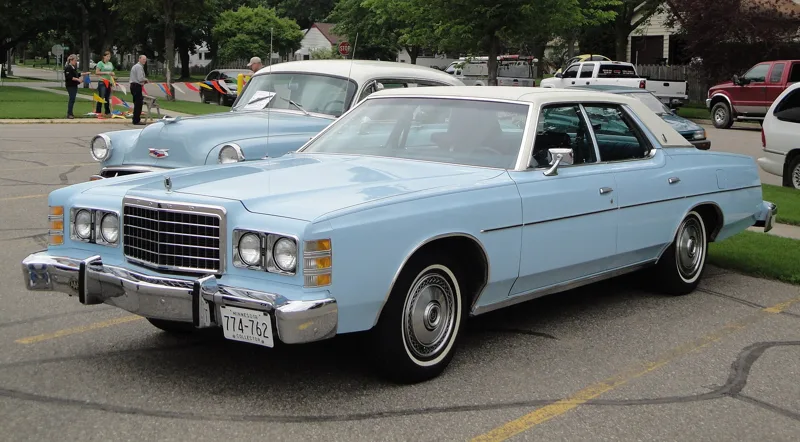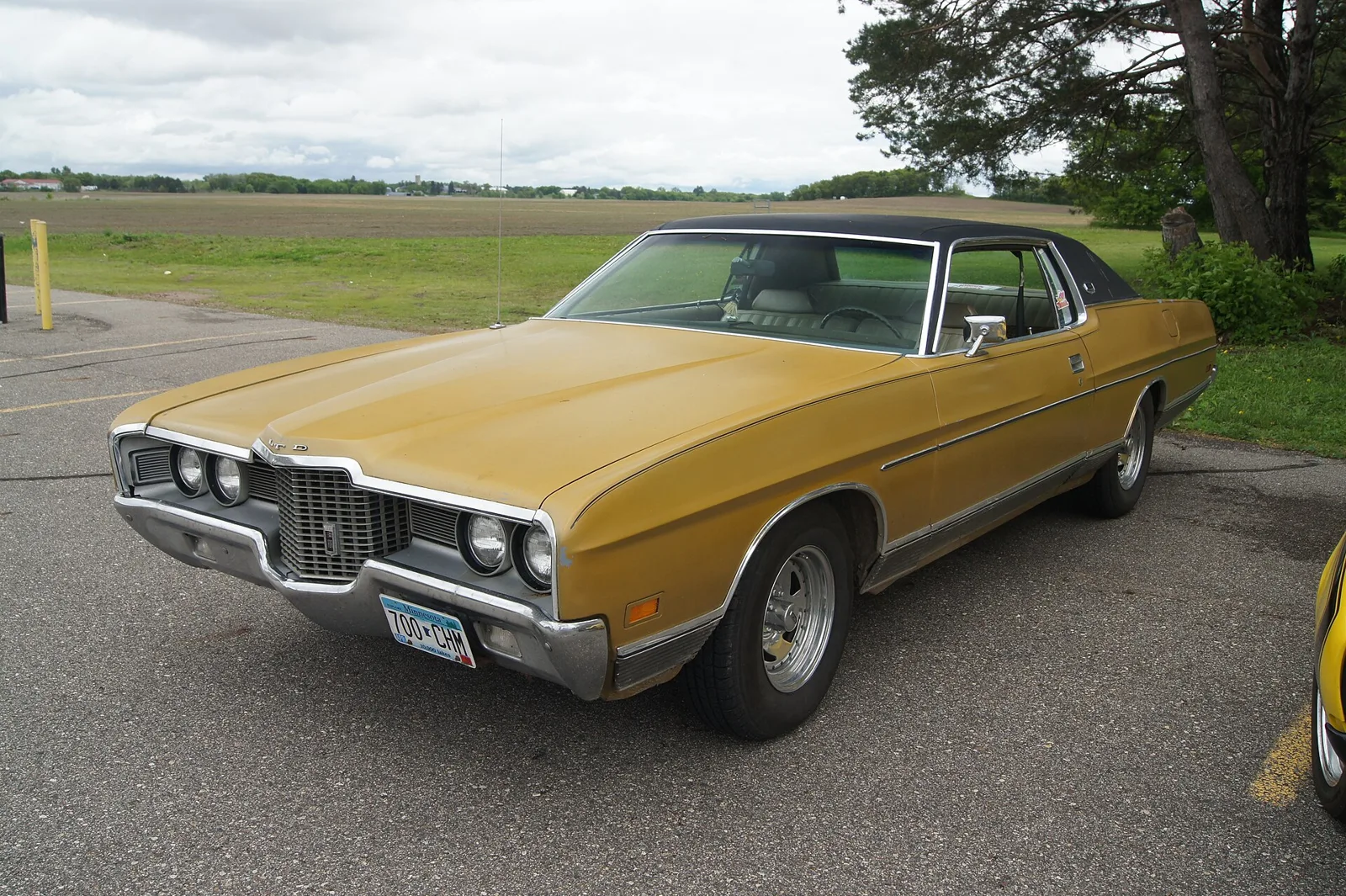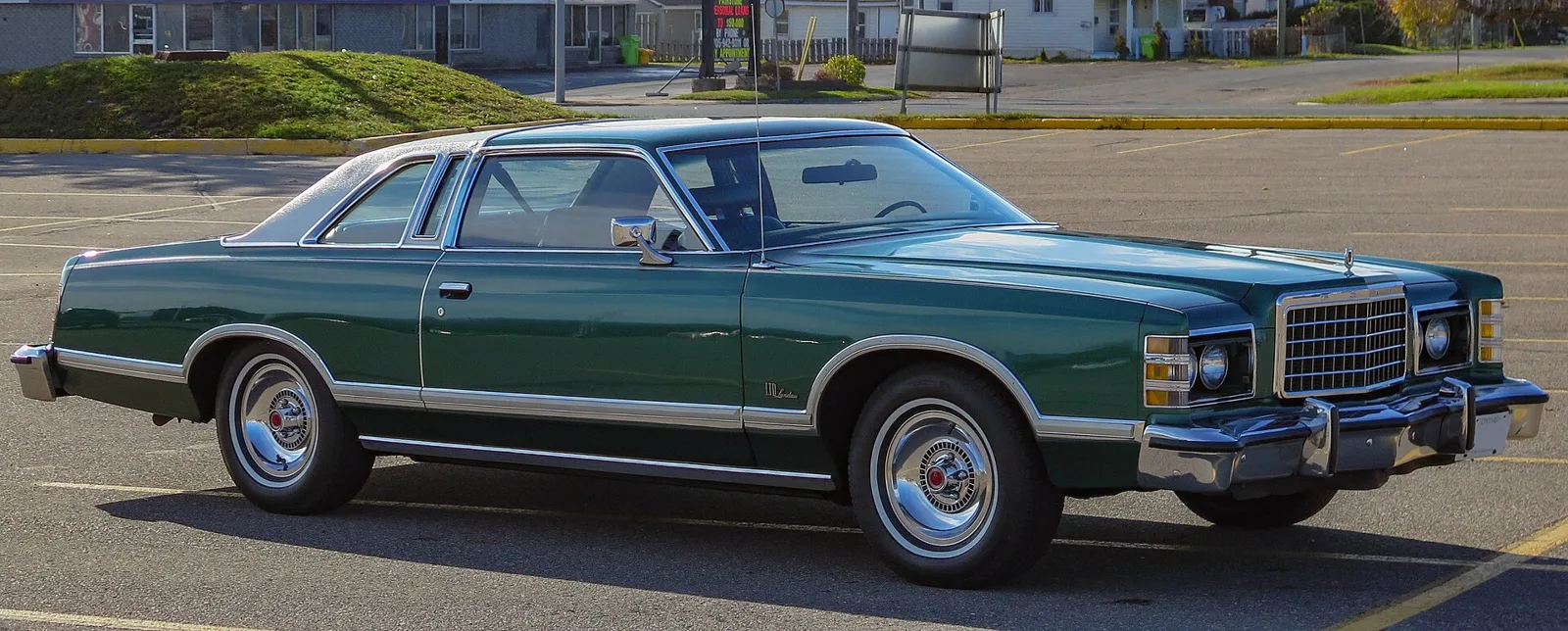
Ford's full-size flagship through the oil crisis and new emissions rules, with more than 2.28 million sold between 1973 and 1978.
The Ford LTD of 1973 to 1978 was a full-size American car that sold more than 2.28 million units in six years. It was Ford's flagship apart from the Thunderbird, and from 1975 it became the only full-size Ford offered to private buyers.
The Ford LTD of the 1973 to 1978 model years was the flagship of Ford's line-up apart from the exclusive Thunderbird, and the largest and heaviest car in the Ford brand. Its new body was longer and heavier than before, arriving just as the oil crisis and tighter emissions rules were pushing the industry towards smaller cars. Ford kept building it anyway, and more than 2.28 million were sold in six years.
Where did the LTD fit in Ford's line-up?
In the 1960s Ford's full-size range was the Custom and the Galaxie, with the Custom as the cheaper base model. The LTD began in 1965 as a luxurious trim package for the Galaxie and became a separate model above both in 1967.
The third generation arrived with new bodies for 1973 on unchanged mechanicals. For two years the three ranges stood side by side. Then Ford restructured the line-up: the Galaxie was dropped before the 1975 model year, and the Custom went only to fleet buyers such as public authorities, taxi firms and car rental companies. From 1975 the LTD was therefore the only full-size Ford sold to private customers.
Ford's full-size flagship, built and sold through the oil crisis years.
What rules shaped the LTD's years?
Regulators reacted to rising raw material prices after the 1973 oil crisis, and also to changing ideas about environmental protection and safety. From 1975 the CAFE fleet fuel rules forced American makers to cut the consumption of their cars. In January 1973 catalytic converters were ordered for all new cars registered from 1975, which meant engines had to be adapted to unleaded petrol.
Manufacturers had to develop smaller, lighter and more economical cars in every segment. Ford moved more slowly than General Motors. Lee Iacocca, a former Ford manager, blamed a refusal to face reality, and he suspected that the company head, Henry Ford II, disliked smaller cars. Ford was relatively late to start work on a smaller full-size platform, called Panther, which appeared only for the 1979 model year, a year after General Motors downsized its full-size cars. Until then the 1973 LTD stayed in the range, and it was among the largest cars built in the United States.
How was the LTD built?
The LTD had a separate frame with the body mounted on top. Its wheelbase matched that of the second generation introduced in 1969, and the chassis was shared with the contemporary full-size Mercurys. Those two- and four-door Mercurys had a wheelbase 76 mm longer, and the even longer Lincoln Continental used the same chassis.
The front wheels had independent suspension and the rear had a solid axle, with coil springs at all four corners. Disc brakes were standard at the front and drums at the rear, and power steering came as standard equipment.
What body styles were offered?
The 1973 to 1978 LTD came on steel-panel bodies in several styles. The body closely matched the contemporary Mercury Marquis, apart from the front and rear styling. The styles changed as the range developed, with coupes, sedans and estates offered in turn.
- Two-door hardtop coupe, no B-pillar, wide C-pillar (1973 and 1974)
- Two-door pillared hardtop coupe with a B-pillar (1975 to 1978)
- Four-door hardtop sedan, no B-pillar (1973 and 1974)
- Four-door pillared hardtop sedan with a B-pillar (1973 to 1978)
- Four-door estate with a tailgate (1973 to 1978)
The 1973 body was longer, wider and heavier than the one it replaced. New cars from 1973 needed safety bumpers at the front, designed to prevent body damage in impacts at up to five miles per hour (about 8 km/h), and the rule was extended to the rear bumpers the following year.
What engines did the LTD use?
Only V8 petrol engines were offered. The base engine displaced 5,752 cc (351 cu in) and the stronger option 6,555 cc (400 cu in). In 1973 Ford added a 7,538 cc (460 cu in) V8 as the top engine, an engine until then kept for the big Lincoln models.
Rivals and Ford alike met the stricter consumption and emissions limits year after year mainly by cutting engine output. Common steps were lower compression ratios and dropping the twin or quadruple carburettors that had been widespread until then. Every LTD came with a three-speed automatic as standard.
What were the key specifications?
| Item | Specification |
|---|---|
| Construction | Steel panels on a separate frame |
| Engines | V8 petrol only |
| Base engine | 5,752 cc (351 cu in), 158 SAE PS (118 kW) in 1973 |
| Stronger engine | 6,555 cc (400 cu in) |
| Top engine (1973) | 7,538 cc (460 cu in), 202 SAE PS (151 kW) |
| Transmission | Three-speed automatic, standard |
| Front suspension | Independent, coil springs |
| Rear axle | Solid axle, coil springs |
| Brakes | Discs at the front, drums at the rear, standard |
| Steering | Power steering, standard |
| Length | 5,585 mm (219.9 in) in 1973, rising to 5,692 mm (224.1 in) |
| Kerb weight | About 2.0 tonnes (4.4 thousand lb) from 1975 |
| Top speed (1976) | 170 km/h (106 mph) |
What did the 1973 and 1974 cars offer?
The 1973 LTD brought a new, longer and heavier body, with the base 5.8-litre V8 now producing 158 SAE PS (118 kW). The 7,538 cc top engine gave 202 SAE PS (151 kW). List prices rose by about 100 US dollars on the previous year, and Ford built almost 556,000 LTDs in the 1973 model year.
The Country Squire with three rows of seats was the best seller, with 142,933 cars, followed by the four-door LTD Sedan with a B-pillar at 122,851 examples.
The 1974 model year brought little beyond new grille styling, but the oil price shock hit hard. Petrol was no longer freely available, and fuel prices rose sharply. LTD sales fell by more than 45 per cent, to 302,627 cars. Nearly 94,000 Galaxies were built alongside it, as 1974 was the last year the Galaxie was offered with the LTD.
What changed in 1975 and 1976?
The Galaxie and the Custom were dropped in 1975, leaving the LTD as Ford's only full-size model. It came in three trim levels: the base car, the middle Brougham line and the newly introduced Landau. The four-door hardtop and the two-door hardtop coupe without a B-pillar disappeared, replaced by a pillared coupe with a centre pillar.
The new rear end put narrow, vertically arranged light units in the wing ends, with a decorative strip running the full width of the car and housing the reversing lights. This styling stayed until the LTD was discontinued at the end of 1978. Sales held roughly steady, at 310,057 LTDs in 1975, but without Galaxies alongside it, total full-size Ford sales fell by almost 25 per cent.
In 1976 the LTD Brougham went into its last model year, and small technical changes cut weight by about 50 kg. The 5.8-litre engine returned as the base unit with 153 SAE PS (114 kW), giving sluggish performance: the car needed 13.9 seconds to reach 96 km/h from a standstill, and its top speed was quoted at 170 km/h (106 mph). For an extra charge buyers could have the 6.6-litre with 180 SAE PS (134 kW), or the big 7.5-litre block at 202 SAE PS (151 kW).
Ford produced 367,744 LTDs in 1976, and the four-door sedan, with 108,166 examples, was the best-selling single model.
How did 1977 and 1978 change?
In 1977 the LTD range consisted only of the plain LTD and the high-grade LTD Landau. Ford raised the list price of the plain car to the level of the Brougham that had since gone, which narrowed the gap to the Landau from more than 700 US dollars to 500 US dollars.
The Landau sold far less well: for 160,255 four-door plain LTD sedans there were only 65,000 Landau sedans. Ford built more than 434,000 LTDs that year. Some sources put the rise over 1976 down to conservative buyers who wanted one more full-size car of traditional size before the smaller LTD generation arrived.
The final model year brought almost no changes. The 5.8-litre engine dropped to 144 SAE PS (107 kW) and the 6.6-litre to 166 SAE PS (124 kW), while the big block held at 202 SAE PS (151 kW). Production fell to about 308,000 cars.
Where was the LTD built, and how many were made?
Production was spread across five plants in the United States and one in Canada. Across all body styles over six years, almost 2.28 million LTDs were built. The 1973 model year was the largest, at almost 556,000 cars.
Did the Country Squire stand apart?
The Country Squire was the most expensive and best-equipped of the large estates, and like the saloons it was built only with V8 engines. Until 1968 the estates formed a separate range in styling, although they shared most of their engineering with the saloons.
From the 1969 range the estates lost that separate identity and were assigned to the Custom, Galaxie and LTD lines, under the sales names Custom Ranch Wagon, Galaxie Country Sedan and LTD Country Squire. By 1974 only the Country Squire was left. Stronger engines were its standard fitment, whereas saloon LTDs took them only on request.