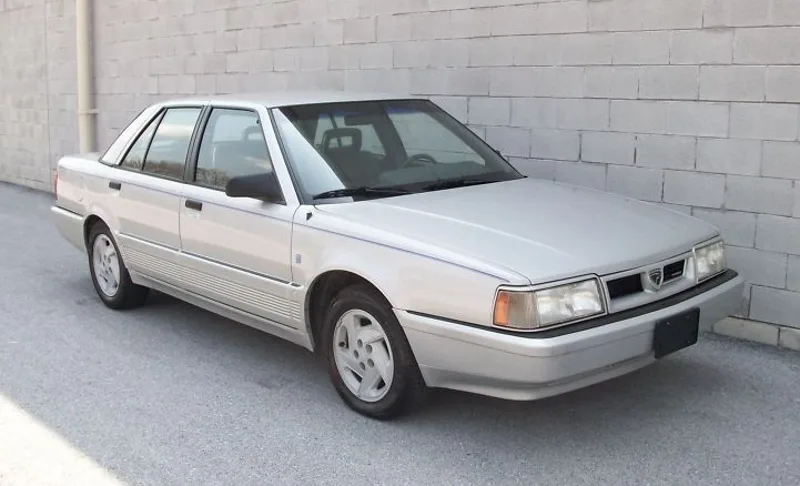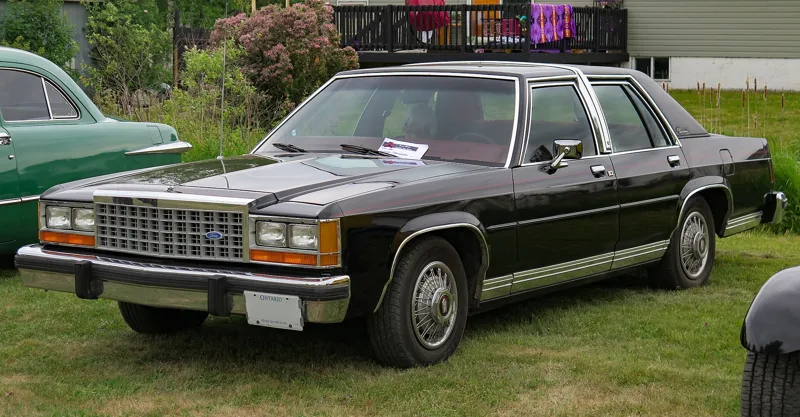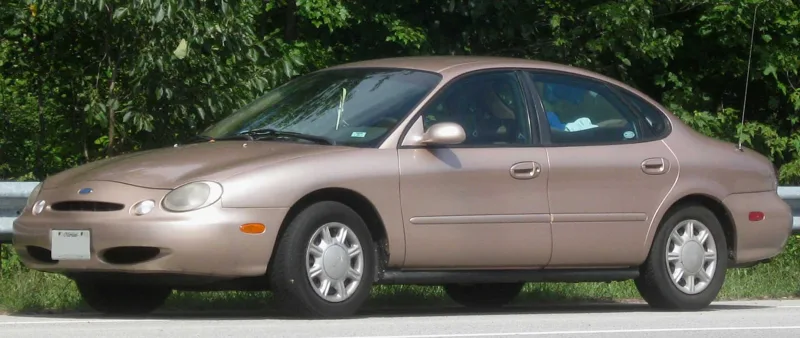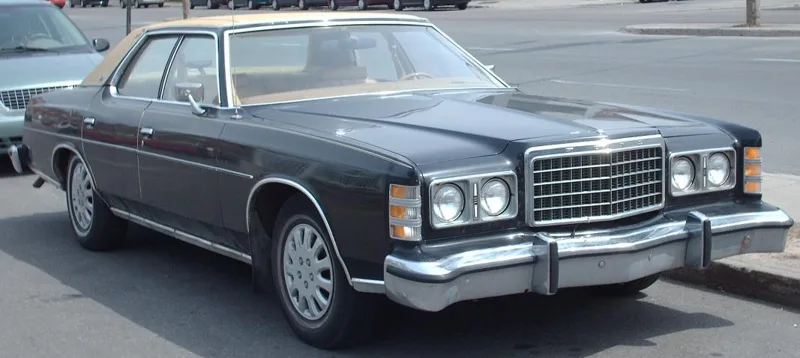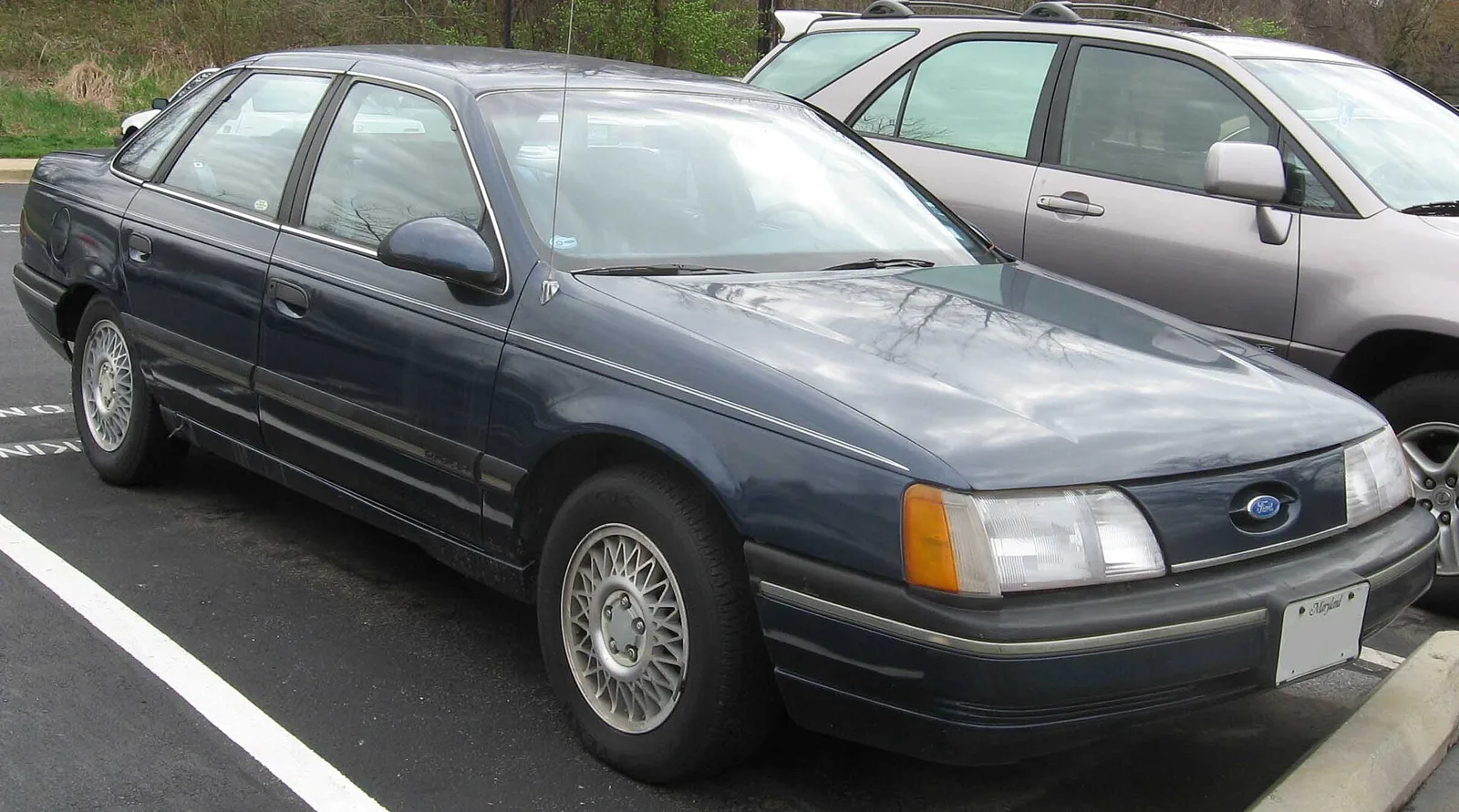
A front-wheel-drive aero sedan developed by Team Taurus, which became Motor Trend's Car of the Year and sold over two million by 1991.
The first-generation Ford Taurus was a front-wheel-drive sedan launched in December 1985 as a 1986 model. Its aerodynamic design and teamwork-based development helped Ford recover, and the car sold more than two million units before production ended in 1991.
The first-generation Ford Taurus and its Mercury Sable twin were the first of six generations of the Taurus. Launched on 26 December 1985 as a 1986 model, the front-wheel-drive car is often credited with saving Ford from bankruptcy. It also started a wider shift towards aerodynamic design across North American carmakers, and it stayed in production until 1991.
Why was the Taurus so important for Ford?
Ford had been short of a competitive product line from the late 1970s into the early 1980s. The Taurus was developed to replace the Ford LTD, at a cost of about 3 billion dollars. Chairman Philip Caldwell staked much of the company's finances and future on the success of the team that developed it, and the car's influence on Ford's fortunes was considerable.
The gamble was real. Ford executives feared the car might be too advanced to attract buyers, in the way the Edsel had failed. For that reason Ford kept building the LTD while the Taurus was being prepared. If the new car had failed, the company would have faced Chapter 11 bankruptcy. The Taurus instead became a resounding success and sold more than a million units in its first generation alone.
A front-wheel-drive aero design that Ford bet its future on, and which rewrote how American carmakers shaped their sedans.
How did the Taurus team work?
The Taurus was developed by a team led by vice president Lewis Veraldi, which became known as Team Taurus. Development began in the spring of 1980 after Ford's executive board approved the project. Ford gave the team unusual freedom, and the car was developed entirely by American engineers at the company's headquarters, rather than by engineers from Ford branches around the world as the Escort had been.
The approach was revolutionary. Before this, designers at Ford and General Motors had worked separately from engineers and from each other, and the interiors and exteriors of many American cars looked mismatched as a result. Team Taurus combined designers, engineers and marketing staff into a single group that worked on the car together. Designer Jack Telnack assembled the team, Ray Everts led the sedan exterior and Jeff Teague the wagon exterior.
Customer input also shaped the car. Radios, steering wheels, seats, wheels and entire suspension setups were chosen after large numbers of ordinary people took part in a series of surveys. Ford's engineers also took apart competing cars, including the Toyota Camry, the Honda Accord and the pricier BMW 5 Series, to study their parts and components. The company was determined not to repeat the mistakes made with the Edsel.
What did the 1985 unveiling look like?
The Taurus was unveiled in mid-1985 at MGM Studios Soundstage 85, the room where Gone with the Wind had been filmed. Its decor was a space theme, with wall stars, flying saucers and refreshments served in saucer-shaped coolers. Space music played, and projected stars drifted around the room. The car outlines glowed green behind a curtain, which rose with strobe lights flashing to highlight the cars.
Industry journalists and executives at Ford and Chrysler did not expect the car to succeed. Chrysler executives thought buyers would turn to the Dodge Dynasty and Chrysler New Yorker, both still being developed then. The Taurus proved them wrong, and it became one of the most anticipated new cars of 1986.
How did critics and the public receive the Taurus?
Motor Trend tested several prototypes before the car went on sale, praised them extensively and called them the shape of tomorrow. Popular Mechanics tested pre-production cars and described them as a totally new breed of car. After release the Taurus received unanimous praise from automotive publications, and it won the Motor Trend Car of the Year award for 1986. It also appeared on Car and Driver's Ten Best list for 1986.
The public agreed. More than 200,000 Tauruses sold in the 1986 model year, and its radical design caught the eye of Hollywood. Modified Taurus models appeared in Back to the Future Part II, and the car was prominent in the 1987 action film RoboCop, where modified 1986 LX sedans served as police vehicles. One of the Taurus sedans used in that film is on display at the Branson Auto Museum in Missouri. The millionth Taurus was sold in 1989, three years into production.
The car still earns praise. USA Today placed it sixth on its 2007 list of 25 Cars That Made a Difference, and Autoblog named it a Future Classic. The 1986 Taurus tested by Motor Trend is on show at the Henry Ford Museum's Showroom of Automotive History, where it is described as one of the two most significant American cars of the 1980s.
What was the Taurus's exterior design?
The exterior used an aerodynamic shape, often compared to a jelly bean or a flying potato. It drew inspiration from the Audi 100 and from Ford's own Tempo. The shape made the car more fuel efficient, which helped Ford meet the tighter CAFE standards set by the US government. The Taurus led a wider revolution, and Chrysler and General Motors soon developed aerodynamic cars of their own.
Many features were new to the mainstream market. The Taurus had flush composite headlights, among the first in an American sedan. At the time the NHTSA had required sealed beam headlights in standard round or rectangular shapes, so Ford had to persuade the agency to allow headlights of any shape that met federal lighting standards. The car also had a grille-less nose, a feature first used on the Citroen DS in the 1950s. Its doors flowed up into the roof, its door handles and windows were flush with the body, and its bumpers were built into the body design.
The wheels were pushed out to the ends of the frame and sat flush with the fenders rather than being recessed. The layout improved both aerodynamics and handling. The car's drag coefficient was 0.32, which made it one of the most aerodynamic cars of its era, and many of its features are still standard on cars today. For that reason the exterior changed little across the production run. The biggest change came in 1988, when a slimmer grille and new headlights, with a full-length chrome bar below, arrived for the 1989 model year.
What made the Taurus interior stand out?
The interior introduced many features that other manufacturers later copied. Its controls were designed to be recognised by touch, so the driver could work them without looking away from the road. The power window and lock switches had one raised half and one recessed half, so their function could be felt, in the manner of Braille. The main controls sat in the centre of the dashboard within the driver's reach, and the left side of the dash curved gently around the driver to create a cockpit feel without shutting out the passenger.
The interior could be spartan or luxurious, depending on the options. The entry L had only an AM radio and a cloth front bench as standard, whereas the LX was loaded with equipment. The 1989 model year brought new door panels with built-in armrests and side speakers. For 1990 there was a redesigned dashboard, which had a different radio placement and room for either cupholders or a CD player. It also received a steering wheel with an airbag, as Ford was making airbags standard across its cars.
Which models and engines did the Taurus offer?
The launch line-up had four versions: the L, the MT-5, the GL and the LX. The L sat at the bottom of the line, equipped as simply as possible. The MT-5 was aimed at Japanese imports, and it came only with a four-cylinder engine and a five-speed manual, which gave the model its name. The GL was the value model, with rear headrests, a folding rear armrest, and electric windows and locks. The LX was the top model, with cornering lamps, side body cladding, its own seat design, automatic climate control, six-speaker Premium Sound and six-way electric seats with inflatable lumbar support.
The MT-5 wagon was dropped in 1988 because of poor sales, and the MT-5 sedan followed after the 1988 model year. In 1989 the SHO arrived as a separate model rather than a part of the Taurus line. Base-model power came from a 2.5-litre HSC four rated at 90 hp (67 kW), which served the MT-5 and L. The 140 hp (104 kW) 3.0-litre Vulcan V6 was an option on the L and came as standard on the GL and LX. The MT-5 used a five-speed manual, the Vulcan models a four-speed AXOD automatic, and the HSC cars a three-speed ATX automatic.
Ford added its 3.8-litre Essex V6 in 1988 as the top engine option on the LX and GL. It was rated at the same 140 hp (104 kW) as the 3.0, but it produced 215 lb ft (292 N m) of torque. The 2.5-litre four was dropped in early 1991.
What was the Taurus SHO?
The Taurus SHO, short for Super High Output, was the performance model. It arrived in late 1988 as a 1989 model and shared its body with the Taurus sedan, but it had a different drivetrain, suspension, brakes, wheels and bodywork and interior details. There was no SHO wagon.
Its 3.0-litre DOHC V6 was developed and built for Ford by Yamaha. It made 220 hp (164 kW), which was only 5 hp less than the 4.9L V8 in the Ford Mustang, and every SHO came with a five-speed manual. Ford SVO developed the car as its first four-door vehicle. It was meant to be a limited-production model for 1989, but strong sales led Ford to keep it as the flagship of the Taurus range until 1991.
Part of the reason for the Yamaha engine was a supply contract. Ford had shelved earlier plans to use the same V6 in a mid-engined sports car that would have competed with the Pontiac Fiero and Toyota MR2.
How did the Taurus sell in Japan?
In 1988 the Taurus was sold in Japan in limited numbers through Autorama, a joint venture dealer network with Mazda. The Taurus LX and SHO were offered there as sedans and wagons with left-hand-drive, and the sale continued until 1991. Japanese buyers saw the car as a luxury model, because its exterior dimensions and engine size exceeded local government limits and attracted extra taxes.
The 2.5-litre four and 3.0-litre V6 also pushed up annual road tax for Japanese drivers, which hurt sales. The car's size and engines, which suited North America, were a poor fit for Japanese rules.
How was the Taurus made, and what did the Sable add?
The Taurus and Sable were built at Chicago Assembly in Illinois and at Atlanta Assembly in Hapeville, Georgia. They replaced the Ford LTD and Mercury Marquis at those plants. The Mercury Sable was the Mercury counterpart, sold through the Lincoln-Mercury division, and it replaced the Mercury Marquis. Both shared a chassis and drivetrain, while the Sable had a slightly longer body and its own interior.
The Sable was the upscale model in the pair. Its blacked-out roof pillars and low-cut rear wheel openings gave it an extra touch of advancement, and it had a lightbar lamp between the headlights rather than a conventional grille. The Sable came only with an automatic transmission, in GS and LS trims, and it was offered as a sedan and a station wagon. Ford sold the car as the Taurus in Mexico, Europe and New Zealand.
Several Sable variants never reached buyers in quantity. A convertible prototype with a power-folding top was shown at the 1988 North American International Auto Show, and it was sold on eBay in 2006. A Sable LTS was planned for 1989 as the Taurus SHO's counterpart, but it was shelved over concerns about internal competition. Instead 50 examples were built as 50th Anniversary Mercury Sables with 3.8-litre V6s, mainly to test SHO chassis changes. Ford also built 20 aluminium-bodied Sables with SHO V6 engines for its Aluminum Intensive Vehicle programme.
How many first-generation Tauruses were sold?
Sales were strong from the start. The model topped 200,000 in the 1986 model year and passed one million by 1989. By the time output stopped in 1991, sales had passed 2,000,000 for the first generation, which shows how well the design performed across its life.
What were the Taurus specifications?
| Specification | Detail |
|---|---|
| Launch | 26 December 1985 as a 1986 model; front-wheel drive |
| Development cost | About 3 billion dollars |
| Drag coefficient | 0.32 |
| HSC four-cylinder | 2.5 litre, 90 hp (67 kW), dropped in early 1991 |
| Vulcan V6 | 3.0 litre, 140 hp (104 kW) |
| Essex V6 | 3.8 litre, added 1988, 140 hp (104 kW), 215 lb ft (292 N m) |
| SHO engine | 3.0 litre DOHC V6 by Yamaha, 220 hp (164 kW), five-speed manual |
| Sales, 1986 model year | Over 200,000 |
| Millionth sale | 1989 |
| Total first generation | Over 2,000,000 by the end of production in 1991 |
| Car of the Year | Motor Trend, 1986 |
Read the table alongside the engine notes above. The SHO figures apply only to that model, and the Vulcan and Essex figures apply to the specific engine options listed.