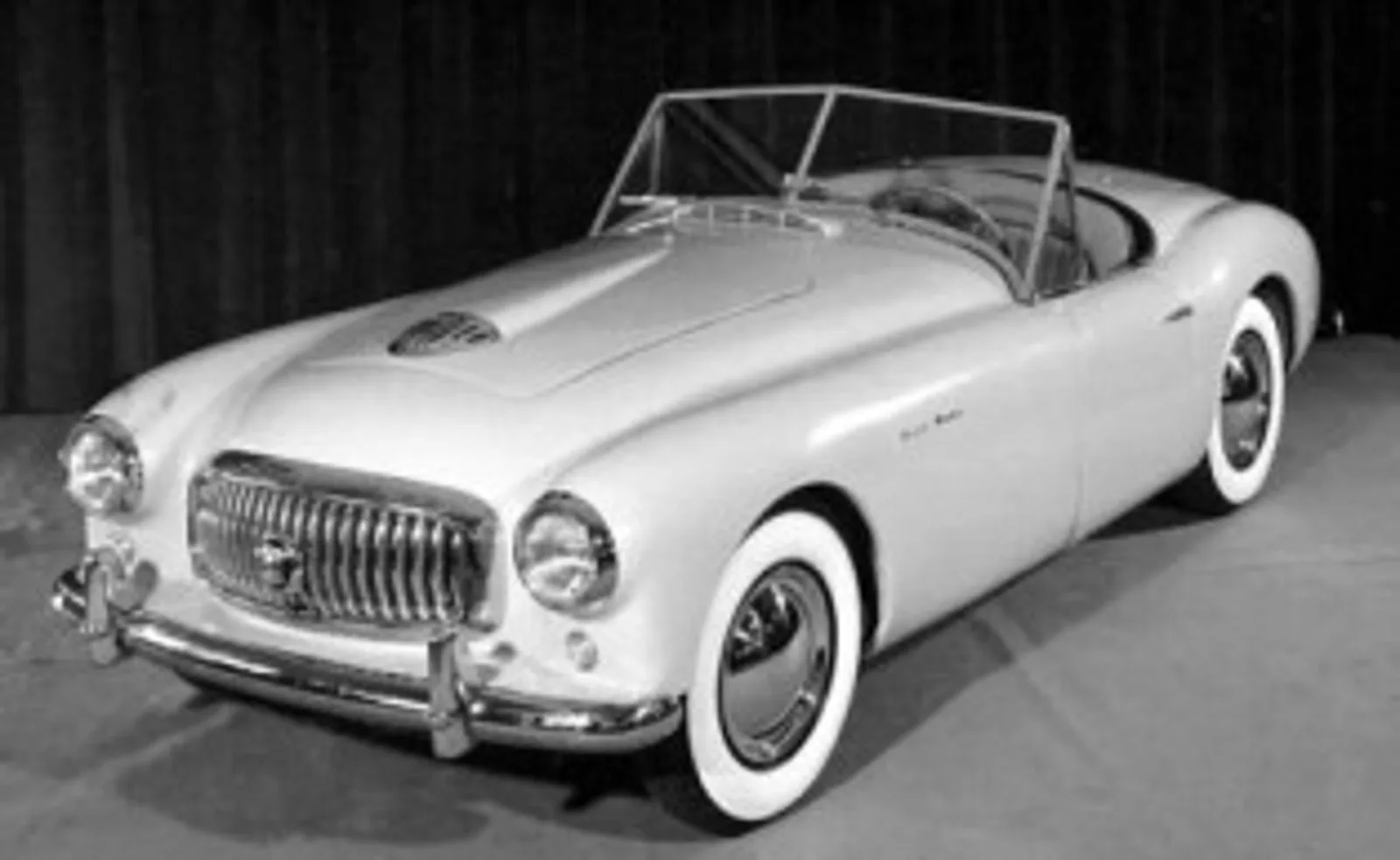
Nash's flagship full-size car, nicknamed the Kenosha Duesenberg, ran from a 1927 club sedan to a 1957 V8 and carried its name on through the American Motors years.
The Nash Ambassador was a full-size Nash Motors car built from 1927 to 1957, starting as a top trim level and becoming a standalone luxury model in 1932. The Ambassador name carried on under American Motors until 1974.
The Nash Ambassador was a full-size car produced by Nash Motors from 1927 until 1957. It began as a top trim level, became a standalone luxury model from 1932, and was nicknamed the Kenosha Duesenberg for its quality.
This profile follows the Ambassador from its 1927 debut through the Airflyte years, the first V8, the racing record and the American Motors years that kept the name going until 1974.
Where did the Ambassador name come from?
The name debuted on the 1927 model year, applied to a five-seat, four-door club sedan on the Advanced Six chassis. The reveal came in January 1927 at the National Automobile Show in New York.
Sitting at the top of the range, it received richer upholstery and trim. The base price was US$2,090 FOB, and its lavish equipment earned it the Kenosha Duesenberg name.
The Ambassador began as Nash's most expensive car and ended as a V8 flagship that won a Carrera Panamericana finish and the Indianapolis pace car role.
How did the Ambassador sell in its early years?
Nash domestic sales for the 1927 model year totalled 109,979. Exports accounted for almost eleven percent of production, and several royal families bought the cars.
Prince Wilhelm, Duke of Sodermanland, visited the Nash factory in Kenosha, Wisconsin, in 1927, and his Ambassador Six four-door Brougham was delivered to him by Scandinavian factory workers.
When did the Ambassador become a standalone model?
The Ambassador lost its place as Nash's most expensive car in 1929, when larger seven-passenger sedans and limousines arrived. Those continued to be sold through the 1934 model year.
The Ambassador stayed in the Advanced Six range until 1930, when it moved into the Twin Ignition Eight series. In 1931 the Eight-90 designation replaced the cumbersome model name.
What was the Ambassador Eight of 1932?
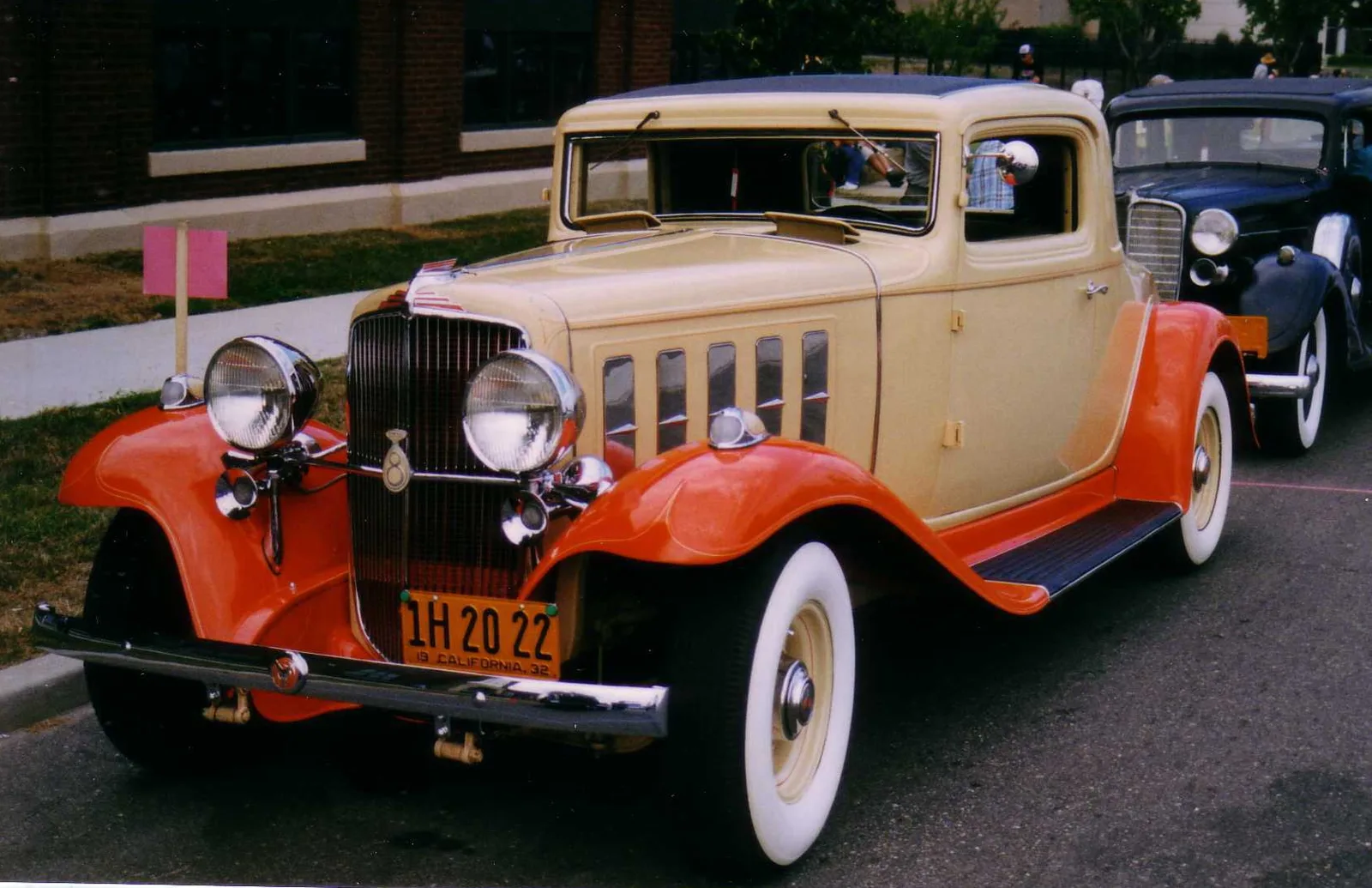
From mid-1932 the Ambassador Eight was sold as its own range, in several body styles such as coupes and victorias. Wheelbases were 133 inches (3,378 mm) or 142 inches (3,607 mm).
The straight-eight had 322 cubic inches (5.3 L) and twin ignition with overhead valves, producing 125 hp (93 kW; 127 PS). It was part of Nash's second 1932 series, which brought new bodies and engineering updates to all of its models.
Most carmakers suffered in the Depression, yet Nash was one of only two firms to profit in 1932, the other being General Motors.
How did the 1934 Speedstream look?
For 1934 Nash introduced a styling theme called Speedstream. It used ornamental moldings in body panels and fenders in a streamlined, Art Deco manner, and the designs were influenced by Russian Count Alexis de Sakhnoffsky.
Styling details included bullet-shaped headlights, horizontal hood ribs, rear-wheel spats and luggage boots built into a beaver-tail rear. The Ambassador Eight that year was limited to four-door sedans, and it faced new rivals such as the LaSalle, the Auburn V-12 and the Chrysler Imperial Airflow.
Why are the 1930s Nash cars prized today?
The Classic Car Club of America recognises the 1932, 1933 and 1934 Nash Ambassador Eight models as Approved Classics. Historian David Brownell famously dubbed them Kenosha's Duesenberg.
The Ambassadors of the period were custom-built to individual order in many cases, which is why they are still treated as limited production, high-priced cars from their era.
What changed in 1935 and 1936?
The 1935 model year brought complete restyling, described as Aeroform, and the Ambassador Eight moved to a shorter 125-inch (3,175 mm) wheelbase with the smaller former Advanced Eight engine. Nash dropped the big models of the 1930 to 1934 era.
The 1936 Ambassador Six added Nash's largest in-line six, of 234.8 cubic inches (3.8 L), on a 121-inch (3,073 mm) wheelbase. Its body was built on the former Advanced Six.
How did Nash-Kelvinator take shape?
In 1937 Nash acquired the Kelvinator Corporation. The deal allowed Charlie Nash's chosen successor, George W. Mason, to take the presidency of the new Nash-Kelvinator Corporation.
From 1936 onward the senior Nash models used identical bodies, with a longer wheelbase and different hood and front fenders to separate the more expensive Eights from the Sixes. That formula was used through the final AMC Ambassador in 1974, apart from 1962 to 1964.
What was the Sakhnoffsky Special?
A custom-designed and built convertible was marketed for 1940 as the Sakhnoffsky Special Cabriolet. The Classic Car Club of America recognises it as an Approved Classic.
Coupes and convertibles returned to the Ambassador lines for 1937, and the low-priced LaFayette series came under the same plan from that year.
What did the 1941 Ambassador 600 introduce?
For 1941 and 1942 all Nash vehicles became Ambassadors, built in long and short wheelbases. The Ambassador 600, on a 112-inch (2,845 mm) wheelbase, was the first popular domestic automobile built with the single-welded unibody construction Nash called Unitized.
From 1941 to 1948 the Ambassador models placed that unibody structure on top of a conventional frame. The car was also one of the first in the low-priced segment with coil spring suspension front and rear, which gave it the Arrow-Flight ride.
Wartime conservation removed the twin ignition from the 1942 Ambassador Six and Eight, which returned to one spark plug per cylinder. Civilian car production was then curtailed during the Second World War.
How did Nash restart after the war?
Nash-Kelvinator restarted car production on 27 October 1945. Demand was high, because the cars on the road were old and poorly maintained after years of wartime restrictions on parts and a shortage of skilled mechanics.
The 1946 Ambassador was a facelifted 1941 car, with a new grille and minor trim changes. It kept the same body, chassis and drivetrain, and the Ambassador Six became the top-tier Nash.
That six had 234.8 cubic inches (3.8 L) and 112 hp (84 kW). It used aluminium alloy pistons, automatic spark control and a balanced crankshaft, with a three-speed manual gearbox and an optional overdrive that Nash branded Cruising Gear.
What was the Ambassador Suburban?
The Suburban was a distinctive, partly wood-bodied variant for 1946, designed as a halo car to draw buyers into showrooms. Its coachwork was based on the Slipstream sedan, with a one-piece metal roof and steel inner doors.
Exterior panels were crafted from hardwood, with Honduras mahogany paneling supplied by Mitchell-Bentley of Owosso, Michigan. Weather Eye heating drew outside air into the cabin, and the driver could change stations on a Zenith radio using a button on the floor.
Nash built 1,000 Suburbans between 1946 and 1948, and 275 of them were made in 1946.
How did the 1948 convertible and Twin H Power begin?
For 1948 Nash added a new convertible body style to the Ambassador range. It was a one-year model of about 1,000 examples, and Nash reportedly allocated only one to each of its major dealerships.
Four Ambassador convertibles were fitted at the factory with twin carburettors and high-compression engines. Nash named the conversion Twin H Power, and the cars were loaned to members of the newly formed NASCAR for use in the 1948 season.
The name later passed to Hudson, which used it for its dual-carburettor setup on the Hudson Hornet from 1951. That led to talks between Nash and Hudson, which eventually produced the 1954 merger that formed American Motors.
What was the Airflyte Ambassador?
The completely new unibody Airflyte design arrived for the 1949 model year. It was the product of George Mason's wish to build a car unlike the mainline Big Three cars, and of the engineering work of Nils Eric Wahlberg, who had access to a wind tunnel during the war.
The Ambassador kept its 121-inch (3,073 mm) wheelbase on the new chassis, which the company said included 8,000 welds and was one and a half to two and a half times as rigid as conventional cars. Its curved one-piece windshield was a first for the year.
From 1949 until 1951 Ambassador sales gained significantly, selling only four- and two-door sedans. The 1950 Ambassador became the first non-GM car fitted with GM's Hydramatic automatic transmission.
Mason also believed that the compact car would be Nash's best hope once the post-war seller's market ended, and his small car programme eventually led to the Nash Rambler.
What was the 1952 restyle?
The Ambassador received a complete restyle for 1952, which also celebrated Nash's 50th anniversary. The predecessor firm, the Thomas B. Jeffery Company, had marketed its first cars in 1902.
The Golden Anniversary Airflyte was credited to Pininfarina, but the design also drew on ideas from Edmund E. Anderson, Nash's lead designer. Its large envelope-bodied sedans followed the enclosed-wheel pattern, with die-cast grille bars and reverse-slanted C-pillars.
Buyers chose between the Super and Custom series, as four-door or two-door sedans and a Country Club hardtop. The engine fitted as standard was a 252.6 cubic inch (4.1 L) six, the Super Jetfire, making 120 hp (89 kW), and Custom cars added two-tone upholstery.
How did the Korean War affect the Ambassador?
Materials restrictions caused by the Korean War led to a sharp fall in Nash sales in 1952, as they did for many other carmakers.
In 1953 the Ambassador received minor changes, including small chrome spacers on the cowl air scoop. Dual carburettors and a high-compression aluminium head produced 140 hp (104 kW) in the Le Mans option, which was also used on the Nash-Healey.
The 1953 Country Club hardtop was promoted to men who had once dreamed of a Stutz Bearcat, asking them to rediscover that boyhood wish in an Ambassador.
What was the 1954 Weather Eye system?
In 1954 the Ambassador became the first American car with a heating, ventilation and air-conditioning unit fully integrated into the front end. The system was called Weather Eye and could be fitted with Nash-Kelvinator's air conditioning unit.
Nash's unit was inexpensive, compact and fitted under the hood, while rival systems used large trunk-mounted expanders. In 1955 Nash offered the option at US$345, against $550 for Oldsmobile and $570 for Chrysler.
The 1954 car had a new floating grille, partly chromed headlamp bezels and a redesigned instrument panel. Its standard 252.6 cubic inch six was rated at 130 hp (97 kW) at 3,700 rpm, with a 7.6:1 compression ratio.
How did the Nash-Hudson merger change the Ambassador?
Nash-Kelvinator merged with the ailing Hudson Motor Car Company on 14 January 1954, forming American Motors Corporation. Mason's group had argued that independents lacked the mass production and distribution of the Big Three.
Rambler sales powered the new company's bottom line, and as the compact Ramblers grew, sales of the senior Nash cars fell. A total of 21,428 Ambassadors were built in 1954.
What was the 1955 V8 Ambassador?
The Airflyte styling entered its final season in 1955, with a heavy facelift under Edmund E. Anderson. Scenaramic wrap-around windshields arrived with an oval grille that incorporated the headlights.
Ambassadors were offered with a V8 for the first time. It was supplied by Packard as part of George W. Mason's plan to have Packard join AMC, and the 320 cubic inch (5.2 L) V8 produced 208 hp (155 kW) with Packard's Ultramatic automatic.
How were the 1956 and 1957 cars changed?
The 1956 Ambassador was restyled at the rear, with big lollipop taillights. The line was reduced to Super sedans with six-cylinder engines and V8 Super and Custom sedans, plus the Custom Country Club hardtop.
In April 1956 AMC introduced a 250 cubic inch (4.1 L) V8 rated at 190 bhp (142 kW), which was used only in the Nash Ambassador Special and the Hudson Hornet Special. Those Specials had the lighter and shorter Statesman and Wasp bodies.
The 1957 models were the first cars with standard quad headlights, stacked vertically in the front fender pontoons. The wheels were 14-inch, with standard 8.00x14 tyres.
The standard 1957 engine was AMC's 327 cubic inch (5.4 L) V8, rated at 255 hp (190 kW) and 345 lb-ft (468 N-m). The final Nash Ambassador rolled off the Kenosha line that year, after fewer than 3,600 big Nash cars had been built.
How did the Ambassador do at Carrera Panamericana?
Nash fielded eight Ambassadors in the 1950 Carrera Panamericana, a 2,172-mile (3,495 km) marathon across Mexico lasting five days. Of the 126 starters, 47 were classified as finishers.
Curtis Turner took over Roy Pat Conner's car after Conner fell ill in sixth place, and he finished third overall. He was later disqualified because race rules prohibited changing a car's crew.
Bill France crashed out of the race, but the damaged car was driven back to the United States and used for a season of dirt track racing in the Southern states.
What was the Ambassador's NASCAR record?
Nash was the first manufacturer to support NASCAR actively, with factory sponsorship for the 1950 and 1951 Grand National seasons. For 1950 it signed Curtis Turner and Johnny Mantz.
On 8 April 1951 Johnny Mantz's Ambassador finished second at Carrell Speedway in Gardena, California, although Ebenezer Slick Smith was driving at the flag in relief. Later that year Curtis Turner won at Charlotte in a Nash Ambassador, the only first-place finish for a large Ambassador in the Grand National series.
The 1951 Ambassador used as the Official Pace Car of the Motor City 250 at Michigan State Fairgrounds was driven by NASCAR's president, Bill France.
What did Indianapolis and Cannonball Baker add?
In 1947 an Ambassador was chosen as the official pace car of the Indianapolis 500. It was Nash's only time to pace the event, and it was driven by George W. Mason. The pace car wore a non-factory canary yellow finish and was the first four-door closed car to serve in that role.
Erwin George Cannonball Baker drove a 1947 Ambassador 7,492.8 miles (12,058 km) from Indianapolis to Portland, Oregon, and back, averaging 27.1 mpg-US (8.7 L/100 km). He reported operating costs of approximately $0.0077 per mile.
On 20 September Baker set a stock closed-car record up the Mount Washington Auto Road, completing the 99 hairpin turns in 15 minutes and 27.66 seconds. On 22 October he climbed Mount Mitchell in 38 minutes and 31.6 seconds.
What was the Ambassador's legacy?
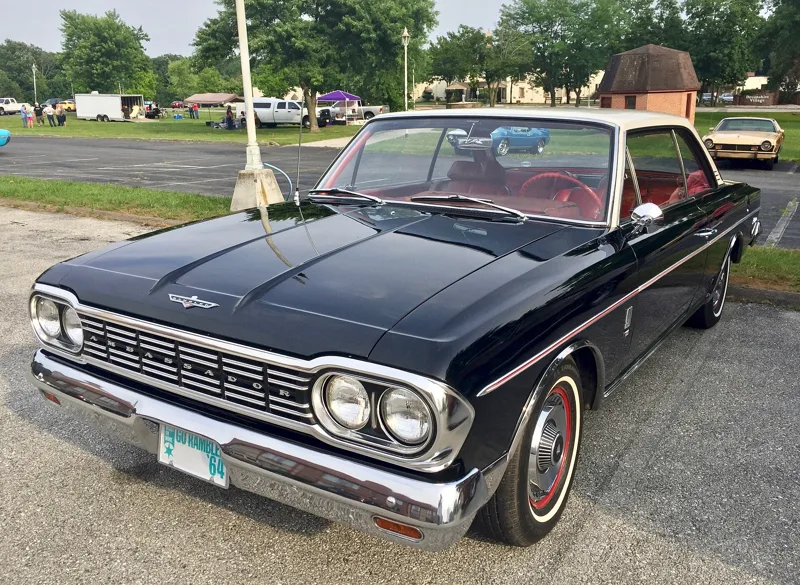
The American Motors Corporation kept the Ambassador as its top-of-the-line model, moving it onto a lengthened Rambler platform with many standard features. From 1958 through the 1965 model year the cars were named Rambler Ambassador.
From 1966 American Motors' flagship line was marketed as the AMC Ambassador, with facelifts and air conditioning made standard, until it was discontinued after the 1974 model year.
Few nameplates lasted as long as the Ambassador did by the 1970s.
What were the Nash Ambassador specifications?
| Item | Detail |
|---|---|
| Built | 1927 to 1957 by Nash Motors |
| 1927 base price | US$2,090 FOB |
| 1936 six | 234.8 cu in (3.8 L) in-line six |
| 1947 six | 234.8 cu in, 112 hp (84 kW) |
| 1952 Super Jetfire | 252.6 cu in (4.1 L), 120 hp (89 kW) |
| 1954 six | 252.6 cu in, 130 hp (97 kW) at 3,700 rpm |
| 1955 V8 | 320 cu in (5.2 L), 208 hp (155 kW) |
| 1956 AMC V8 (Special) | 250 cu in (4.1 L), 190 bhp (142 kW) |
| 1957 AMC V8 | 327 cu in (5.4 L), 255 hp (190 kW) |