A car named for the distance it could travel on one tank, a well-equipped compact convertible and a baby Nash assembled by Austin in Birmingham.
The Nash 600 of 1941 was America's first mass-produced unibody car, the Rambler of 1950 helped establish the compact class, and the Metropolitan of 1953 was a tiny economy car built in England. Nash used them to sell efficiency to buyers raised on big cars.
In 1941 Nash named a car after a distance: 600 miles (966 km) on a single tank of fuel. The promise came with a structural first, because the 600 was the first mass-produced car in the United States whose body and frame were one welded unit, and it set the course for a small-car strategy that ran through the Rambler and the Metropolitan.
What was the Nash 600?
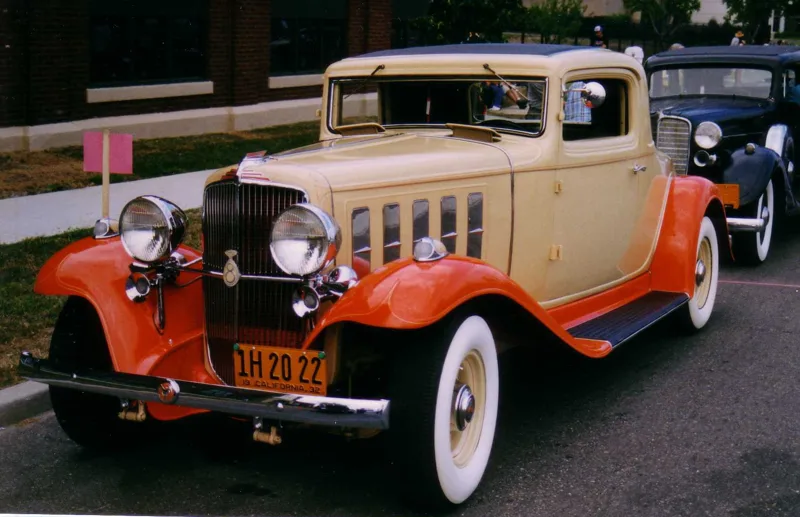
The Nash 600 was a low-priced car built by Nash-Kelvinator in Kenosha, Wisconsin, for the 1941 to 1949 model years, replacing the LaFayette. It was the first mass-produced unibody car in the United States, and its name came from the claim that it could cover 600 miles on one tank. Nash renamed the line the Statesman for 1950.
Behind the project stood George W. Mason, who headed the freshly merged Nash-Kelvinator and wanted to remake the company's image. Nash leaned on Ted Ulrich of the Budd Company for body-manufacturing ideas. Ulrich also worked with the engineering chief, Nils Erik Wahlberg, on the radical 1949 Airflyte models.
Most cars of the time bolted a body onto a separate chassis. Imagine the difference between a house built on a trailer and one poured as a single slab. In the 600 the body and frame were welded into one integral structure, which cut around 500 lb (227 kg) from the weight, made the car stiffer and helped it avoid the rattles and squeaks that separate bodies were prone to. Independent front suspension and coil springs at the rear gave a ride advantage over rivals that still used leaf springs behind. The development and tooling cost $7.5 million, a large sum for a small independent, and the new construction demanded new collision-repair methods, including a portable body and frame puller that gained international acceptance.
How did the 1941 car perform?
Time magazine called the 1941 Nash the only completely new car of the year. It launched as the Ambassador 600 in a new lower-price category, with four-door Slipstream and Sedan versions, a Coupe Brougham seating six, and a Business Coupe. In a few minutes the rear seat of the sedans could be turned into a bed.
The engine was a 172.6 cu in (2.8 L) L-head six making 75 hp (56 kW) at 3,600 rpm, with a three-speed manual gearbox and an electrically controlled overdrive. Coil springs sat at all four wheels, and the turning circle was 33 feet (10.1 m). In an event sponsored by the American Automobile Association and Gilmore Oil, the 600 returned 25.81 mpg-US (9.1 L/100 km) on regular roads and won its class. Calendar-year production reached 80,428, giving Nash a little over two percent of the domestic market.
The war cut it short. For 1942 the 600 stayed as one of three Nash series, with NASH letters in the grille, and the company hoped Washington would allow restricted production of such an efficient car. About 5,400 were built before civilian manufacturing stopped, and by September 1941 Nash had taken almost $100 million in defence orders.
What changed after the war?
Nash restarted car production on 27 October 1945 and claimed more than 100 updates for the 1946 600. Norman Bel Geddes refined the trim and dashboard. The car sat on a 112 in (2,845 mm) wheelbase, with the two-door Brougham at $1,293, the four-door Slipstream at $1,298 and the Trunk Sedan at $1,342. Power rose to 80 hp (60 kW) at 3,800 rpm as the compression ratio went from 6.4 to 6.8. The Ambassador name was now kept for the larger luxury car.
Nash promoted the body structure, which had more than 8,000 spot welds. A Kentucky dealer, Cooke Motor of Lexington, put one of the cars on its side in the showroom so buyers could see the construction.
Fuel economy stayed the selling point. In 1947 Andy Henderson won the 300-mile (483 km) Death Valley Economy Run in a 600, at 28.6 mpg-US (8.2 L/100 km) and an average of 36.7 mph (59.1 km/h). By 1948 the line came in Deluxe, Super and Custom trims, with interiors by Helene Rother, and a stripped Business Coupe at $1,478, built only that year, aimed at travelling salesmen.
A low price alone would not sell small cars in volume, so Nash made the Rambler well equipped and built the Metropolitan in England.
How did the Nash Rambler help start the compact car?
The Rambler, introduced on 13 April 1950, was a small but well-equipped car designed to carry five people. Mason had seen what other makers missed: a low price alone would not sell small cars in volume, because Americans also wanted a car big enough to be the family's main one. Nash used the Rambler to define the compact class.
It was smaller and lighter than the popular cars from Chevrolet, Ford and Plymouth, which saved Nash materials and gave owners better fuel economy. The wheelbase was 100 in (2,540 mm), and the 172.6 cu in (2.8 L) flathead six made 82 hp (61 kW). Pontoon styling, with fender skirts that enclosed the front wheels, followed the larger Nash models.
The first Rambler was a single model: the two-door Landau, a fixed-profile convertible. That was a calculated risk. Mason knew that a car seen as a cheap little car would fail, and the examples of Crosley and Henry J were in his mind. A fixed-profile convertible kept the door and rear window frames and used them to guide a retractable canvas top, so the unibody stayed rigid without extra bracing. Nash showed the strength of the structure by turning a whole car upside down.
The price was $1,808, slightly below the base convertibles it was meant to rival, and it came with whitewall tires, full wheel covers, an electric clock and a pushbutton radio as standard. Fuel economy of up to 30 mpg-US (7.8 L/100 km) was claimed. The shortened first year brought sales of 9,330 convertibles.
Where did the Rambler name come from?
Nash planned to call the car the Diplomat, but Dodge had already reserved that name for a two-door hardtop. The company went back to its history and revived Rambler, the name of an 1897 prototype and of its first production car in 1902. Trademarks for Rambler and Statesman were filed on 22 May 1950.
Wartime had exposed Americans to smaller, more efficient European cars, and Nash's chief executive visited Italy, France and England to study small vehicles. Italian designs influenced the convertible's styling.
How did the Rambler grow?
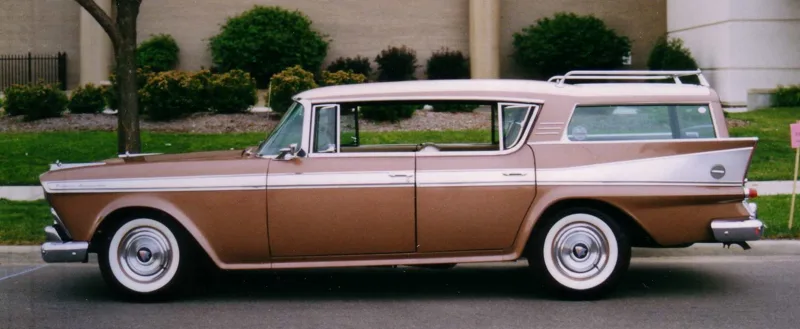
For 1951 the range added a two-door wagon and the pillarless Country Club hardtop, in Custom and Super trims. Britain's The Motor tested a car that year and recorded 80.9 mph (130 km/h), 0 to 60 mph in 21.0 seconds and 25.2 mpg-imp (11.2 L/100 km). Tunku Abdul Rahman, first prime minister of the Federation of Malaya, used a 1951 Rambler convertible at Melaka in 1957, the year he announced independence from British rule.
The 1952 Ramblers included a Deliveryman utility wagon at $1,892 and Greenbrier wagons at $2,119. Nash built 53,000 of them. The first restyle came in 1953, credited to Battista "Pinin" Farina, with a 184 cu in (3.0 L) six making 85 hp (63 kW), or a 195.6 cu in (3.2 L) six making 90 hp (67 kW) with the optional Hydra-Matic automatic. Production that year was 31,788, led by 15,255 Country Club hardtops.
A Popular Mechanics survey of 1953 owners found economy was the feature they liked best. Only four percent called the car too small, 67 percent rated it excellent and 29 percent had no complaints at all. Rear legroom, leaks and the position of the dimmer switch drew the criticism.
For 1954 Nash added a four-door sedan and the Cross Country wagon, on a longer 108 in (2,743 mm) wheelbase, in response to larger families. Heater and radio became options, and the company offered an integrated heating, ventilation and air conditioning system for $345. But a Ford and Chevrolet price war was squeezing the independents. The Ramblers sold, yet they were not very profitable.
On 1 May 1954 Nash and Hudson announced their merger as American Motors Corporation, and Hudson dealers began to receive Ramblers that differed only in badge. For 1955 the front skirts disappeared, trimming the turning radius by 6 ft (2 m) to 36 ft (11 m), the smallest in the industry for two-door models. AMC later reintroduced the Rambler for 1958 to 1960.
Why did Nash build the Metropolitan in England?
Mason and Nash's management reckoned that a car this small could not be built from scratch at home, since the cost of tooling would have been out of reach. The only workable route was to build abroad from existing mechanical parts, leaving only the body panels and a few unique items to tool. On 5 October 1952 it announced that Austin and Fisher & Ludlow, both in the Birmingham area, would build the car.
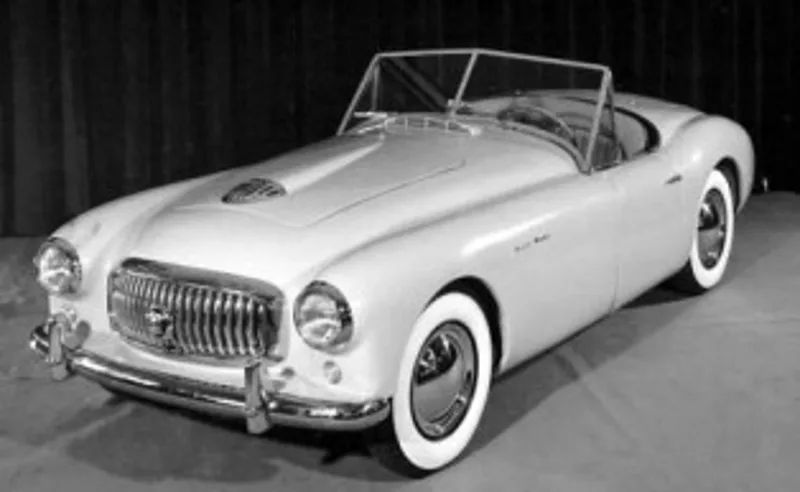
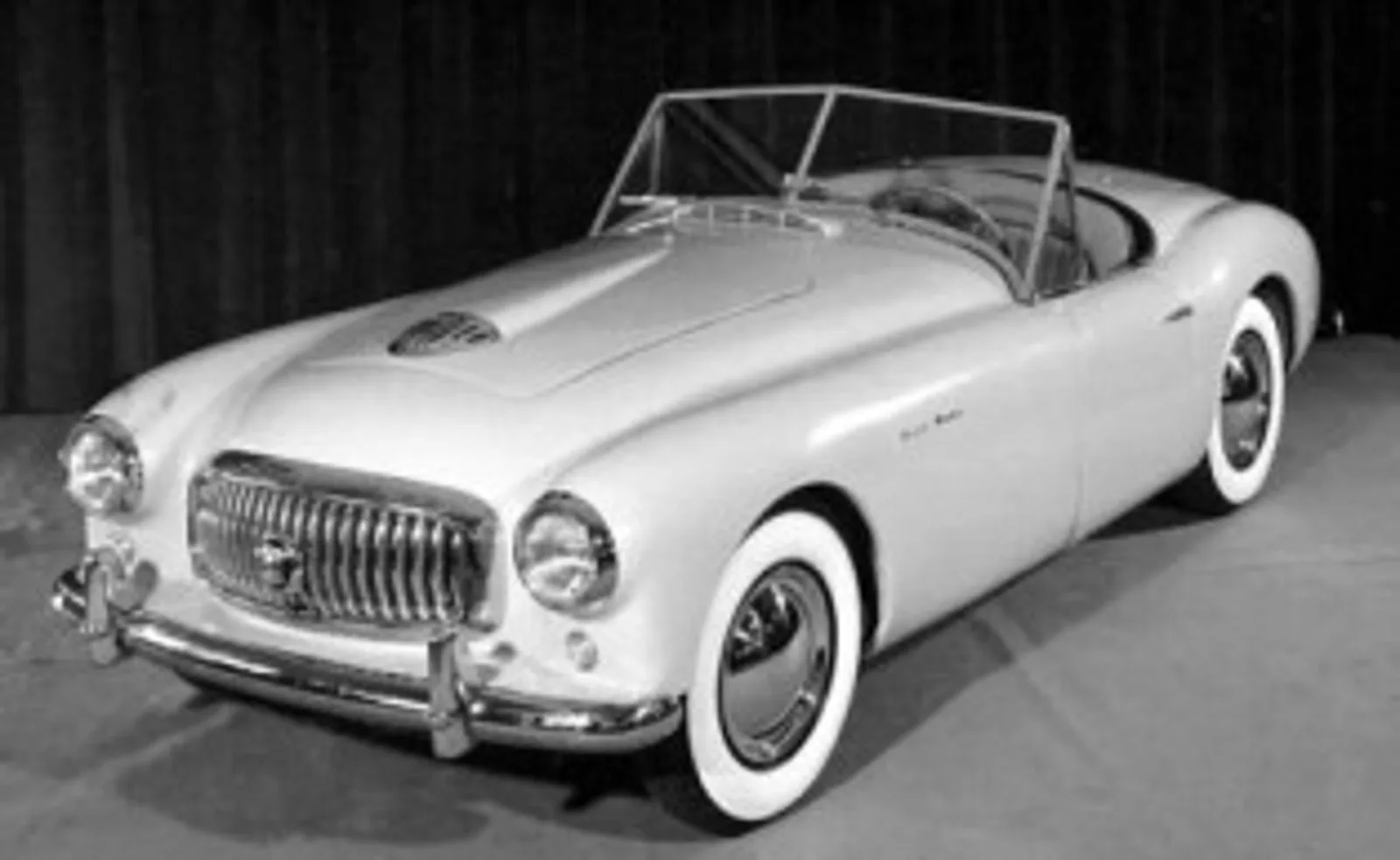
The Metropolitan was designed in Kenosha and patterned on the NXI concept, built by the independent designer William J. Flajole. It was meant as the second car in a household, one for the school run or the commute to the railroad station, and its wheelbase was shorter than the Volkswagen Beetle's. Nash showed the concept at "surviews" in New York from 4 January 1950, then built prototypes with roll-up windows, a stronger engine and a column shifter. Nash positioned it as a personal-use car and as a way to return to overseas markets, and the company marketed it to women.
The deal made the Metropolitan the first American-designed car sold in North America but built entirely in Europe, a captive import sold and serviced through Nash dealers. Fisher & Ludlow supplied the bodies, Austin provided the mechanicals and performed final assembly, and five pre-production prototypes were tested. Total tooling came to US$1,018,475.94, split between Austin at US$197,849.14 and Fisher & Ludlow at US$820,626.80, which was a fraction of the cost of tooling a car in America.
What was the Series I like?
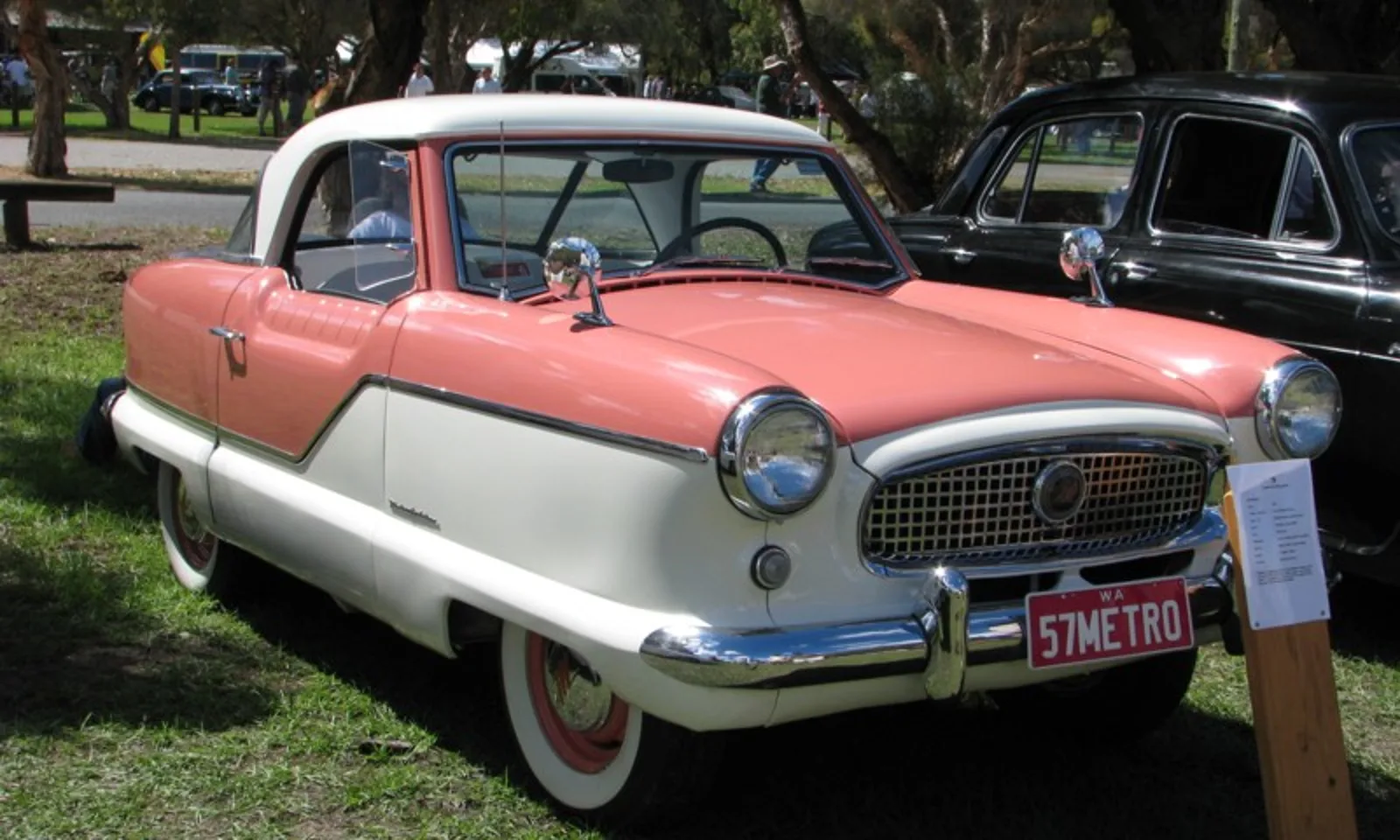
Production began at Austin's Longbridge factory in October 1953. The convertible and hardtop sat on an 85 in (2,159 mm) wheelbase, measured 149.5 in (3,797 mm) in length and weighed 1,785 lb (810 kg) and 1,825 lb (828 kg). That made them smaller than a Beetle. A 1,200 cc (73 cu in) overhead-valve Austin A40 four drove the rear wheels through a three-speed manual gearbox, and the first order was for 10,000 cars.
Nash had the car proven publicly. In December 1953, two cars went to the new Raleigh Speedway in North Carolina for tests certified by NASCAR officials, including Bill France. One completed a 24-hour endurance run of 1,469.7 mi (2,365 km) at an average of 61.2 mph (98 km/h), returning 21.1 mpg-US (11.1 L/100 km), and needed nothing except tyres. The other, refuelled on the move from a can through the side window, averaged 41.7 mpg-US (5.64 L/100 km) over 24 hours.
The car was to be the NKI Custom, but the name changed to Metropolitan two months before release, so dealers had to rebadge early cars. The first Nash-badged cars went on sale on 19 March 1954. Autocar noted that with output under 400 cars a week the Metropolitan could not become a big seller. In the first month 862 were sold in the US and Canada, and 7,042 in the first six months.
Why did it not sell more?
Surveys had suggested Americans wanted economy cars, but few bought the Metropolitan. Demand never rose above its original level, mainly because the car was slow by North American standards. It was priced at $1,445 for the hardtop and $1,469 for the convertible, and a radio and heater pushed the figure above $1,500, while a Volkswagen Beetle cost $1,425.
Hudson dealers began selling it by August 1954 and it was marketed as a Hudson Metropolitan in 1955. It became a standalone brand in 1957, marked with a stylised M on hubcaps and grille, and it stayed on sale until 1962.
How did the Nash Metropolitan compare with the Volkswagen Beetle?
Road testers compared the Metropolitan with the Beetle often. It was quicker: Road & Track recorded 22.4 seconds from 0 to 60 mph, almost half the Beetle's 39.2. But at 60 mph, a typical American cruising speed, the Nash was turning 4300 rpm against the Beetle's 3000 rpm, which the magazine said shortened engine life. Its testers also complained of lean and wallow in corners.
Others were kinder. Tom McCahill reached 60 mph in 19.3 seconds, passed 70 mph (113 km/h) and found the handling good, though the lack of a boot opening other than through the rear seat posed a problem. Motor Trend measured 39.4 mpg-US (6 L/100 km) at 45 mph (72 km/h), 27.4 mpg-US (9 L/100 km) at 60 mph (97 km/h) and 30.1 mpg-US (8 L/100 km) in traffic, although it dismissed the rear seat as a joke.
Floyd Clymer, a leading publisher of motoring books, tested a 1954 convertible and wondered whether Nash had started a new trend in American motoring. He then took a 1957 hardtop on a 2,912 mi (4,686 km) road test that went up Pikes Peak to 14,100 feet (4,298 m), and said he could not praise it too highly.
How do the three Nash small cars compare?
| Model | Years | Engine | Wheelbase | Notable price |
|---|---|---|---|---|
| Nash 600 | 1941-1949 | 172.6 cu in (2.8 L) six, 75 hp (56 kW) in 1941 | 112 in (2,845 mm) in 1946 | $1,293 for the 1946 Brougham |
| Rambler | 1950-1954, then 1958-1960 | 172.6 cu in (2.8 L) six, 82 hp (61 kW) | 100 in (2,540 mm) | $1,808 for the 1950 Landau |
| Metropolitan | 1953-1962 | 1,200 cc Austin A40 four | 85 in (2,159 mm) | $1,445 for the hardtop |
What became of the Nash and Hudson lines?
The Rambler displaced both the Nash and Hudson lines, while the Metropolitan kept its own identity until production stopped in 1962. AMC brought the Rambler back for the 1958 to 1960 model years, a rare feat for a name that had been dropped.