From the Nash Ambassador of 1927 to AMC's eighth and final generation, the car that carried American Motors upmarket and then bowed out with an oil-crisis redesign.
The AMC Ambassador was a full-size flagship sold by American Motors from 1957 to 1974, with a 1958 V8 and eight generations of styling. Its roots lay with Nash in 1927, and it ended in 1974 with production shifted to the smaller Matador.
The AMC Ambassador was the flagship of American Motors from 1957 to 1974, and across eight generations it was sold as a sedan, a hardtop, a station wagon and, for a time, a convertible. The name had already served Nash and its successors for decades, which gives it one of the longest continuous nameplate runs in American motoring. Its size shifted between the full-size and mid-size classes several times along the way.
Where did the Ambassador name come from?
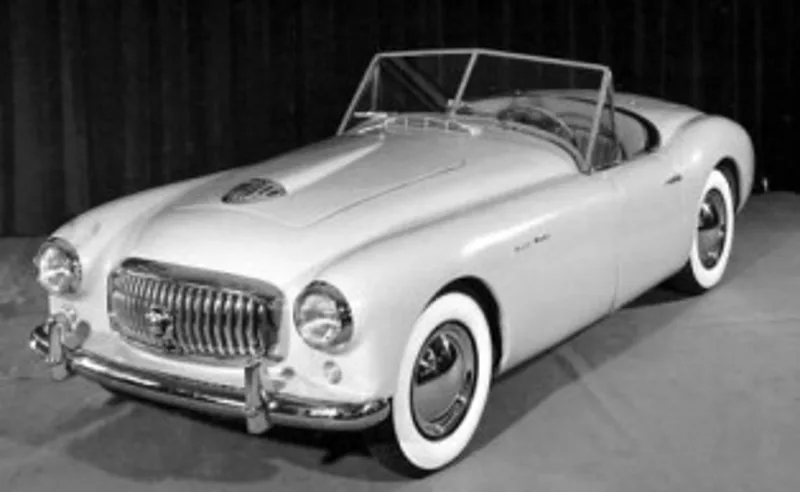
The name first appeared with Nash Motors in the 1927 model year, when it marked a top trim level on a specially appointed four-door sedan. Nash later made the Ambassador its premium flagship, and the nameplate outlived the Nash brand itself, which American Motors dropped in 1957. Under Nash the car was a symbol of equipment, comfort and refinement.
Nash called its best cars the Kenosha Duesenberg, a nod to the Wisconsin factory and the car's opulent character. Rivals included Packard, Lincoln and Duesenberg itself. After the Second World War the Ambassador adopted the Airflyte styling, and it was the first car to offer stacked quad headlamps as standard, a layout that broke some state laws at the time but later became popular.
Nash-Kelvinator and Hudson Motors combined in 1954 to create American Motors Corporation. For a while the Nash Ambassador continued through the Nash brand and dealer network, with 1954 cars largely carried over from 1953. That year 21,428 Ambassadors were built as sales of the large cars slid.
A flagship that started as a Nash trim badge and ended as a full-size AMC with air conditioning as standard.
How did George Romney reshape the Ambassador?
After the sudden death of founder George W. Mason in October 1954, George Romney became president and chief executive. He chose to focus AMC on the compact Rambler, arguing that the company needed large volumes to pay for expensive tooling. The traditional big Nash and Hudson names were dropped, and the final Nash Ambassador left the Kenosha line on 25 June 1957.
What did the 1958 Ambassador look like?
The 1958 Ambassador was a stretched Rambler sold as the Ambassador V-8 by Rambler. It sat on a 117-inch (2,972 mm) wheelbase, wore a reskinned body and used AMC's own 327 cu in (5.4 L) V8 with a three-speed automatic. Rated at 270 hp (201 kW; 274 PS) and 360 lb ft (488 N m), it was the hydraulic-lifter version of that engine.
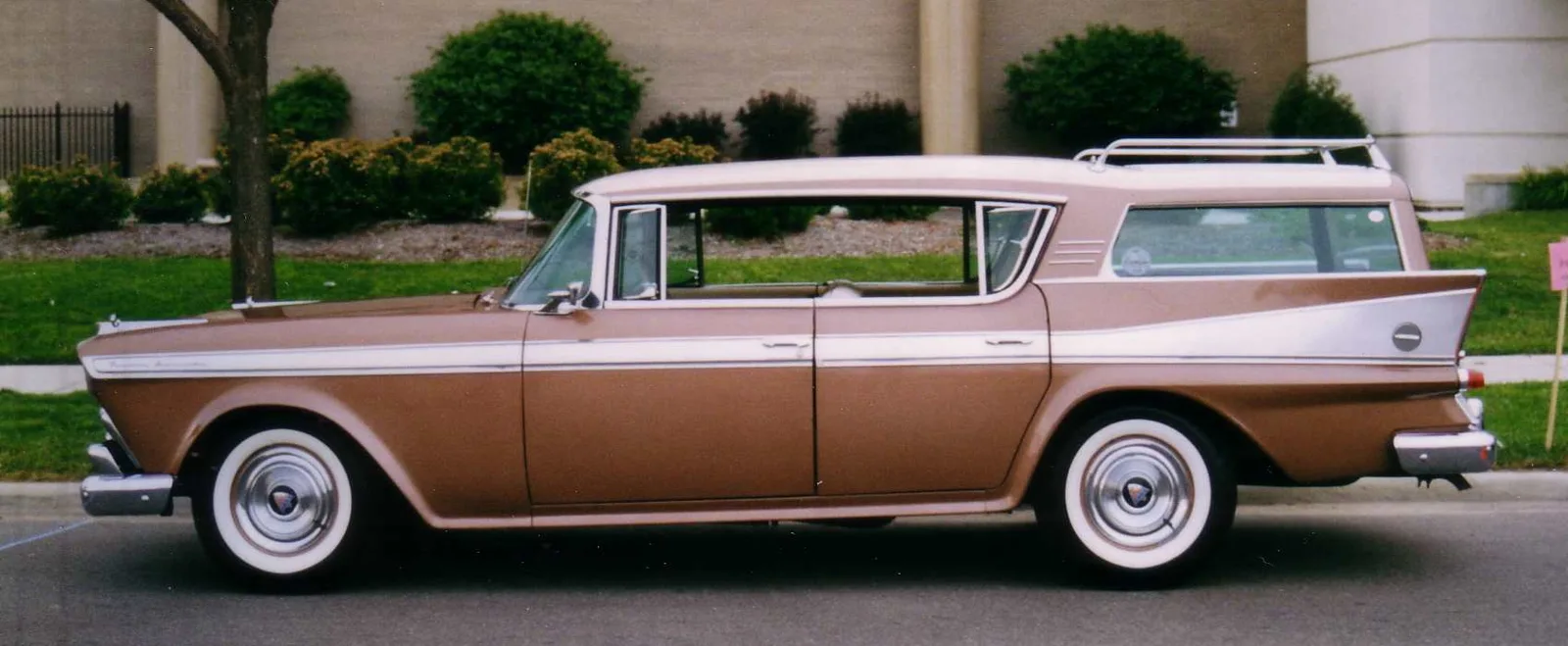
The car arrived on 8 October 1957 with taut, square-edged panels in place of the earlier Nash roundness. Management did not want the upscale Ambassador linked too closely with the economy image of the Rambler name, so the fenders carried Rambler Ambassador badges. Body styles were a four-door sedan, a hardtop sedan, a four-door pillared wagon and a pillarless Cross Country wagon.
Standard equipment included an electric clock, Nash's deep-coil suspension and reclining front seats that folded into a bed. The wheelbase was 9 inches (230 mm) longer than the Rambler Six, but the extra length sat ahead of the cowl, so the passenger compartment kept the same volume. Sales reached 14,570 for the year.
How did the Ambassador change in 1959 and 1960?
For 1959 the rear door skins swept into the tailfins, and the bumpers became more than 20% thicker. Adjustable front headrests appeared as an industry first. The Air-Coil Ride suspension, which used air bags inside the rear coil springs, proved unpopular and was dropped at the end of the model year. Sales rose to 23,769 cars.
The 1960 model was a second-generation design with a compound curved windshield, a lower cowl and an egg-crate grille that spelled out AMBASSADOR. AMC marketed it as America's Compact Luxury Car. The 327 V8 came in two forms: a 270 hp premium-fuel version with 9.7:1 compression, and a regular-fuel 250 hp (186 kW) version with 8.7:1.
With the 270 hp engine and a pushbutton automatic, the 1960 car reached 60 mph (97 km/h) in roughly nine seconds and covered the quarter-mile in 17 seconds. That year 23,798 Ambassadors left the factory, and the Custom sedan was the most popular body at 10,949 cars.
Why did the 1961 Ambassador disappoint?
The 1961 Ambassador wore a new front end, with a trapezoid grille and headlamps set into a body-coloured panel. AMC promoted the look as European, but buyers did not take to it and the press was unimpressed. Its arrival coincided with the 1960 to 1961 recession, which hit overall car sales.
Standard power was a 250 hp 327 V8 with a synchromesh manual gearbox, and a 270 hp power pack was optional. A dual-exhaust system with ceramic-coated mufflers came with the optional engine, and the interior featured a space-age oval instrument pod behind a slender two-tone steering wheel.
Why was the Ambassador downsized for 1962?
AMC downsized the Ambassador for 1962 because sales had fallen in 1961 and the company needed to save money. The car shared its body, windshield and 108-inch (2,743 mm) wheelbase with the Rambler Classic, and it was marketed as a Rambler Ambassador. Every Ambassador kept the 327 V8, while Classics were limited to sixes.
The lighter car with the 270 hp V8 was a strong performer, reaching 60 mph (97 km/h) in just over 7 seconds. That made it quicker than several rival V8 sedans of the era. A dual-circuit brake system, a new 400 trim and a two-door pillared sedan completed the changes.
George Romney was elected governor of Michigan in 1962, and Roy Abernethy became AMC's chief executive that February. A total of 36,171 Ambassadors were built for 1962, but AMC slipped from third to fourth place in US industry sales.
What did the 1963 redesign change?
The 1963 Ambassador was a full redesign by Dick Teague, built on a 112-inch (2,845 mm) wheelbase shared with the Classic. It used a single-sheet uniside outer structure and curved side glass. Its wheelbase was 4 inches (102 mm) longer, yet the car was 1.2 inches (30 mm) shorter overall and about 150 pounds (68 kg) lighter.
The uniside panels were stamped from single sheets that included door frames and outer rockers. That cut the number of parts by 30% and gave a more rigid, quieter structure. Motor Trend awarded its Car of the Year title to the 1963 Rambler line, including the Ambassador.
What was the full-size Ambassador of 1965?
For 1965 Roy Abernethy turned the Ambassador into a full-size car by stretching the platform to a 116-inch (2,946 mm) wheelbase, 4 inches (100 mm) longer than the Classic. Dick Teague gave it a horizontal wall-to-wall grille and vertically stacked quad headlamps. The aim was higher margins per car and direct competition with the Big Three.
A convertible returned in the 990 series, the first Ambassador drop-top since 1948. The standard engine became a new 232 cu in (3.8 L) inline six, the first six offered in the Ambassador since 1956. The two-door sedan started at $2,512, although list prices for the range were around $3,000.
Sales more than tripled, climbing from 18,647 in 1964 to more than 64,000 in 1965 and over 71,000 in 1966. The 1965 breakdown ran to 24,852 four-door sedans, 8,701 station wagons, 5034 990 two-door hardtops, 6382 990H hardtops and 3499 convertibles.
Why did the Ambassador lose the Rambler name?
In 1966 the Ambassador lost the Rambler name and was marketed under AMC branding instead. Abernethy wanted the car further upmarket and away from the economy image of the Rambler name, at a time when buyers were moving toward V8 performance. Styling changes were modest, with twin trim pieces on the fenders and new vertical taillamps.
What did the 1967 Ambassador bring?
The 1967 Ambassador was completely restyled and rode on a 118-inch (2,997 mm) wheelbase, 2 inches (51 mm) more than before. It was aimed at standard-size rivals such as the Galaxie, Impala and Fury. A convertible in DPL trim returned for one final year, and only 1,260 were built.
The new 343 cu in (5.6 L) V8 produced 280 bhp (209 kW) at 4800 rpm and 365 lb ft (495 N m) of torque. A four-link rear suspension replaced the old torque tube, giving a more comfortable coil-spring ride. The styling was rounder, with coke-bottle fenders and sweeping rooflines.
Sales disappointed. Buyers were confused by the company's abrupt push upmarket, which looked to many like a copy of the Big Three, and the strategy cost AMC money. Abernethy was released by the board later that year with Roy D. Chapin Jr. and William V. Luneberg taking over.
Why was air conditioning standard in 1968?
In 1968 AMC made air conditioning standard on the Ambassador, which made it the first volume car to offer that as standard. Buyers could delete it and save $218, but most still ordered it. Few rivals offered it as standard, and Cadillac and Lincoln had not done so on their luxury cars.
The top SST model had standard V8 power, individual reclining seats and wood-look trim, and reviewers called it the Kenosha Cadillac. The flush paddle door handles introduced that year cut the car's width from 78.4 in (1,991 mm) to 77.2 in (1,961 mm), and they predated later safety rules.
How did the 1969 Ambassador grow?
The 1969 Ambassador was restyled and gained 4 inches (102 mm) in length. Its wheelbase grew to 122 in (3,099 mm), and its track widened from 58.5 to 60 inches (1,486 to 1,524 mm). Quad headlamps now sat horizontally in a blacked-out grille. The car was sold on limousine-style comfort, and dealers invited shoppers to a demonstration ride with a uniformed chauffeur.
Robert Estes, a Chicago auto leasing executive, commissioned Armbruster/Stageway to turn Ambassadors into 24-foot (7.3 m) stretch limousines on a 158-inch (4,013 mm) wheelbase. The Royale Stretch Limo had its original rear doors welded shut and a new central door added, and power came from the 390 V8 rated at 315 hp (235 kW; 319 PS). The State of Wisconsin owned one for Governor Warren Knowles.
What changed for the 1970 model year?
The Hornet replaced the Rambler American for 1970, while the Ambassador gained a new rear end and a standard 6-foot (1,829 mm) luggage rack on wagons. The DPL and SST trims continued, and a fleet-oriented Basic sedan was offered only as a four-door. The Ambassador's new 304 cu in (5.0 L) V8 produced 210 hp (157 kW; 213 PS) at 4400 rpm and was standard on DPL and SST models.
The optional four-barrel 390 cu in AMX V8 produced 325 hp (242 kW; 330 PS) at 3200 rpm with 420 lb ft (569 N m) of torque. The three-speed automatic was standard on DPL and SST cars. Only the Basic fleet model kept a 232 cu in six as standard.
Marketing called the Ambassador AMC's finest car, comparable to the Cadillac, Continental and Imperial, yet priced well below GM, Ford or Chrysler equivalents. An SST two-door hardtop listed at $3,739, and the average MSRP was $3,677 across the 58,900 cars built that year. Robert De Niro appeared in TV spots as a young accountant who bought a luxury car.
What changed in 1971 and 1972?
The 1971 Ambassador lineup was streamlined, with the sedan-only DPL as the entry model and a new top Brougham trim above the SST. Every car came with a Shift-Command automatic. The DPL's new 258 cu in (4.2 L) inline six produced 150 hp (112 kW; 152 PS), and the top engine was a 401 cu in (6.6 L) V8 rated at 335 hp (250 kW).
For 1972 the six was dropped, making the Ambassador a V8-only car for the first time since 1964. AMC also introduced a 12-month or 12,000-mile (19,000 km) bumper-to-bumper warranty, which was a first in the industry. A Popular Mechanics survey of owners who had driven a combined 1,000,000 miles found that 92% would buy one again.
What was the 1974 Ambassador like?
The 1974 Ambassador was the eighth and final generation, arriving just as the oil crisis reshaped the American market. It grew to 217.8 in (5,532 mm), the longest AMC-built version, and was redesigned around federal energy-absorbing bumpers. Its overall length rose by 8.2 in (208 mm) on the 1972 car, while the 122 in wheelbase was kept.
The grille was a squared-off loop design with a forward-protruding centre, which gave the car a coffin-nose look. The two-door hardtop was dropped, leaving four-door sedans and station wagons, all in Brougham trim. Standard front seats were 50-50 reclining units, and the dashboard had soft-plastic knobs marked with international symbols.
With the trailer package the Ambassador was rated to tow 5000 lb (2,268 kg). The sedan fuel tank grew to 24.9 US gal (94 L; 21 imp gal). The standard engine was the 304 V8, with 360 and 401 options, and air conditioning, power steering and power front disc brakes were all standard.
Demand had moved toward smaller cars, and full-size sales fell 37% in the 1974 model year. In June 1974 the last Ambassador left the Kenosha line, ending a nameplate that had run for 48 years. Production for the final year was 17,901 sedans and 7,070 station wagons, a total of 24,971.
Where was the Ambassador built outside the United States?
Ambassadors were assembled overseas as well. Industrias Kaiser Argentina built them in Cordoba from 1962 until 1972, and they remained available by special order until 1975. Australian Motor Industries assembled right-hand-drive kits at Port Melbourne from 1961 to 1963, and ECASA in Costa Rica built them through 1970.
Mexico saw only the 1958 and 1959 cars, which Planta REO assembled in Monterrey as four-door hardtops with the 270 hp V8. Canada's Brampton plant built Rambler Ambassadors until 1968, after which Canadian cars came from the United States. Right-hand-drive cars were sold in the United Kingdom through Rambler Motors (A.M.C.) Ltd in Chiswick until 1974.
What became of the Ambassador after 1974?
American Motors carried the Ambassador on in the form of the Matador sedan and station wagon. From 1975 the Matador used the Brougham trim and the model codes of the Ambassadors it replaced. A Barcelona four-door sedan topped the range in 1978, the final production year for the line.
What are the AMC Ambassador specifications?
| Specification | Detail |
|---|---|
| Years built | 1957 to 1974, eight generations |
| Wheelbase (1958) | 117 in (2,972 mm) |
| Wheelbase (1969 on) | 122 in (3,099 mm) |
| Top V8 (1958) | 327 cu in (5.4 L), 270 hp (201 kW; 274 PS), 360 lb ft (488 N m) |
| Top V8 (1967) | 343 cu in (5.6 L), 280 bhp (209 kW), 365 lb ft (495 N m) |
| Top V8 (1971) | 401 cu in (6.6 L), 335 hp (250 kW) |
| Overall length (1974) | 217.8 in (5,532 mm) |
| Towing (1974) | 5000 lb (2,268 kg) with trailer package |
| Fuel tank (1974 sedan) | 24.9 US gal (94 L; 21 imp gal) |
| Warranty (1972) | 12-month or 12,000-mile (19,000 km) bumper-to-bumper |
| Output (1974) | 24,971 cars: 17,901 sedans and 7,070 station wagons |