American Motors' two-door pony car from 1968 to 1974, with its Trans-Am record, Alabama patrol service and licensed assembly abroad.
The AMC Javelin was a two-door pony car built by American Motors for the 1968 to 1974 model years. It was styled by Dick Teague, built in Kenosha, Wisconsin, and assembled under licence in several other countries. Its two generations ranged from economy six-cylinders to big-block muscle cars.
American Motors built the Javelin as its entry in the pony car segment, a market that the Ford Mustang had created. The two-door hardtop came in two generations between 1968 and 1974, and it was styled by Dick Teague.
It ranged from economical six-cylinder cars to muscle machines, and it won the Trans-Am series in 1971, 1972 and 1976. It was also assembled under licence in several countries and was the first pony car used for routine highway patrol work by an American agency.
Where did the Javelin come from?
The Javelin grew out of two AMX show cars shown in 1966, a fiberglass two-seater and a four-seat AMX II. The company wanted to shed its economy-car image and reach younger, performance-minded buyers. A convertible was not pursued, because convertible sales were falling and AMC lacked the budget for separate hardtop bodies.
Ford's Mustang created the segment, although Ford was not the first to offer such a car. The AMX prototypes made the rounds of AMC's Project IV show circuit, and their ideas carried into production.
The Javelin was built on AMC's compact Rambler American platform, but only as a two-door hardtop. With budgets tight, the styling team under Teague drew a single semi-fastback roofline rather than separate fastback and notchback bodies.
A pony car that won Trans-Am titles, served as a police cruiser and was assembled under licence in five countries.
What did the first-generation Javelin look like?
The first Javelin went on sale from late September 1967 as a 1968 model, priced from $2,743. It had flush paddle-style door handles, fiberglass-padded windposts and a luggage space of 288.83 L (10.2 cubic feet). Its base engine was a 232 cu in six, and its body had a twin-venturi grille.
Safety touches included exterior side marker lights, three-point belts and headrests for the front seats. There were no side vent windows, so flow-through ventilation pulled air out through apertures in the doors.
Up front, a recessed honeycomb grille sat between outboard headlamps, and the simulated hood scoops were raked at 59 degrees. Road & Track praised the car against its rivals, and Motor Trend placed it at the top of the sports-personal class in its Car of the Year issue.
Which engines and packages did the 1968 Javelin offer?
The base engine was a 232 cu in straight-six, with 290 and 343 cu in V8s as options. The optional Go Package paired the 343 four-barrel with disc brakes, heavy-duty suspension, dual exhausts and red-line tyres on Magnum 500 wheels.
The Go Package car could reach 60 mph in about eight seconds and run the quarter-mile in 15.4 seconds, with a top speed near 120 mph (193 km/h). That made the 343 car a serious performer for its size.
Mid-1968 brought the 390 cu in V8 as a Go Package option, rated 315 hp (235 kW; 319 PS) with 425 lb-ft (576 N-m) of torque, which could send the car from zero to 60 mph in the seven-second range. AMC also offered Group 19 dealer accessories, including dual four-barrel cross-ram manifolds and camshaft kits.
The first 1,000 buyers averaged 29 years old, ten years younger than the typical AMC customer. The campaign by Mary Wells Lawrence of Wells, Rich, and Greene compared the Javelin directly with the Mustang, and some advertisements showed the rival being smashed with sledgehammers.
How did the 1969 and 1970 Javelins change?
The 1969 car gained revised striping, a bull's-eye grille emblem and a larger tachometer, and a mid-year Mod Javelin package added a roof spoiler and simulated air scoops. The 1970 model was a one-year redesign with a new front end and a Ram Air hood option.
The 1969 Go Package kept disc brakes, a Twin-Grip limited-slip differential and performance tyres on Magnum 500 wheels. From January 1969 four-speed manuals came with a Hurst floor shifter for shorter throws. The 1969 production total was 40,675 cars.
The 1970 front had a broad twin-venturi grille that took in the headlamps, and the bumper lost its air intakes. The 390 gained new heads and one Autolite four-barrel, and its output rose to 242 kW (330 PS), or 325 bhp at 5000 rpm.
A Popular Science road test found the 1970 Javelin the roomiest of four pony cars, with the most trunk capacity at 10.2 cubic feet (289 L). A four-speed car reached 60 mph in 6.8 seconds, the quickest of the group.
What were the Donohue and Trans-Am special editions?
The Donohue Javelin existed to homologate a ducktail spoiler that Mark Donohue had designed, with 2,501 SST versions made. AMC also built about 100 Trans-Am replicas for the street, priced at $3,995. The Donohue spoiler was itemised at $58.30 on the sticker.
The Donohue cars carried no special VIN or door tag, so the window sticker and dealer papers are the only proof. That makes authentic examples hard to confirm, and dealers sometimes made their own versions.
Trans-Am replicas wore the team colours of Matador Red, Frost White and Commodore Blue in a hash pattern, along with 390 V8s, front and rear spoilers and power-assisted steering. They weighed 2,850 lb, against 3,060 lb for the Camaro and 3,442 lb for the Mustang.
How did AMC's Trans-Am racing go?
Javelins raced in the SCCA Trans-Am series from 1968, first under the Kaplan Engineering team, which finished third in the over-2-litre class and was the only factory entry to finish every race it entered. The programme passed to Penske for the 1970 season.
In 1968 Ron Kaplan and Jim Jeffords prepared three cars and worked on anti-dive geometry, a cross-ram manifold with Vic Edelbrock and a new four-bolt-main block. The 1969 campaign went less well, with engine homologation problems and limited budgets.
Penske bought the team equipment, and Mark Donohue lowered the front of the car, replaced rubber bushings with heim joints and developed new roll bars. The car was said to handle very precisely after that work.
In 1970 the two-car Penske effort finished second in the over-2-litre class. Javelins then took the Trans-Am crown in three seasons: 1971, 1972 and 1976. George Follmer and Mark Donohue were among the drivers.
How did the second-generation Javelin differ?
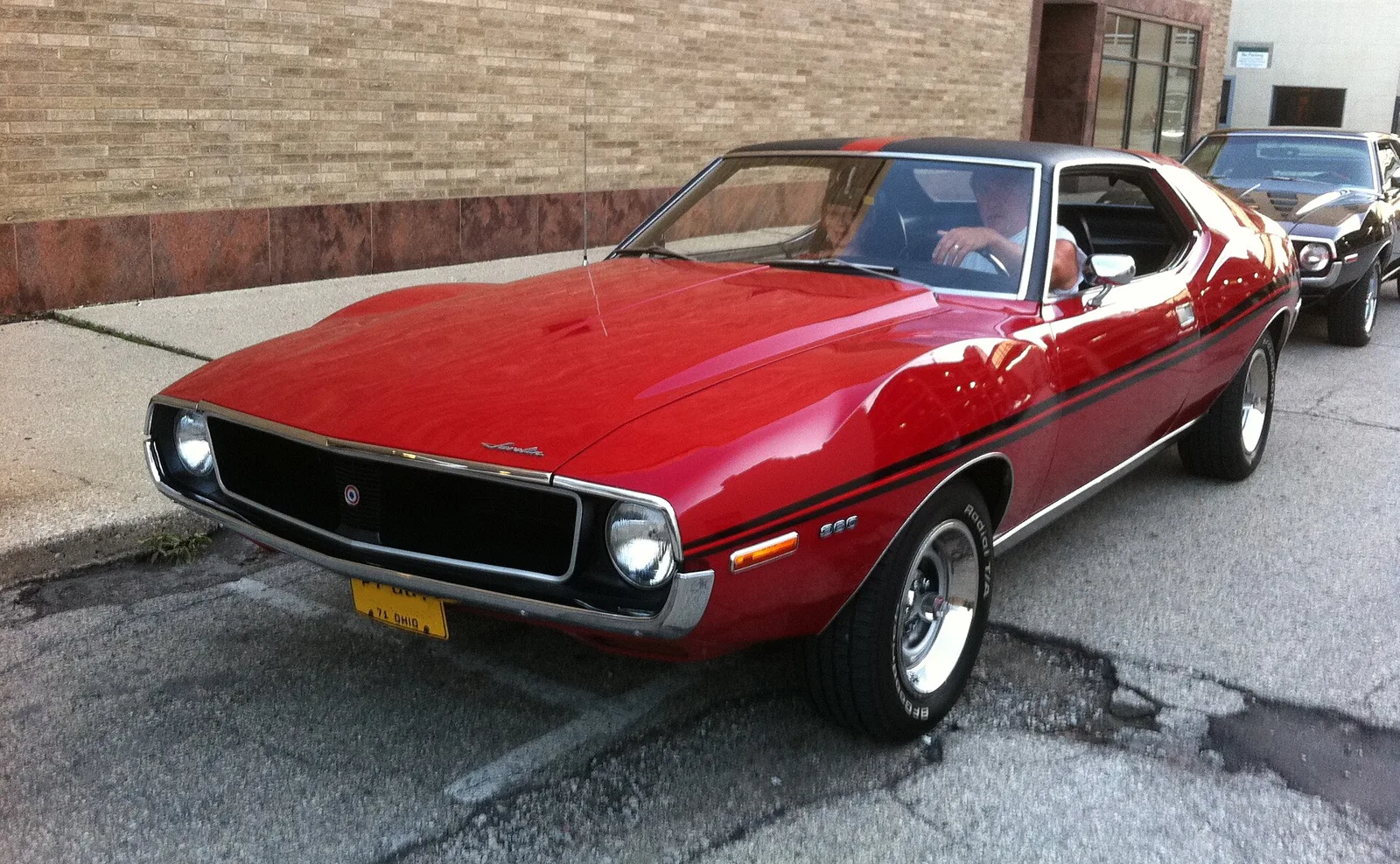
The second generation arrived for 1971 with a restyle led by Chuck Mashigan. The wheelbase grew by an inch to 110 inches, the body was 3.31 inches wider, and the AMX became a premium high-performance version of the Javelin. Its styling was meant to look like an expensive European exotic.
The 1971 range ran from a 232 cu in six up to a 401 cu in V8 with a single four-barrel carburettor, rated at 330 bhp at 5000 rpm and 430 lb-ft at 3400 rpm. The BorgWarner T-10 four-speed came with a Hurst floor shifter.
The AMX gained a fiberglass cowl hood, a rear spoiler, engine-turned trim and wheels with white-letter tyres. Mark Donohue advised making the grille flush for airflow, so a stainless mesh screen replaced the open grille openings.
Penske's testing at Ontario Motor Speedway found that the rear spoiler added 100 lb of downforce. A 401 car weighing 3,244 pounds (1,471 kg) ran the quarter-mile at 93 mph, in the mid-14 second bracket.
For 1972 the Javelin had an egg-crate grille, and American Motors added a one-year Buyer Protection Plan that covered repairs, with a loaner car if a repair took more than a day. Power ratings switched to SAE net figures, and automatics became Chrysler TorqueFlite units called Torque-Command.
Pierre Cardin designed a special interior for 1972 and 1973, with pleated stripes in red, plum, white and silver on black. About 4,152 cars were built with the option, which cost $84.95 and went on sale on 1 March 1972.
The 1973 Javelin dropped the SST name, and the Turtle Back seats gave way to a slimmer design with more rear legroom. Its non-telescopic bumpers could take a 5 mph front impact and a 2.5 mph rear impact without damage. The 401 was rated at 255 hp net and ran 0 to 60 mph in 7.7 seconds.
A Trans Am Victory edition marked the 1971 and 1972 championships, and it was offered in 1973 as a limited package on SST cars. Production for the 1973 model year totalled 30,902 units, including 5,707 AMX models.
Why did the Javelin's sales fade by 1974?
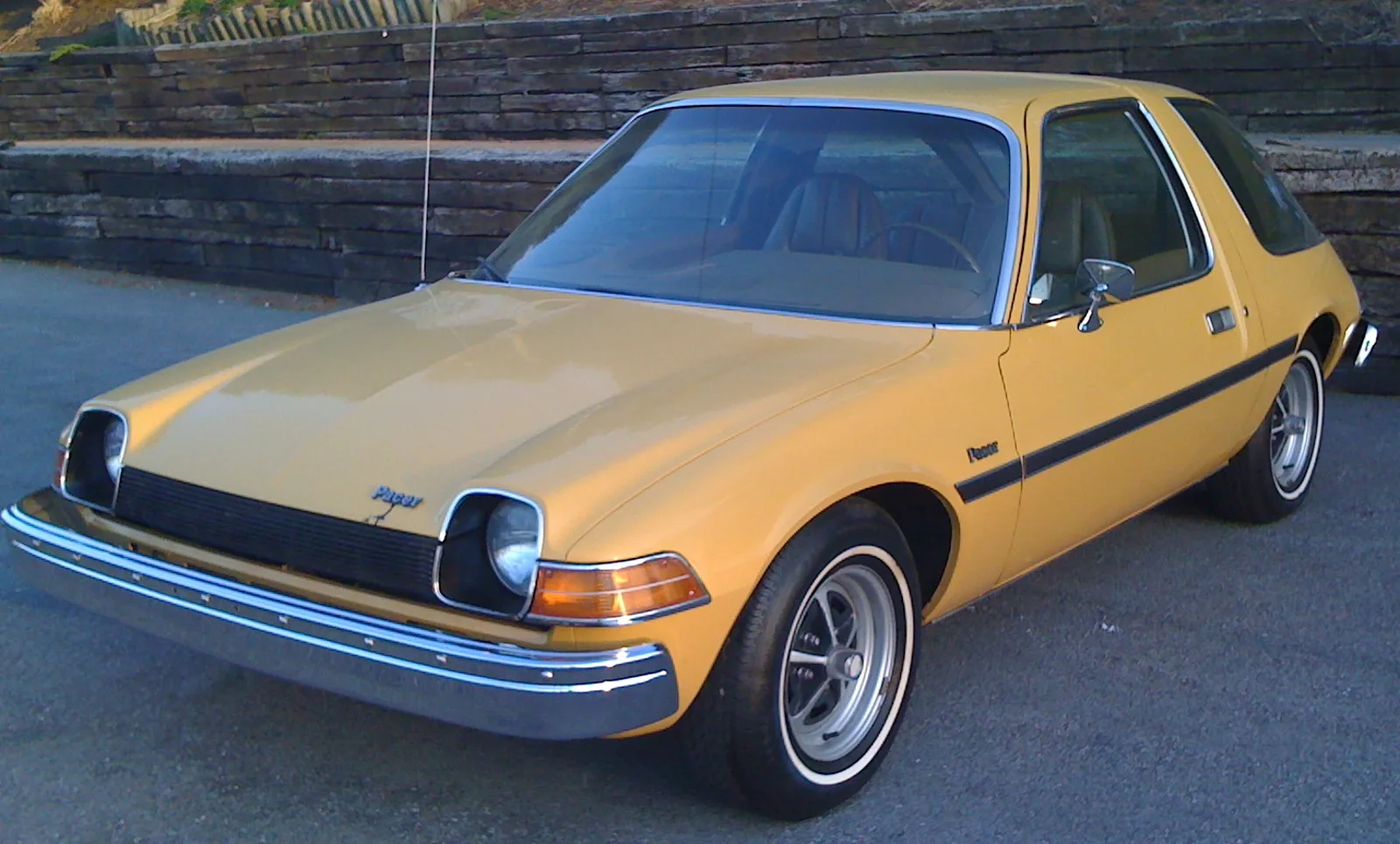
Pony cars lost popularity in the mid-1970s, and Chrysler quit the segment in 1974. Fuel prices after the 1973 oil crisis, a national 55 mph speed limit and higher insurance premiums all pushed buyers away from performance cars. AMC needed the production line for its new Pacer, so the Javelin was dropped.
The 1974 car had upgraded bumpers with standard guards and front disc brakes as standard, with radial tyres as an option. Bigger bumper guards became mandatory in four states: California, Georgia, Maryland and North Carolina.
The 1974 AMX did poorly against the new Camaro, Firebird and downsized Mustang II, although the final year still produced 27,696 units, about 15 percent of them AMX models. The regular Javelin peaked at 22,556 cars in the second generation, and 4,980 AMX models joined them in the final year.
Was the Javelin used by police?
Yes. The Alabama Department of Public Safety bought 132 Javelins in 1971 and 1972, a US first for pony cars used on routine highway patrol work. Cruisers cost the state $3,047 in 1971 and $3,242 in 1972, according to the bids.
The state had been short of money, so troopers could not buy the full-size Fords they were used to. After testing a basic 304 V8 car and finding it lacking, they tried a vinyl-roofed AMX with a 401 engine, which became the most abused police car in Alabama's history.
The 1971 cars were base Javelins with the fleet 401 four-barrel, a rear spoiler, power disc brakes, heavy-duty suspension and a 140 mph speedometer. The 1972 cars were all SST models. The department then fitted decals, a warning beacon, a siren and a radio.
The archives record high-speed chases, and some of these cars were clocked above 150 mph (240 km/h). The Alabama Javelins stayed in service until June 1974, and the last was retired in 1979.
How was the Javelin sold overseas?
AMC sold and assembled the Javelin in several countries. Australia's AMI built right-hand-drive examples from 1968, Karmann built 280 cars for Europe, and Mexico's VAM built the car under licence until 1973. Venezuela and the Philippines assembled cars locally, while Switzerland and Britain imported them.
In Australia, Australian Motor Industries assembled Javelins in Victoria from knock-down kits, selling them under the Rambler name. The AMI cars were the only American muscle cars of their era sold new in Australia. The first generation sold for AU$7,495, against AU$3,790 for the Holden HK Monaro GTS and AU$4,200 for the Ford XT Falcon GT.
Karmann's Rheine plant assembled the German cars from crates of American parts, with about 90% of components coming from the United States. The cars used the 79-K designation and Karmann serial numbers on the firewall, and their speedometers read in km/h.
Mexico's VAM assembled Javelins from 1968 through 1973, with AMC holding 40% equity. It was VAM's first model without the Rambler badge, and it carried more standard equipment than its North American sibling.
In the Philippines, Luzon Machineries assembled cars from 1968 to 1970, with only the 258 cu in six allowed by tax rules. Venezuela's Constructora Venezolana built them in Caracas from 1968 to 1974. In Britain, right-hand-drive cars came from Brampton in Ontario from 1969, and Rambler Motors sold them in Chiswick.
What is the Javelin's legacy among collectors?
Collectors now value the Javelin for its style and its performance heritage. The Antique Automobile Club of America splits muscle Javelins into two classes, and the 1970 Donohue car is highly prized, especially factory originals.
The AACA's Class 36-e covers 1968 and 1969 cars fitted with a 343 or bigger V8, and Class 36-j covers 1970 to 1974 cars with a 360 or bigger V8. Desirable options include the 390 and 401 V8s, the Go package and the original Big Bad paint.
A fully documented Donohue Javelin won Best of Show in the 1999 Mopar Muscle judging. Owners' clubs remain active, including the National American Motors Drivers and Racers Association, and parts vendors sell new old stock and reproductions.
In 2017 a customiser prepared a 1972 AMX powered by a Hellcat Hemi for the SEMA show. The wheelbase was stretched, and the 6.2-litre Hemi with a Whipple supercharger made 1,036 hp. The car was built for Prestone and named Defiant.
What are the AMC Javelin specifications?
The Javelin was a front-engined, rear-drive two-door hardtop built on a compact platform, with a range of straight-six and V8 engines. The table covers the main figures for each generation, with the engine line-up shown for the years each unit was offered.
| Specification | Detail |
|---|---|
| Model years | 1968 to 1974, two generations |
| Platform | Rambler American, two-door hardtop |
| Base engine | 232 cu in (3.8 L) straight-six |
| 1968 V8 options | 290 cu in (4.8 L); 343 cu in (5.6 L); 390 cu in (6.4 L) from mid-1968 |
| Top 1968 engine | 390 cu in, 315 hp (235 kW; 319 PS), 425 lb-ft (576 N-m) |
| 1970 engines | 304 cu in (5.0 L) base V8; 360 cu in (5.9 L); 390 cu in at 325 bhp |
| 1971 top engine | 401 cu in (6.6 L) V8, 330 bhp at 5000 rpm, 430 lb-ft at 3400 rpm |
| 1973 401 | 255 hp net; 0 to 60 mph in 7.7 seconds |
| Wheelbase | 110 inches from 1971 |
| Trunk | 10.2 cubic feet (288.83 L) |
| Production | 55,125 in 1968; 40,675 in 1969; 30,902 in 1973; 27,696 in 1974 |
| Trans-Am titles | 1971, 1972 and 1976 |