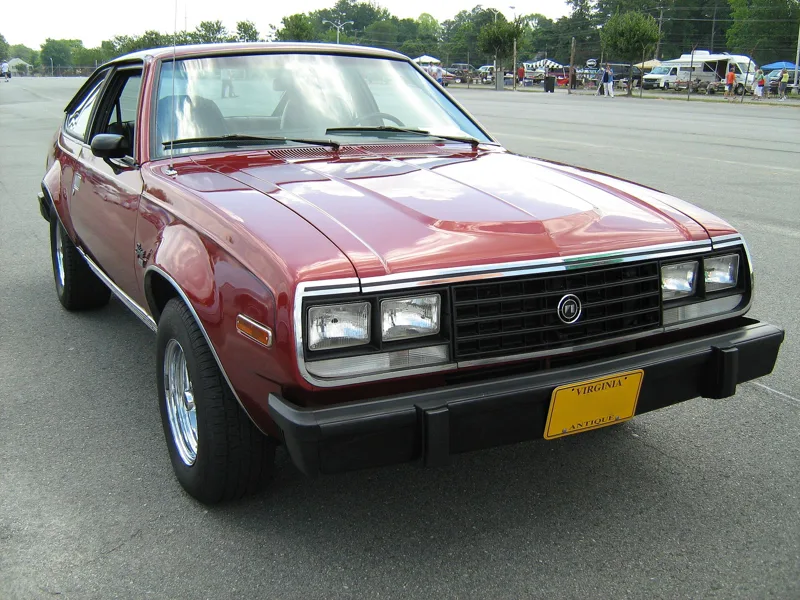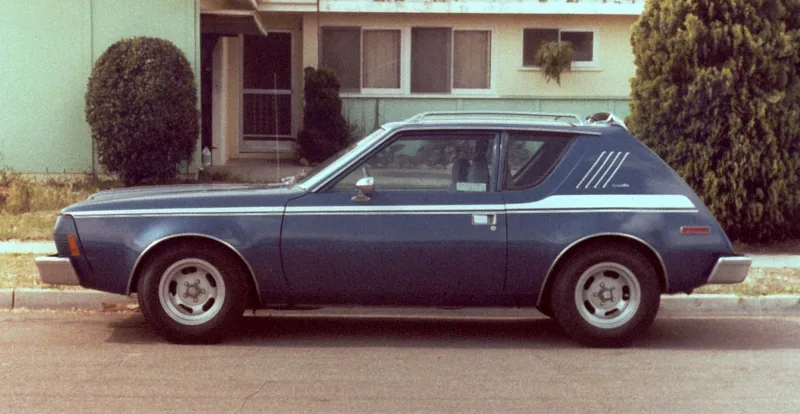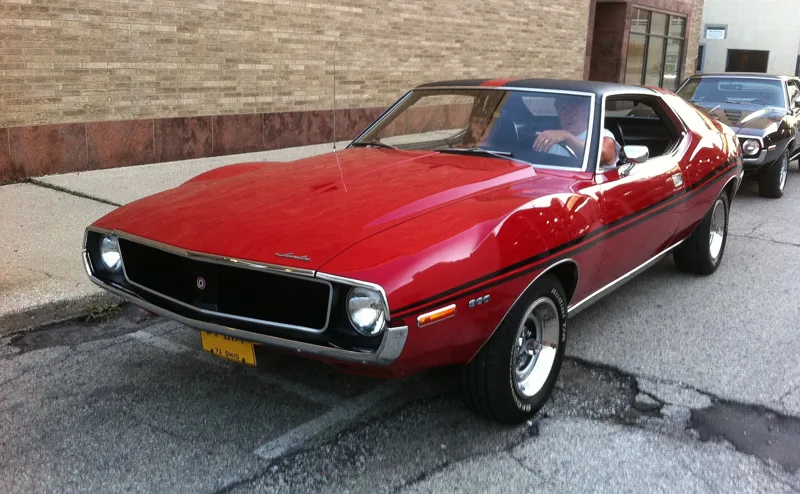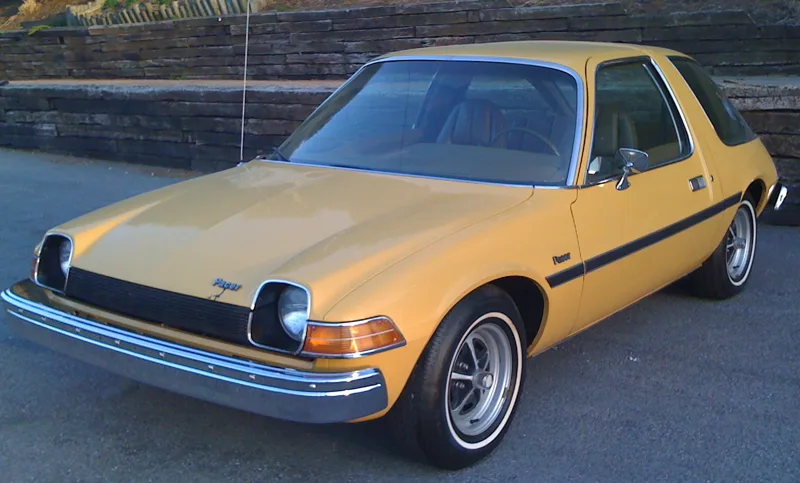
AMC's 1970 compact, its SC/360 and AMX muscle, a Bond stunt jump and the platform that later carried the Concord and Eagle.
The AMC Hornet was a compact car built by American Motors from 1970 to 1977, replacing the Rambler American. It came as a sedan, wagon or hatchback coupe, and its platform carried on to the Gremlin, Concord, Spirit and Eagle until 1988.
AMC's Hornet was one of the company's best sellers of the early 1970s, and its platform became the base for the Gremlin, Concord, Spirit and Eagle. The model also starred in one of the most famous stunts in a James Bond film.
What was the AMC Hornet?
The AMC Hornet was a compact car sold by American Motors Corporation from 1970 to 1977, in two- and four-door sedan, station wagon and hatchback coupe forms. It replaced the Rambler American, which marked the end of the Rambler name in the United States and Canada.
The car was launched in September 1969 for the 1970 model year. It had a 108-inch (2,743 mm) wheelbase, 2 inches (51 mm) longer than its predecessor, and it was the first US-made car with guardrail beam doors to protect occupants in a side impact.
Development took three years, a million person-hours and US$40 million. Dick Teague and chief executive Roy D. Chapin Jr. shaped the company's 1970s direction around the new model, and the platform went on to underpin the Gremlin, the Concord, the Spirit and the four-wheel drive Eagle, the last of which was built through 1988.
AMC's compact best-seller, a Bond stunt car and the platform that later carried the Concord, Spirit and Eagle.
Why did AMC build the Hornet?
AMC built the Hornet to stem the tide of imported small cars, which had taken about 10% of the US market, by offering economy with style and fun to drive. Domestic rivals included the Ford Maverick, the Chevrolet Nova and the Plymouth Duster, all aimed at the same buyers.
AMC promoted the Hornet as a little rich car with room for five passengers. Its interior and equipment were a step above what buyers expected from a budget compact, and its extra width and wheelbase gave it more stability and ride comfort than the car it replaced.
Only four of the original eleven compact nameplates still qualified as compact by 1969, and only the Rambler American was priced under $2,000. The Hornet was designed to fill that gap.
How much did the Hornet cost?
The base two-door Hornet listed at $1,994 in 1970, with the four-door $78 more and the SST trim $150 above the base models. The Ford Maverick was listed $1 higher, while the Chevrolet Nova and Plymouth Duster cost 10% more.
Prices rose later. The 1973 base two-door sedan started at $2,298, and the hatchback at $2,449. In 1975 AMC raised suggested prices by an average of 13%, and cash rebates of $200 to $600 were offered to tempt buyers.
The SC/360 muscle car was priced at just US$2,663 in 1971, about $40 below the Plymouth Duster 340.
Which engines did the Hornet offer?
The 1970 Hornet offered two six-cylinder engines and a 304 cu in (5.0 L) V8. The base six was a 199 cu in (3.3 L) rated at 128 hp (95 kW; 130 PS), while the 232 cu in (3.8 L) six made 145 hp (108 kW; 147 PS) and the V8 210 hp (157 kW; 213 PS).
The V8 came only with the automatic, and it had a standard front sway bar, larger 11-inch drum brakes and optional power-assisted front disc brakes. Torque for the 232 was 215 lb-ft (292 N-m) at 1600 rpm, and the V8 produced 305 lb-ft (414 N-m) at 2800 rpm.
By 1973 the V8 options were the 304 cu in (5.0 L) and a two-barrel 360 cu in (5.9 L), which made 175 hp (130 kW; 177 PS). Any Hornet could be ordered with the 360 and an automatic transmission.
What was the SC/360?
The SC/360 was a compact two-door muscle car introduced for 1971, with AMC's 360 cu in (5.9 L) V8 as standard. In standard form it made 245 hp (183 kW; 248 PS) and was priced at just US$2,663, which gave buyers V8 speed without the cost of a big muscle car.
AMC chose the combination to achieve a 12.5:1 weight-to-horsepower ratio for insurance rate calculations. The $199 Go package added a four-barrel carburettor and ram-air induction, raising output to 285 hp (213 kW; 289 PS).
Motor Trend called it a plain gas to drive, while Car Craft bolted on better tyres and headers to run the quarter-mile in 13.78 seconds at 101.92 mph (164 km/h). Hot Rod ran an automatic SC/360 at 14.80 seconds in bone-stock form.
The SC/360 lasted a single year. AMC had planned as many as 10,000 cars, but high insurance premiums and falling demand for muscle cars cut production to 784 examples, of which 304 had a four-speed manual and a four-barrel carburettor.
What was the Sportabout?
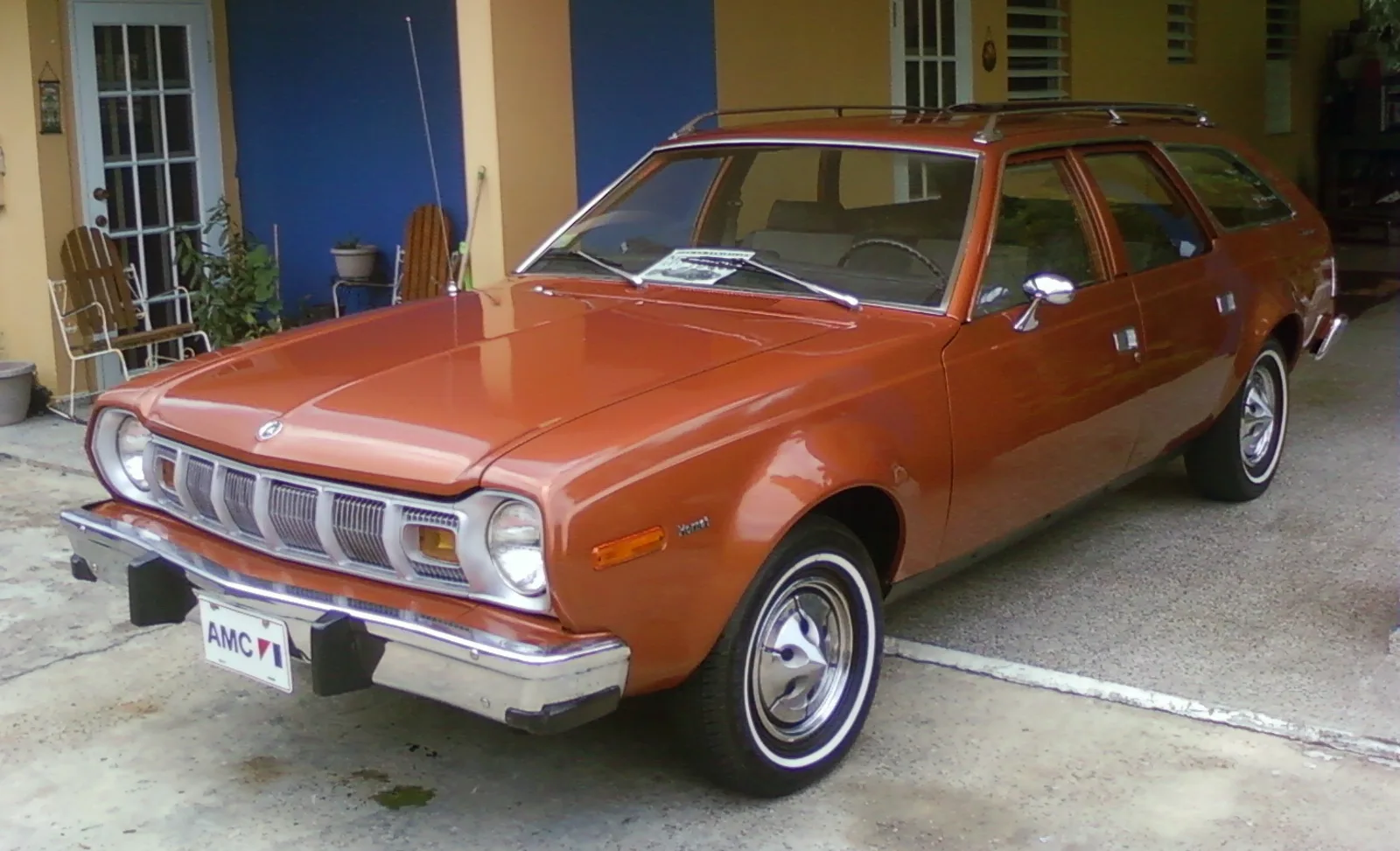
The Sportabout was a four-door wagon added for 1971, with a steeply raked hatchback rather than a traditional station wagon design. It outsold every other Hornet model combined in its debut year, and for most of its production it was the only American-made wagon in its size class.
Advertising stressed that it was less a station wagon than a sporty car with cargo space. The 1971 Sportabout wagon sold 73,471 units, making it by far the most popular Hornet of the early years.
The Gucci version, a 1972 luxury option developed with Italian fashion designer Dr. Aldo Gucci, had beige upholstery, Gucci emblems and a choice of four exterior colours. Some 2,583 were built in 1972, and another 2,252 followed for 1973.
How did the Hornet change through the 1970s?
The Hornet was revised most years. In 1972 AMC added a 12-month or 12,000-mile (19,312 km) warranty, in 1973 a hatchback coupe and new front bumpers arrived, in 1975 an overdrive and catalytic converters appeared, and in 1977 the manual shifters moved to the floor as the AMX joined the range.
The 1972 Buyer Protection Plan was an industry first, pairing a comprehensive warranty with a loaner car and trip-interruption protection. The base models were dropped that year, and every Hornet became an SST.
The 1973 facelift added a V-shaped grille, a slightly recessed and longer hood and a 5 mph bumper, and the overall length grew 6 inches (152 mm). Car and Driver praised the new hatchback as the styling coup of the year.
Popular Science rated the hatchback among the most modern cars on the market. With the 304 V8 and automatic it reached 60 mph in 12.1 seconds and returned 16.453 mpg-US (14.296 L/100 km; 19.759 mpg-imp).
AMC focused on developing the new Pacer in 1975, and the Hornet was kept mostly unchanged apart from a new grille with vertical grating. By 1976 the Pacer's arrival was affecting sales of the compact and subcompact Gremlin, and the Dodge Aspen and Plymouth Volare wagons ended AMC's monopoly on domestic compact wagons.
What was the Hornet AMX?
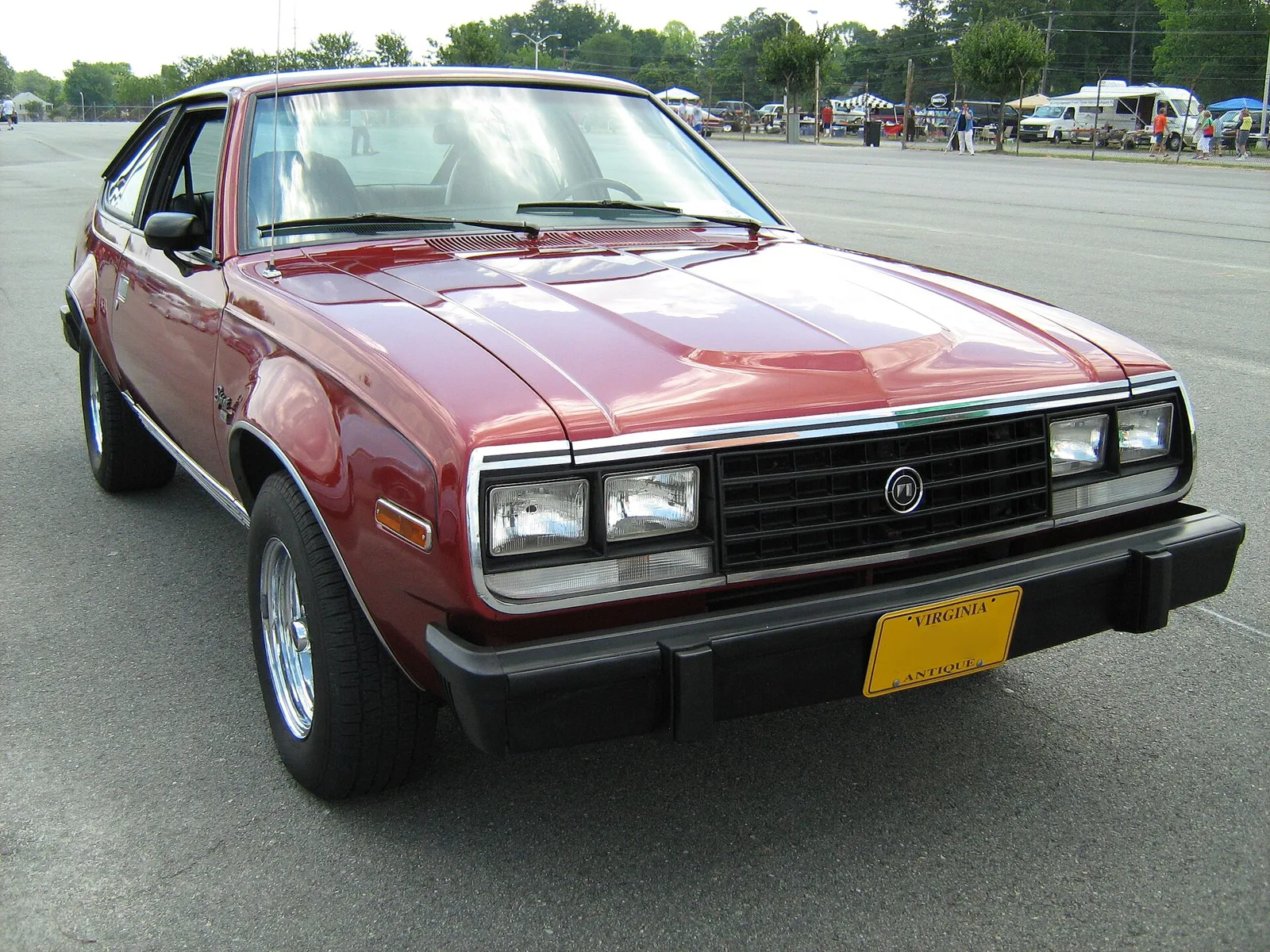
The Hornet AMX was a sports-oriented hatchback for the 1977 model year, reviving a name from AMC's original two-seat AMX. It came with a four-speed manual or automatic on the six, and the V8 was available only with the automatic. Standard features included spoilers, airfoils and body-coloured rear window louvers. Only 5,207 were built.
The AMX came in Alpine White, Firecracker Red, Sunshine Yellow or Lime Green, with a front spoiler, a brushed aluminium Targa-top band over the B-pillars and roof, and Hornet graphics. Only 100 AMX models had the Levi's interior.
Popular Science tested it against the Mustang II Cobra II, the Monza Spyder and the Volare Road Runner, and found the Hornet AMX reached 60 mph in 12.0 seconds. The authors called these cars image machines rather than tire-burning rockets.
Of the 5,207 AMX models built, 3,196 had the six and 2,011 the V8. The authors described the AMX as a crucial stopgap between eras, when muscle cars gave way to sporty looks and handling packages.
How many Hornets were built?
The Hornet sold strongly through most of its life. In 1973 output reached 40,110 hatchbacks alongside 44,719 wagons, and the 1974 hatchback reached 55,158, the high point of the range.
In 1970 AMC built 43,610 base two-doors, 17,948 base four-doors, 19,748 SST two-doors and 19,786 SST four-doors. Output fell in 1975, when the hatchback dropped to 13,441 and the wagon to 39,593.
The 1977 model year produced 6,076 two-doors, 31,331 four-doors, 28,891 wagons and 11,545 hatchbacks, and the platform's later life under the Concord and Eagle was far larger.
How did the Hornet perform in motorsport?
The Hornet raced in NASCAR, drag racing, IMSA and endurance events. Bobby Allison drove AMC's NASCAR entries, and Wally Booth won the 1974 Gatornationals and the 1976 NHRA U.S. Nationals in a Hornet.
In 1970 Lou Haratz drove a Hornet from Ushuaia, Argentina to Fairbanks, Alaska in 30 days and 45 minutes, setting a Trans-Americas record over more than 14,000 miles (22,531 km).
IMSA racing from 1971 saw Hornets in the GTO and American Challenge classes, with cars powered by modified AMC 232 six-cylinder engines. In 1973 Amos Johnson and BMW driver Nick Craw ended the IMSA series as co-champions in Class B.
On 6 February 1977 a Hornet finished 22nd overall and 12th in the GTO class at the 24 Hours of Daytona, covering 394 laps and 1,582 miles (2,546 km). Team Highball's 1977 AMX finished 34th in GTO out of 68 starters at the 24 Hours of Daytona.
In 1972 two Hot Rod staffers entered a Hornet X hatchback, modified with a 401 cu in (6.6 L) V8, in the Cannonball Baker run from New York to Redondo Beach. They finished 13th after 41 hours and 15 minutes at an average of 70.4 mph (113 km/h).
Did a Hornet appear in a James Bond film?
Yes. A red Hornet hatchback performed an airborne jump over a broken bridge in The Man with the Golden Gun in 1974, with Roger Moore making his second appearance as Bond in that film.
The jump was performed by an uncredited British stuntman after seven tests, with six or eight cameras rolling. The stunt car had a redesigned chassis with the steering wheel moved to the centre, and computer modelling at the Cornell Aeronautical Laboratory calculated the ramp angles.
The stunt was adapted from Jay Milligan's Astro Spiral Javelin show cars, which had been jumped at AMC-sponsored thrill shows at fairs around the US. The actual Bond Hornet is preserved at the National Motor Museum in Beaulieu, and the stunt car was auctioned in 2017 in operable, as-jumped condition.
How was the Hornet built outside the United States?
The Hornet was assembled abroad under licence, with Australian Motor Industries building 1,825 cars at Port Melbourne between 1970 and 1975, Motor Assemblies in South Africa producing 840, and VAM in Mexico building Hornet-based models from 1970 to 1977.
Australian Hornets were right-hand drive and sold as the Rambler Hornet in four-door form, with luxury trim. The car cost $3,999 in 1970. Sales peaked at 597 in 1971 before falling to 355 in 1972 and 212 in 1973.
In Costa Rica, Purdy Motor assembled Hornets from 1970 as the Rambler SST. The Hornet Sportabout later appeared there as the AMC Unisex, and the local Motorizada company was liquidated in 1979.
VAM's Mexican Hornets had their own engines, including a 282 cu in (4.6 L) six that made 200 hp (149 kW; 203 PS) in 1976. The cars also had unique trims and interiors, and the VAM American ECD luxury four-door arrived in 1975.
What experimental Hornets were built?
The Hornet served as a test bed for alternative power. Williams fitted a WR-26 gas turbine to a 1971 Hornet, New York City evaluated a 1973 turbine car, and the California Air Resources Board converted Hornets for hybrid research in 1976.
The New York turbine produced 80 hp (60 kW; 81 PS) at 4450 rpm and weighed 250 lb (113 kg). It needed more work for city driving than the purpose-built Chrysler Turbine Car, which lacked the refinement of that rival.
Other tests included a Straticharge stratified-charge direct injection system on a 1973 Hornet, the Electrosport plug-in electric wagon based on the Sportabout in 1971, and dual-fuel conversions of 1970 Hornets run by the Consumers Gas Company.
What is the Hornet's legacy?
The Hornet's platform became the starting point for AMC's later cars, and the name returned in 2023 on a Dodge crossover. The original name also belonged to Hudson's 1951 stock car, which became famous for its wins and title sweeps between 1951 and 1954.
The Concord, launched in 1978, moved the platform upscale into the luxury compact segment. The Eagle, which debuted in 1979 for the 1980 model year, brought four-wheel drive to the same underpinnings.
The name passed to Chrysler when it acquired AMC in 1987. A 2006 Dodge Hornet concept car, a mini front-wheel drive design, was shown for possible production, and Dodge revived the name in 2023 on a compact crossover that uses the Alfa Romeo Tonale platform.
What were the Hornet's specifications?
| Specification | Detail |
|---|---|
| Body styles | Two- and four-door sedan, Sportabout station wagon, and hatchback coupe from 1973 |
| Wheelbase | 108 in (2,743 mm) |
| Base six, 1970 | 199 cu in (3.3 L), 128 hp (95 kW; 130 PS) |
| SST six, 1970 | 232 cu in (3.8 L), 145 hp (108 kW; 147 PS) |
| Top V8, 1970 | 304 cu in (5.0 L), 210 hp (157 kW; 213 PS), automatic only |
| SC/360 | 360 cu in (5.9 L) V8, 245 hp (183 kW; 248 PS), 12.5:1 weight-to-power |
| Hatchback cargo space | 9.5 to 30.5 cubic feet (269 to 864 L) with the rear seat folded |
| Mexican six, 1973 | 258 cu in (4.2 L), 170 hp (127 kW; 172 PS) |
| Hornet AMX, 1977 | 5,207 built; 60 mph in 12.0 seconds |
| Base price, 1970 | $1,994 for the two-door |
| Experimental turbine | 80 hp (60 kW; 81 PS), 250 lb (113 kg) |