American Motors rounded, glass-heavy compact was as wide as a full-size car, sold strongly at launch and faded before production ended in 1979.
Built by American Motors from 1975 to 1980, the Pacer was a wide two-door compact with a glass-heavy body. It was first planned around a Wankel rotary engine that never reached production, and 280,000 were built at Kenosha, Wisconsin. Production cars used six-cylinder engines, with a V8 added from 1978.
The AMC Pacer was a two-door compact that American Motors built between 1975 and 1980. Its rounded body carried a large area of glass, and its width rivalled the largest domestic models of its day despite the compact class. Mexican maker VAM also built the Pacer, selling a version there as a premium-priced luxury car.
Where did the Pacer come from?
The Pacer grew out of a design project that began in 1971 under chief stylist Dick Teague. American Motors aimed it at buyers moving from large cars to a smaller package, and it unveiled the car on 13 January 1975 with sales starting on 28 February 1975.
The first engineering plan centred on a Wankel rotary engine. AMC signed a Wankel licensing deal with Curtiss-Wright in 1973, but GM cancelled its own rotary engine in 1974. That decision left the Pacer without an engine, and the company had to fall back on conventional six-cylinder units.
Marketing leaned heavily on one claim: AMC called the car the first wide small car. The model was built at Kenosha, Wisconsin, where production ended on 3 December 1979. By then the company had invested $52 million in tooling and $8 million in associated expenses.
A wide, glass-heavy compact that looked nothing like its rivals and still draws attention today.
Why was the Pacer so wide?
The Pacer was as wide as the full-size domestic cars of its era, even though it was a compact in length and class. That width gave the cabin a spacious feel, which Motor Trend praised along with the car's visibility.
The body was built with few interruptions. Rain gutters were eliminated, so the door tops blended into the roof and the car presented one continuous sweep of glass and metal. The dashboard was laid out for easy servicing, with few screws to remove when work was needed.
What made the Pacer's body unusual?
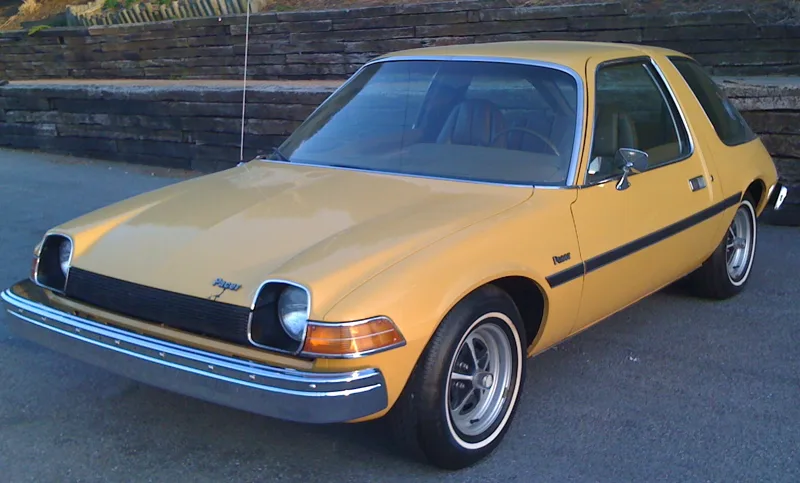
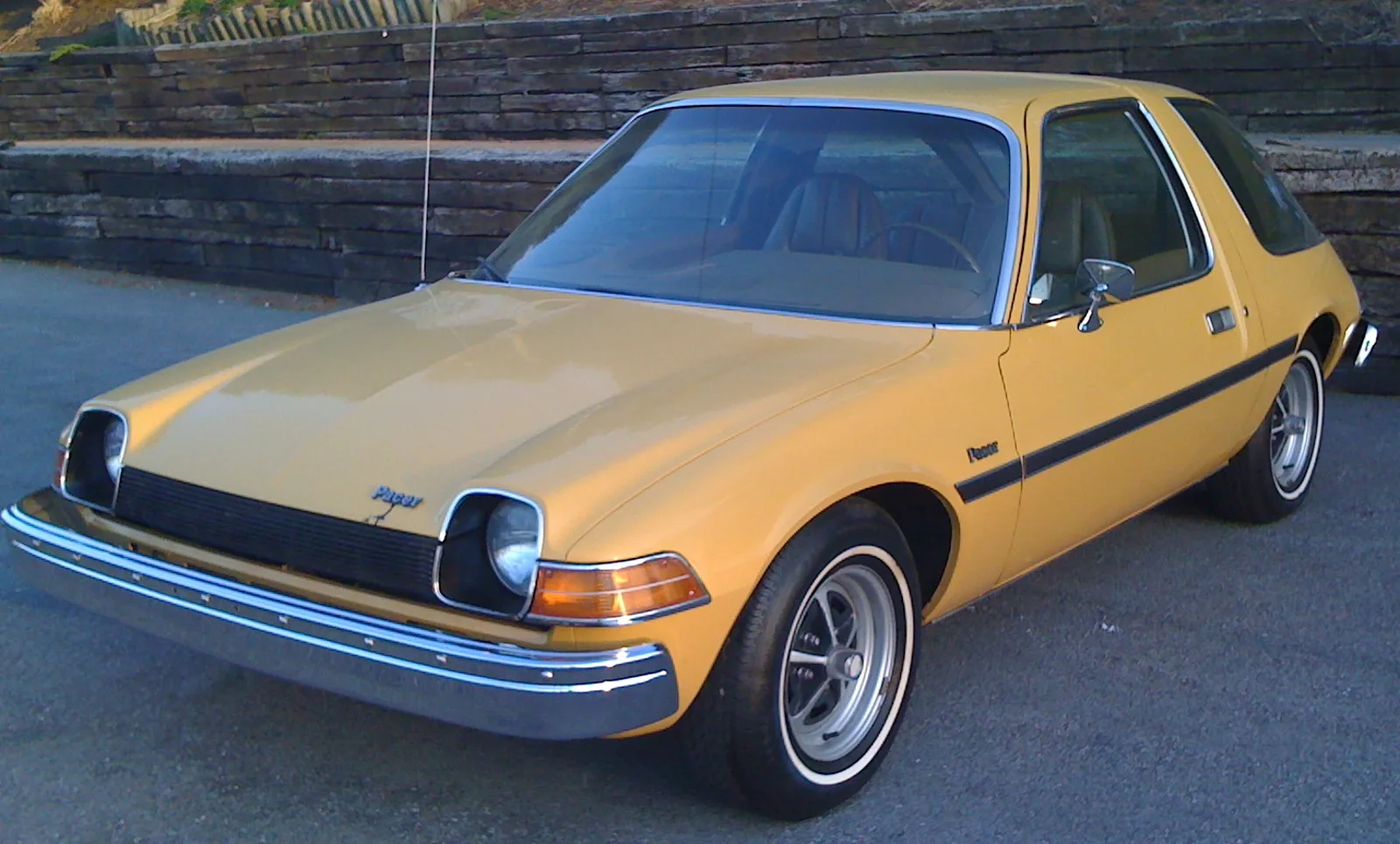
The Pacer had a rounded, jellybean-style body with a very large glass area. Glass made up 37% of the body surface, which measured 5,615 square inches (3.6 m2), and the drag coefficient was 0.43.
Car and Driver gave the car the nickname Flying Fishbowl in May 1976, a label that pointed straight at the big windows. The passenger door was 4 inches (102 mm) longer than the driver's door, a detail that set the body apart from the usual two-door layout.
The body used rounded jellybean styling with a large glass area, and that outline became the car's signature. The soft shape and wide glasshouse made it look unlike its rivals.
What engines did the Pacer offer?
The standard engine was a 232 cu in (3.8 L) straight-six rated at 100 hp (75 kW; 101 PS). Buyers could specify a 258 cu in (4.2 L) six with better mid-range torque, and from 1978 a 304 cu in (5.0 L) V8 became available.
The base engine used a single barrel. The 258 cu in six was also rated at 100 hp, but its mid-range torque was stronger, which made it the more useful choice for everyday driving.
A quench-head design arrived in 1977 to suit unleaded fuel, and it gained 1 mpg in economy. A four-speed manual gearbox was introduced in mid-1976, adding to the range of drivetrains available to buyers.
The Mexican-built cars used different engines. VAM's 282 cu in (4.6 L) six produced 200 hp (149 kW; 203 PS) in 1976, while its 1979 unit was rated at 132 hp (98 kW; 134 PS). The VAM Pacer X in 1979 was estimated at 147-152 hp (110-113 kW; 149-154 PS).
How did the Pacer handle on the road?
Reviewers were divided on the car's driving manners. Popular Mechanics found the rack-and-pinion steering precise, but Road and Track criticised the heavy inline-six and the rear leaf springs. The Pacer was only the second American production car after the Ford Pinto to use rack-and-pinion steering.
The front subframe isolated the cabin from the loads coming from the engine, suspension and steering. AMC presented the Pacer as the first US small car to isolate engine and suspension noise from the cabin.
Did the Pacer come with an electric option?
Yes. EVA produced an electric version called the Change of Pace, which used a 15 kW (20 hp) series DC motor. It had a range of 53 miles (85 km) and cost $12,360 in 1978, and EVA converted over 100 Pacers to electric power in total.
Converting a Pacer meant fitting the motor and related components into a body that was never designed for electric drive, which is part of what makes the conversions interesting. The electric conversions were not limited to private buyers. Consolidated Edison bought 40 modified AMC Pacers from EVA, which shows that the body could carry a very different drivetrain.
How well did the Pacer sell?
The Pacer sold well at launch, with first-year sales of 145,528 units and more than 100,000 cars built in less than eight months. Sales fell after the first two years, and production finally ended in December 1979.
Early output began at 530 cars per day. It rose to 700 by April 1975 and reached 800 per day in September 1975, a rapid ramp for a new model. Output climbed quickly through the first year of production.
VAM's version was a different proposition. Made in Mexico from 1976 to 1979, it was sold as a premium-priced luxury car and used engines that differed from the American line-up. VAM built 619 Pacers in 1979, its last year of production. The car could still be bought new in Belgium as late as 1983, while C.T. Wooler carried out right-hand drive conversions in Britain. AMC had already stopped exporting the Pacer to the UK after poor reviews.
What variants of the Pacer were sold?
The X Package ran on the coupe from 1975 to 1977 and brought vinyl bucket seats and a sports wheel. The Sport Package replaced it in 1978, when D/L also became the base model. Limited trim in 1979 and 1980 added leather seats and deeper carpet.
The Sport Package could be ordered with either the 258 or the 304 engine. A 1975 California package called Sundowner was priced at $3,599, and the Levi's Pacer of 1977 featured denim-like upholstery that set it apart from the rest of the range.
Several concepts explored the Pacer idea further. The Crown Pacer appeared on the 1978 show circuit, while the AM Van was a 1977 three-quarter scale concept with Pacer lines. The AM Van was one of seven vehicles on the Concept 80 auto show tour, and VAM limited its Pacer X to 250 units.
Did the Pacer compete in motorsport?
Yes. A 1976 Pacer finished second in Class 6 at the 1979 SCORE Baja 1000, behind a Ford Ranchero. Modified Pacers also competed in the IMSA GT series, and several specialist builders produced race and show cars based on the car.
Before a radiator impact ended its lead, the car had raced for 21 hours and 20 minutes. That stint kept it in contention for most of the event.
Carl Green built Pacers with 401 cu in (6.6 L) AMC V8s, a much larger unit than the standard six, so those builds moved the car a long way from its production specification. Amos Johnson raced modified Pacers in the IMSA GT series. Centaur was a turbocharged SCCA race prototype built in 1976, while the Pacer Stinger was a 1976 show car with bumblebee stripes. Two Pacer pace cars were built for B.F. Goodrich.
How did critics rate the Pacer?
Critics were broadly positive about the car's visibility, steering and cabin, although its engine and suspension drew complaints. Car and Driver editor Don Sherman called it the first real urban transporter, while Consumer Reports recommended it over the Pinto and Vega.
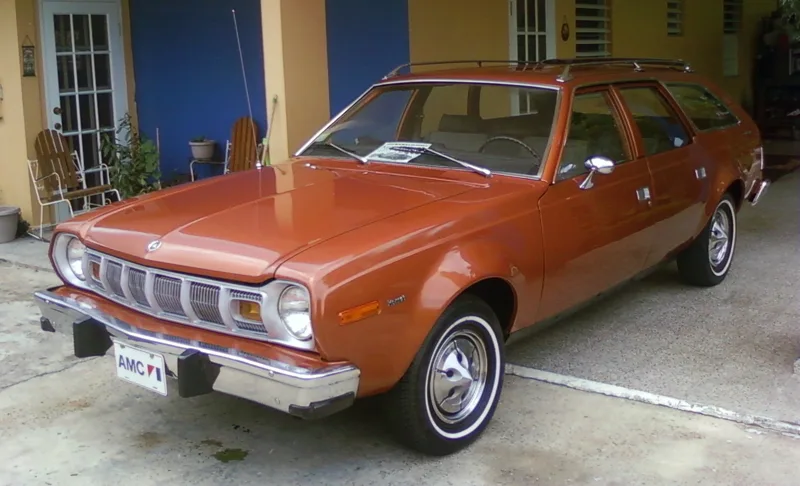
Motor Trend praised the Pacer's visibility and spacious cabin. Reviewers were more divided on the car's looks, but they generally credited its practical strengths. Popular Mechanics went further, calling the 1977 wagon a styling coup and noting how precise the steering felt for a mainstream American car of its time.
What is the Pacer's legacy today?
The Pacer is remembered as a styling oddity that still stands out on any street. Its best-known appearances came in comedy films, which kept the design in front of audiences after production ended.
Coluche drove a Pacer X in the 1976 French film The Wing or the Thigh, and the X trim was the one with vinyl bucket seats and a sports wheel. Wayne's World's Mirthmobile Pacer sold for $37,000 at a 2016 auction, a sign that the car still draws collectors.
Few American compacts of the decade looked as unusual as the Pacer, and that oddity is what most people remember about it. The glass-heavy body and jellybean styling make the Pacer easy to recognise, even for people who never sat behind its wheel. Its legacy rests on that distinctive look rather than on any single engine or sales record.
What were the AMC Pacer specifications?
The AMC Pacer came with a 232 cu in (3.8 L) inline-six rated at 100 hp (75 kW; 101 PS) as standard. It had a drag coefficient of 0.43, a total build of 280,000 cars and first-year sales of 145,528 units.
| Specification | Detail |
|---|---|
| Production | 1975 to 1980, Kenosha, Wisconsin |
| Total built | 280,000 |
| Standard engine | 232 cu in (3.8 L) I6, 100 hp (75 kW; 101 PS) |
| Optional V8 | 304 cu in (5.0 L), from 1978 |
| Drag coefficient | 0.43 |
| Glass area | 37% of body surface |
| Body surface area | 5,615 square inches (3.6 m2) |
| Wagon cargo area | 47.8 cubic feet (1,354 L) |
| First-year sales | 145,528 units |
| Last production day | 3 December 1979 |