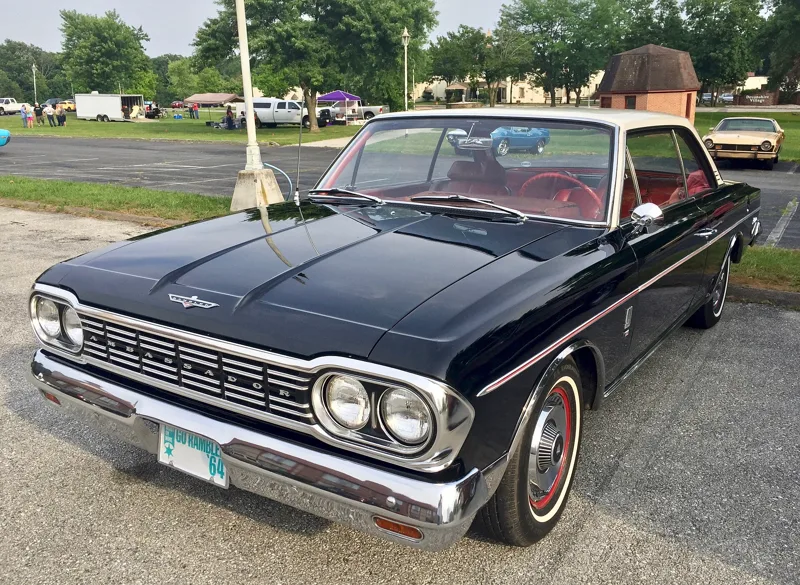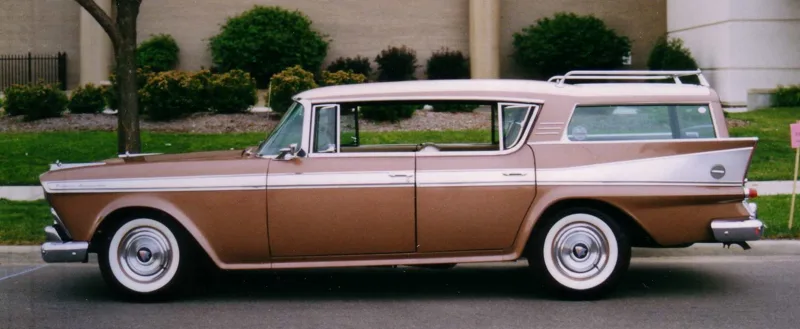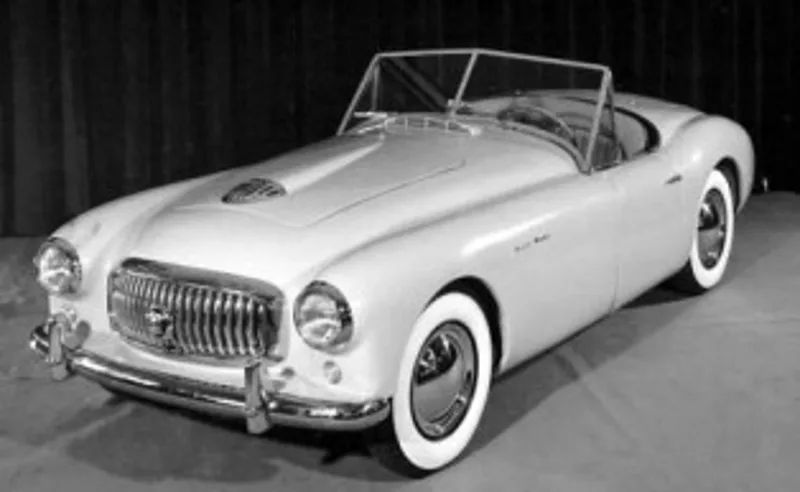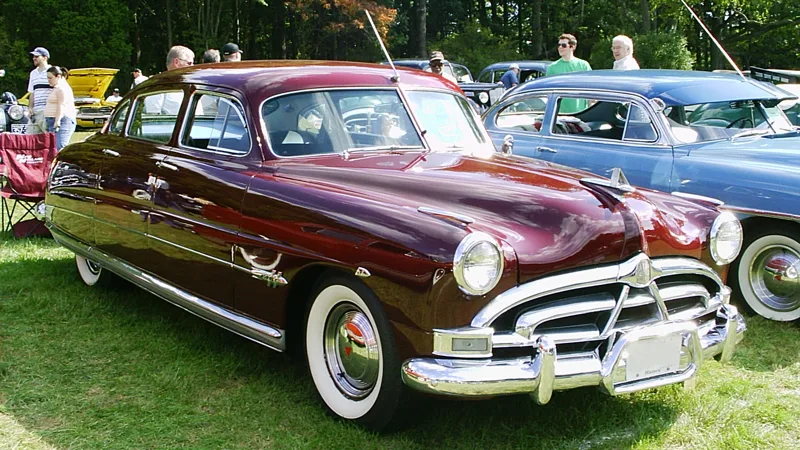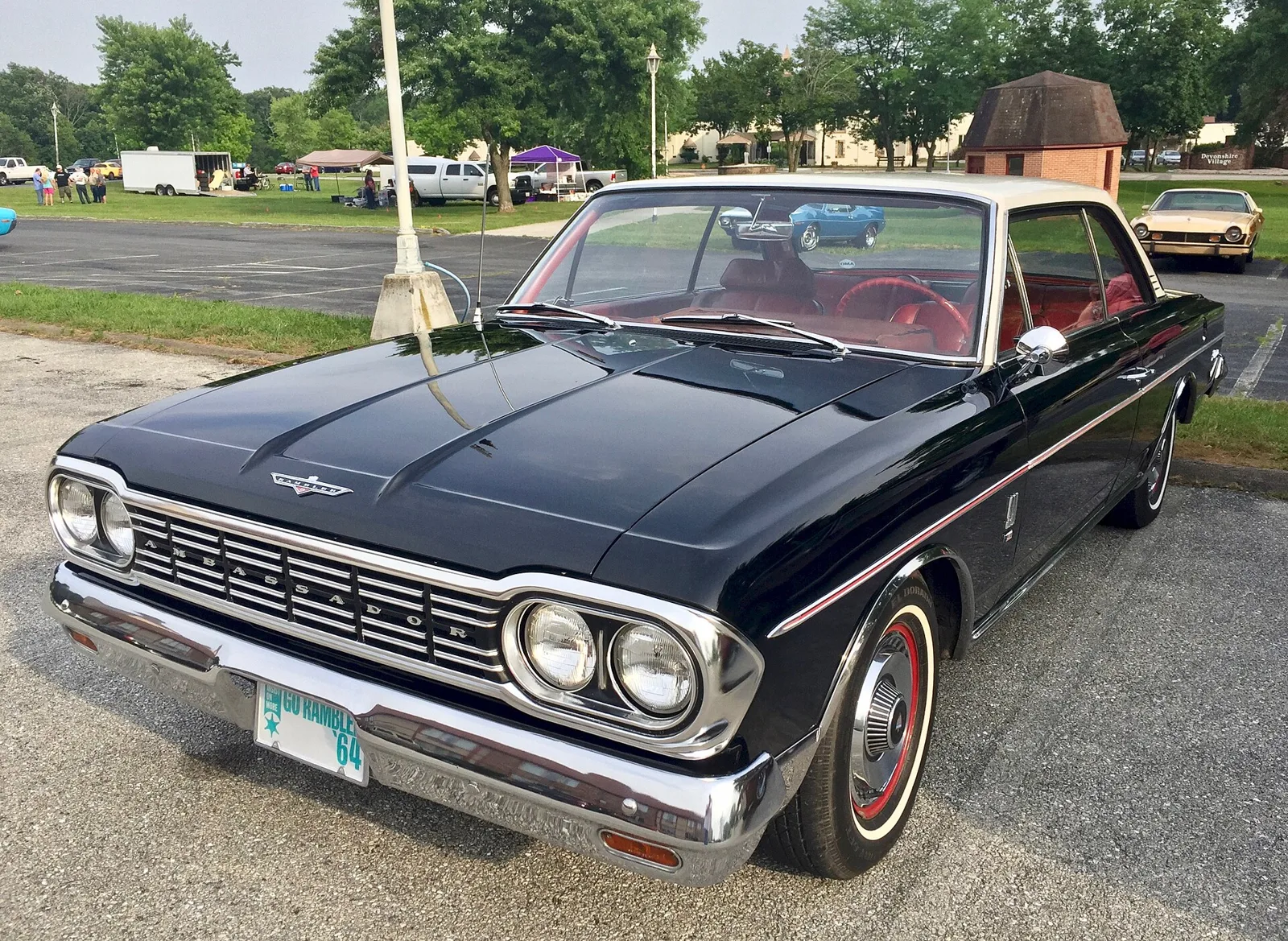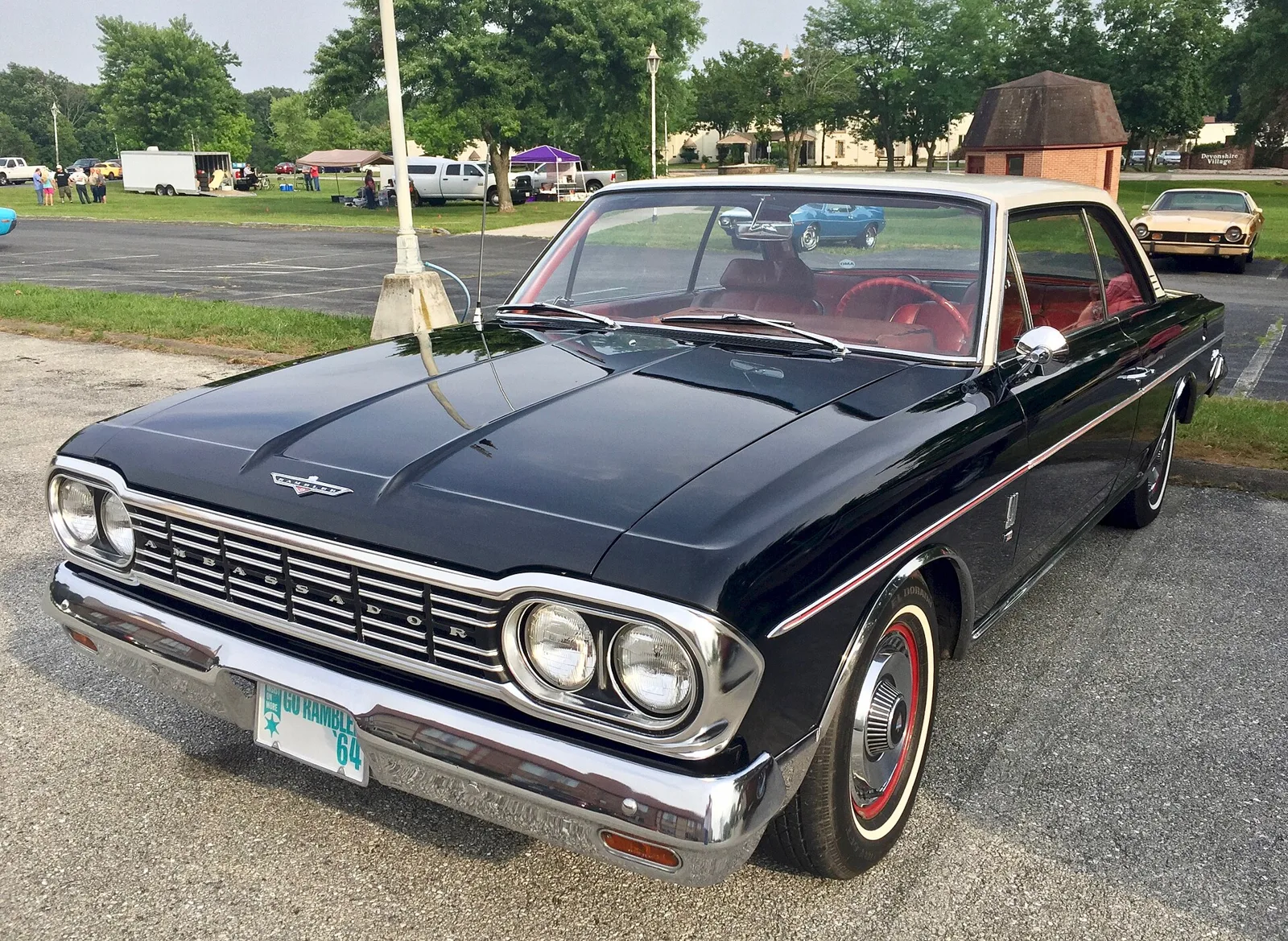
AMC's long-running Ambassador nameplate against Ford's LTD, from the Nash heritage of 1927 to the Panther-platform LTD of 1979.
Two long-running American full-size models, the AMC Ambassador and the Ford LTD, covered different decades. The Ambassador was built from 1957 to 1974 on a name first used in 1927, while the LTD ran from 1965 to 1986 and was downsized in 1979.
The AMC Ambassador and the Ford LTD were each the top car in their makers' ranges, but they came from different eras and different philosophies. The Ambassador was American Motors' flagship for most of its life, sold from 1957 to 1974 on a nameplate that dated back to 1927. The LTD began in 1965 as Ford's top full-size trim and ran until 1986.
The two cars never shared a showroom for long, so the comparison works best as a study of how each maker used a prestige badge. The Ambassador material centres on its 1958 generation, while the LTD material follows the car through several generations and a major downsizing.
Where did each nameplate begin?
The Ambassador name first appeared with Nash Motors in 1927, when it marked a high-trim four-door sedan. The LTD began in 1965 as the luxury trim of the Galaxie 500, which Ford hoped would lift its full-size line above the standard models.
Nash used the name for its premium models through the pre-war years, and by 1932 Ambassador had become a distinct flagship range. Buyers liked its lavish equipment and sturdy build, and the car earned the nickname the Kenosha Duesenberg, since it came from the Wisconsin plant.
Ford's LTD was meant to carry features that had once been reserved for Mercury and Lincoln. Its name never received a full explanation. Suggestions included Luxury Trim Decor and Limited, while Ford Australia later used the reading Lincoln Type Design.
Two flagships from different decades, one a fading AMC prestige name and the other a Ford full-size trim that grew into a family.
How did the AMC merger shape the Ambassador?
American Motors was born in 1954 when Nash-Kelvinator joined with Hudson, and the Ambassador carried on under the Nash brand for a time. George Romney took over after the sudden death of George W. Mason in October 1954, and he steered AMC toward the compact Rambler models.
Romney judged that the big-car market needed volumes that AMC could not reach with two ageing large nameplates. Ambassador sales fell as Rambler grew, with 21,428 built in 1954. Fewer than 3,600 large Nash cars were made in 1957, and the last one rolled off the Kenosha line on 25 June 1957.
Romney then retired the Nash and Hudson names, which cleared the way for a new large Ambassador sold as the Ambassador V-8 by Rambler.
What did the 1958 Ambassador offer?
Management had reasons for the new name. Buyers linked the Rambler badge with small economy cars, so the larger car was branded as an Ambassador V-8 under the Rambler name, borrowing its success while signalling a different kind of vehicle.
The 1958 Ambassador moved to a 117-inch (2,972 mm) wheelbase and a fully reskinned body with a square-rigged look. Its 327 cu in AMC V8 made 270 hp (201 kW; 274 PS), with torque of 360 lb-ft (488 N-m), and a three-speed automatic with push-button selection on the dashboard handled the gears.
The body styles were a four-door sedan, a hardtop, a pillared four-door wagon and a pillarless Cross Country wagon. Standard kit included an electric clock, twin ashtrays, deep coil springs front and rear, and front seats that reclined and folded into a bed.
Set against the smaller Ramblers, the Ambassador carried nine extra inches (230 mm) of wheelbase ahead of the cowl, which left its passenger space the same size as the cabins of the cheaper cars.
Performance was lively for its era, and the car could reach 60 mph (97 km/h) from rest in under 10 seconds, with a quarter mile in about 17 seconds. Buyers could add a limited-slip differential, power brakes, steering assistance, power windows and air conditioning.
How did AMC's own V8 arrive?
AMC built its first V8 in 1956, a 250 cu in (4.1 L) unit with a 3.25-inch stroke and a forged steel crankshaft, giving 215 hp (160 kW; 218 PS) through a four-barrel carburetor. For 1957 it was bored out to 327 cu in (5.4 L). That 327 arrived years ahead of Chevrolet's own 327 engine, despite the shared displacement.
The Rambler Rebel version of that 327 relied on solid lifters and Bendix electronic fuel injection, which lifted output to 288 hp (215 kW; 292 PS). The Ambassador's 1958 unit was the hydraulic-lifter version.
Before its own engines, the Ambassador had gained a Packard-supplied V8 and Packard's Ultramatic automatic transmission in 1955, a sign that AMC then leaned on outside suppliers for its big-car drivetrains.
How did the Ambassador change in its last full-size years?
The 1955 facelift gave the Ambassador wrap-around windshields, a new oval grille with integrated headlights and front fenders with wheel arches that exposed more of the tyres. The 1956 restyle added a V-line theme and a choice of two- and three-tone paint schemes.
The 1957 Ambassador was among the first cars with quad headlights as standard equipment, stacked vertically within the front fender pontoons. Its standard engine was AMC's own overhead-valve V8, which had grown to 327 cu in (5.4 L).
Trim levels also sorted the range. Super models had painted side trim matching the body colour, while Custom sedans had a silver anodised aluminium panel and Custom wagons carried vinyl woodgrain decals.
What changed in the LTD's first generation?
The 1965 LTD arrived as a luxury option inside Ford's full-size range, sold as a two-door and a four-door hardtop with plush cloth interiors, woodgrain accents and contoured seats. Power windows, a power driver's seat, air conditioning and a Landau or Brougham roof were available.
Rivals responded quickly. Chevrolet introduced its Caprice mid-year, AMC answered with the Ambassador DPL in 1966, and Plymouth and Dodge answered with the Fury VIP and the Monaco.
In 1966 Ford removed the Galaxie name from the LTD, and in 1967 a four-door pillared sedan joined the line-up. Federal safety rules brought a padded steering hub and a dual-circuit brake master cylinder that year, and the hidden headlamps introduced in 1968 marked the top-trim LTD until 1971.
How did the LTD grow through the 1970s?
The second generation arrived for 1969 with a largely carried-over chassis and a wheelbase two inches longer. Across 1969 to 1978, roughly 7,850,000 full-size Ford and Mercury cars found buyers, making the platform the second best-selling Ford after the Model T.
Powertrains became V8-only across the full-size line, starting with a base 302 cid and rising through a 351 and a 400 to a 429, which gave way to a 460 for 1974.
Police packages were a special feature. The 1973 to 1978 LTD Police Interceptor used a 460 rated at 260 net hp, and the figures given for it include 0-60 mph in about eight seconds and top speeds above 135 mph.
Ford's advertising for the 1977 LTD II set it side by side with the Cadillac Fleetwood Brougham, a flagship sedan that GM had just downsized. The LTD II arrived in 1977 as a restyled Torino, offered as a smaller alternative to the full-size car, and it was dropped after 1979 without a direct replacement in that size.
Why did the LTD downsize in 1979?
General Motors had shrunk its full-size cars for 1977, and Ford answered with the Panther platform for the 1979 LTD. The new car lost roughly 15 inches from its body and 7 inches from its wheelbase, and it shed more than 700 pounds of curb weight.
Lincoln introduced its downsized Continental for 1980, which made it the last brand to shrink its full-size cars. Ford's Panther cars shared the rear-wheel drive layout and a completely new chassis rather than a rebodied older design.
The LTD remained a full-size car, but with trimmer body lines and better fuel economy to meet CAFE standards. Interior and trunk space grew despite the smaller outside dimensions.
Engine choices shifted as well. The 302 stayed standard with a 351 optional, while a 4.2-litre V8 became standard for 1981 at only 115 hp, the lowest rating for a Ford V8 since the 1953 Flathead.
| Feature | AMC Ambassador | Ford LTD |
|---|---|---|
| Years built | 1957 to 1974, eight generations | 1965 to 1986 |
| Size class | Full-size 1957-1961; mid-size 1962-1966; full-size 1967-1974 | Full-size top trim; LTD II mid-size 1977-1979; mid-size from 1983 |
| Body styles | Sedans, hardtops, station wagons, convertibles | Hardtops, pillared sedans, convertible, five-door wagon |
| Notable engine | 327 cu in V8 at 270 hp (1958) | 460 Police Interceptor at 260 net hp (1973-1978) |
| Notable figure | 0-60 mph in under 10 seconds (1958) | Roughly 7,850,000 full-size Ford and Mercury cars, 1969-1978 |
| Standing | Flagship of AMC; nameplate used from 1927 to 1974 | Top full-size trim; largest Ford vehicle for three generations |
| Ended | 1974 | 1986, replaced by the front-wheel drive Taurus |
Which buyer would each car suit?
The Ambassador's facts favour a buyer who wanted a big V8 family car with generous equipment and a long pedigree. The 1958 car offered a 117-inch wheelbase, a lively V8 and options such as power steering and air conditioning.
For the LTD, the picture points to a shopper after a luxury trim within a wide full-size range, offered across several body styles and decades. Later Panther-platform cars added a lighter, more efficient design for buyers worried about fuel economy.
Both cars also show how a flagship badge could stretch across trims. The Ambassador ran from a top Nash trim to a Rambler-branded flagship, while the LTD ran from a Galaxie trim to a family of models.
Neither set of facts settles which car was better overall, because they cover different decades and different slices of the same segment.
How do the sales figures compare?
The LTD's later Panther-platform years carried a clear theme: a full-size car that was smaller outside yet more spacious inside, which suited families and fleet buyers alike.
The Ambassador's sales are only recorded for 1954, when 21,428 were built, while the LTD's platform totals run across a decade. That gap in the record makes a direct sales race impossible to call.
What can be said is that the LTD sat inside a much bigger Ford operation, while the Ambassador was AMC's most prestigious car at a time when the company was shrinking its big-car effort. Both cars, in other words, were flagship answers to the same full-size question.