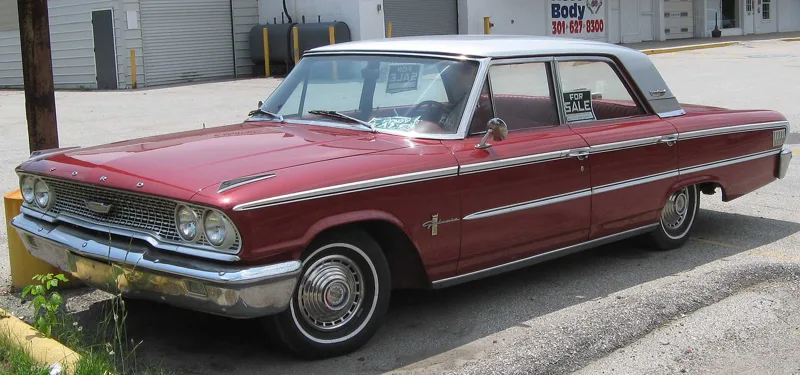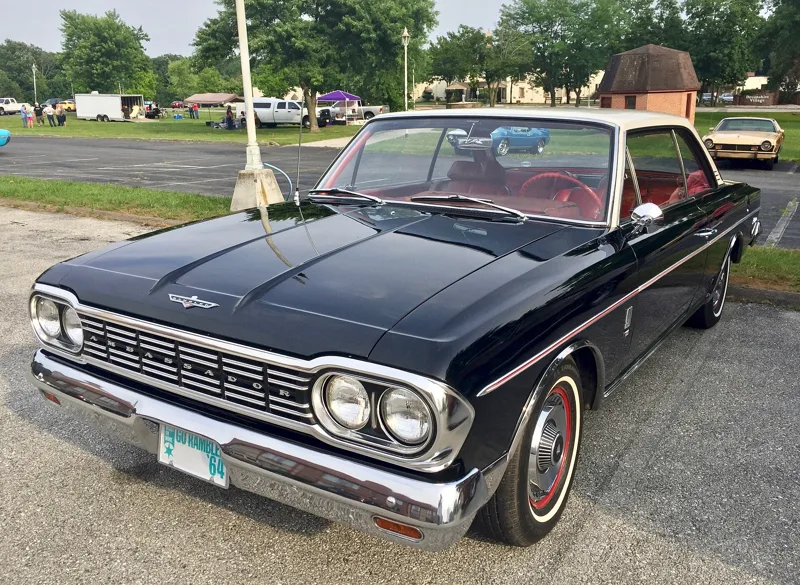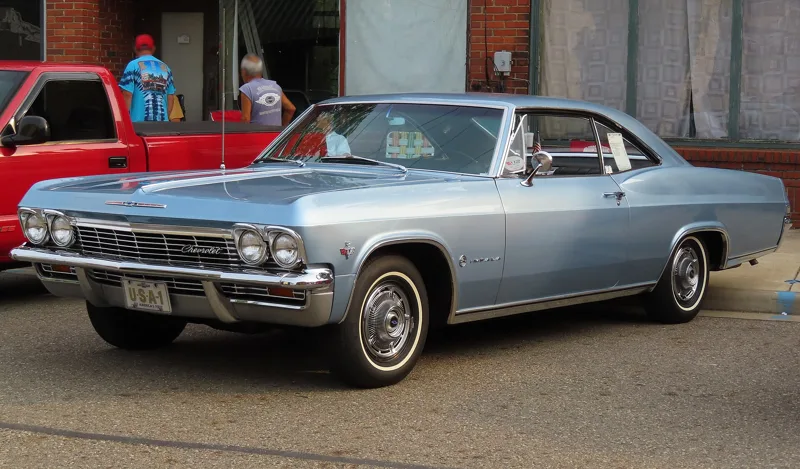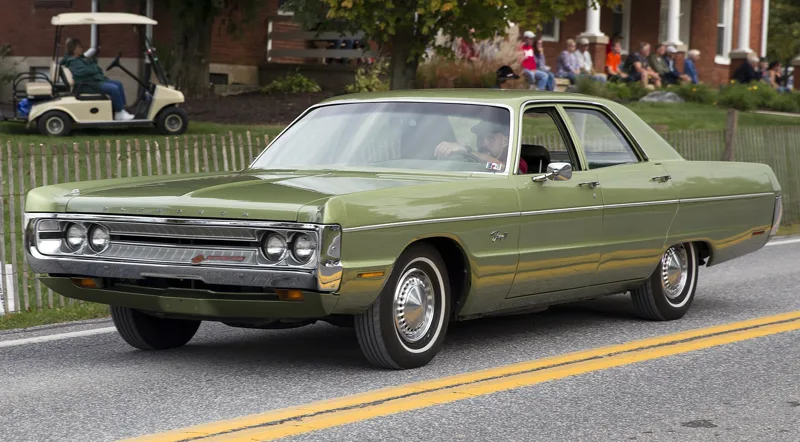
AMC's Ambassador carried a Nash name back to the 1920s, while Plymouth's Fury grew from a Belvedere trim level into a full-size luxury car.
The AMC Ambassador was the flagship of American Motors, carrying a Nash name from 1927 to 1974. The Plymouth Fury began as a 1956 Belvedere sub-series and ran until 1989, and the two met in the sixties as luxury full-size rivals.
AMC's Ambassador and Plymouth's Fury were both big, comfortable cars built for family buyers who wanted more than a basic sedan. They had different ancestry and different ambitions. The Ambassador was AMC's flagship, a name with roots in the Nash range going back to the 1920s. The Fury began as a sub-series of the Plymouth Belvedere and grew into one of the Chrysler group's leading full-size cars.
Why were the Ambassador and Fury rivals?
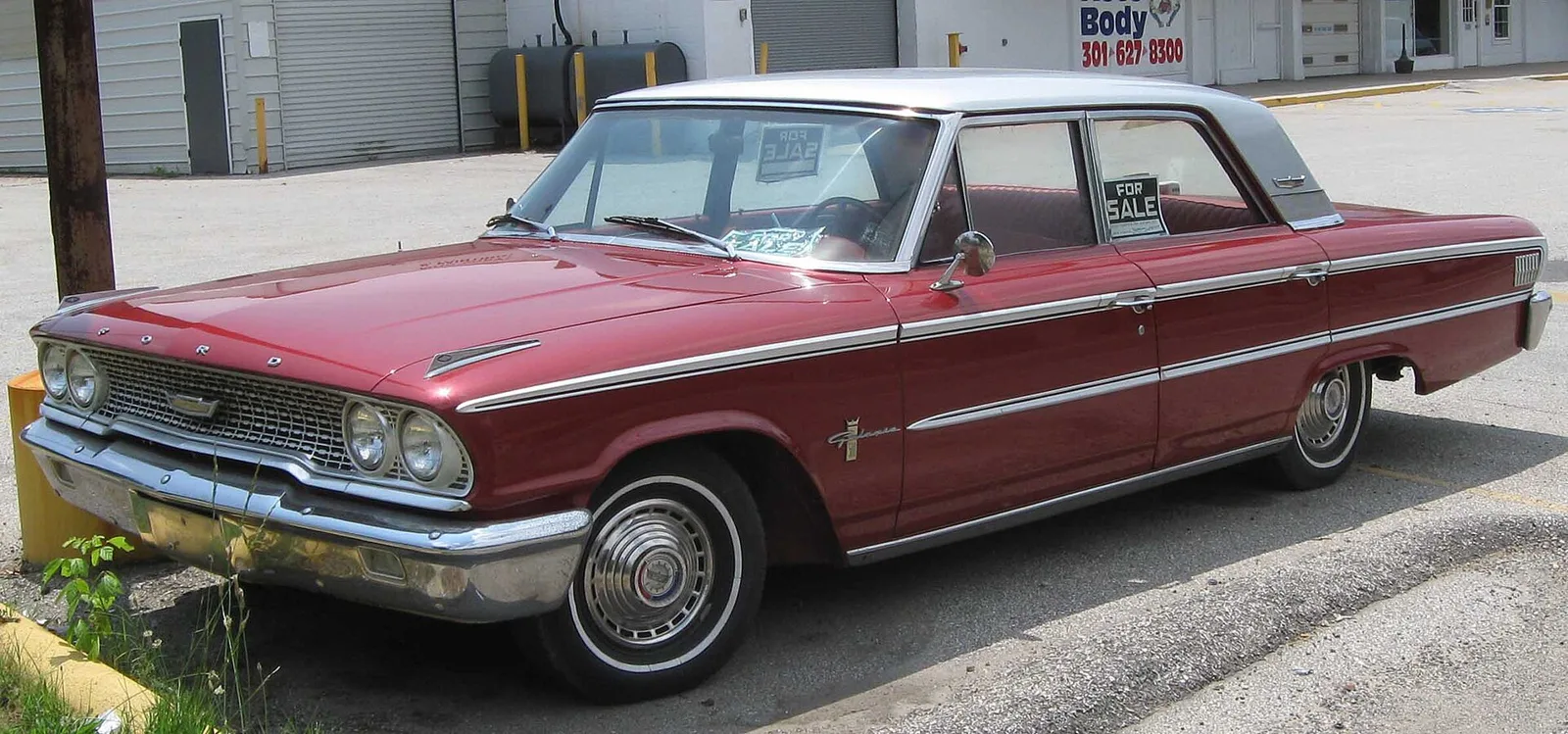
In the middle of the sixties the Ambassador and the Fury were both positioned as luxury family cars. The 1966 Plymouth VIP was launched in response to the Ford LTD, the Chevrolet Caprice and the AMC Ambassador DPL, while the Fury's sporting models were set against the Impala and Galaxie sporty versions.
Both makes were built around a full-size body for much of their lives, and both were pitched as roomy, comfortable and well equipped. The rivalry was less about speed than about showroom appeal, with carpet, woodgrain and an upmarket interior doing much of the work.
One car was a Nash name grown into a flagship, the other a Belvedere trim level that became a full-size luxury car, and both were built to keep up with the big sedans.
How did the Ambassador's name come from Nash?
The Ambassador name was first used by Nash Motors in the 1927 model year, when it denoted a specially appointed four-door sedan. By 1932 it had become the flagship of the Nash range, and the nameplate went on to last until 1974, making it the longest continuously used car name until then.
Pre-war Ambassadors were known for lavish equipment and sturdy construction, and the Wisconsin factory gave them the nickname the Kenosha Duesenberg. Competitors in the 1930s included Packard, Lincoln and Duesenberg itself. After the war, the Ambassador adopted the Airflyte styling, and the first Nash to carry stacked quad headlamps was an Ambassador.
After the 1954 merger with Hudson, AMC kept Nash as a brand for a time. The final Nash Ambassador left the Kenosha line on 25 June 1957, and George Romney went on to drop both the Nash and Hudson names to concentrate on the Rambler.
How did the Fury start out?
Plymouth built the Fury between 1955 and 1989. Its first year was 1956, when it sat as a sub-series of the Belvedere, and for 1959 it became a separate series one level above the Belvedere. The Fury was a full-size car from 1959 to 1961 and again from 1965 to 1974, with a mid-size interlude in between.
The early Furys were limited and luxurious. From 1956 to 1957 they came as sandstone white two-door hardtops with gold anodised aluminium trim, and in 1958 the colour changed to buckskin beige. They had special interiors, bumper wing-guards and V8 engines with twin four-barrel carburettors.
The 1957 Fury was restyled with very large tailfins and a torsion-bar front suspension, shared with Chrysler's other models from 1957. Quality problems came with the speed of the new cars, which reached the market before engineering could fully address their weaknesses.
Ambassador and Fury compared on paper
| Specification | AMC Ambassador | Plymouth Fury |
|---|---|---|
| Production years | 1957 to 1974, eight generations | 1955 to 1989 |
| Origin | Nash Motors Ambassador name from 1927 | Plymouth Belvedere sub-series from 1956 |
| Size classes | Full-size 1957 to 1961; mid-size 1962 to 1966; full-size 1967 to 1974 | Full-size 1959 to 1961; mid-size 1962 to 1964; full-size 1965 to 1974 |
| Body styles | Sedans, hardtops, wagons and convertibles | Two- and four-door hardtops, sedans, wagons and convertibles |
| Early V8 | 250 cu in AMC V8, 215 hp (160 kW), from 1956 | 318 cu in V8 with twin four-barrels, 290 hp (216 kW), 1957 and 1958 |
| Larger V8 | 327 cu in, 270 hp (201 kW), 360 lb ft, 1958 | 350 cu in Golden Commando, 305 hp (227 kW), 1958 |
| Performance | 0 to 60 mph in under 10 seconds; low 17-second quarter-mile | not given |
| Luxury variant | Ambassador DPL in 1966 | Plymouth VIP, 1965 to 1966 |
| Build locations | Kenosha, Wisconsin; Brampton, Ontario; IKA in Argentina | Kenosha, Wisconsin, through 1988 |
| End | 1974 | Last V8 rear-drive Fury built 23 December 1988 |
How did the Ambassador change before 1958?
The Ambassador was a Nash in its early postwar years, and 21,428 were built in 1954, the year of the merger. The 1955 facelift, under Edmund E. Anderson, brought a wraparound windshield and an oval grille with integrated headlamps, and the Ambassador gained the first V8 offered by the company, a Packard unit with an Ultramatic automatic.
The 1956 cars were restyled with a V-line theme and two- and three-tone colour schemes, and AMC's own 250 cu in V8 arrived in April of that year. The line had been streamlined, and fewer than 3,600 large Nash cars were built in 1957 before the last one left Kenosha on 25 June.
What did the Ambassador V-8 bring in 1958?
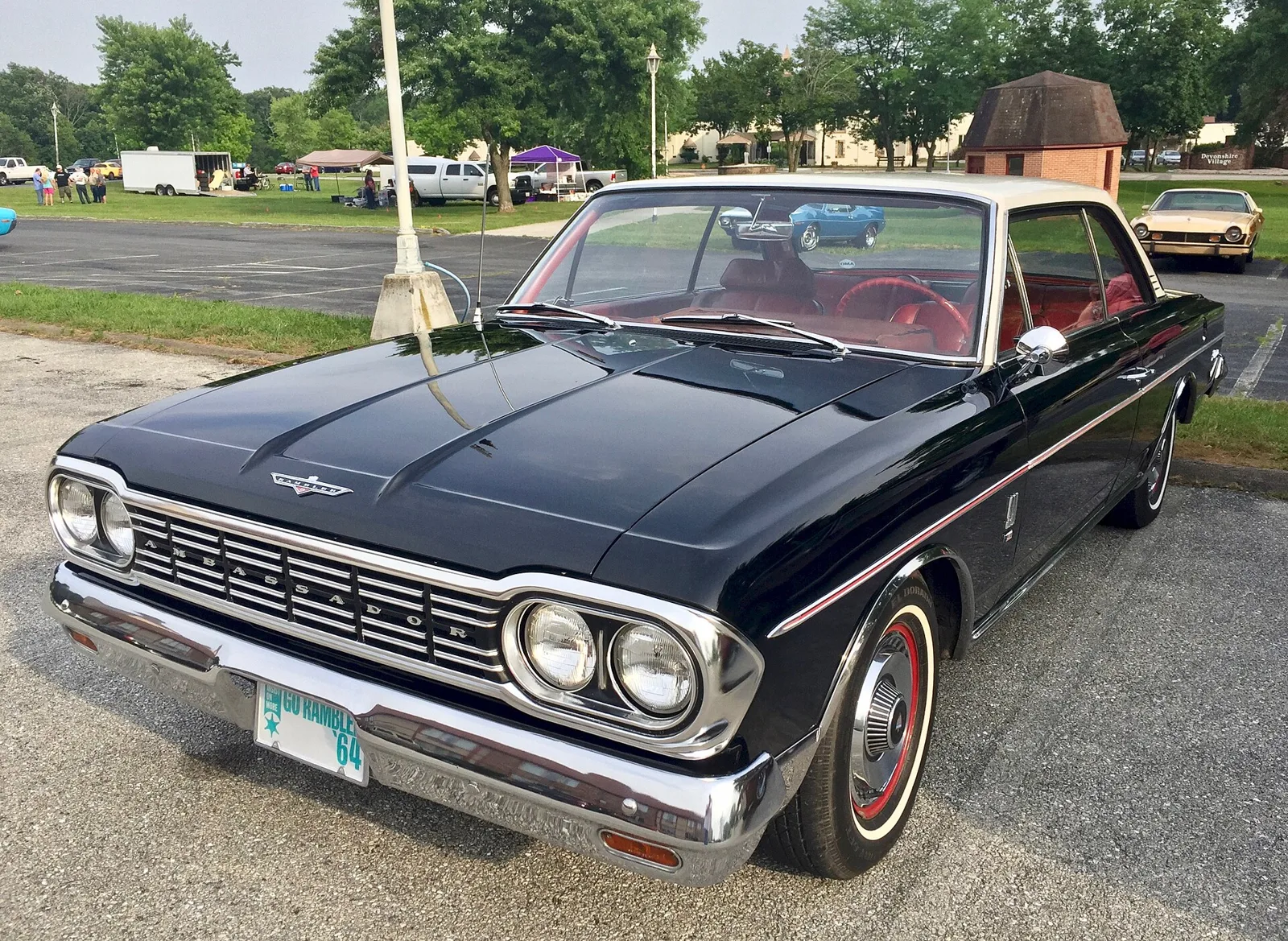
For 1958 AMC introduced the Ambassador V-8 by Rambler, riding on a 117 in (2,972 mm) wheelbase after a full reskin with squarer surfaces. Its engine was the 327 cu in AMC V8 with a four-barrel carburettor and dual exhausts, rated at 270 hp (201 kW) and 360 lb ft, mated to a three-speed automatic with push-button selection on the dash.
AMC wanted the larger Ambassador to avoid being associated with the Rambler's economy image, so the car carried Rambler Ambassador badges. The body styles were a four-door sedan, a hardtop, a pillared wagon and a pillarless Cross Country wagon, a style that had been an industry first on the 1956 Ramblers.
The Ambassador was longer than the Rambler Six and Rebel V8, but its extra length sat ahead of the cowl, so the passenger compartment kept the same volume as the smaller cars. Its performance was spirited for its time, with 0 to 60 mph under 10 seconds and quarter-mile runs in the low 17 seconds.
What engines did the Fury use in its early years?
The Fury's 1957 and 1958 318 cu in V8 produced 290 hp (216 kW) and was shared with the Dodge Coronet. In 1958 the optional engine was a 350 cu in big-block called the Golden Commando, with two four-barrel carburettors and 305 hp (227 kW). A 315 hp fuel-injected version was offered, but the factory recalled the Bendix system and gave owners a conventional dual four-barrel instead.
In 1959 the 350 gave way to a 361 cu in Golden Commando with two- or four-barrel carburettion. The dual four-barrel 318 was also introduced that year, and a V-800 Dual Fury designation went with it.
Chrysler's 1965 full-size Fury returned to the C-body platform and rode on a 119 in (3,023 mm) wheelbase. The 426 street wedge V8 arrived that year with 385 hp (287 kW), and it was finally legal for the street. The 1967 model year then ended the 318 cu in V8 in favour of the lightweight LA engine, which kept the same advertised figure with more power and less weight.
How did the Fury's full-size 1965 range work?
In 1965 the Fury came in Fury I, Fury II and Fury III trim, with the Sport Fury as the top model. The Sport Fury was aimed at the Chevrolet Impala Super Sport and the Ford Galaxie 500 XL, with a sportier interior and exterior trim package.
Full-size Furys offered automatic transmissions, power steering, white sidewall tyres with full wheel covers, stereo radios, vinyl roofs and air conditioning. The Fury II was a two-door hardtop only in Canada, while in the United States it came only as a sedan or a station wagon.
The grille lost its chrome, and the car gained two vertically stacked headlights on each side. All of the 1965 Furys rode on the new 119-inch wheelbase, and the wagons on 121 inches.
How did the Plymouth VIP compete with the Ambassador DPL?
Plymouth introduced the VIP, a plush luxury Fury, as a direct answer to the Ambassador DPL and its other luxury rivals. It first appeared in the autumn of 1965 as a four-door hardtop, and in early 1966 a two-door hardtop joined it. The company's own description was very important Plymouth.
The VIP had plush upholstery, contoured door panels with ample woodgrain trim and VIP emblems, and fender skirts as standard. Although it was really an upgraded Fury III, it was marketed as a separate model. It used the 318 cu in V8, with a three-speed manual available, though most buyers chose the TorqueFlite automatic.
The VIP ran from 1966 until 1969, when it was discontinued. In that time it gave Plymouth a direct answer to the Ambassador DPL, though the Ambassador held the flagship role for AMC for longer.
How did the Fury change in the late sixties?
For 1967 the Fury received a sharper, more angular body, with stacked quad headlight bezels set more deeply and a longer roofline. A new formal two-door hardtop, the fast top, had smaller rear quarter windows and a wider, back-slanted C-pillar. The 1967 cars also brought dual-circuit brakes and energy-absorbing steering columns to meet new safety rules.
The 1968 Furys received only minor grille updates, side marker lamps and shoulder belts for the front outboard occupants. Most of the rear sheet metal changed, and the Suburban name returned to the wagons.
In 1970 the Fury gained Chrysler's round-sided Fuselage Look, a year after the lead models. The Sport Fury GT used the 440 cu in engine, which in 1970 could be ordered with three two-barrel carburettors that produced 390 hp, and the base 440 made 350 hp (261 kW).
Where were the Ambassador and Fury built?
The car was made in Kenosha, Wisconsin, up to 1974, and also at Brampton in Ontario from 1963 to 1966. Australia's AMI put together right-hand-drive Ambassadors from kits between 1961 and 1963.
The fifth-generation Ambassador was made by Industrias Kaiser Argentina in Cordoba from 1965 to 1972, and ECASA in Costa Rica assembled it from 1965 through 1970. Planta REO built the first-generation car in Monterrey, Mexico. Later Ambassadors were stretched into limousines in Argentina and the United States.
The Fury's home was the Kenosha plant as well, and it ran there until the last rear-drive V8 car was built in December 1988.
What became of the Ambassador and the Fury?
The Ambassador nameplate ended in 1974, when it had been in use for almost half a century. Its later generations were built at Kenosha and in Argentina, where Industrias Kaiser Argentina produced the fifth generation from 1965 to 1972.
The Fury carried on. In 1972 it gained the Fury Gran Coupe and Gran Sedan, which later became the Plymouth Gran Fury. From 1975 to 1977 the Fury was a mid-size car again, sold alongside the full-size Gran Fury, and in 1980 the R-body Gran Fury filled the gap left by the Fury's departure from the full-size range.
The last V8, rear-drive Plymouth Fury was built at the Kenosha Main assembly plant on 23 December 1988, bringing the model to an end after more than three decades. Plymouth did not see the return of a large V8 rear-drive sedan.