A sport luxury Chrysler from 1939 that carried the 331 cu in Hemi in 1951, raced in Mexico and Le Mans, and returned as a rebadged Dodge in Europe.
The Saratoga was a Chrysler sport luxury model that began in 1939 with the New Yorker's straight-eight. It was named after Saratoga Springs, New York, and used the 331 cu in Hemi V8 from 1951, a year when it carried the new engine into competition.
The Chrysler Saratoga was a sport luxury car that Chrysler sold in the United States from 1939 to 1952 and again from 1957 to 1960. It carried the 331 cu in Hemi V8 that Chrysler introduced in 1951, and it survived in Canada until 1965 and in Europe as a rebadged Dodge Spirit from 1989 to 1995.
Where did the Saratoga name come from?
The name comes from Saratoga Springs, New York, home of the Saratoga Race Course, a thoroughbred racing track. Chrysler introduced the Saratoga in 1939 as a sport luxury model one year after the New Yorker, using the same Straight Eight engine.
Chrysler's sporting heritage was not new. The company had entered a Chrysler Six at Le Mans in 1925, and the Saratoga was pitched as a sporting luxury car with leather and Bedford cord upholstery and an optional sun roof.
The Saratoga put Chrysler's Hemi into a sporting luxury car, and the Hemi's first season was its finest.
How was the 1939 Saratoga priced and equipped?
The 1939 Saratoga shared a 125 in (3,175 mm) wheelbase and a 323.5 cu in (5.3 L) Straight-8 with the New Yorker and Imperial. It came as a Club Coupe at US$1,495 or a four-door sedan at US$1,443, and it was Chrysler's second most expensive model at launch.
The 1940 models moved to a 128.5 in (3,264 mm) wheelbase, and the Saratoga became a sedan-only trim. It came in two interior setups, a standard one and a sport formal version with a glass privacy partition in the front seat back.
Fluid Drive reached the range in 1940, mated to a three-speed manual with overdrive. In 1941 the Saratoga was demoted to the bottom of the eight-cylinder series, with a wider choice of body styles that included a business coupe, a club coupe and a six-window sedan.
How did the Saratoga fare after the war?
The Saratoga returned in 1946 with an average price of US$1,826, and 1,544 cars were built that year. By 1948 production had risen to 2,121, the average price had reached US$2,244, and Chrysler began building the car at its Maywood, California factory.
The 1946 car shared the longer wheelbase of the Windsor and offered the New Yorker's body styles. It had a die-cast grille shared with all Chryslers, pile fabric or broadcloth upholstery, rubber floor covering for the front passengers and an illuminated trunk.
In 1949 the new Second Series Saratoga had a 131.5 in (3,340 mm) wheelbase and the 323.5 cu in straight-eight of the New Yorker. Production that year was 2,275 cars at an average list price of US$2,461, and output dropped to 1,300 cars in 1950.
What made the 1951 Hemi Saratoga special?
The 1951 Saratoga carried the 331 cu in Hemi V8 with 180 hp on a shorter 125.5 in (3,188 mm) wheelbase, shared with the Windsor. Hydraguide power steering, an industry first, was optional, and 34,806 cars were built that year.
| Specification | 1951 Saratoga |
|---|---|
| Engine | 331 cu in (5.4 L) Hemi V8 |
| Power | 180 hp |
| Wheelbase | 125.5 in (3,188 mm) |
| Power steering | Hydraguide, optional, an industry first |
| Transmission option | Fluid Torque Drive, a true torque converter |
| Brakes | Power drum brakes standard with V8 engines |
| Production | 34,806 cars |
Chrysler's Hemi put the Saratoga in the same performance league as the Oldsmobile Rocket 88, and the Saratoga was regarded as the quicker car. The lightest body style, the two-door Club Coupe, became the choice for road racing and stock car competition.
The 1951 model year also added a wagon and an eight-passenger sedan with forward-facing jump seats, though most buyers chose six-passenger four-door sedans.
How did the Saratoga perform in racing?
In 1951 a Saratoga driven by Bill Sterling finished third in the Carrera Panamericana behind two Ferraris, and Mercury Marine ran two Saratogas in the race in 1951 and 1952. The Cunningham C-2R, powered by the Hemi, also debuted at the 1951 24 Hours of Le Mans.
The Carrera Panamericana was a cross-country rally from the northern to the southern border of Mexico. Speeds in some segments approached 110 miles an hour, and one Saratoga recorded the fastest average in a segment.
Mercury Marine was owned by Carl Kiekhaefer, and it raced a pair of Saratogas in both years. Chrysler's racing history went back to the 1925 Le Mans entry, and the Hemi's success on the track fed its reputation on the street.
What happened when the Saratoga returned in 1957?
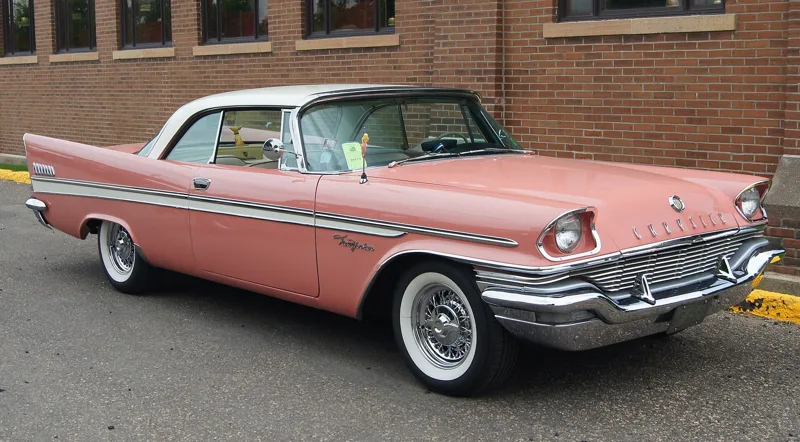
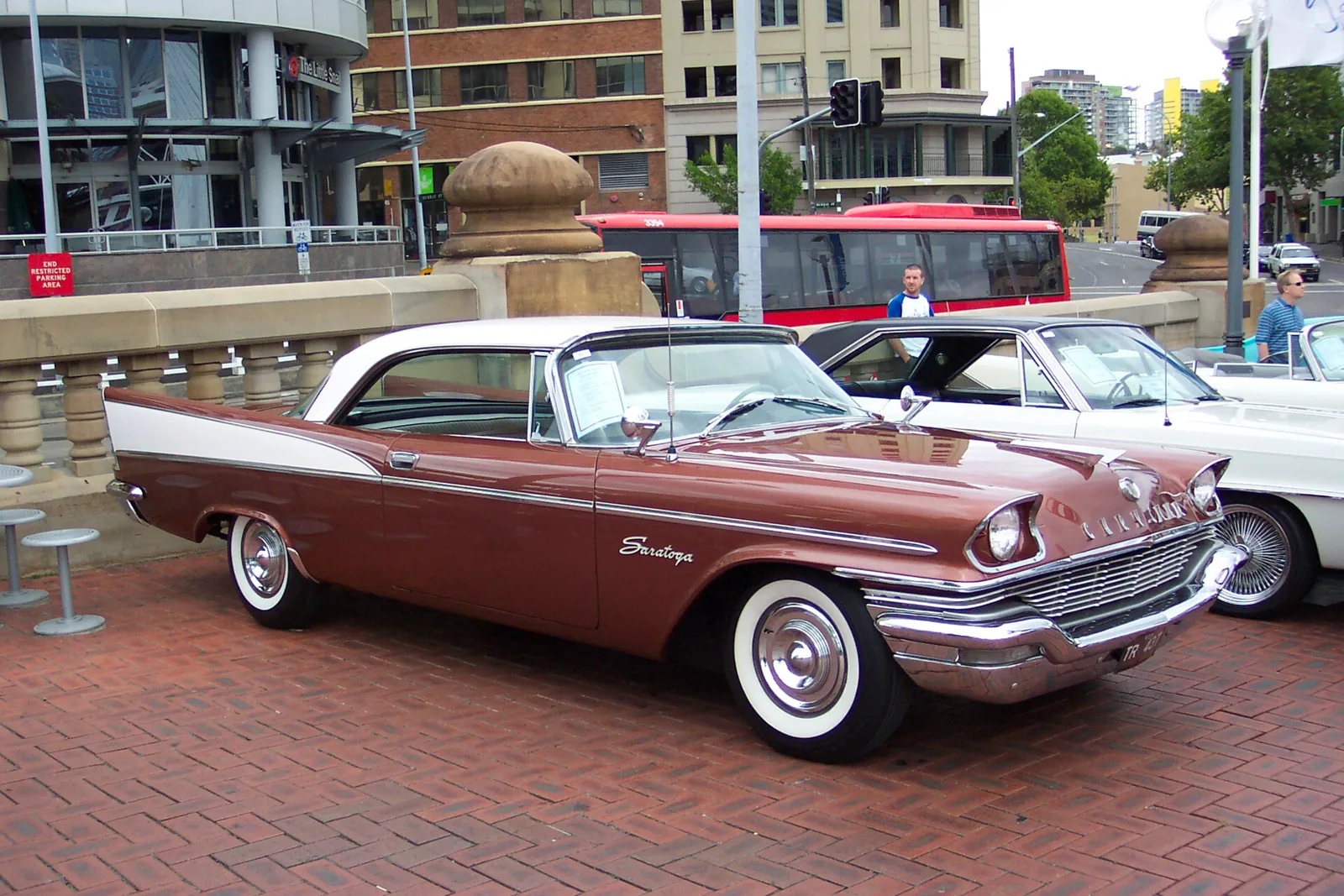
The Saratoga came back in 1957 with the Forward Look styling and a 354 cu in Poly V8, with a 392 cu in Hemi as an option. Production was 37,196 that year, and the average list price was US$3,768.
The Saratoga stayed between the entry-level Windsor and the top New Yorker models. In 1958 it kept a 126-inch wheelbase on the New Yorker body, offered as a four-door sedan, four-door hardtop and two-door hardtop coupe.
The 1960 Saratoga was based on the New Yorker body shell, less the New Yorker trim, and 15,525 were built in its final US year. The nameplate then disappeared from the American line until 1965 in Canada.
Did the Saratoga live on in Canada?
The Saratoga remained in production in Canada until 1965, when it was the last North American Saratoga. In Canada the 1957 and 1958 cars were sold as Windsors, and from 1959 the Saratoga name returned to the Canadian line.
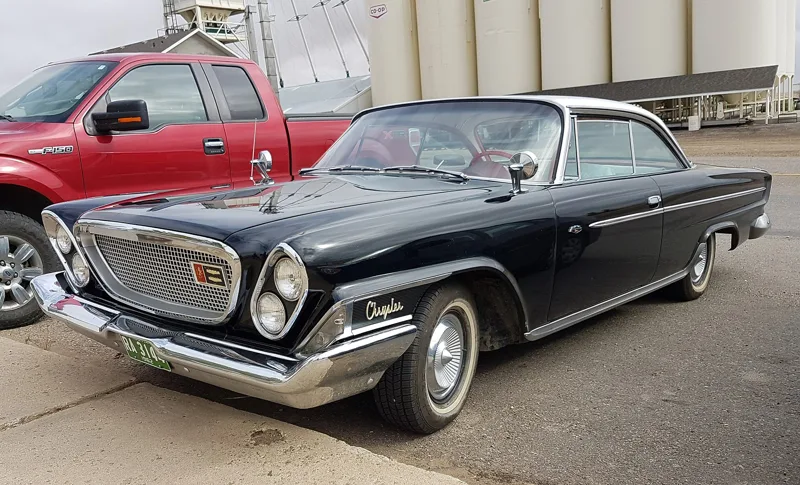
The 1961 Saratoga was basically the US Windsor with Saratoga nameplates on the 122-inch wheelbase. From 1963 the Canadian cars used 300 nameplates and the styling of the US 300, and the 1965 cars were identical to the US 300.
How did the Saratoga name return in Europe?
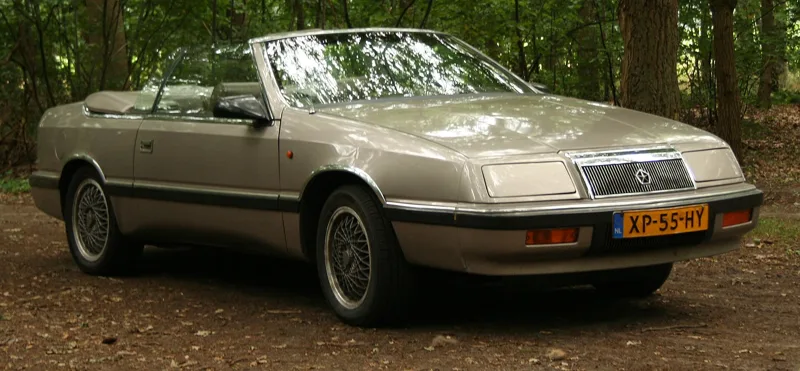
In 1989 Chrysler rebadged its Dodge Spirit as the Saratoga for export to Europe, with a 2.5 L four-cylinder and a five-speed manual, or a Mitsubishi 3.0 L V6 with an automatic. The export cars were built at Sterling Heights Assembly.
The export cars were not simply rebadged Spirits. Differing safety and emissions rules required different headlamps, lights, glass, seat belts and engine control units, and all Saratogas had front bucket seats.
The final Saratogas, sold in 1994 and 1995, were built on the LeBaron sedan sold in the US. Saratoga production ended on December 9, 1994, and the nameplate was replaced by the Chrysler Stratus.
What changed for the Saratoga in 1952?
The 1952 Saratoga brought new tail lamps, with the backup lamps moved into the same housing. Production dropped to 17,401 cars for the model year as the Korean War limited supplies, and a further 1,300 were built in Canada.
Strategic materials shortages also affected the trim, and pot metal parts were painted silver rather than chromed. The Canadian cars were the first eight-cylinder Chryslers to come out of the Windsor plant since 1937.
How did the 1950 Saratoga sit in the range?
The 1950 Saratoga was positioned lower than the New Yorker, offering plainer trim with cloth upholstery in several colours and a roomy interior with chair-height seats. It kept the straight-eight, with the Spitfire engine as its power unit.
New grilles and taillights appeared for 1950, along with a larger rear window, and output fell to 1,300 cars. The padded dashboard had already arrived across the range from model year 1949.
Did the Saratoga's styling change in 1957?
The 1957 Saratoga kept its place between the Windsor and the top New Yorkers, receiving trim upgrades and better interior appointments. The cars were related to the DeSoto Firedome, and by the end of the model year every Saratoga had quad headlights.
Early 1957 cars had dual headlights, with quad headlights optional where state law allowed them. The Forward Look styling by Virgil Exner gave the Saratoga the same tailfin treatment as the rest of the Chrysler line.
How did the Saratoga name fare in Canada in 1961?
The 1961 Canadian Saratoga shared the AstraDome instrument cluster with the 300, Newport, Windsor and New Yorker. Its semicircular dome housed the speedometer and every gauge in one place, lit at night by Panelescent light.
The AstraDome drew comparisons with a gumball machine, a nickname that reflected its round shape. Canadian models kept the name as the US line dropped it.
Which engine did Canadian Saratogas use?
Canadian 1959 and 1960 Saratogas used the B-block 383 engine, as Dodge and DeSoto did, rather than the Chrysler-only RB unit used in the US. That kept the Canadian cars in line with other Chrysler-group models.
The 1959 Canadian Saratoga shared its interior with the Canadian-built DeSoto Firedome, which kept the car's costs down while maintaining the Saratoga's upscale look.
Why did the Saratoga leave the US market?
The Saratoga was dropped in the US after 1960 when the Windsor was moved into the mid-range and the Newport took the entry-level position. The Saratoga remained in Canada, where it was sold as a Windsor or a Saratoga depending on the year.
Canada kept the Saratoga name for several more model years, and the 300 styling was adopted there from 1963. The last North American Saratogas were built in 1965.
How did Saratoga output move across the decade?
Saratoga output swung sharply from year to year, from 34,806 cars in 1951 to 17,401 in 1952, before recovering to 37,196 in 1957. The final US year, 1960, built 15,525 cars, which marked the end of the American Saratoga.
Those swings reflected a changing market, with the Korean War limiting supplies in 1952 and the 1957 restyle lifting demand. The Canadian line continued quietly while the American volume fell away.
How did the Saratoga's trim compare with the New Yorker's?
The Saratoga's upholstery was less elaborate than the New Yorker's, and it shared the appearance of the Chrysler Royal, which had only six-cylinder power. Because of government limits on certain supplies, Chrysler fitted white steel beauty rings to stand in for whitewall tyres.
Its interior also had turn signals, an electric clock, two-speed wipers and a lit trunk, equipment that was optional on other models. Whitewall tyres returned as an option in 1947.
What was the Saratoga's postwar sales environment?
The years after the war were a sellers market, as customers replaced vehicles they had kept running through the conflict. Chrysler sold every car it made, and in 1948 it raised prices across the board to fund new styling for the next product cycle.
The Presto-Matic semi-automatic transmission arrived in 1947 alongside the traditional three-speed manual, giving buyers a choice of gearbox.
What is the Saratoga remembered for?
The Saratoga is remembered for its Hemi years of 1951 and 1952, when its sporting image rested on the V8 and on road and stock car racing. Its name also lived on in Canadian and European markets long after the US line had ended.
The Saratoga's life was long and varied. Its story tracks Chrysler's changing ideas about the sporting luxury car, from straight-eights to Hemis and finally to a rebadged compact sedan.