A Cincinnati radio magnate, a television salesman, a Sears catalogue car and a Minnesota kit-car company, and what each sold that Detroit's cars did not.
Crosley built small, cheap economy cars from 1939 to 1952, the Muntz Jet was a luxury convertible made in tiny numbers, the Allstate was a Henry J sold through Sears in 1952 and 1953, and the Bradley GT was a Volkswagen-based kit car sold from 1970 to 1981.
The first car to wear the words Sport Utility was a Crosley, a tiny 1948 convertible wagon from a Cincinnati radio magnate whose cars weighed between 1,100 and 1,400 pounds (500 to 640 kg). Four small makers outside Detroit tried ideas the big firms would not, and none outlasted 1981.
Who built Crosley cars?
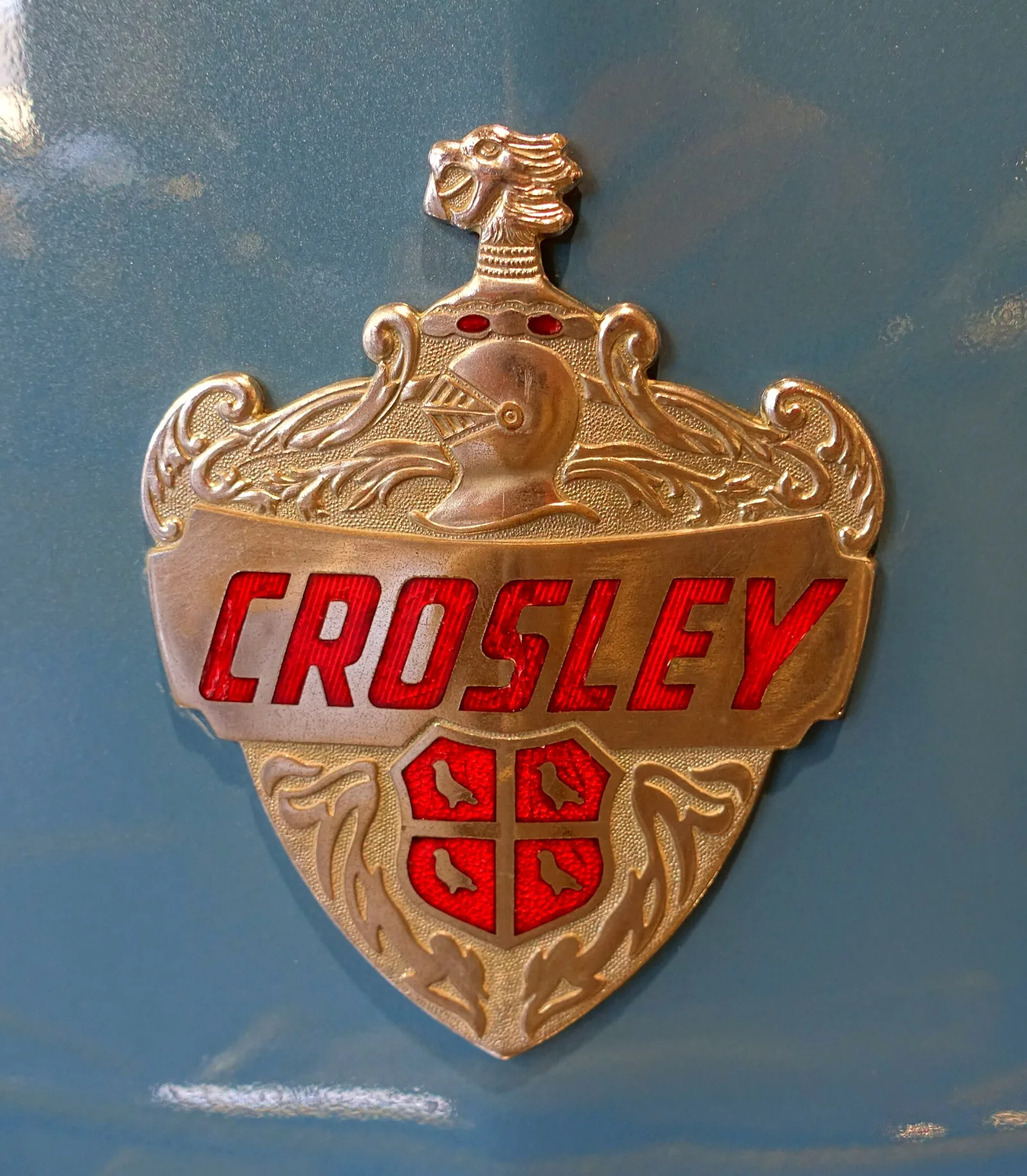
Crosley Motors was a small independent American maker of economy cars, bordering on microcars, based in Cincinnati, Ohio. It was active from 1939 to 1952 apart from the wartime break. Station wagons were the most popular body, but it also built sedans, pickups, convertibles, a sports car and a tiny jeep-like vehicle. Export cars were badged Crosmobile.
Powel Crosley Jr. paid for the venture with radios. He had built his first car at twelve, formed Marathon Six Automotive at twenty-one in 1907 and built a prototype of the Marathon Six, a six-cylinder car priced at US$1,700, but could not fund its production. He then made money from car accessories, from a cheap radio line and from home products such as the Shelvador, a refrigerator with shelves in the door. By 1925 his company was the world's largest radio maker, and he owned the Cincinnati Reds as well as the WLW broadcasting station.
The first Crosley production car was shown at the Indianapolis Motor Speedway on 28 April 1939, and critics were divided. A two-door convertible weighing less than 1,000 pounds (450 kg), it cost US$325 as a two-passenger coupe or $350 as a four-passenger sedan, undercutting the American Bantam at $449 to $565. The chassis had an 80-inch (2,032 mm) wheelbase, and the engine was an air-cooled Waukesha two-cylinder boxer, much like that of the Citroen 2CV, with the fan built into the flywheel. A 4 US gal (15 L) tank sat above the engine and fed it by gravity, so the car needed no fuel pump.
The torque tube that drove the rear axle without joints was judged unreliable, and universal joints replaced it in 1941. Sales were small: 2,017 in 1939, only 422 in 1940 and nearly 2,300 in 1941, when Crosley added a station wagon, panel vans, a pick-up and a Covered Wagon that turned into a truck. Gasoline rationing then made the car attractive, and fuel use was estimated at 50 miles per US gallon (4.7 L/100 km; 60 mpg-imp) at speeds up to 50 mph (80 km/h). No other maker kept civilian production going as long: Crosley stopped only in 1942, after 5,757 cars.
Each of the four tried to sell something Detroit's big cars did not, and each ran out of customers or money.
What did Crosley invent after the war?
The company spent the war on gun turrets, proximity fuzes, field kitchens and experimental vehicles. Powered turrets for PT boats and for B-24 and B-29 bombers were its largest contract. One experiment was the 1942 to 1943 CT-3 Pup, a single-seat four-wheel-drive vehicle of 1,125 pounds (510 kg) that could be dropped from a C-47. Six went overseas, but the project ended because of weak components. Seven of the 36 built survive.
When car production resumed in 1946 at Marion, Indiana, Crosley claimed a run of American firsts. The 1946 CC was the first mass-produced car with flat slab sides in the ponton style, arriving the same year as the Frazer and Kaiser. Its CoBra engine, named for Copper Brazed and carried over from military production, was the first mass-production overhead camshaft engine. The term Sport Utility appeared in 1947 for a 1948 convertible wagon, though it was an open car based on the wagon rather than a wagon on a truck chassis. For 1949 only, Crosleys were the first American cars with four-wheel caliper disc brakes. The Chrysler Imperial had four-wheel discs that year too, but not of the caliper type.
The 1949 Hotshot was America's first volume-built sports car after the war. In 1950 came the Farm-O-Road, a utility vehicle on a 63-inch (1.60 m) wheelbase that foreshadowed the John Deere Gator by decades. Crosmobile badges, hubcaps and instrument markings existed to avoid confusion with Britain's unrelated Crossley, and the cars reached Europe and Cuba.
Why did Crosley cars stop selling?
Crosley made 4,999 vehicles in 1946 and more than 22,500 in 1947. Sales peaked in 1948 at 24,871, and then the CoBra engine, a brazed assembly of copper and stamped steel, let the company down. It had been reliable in the military, but ordinary owners maintained it less carefully. A conventional cast-iron engine replaced it in 1949, but the company's reputation had suffered.
Sales dropped to 8,939 in 1949, 7,612 in 1950, 4,839 in 1951 and 1,522 in 1952. The Hotshot and Farm-O-Road could not stop the slide. Gas rationing had ended, and the Big Three were building larger, more lavish cars at volume, at prices in some cases only a little above a new Crosley. The last car came off the line on 3 July 1952, after about 84,000 in all. Crosley kept building engines for a while to fill a government contract, and then sold the rights. The Marion plant went to the General Tire and Rubber Company.
What was the Muntz Jet?
The Muntz Jet was a two-door hardtop convertible built between about 1949 and 1954 by the Muntz Car Company. Some writers call it the first personal luxury car. It grew out of the Kurtis Sport Car, an aluminium-bodied two-seater by Frank Kurtis, whose rights, parts and tooling Earl Muntz bought from Kurtis Kraft for $200,000. Sam Hanks, later the 1957 Indianapolis 500 winner, helped with the re-engineering.
Muntz, born in 1914 in Elgin, Illinois, had dropped out of school after three semesters, then sold televisions and electronics and worked as a used-car salesman, including for Kaiser-Frazer dealers, earning the title of world's largest car dealer. He was known as Madman Muntz and married seven times. He lost and made several fortunes, according to journalist Turk Smith.
The Jet carried a 160 hp (120 kW) V8 from either Cadillac or Lincoln, with a General Motors Hydramatic automatic or an optional three-speed Borg-Warner manual. Early Glendale cars used the Cadillac engine and aluminium bodies, while later Illinois cars had the Lincoln engine and steel bodies. It weighed almost 4,000 pounds (1,800 kg), some 400 pounds (180 kg) more than the Kurtis, and it rode on a 113-inch (290 cm) wheelbase, ten inches (25 cm) longer, which made room for a back seat and four occupants. It also had power steering, hydraulic brakes on all four wheels, twin exhausts and a padded dashboard, as well as seat belts, which most cars of the day lacked.
Norman Nicholson called it a streamlined, scaled-down limousine in April 1951. Colours included boy blue and elephant pink. The interior was all leather in a tuck-and-roll pattern, with Stewart-Warner gauges and a console with a Muntz radio, and a liquor cabinet and ice chest under the rear armrests were options.
How did the Muntz Jet lose money?
The first 26 to 40 Jets were built in Glendale, California, before materials and transport difficulties pushed Muntz to Evanston, Illinois, where a factory stood at 1000 Grey Avenue. In April 1951 it employed 40 people and made a car a day. Around 1952 production moved again, to 2901 North Sheffield Avenue in Chicago, and it ceased in 1954. Without dealers, Muntz sold direct from the factory and planned factory-run showrooms in New York City, Los Angeles and Houston.
The sums did not work. The Jet sold for $5,500 in 1953 but cost about $6,500 to build, and Muntz estimated labour alone at $2,000 a car. A Cadillac convertible then cost $3,987 and a comparable Lincoln $3,600. Muntz lost roughly $400,000 and gave up after four years. Buyers included Clara Bow, Vic Damone, Grace Kelly, Lash LaRue and Mickey Rooney. After the Jet, Muntz invented the 4-track Stereo-Pak player, the forerunner of the 8-track.
Nicholson put the Jet's official top speed at 112 mph (180 km/h). Muntz said it could reach 80 mph (130 km/h) from rest in nine seconds and claimed 150 mph (240 km/h), though Turk Smith doubted in 1969 that it could manage even 130 mph (210 km/h). Six Jets had a factory hop-up kit with an Edelbrock aluminium intake and twin Stromberg carburettors.
Only 198 Jets were built, not the 400 once estimated, and an estimated 50 to 130 still exist. A registry has accounted for about 125 by serial number, and the Petersen Automotive Museum owns three. Well restored examples sold for $50,000 to $70,000 at auction by 2002 and for more than $100,000 by 2016. Muntz claimed the 1958 Ford Thunderbird was inspired by his car, and quipped that he was eight years ahead of his time.
What was the Allstate?
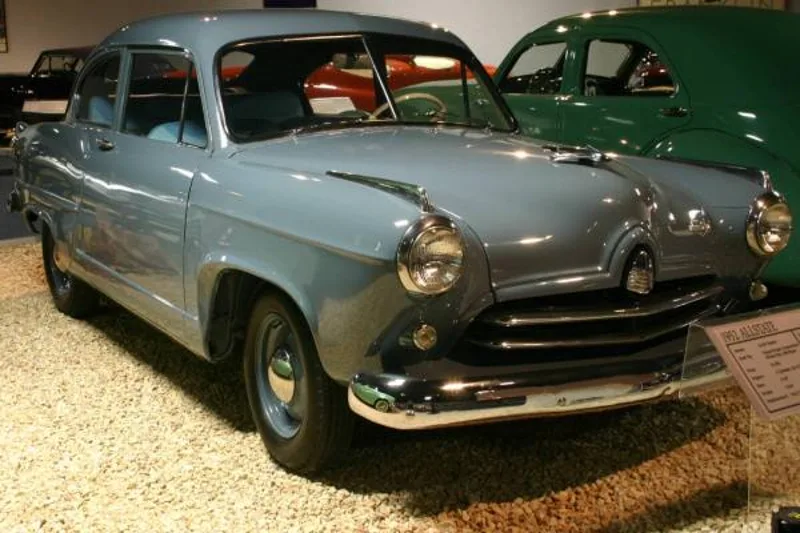
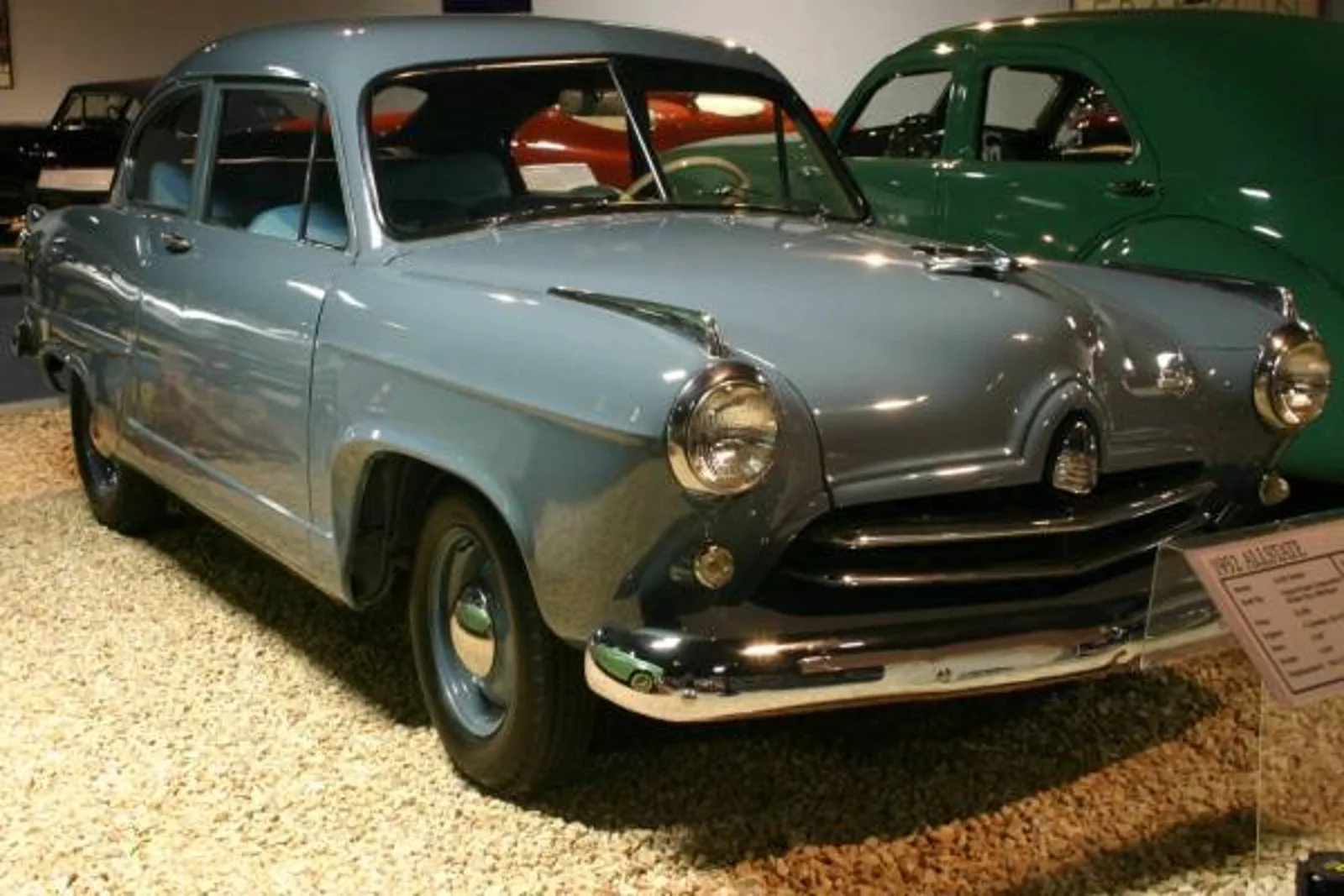
The Allstate was a rebadged Henry J, offered through Sears, Roebuck and Co. for the 1952 and 1953 model years. Kaiser-Frazer built the Henry J from 1950 to 1954. The idea belonged to Henry J. Kaiser, who wanted to mass-market the slow-selling little sedan through Sears, because independents could not match the dealer networks of the Big Four.
Sears had sold cars before, with the Sears Motor Buggy of 1908 to 1912, a high-wheeler shipped by rail in a crate. It dropped the line after 3,500 orders, having judged it unprofitable at $370. Talks over the Allstate began in 1945 with Sears executive Theodore Houser, and the car was announced on 20 November 1951, after three years of negotiation and resistance from existing Kaiser-Frazer dealers.
Differences from the Henry J included Allstate badges, a more upmarket interior of Saran plaid, leather or vinyl, special hubcaps, a locking trunk lid, a blue engine and revised locks. All were painted Sears-blue. Alex Tremulis, who had come from Tucker, designed a two-bar grille and a jet-plane hood ornament, calling it a rush job, and drew the logo too, a map outline of the contiguous United States. The interior fabric was twisted strands of paper coated in plastic, durable enough to make seat covers unnecessary, and the tyres, tubes, spark plugs and batteries were Sears Allstate brand with a Triple Guarantee.
Built at Willow Run, Michigan, and after 1953 in Toledo, Ohio, it came as a fastback two-door sedan with a 100 in (2,540 mm) wheelbase. The Series 4 had a 134.2 cu in (2.2 L) four-cylinder of 68 hp (51 kW) and the Series 6 a 161 cu in (2.6 L) six of 80 hp (60 kW), both from Willys. Prices in 1952 ran from $1,395 for the Basic to $1,693 for the Series 6 DeLuxe, and the $1,486 Standard was the bestseller. In 1953 the Basic cars were dropped and the DeLuxe six at $1,785 was the most popular.
Sears first offered the Allstate only in the South and Southwest, in cities such as Dallas, Houston, Memphis, Phoenix and Salt Lake City. Most were built to order and delivered to the stores. Kaiser-Frazer dealers disliked seeing their car sold elsewhere, particularly since the Allstate had more standard equipment yet cost less than the Henry J. Sears did not accept trade-ins, and shoppers may have hesitated to purchase a car from a department store.
The timing was poor as well. After controls on materials ended in March 1953, a sales war broke out among the Big Three, and buyers wanted bigger cars. Sears sold 2,363 Allstates, 1,566 in 1952 and 797 in 1953, and Kaiser dropped the Henry J the next year. A restored 1953 car stood in Allstate's own corporate building in Northbrook, Illinois, as of 2022.
What was the Bradley GT?
The Bradley GT was a fibreglass kit car on a Volkswagen Beetle chassis, sold by Bradley Automotive of Plymouth, Minnesota, between 1970 and 1981. Gary Courneya, a salesman, and David Bradley Fuller, a fibreglass designer, had earlier run Gary's Bug Shop, making kits and parts aimed at dune buggy owners.
Interest in the GT was built by advertising in popular magazines and offering a brochure for US$1, though when the promotion began neither the brochures nor the car existed. The partners raised money by selling 80,000 shares at $1. Courneya used a made-up name, Gary Bradley, a mix of his own first name and Fuller's middle name, when he phoned sales leads, and this fictional person was even described as founder and president.
Bradley delivered the first production GT in September 1970, and development had cost an estimated $2000 in materials. Its body was a low two-seat coupe with curved sides and no doors at all; two frameless plastic panels hinged upwards like gull wings, and the headlamps hid under opaque covers. A finished car weighed about 1,600 lb (725.7 kg). It inherited the Beetle's 2,400 mm (94.5 in) wheelbase, torsion-bar suspension, air-cooled flat four and four-speed gearbox. The windscreen came from the 1963 to 1967 Corvette, which is why many parts remain easy to find. About 6000 were built.
What were the Bradley GT II and GTE?
In 1976 Bradley launched the GT II, designed in 1975 with help from John Chun, a former Shelby American employee. It was still Beetle-based but far more refined, with proper framed gull-wing doors, electric retractable headlamps, a lower sill, steel roof reinforcement and a roomier cabin for people over six feet tall. Development cost about US$1,000,000, the car went on sale in November 1976, and about 500 were built.
The GTE of 1980 used a General Electric Tracer I motor of 20.7 horsepower (15.4 kW) in place of the Volkswagen engine. Sixteen 6-volt batteries gave 96 volts, and a switch let the driver choose Boost, using all 96 volts, or Cruise, halving the voltage to stretch the range. It weighed about 2,900 lb (1,315.4 kg), reached over 75 mph (120.7 km/h) in Boost and 55 mph (88.5 km/h) in Cruise, and took 8 seconds to reach 30 mph. Fifty were built.
The company's finances came apart. Fuller left, and in 1978 seven salesmen defected to a rival, Fiberfab. Bradley sought protection in bankruptcy, which lasted until April 1980, and was renamed Classic Electric Car Corporation and later The Electric Vehicle Corporation. Complaints mounted that kits arrived late, missing parts or not at all, because orders of 30 to 40 cars a month far exceeded a capacity of 10 or 11 kits. In July 1981 the Minnesota attorney general formally charged the company with consumer fraud. It owed an estimated US$2,500,000 and did not resume operations. The GT lived on through SunRay Products, which bought the molds.
Four makes at a glance
| Make | Years | What it sold | Total built |
|---|---|---|---|
| Crosley | 1939 to 1952 | Subcompact economy cars | About 84,000 |
| Muntz Jet | About 1949 to 1954 | Luxury four-seat convertible | 198 |
| Allstate | 1952 and 1953 | A Henry J sold through Sears | 2,363 sold |
| Bradley GT | 1970 to 1981 | Volkswagen-based kit car | About 6000 GTs |