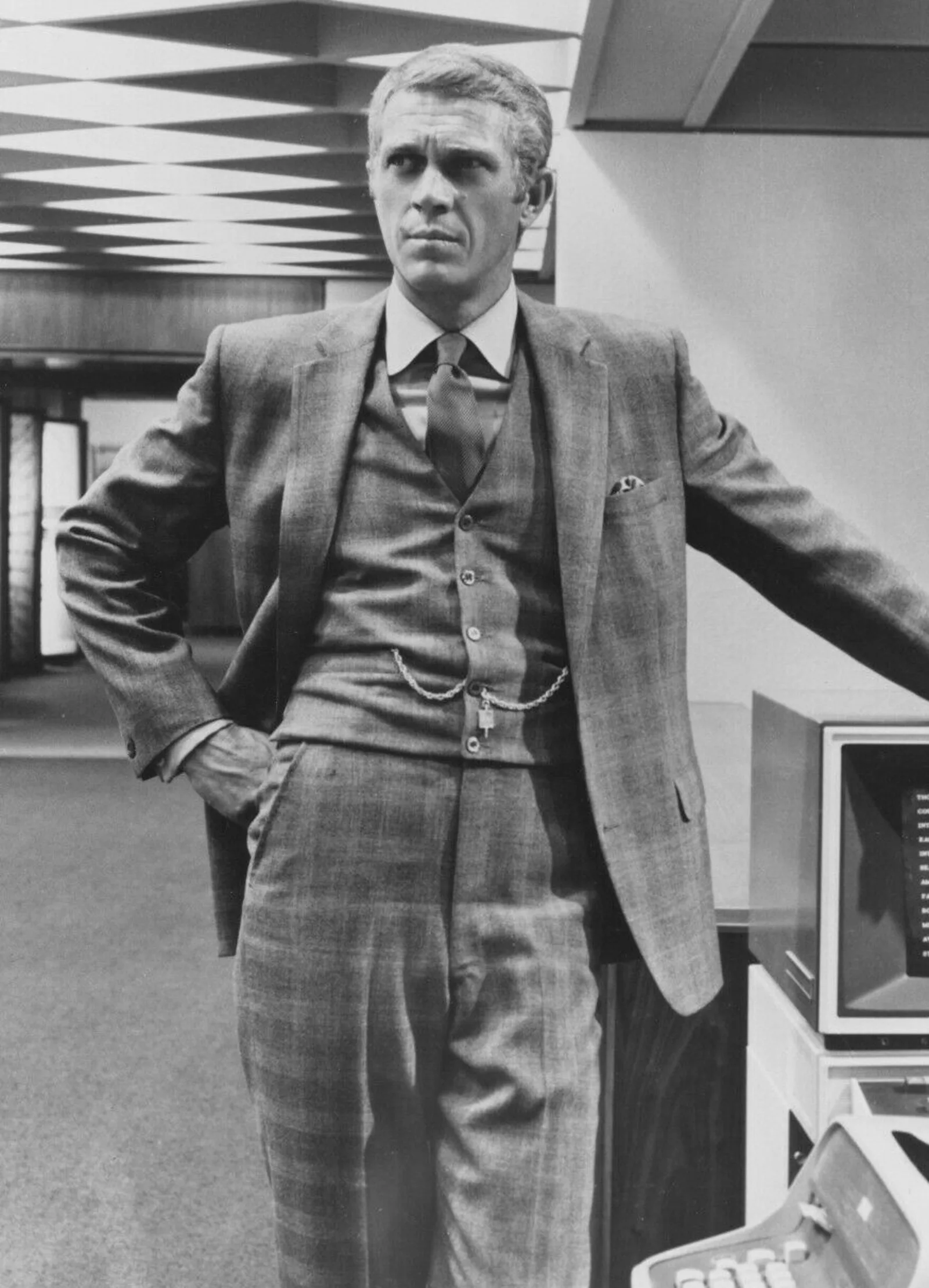
The actor rode motorcycles, raced a Porsche at Sebring and performed the Bullitt chase, and his cars and watches still set auction records.
Steve McQueen was an American actor born in 1930, known as the King of Cool. He became one of the top box office names of his era, and he also raced motorcycles and cars, including a Porsche that won its class at the 1970 Sebring 12 Hours.
Steve McQueen was an American actor whose screen persona made him a major box office name through the late 1950s and into the mid-1970s. He was nicknamed the King of Cool, but for car and motorcycle fans his real credentials are on the track and in the stunt work, where he rode, raced and drove more than most stars of his day.
His best-known car moment is the San Francisco chase in Bullitt, which is still copied. The film, his personal favourite, is only part of the story, because McQueen also raced a Porsche at Sebring, competed in off-road motorcycle events and built a collection of around 100 classic motorcycles and about 100 exotic and vintage cars.
Who was Steve McQueen?
Terrence Stephen McQueen was born on March 24, 1930, in Beech Grove, Indiana. His antihero screen persona suited the 1960s counterculture, and by 1974 he was the highest-paid movie star in the world.
He was also combative with directors and producers, but his popularity gave him the leverage to negotiate some of the largest salaries of the period. In the years that followed, he was counted among the most in-demand actors in Hollywood.
An actor who raced motorcycles, a Porsche at Sebring and the Bullitt Mustang, and whose cars still set records.
How did motorcycles and the Marines shape him?
McQueen's interest in cars began as a child. His uncle Claude gave him a red tricycle on his fourth birthday, and McQueen later credited that gift with sparking his early interest in racing. As a teenager he moved through several homes, a reform school and a spell at sea before he found structure in the Marines.
He enlisted in 1947 with his mother's permission, since he was not yet 18, and went through boot camp at Parris Island in South Carolina. He was assigned to an armored unit, and he later said he had been busted back down to private several times before he settled. During an Arctic exercise he pulled five Marines from a tank before it broke through ice into the sea, and he was then assigned to the honor guard for USS Williamsburg, the presidential yacht of Harry S. Truman.
He was honourably discharged in 1950 and later described the Marines as the experience that made a man of him. Motorcycles remained a constant. Long before acting paid, he was racing motorcycles at weekends at Long Island City Raceway, buying a Harley-Davidson and a Triumph and winning about $100 each weekend, which is roughly $1,200 in 2025 money.
How did his racing and acting intersect?
McQueen studied acting in New York under the G.I. Bill from 1952, and he made his Broadway debut in 1955 in A Hatful of Rain. He moved to Los Angeles in late 1955, and his first big break came in the television western Wanted Dead or Alive, in which he played the bounty hunter Josh Randall. The series ran 94 episodes from 1958 until early 1961.
Randall carried a sawed-off .44-40 Winchester rifle nicknamed the Mare's Leg, which made the character stand out from the typical sixgun-carrying western hero. McQueen spent a lot of time at the Iverson Movie Ranch in Chatsworth, where the show's outdoor scenes were mostly filmed.
Motorcycles followed him into film. In The Great Escape, the famous motorcycle jump over the fence was performed by his friend Bud Ekins, because insurance concerns ruled out McQueen doing it himself. He did ride a 650 cc Triumph TR6 Trophy for much of the film, and at one point editing made him appear to chase himself on another bike in a German uniform.
Why is Bullitt so important to car fans?
Bullitt, released in 1968, is the film that car enthusiasts still talk about. Its car chase through San Francisco was unprecedented at the time and has been endlessly imitated. McQueen's character drove a 1968 Highland Green Ford Mustang GT 390 with a four-speed gearbox, while the hitmen were in a black Dodge Charger R/T 440 driven by veteran stunt driver Bill Hickman.
McQueen did the driving that appeared in the close-ups, but that was only about 10% of what is seen in the chase. The rest of the driving by his character was done by stunt drivers Bud Ekins and Loren Janes. He spent several days before the shoot practising high-speed close-quarters driving with his stunt drivers and Hickman.
The film ran far over budget, and Warner Bros. cancelled the contract on the rest of his films, seven in all. McQueen then made films for independent studios, and the change of image was a deliberate move away from the action roles. He went on to make The Thomas Crown Affair, a film in which he played a wealthy executive.
The Mustang itself remains part of the story. McQueen tried for years to buy the car he drove in the film, but never succeeded. One of the two Mustangs used in the chase was judged beyond repair and surfaced in Mexico in 2017, and the other is hidden from the public eye.
Did McQueen actually race?
Yes, and he was more serious about it than many of his peers. In 1961 he made a single appearance in the British Touring Car Championship, taking third in a BMC Mini at Brands Hatch. He also considered a full career as a professional race car driver.
His most significant result came at the 1970 12 Hours of Sebring. Peter Revson and McQueen, the latter wearing a cast on his left foot after a motorcycle accident a fortnight before, won the three-litre class in a Porsche 908/02. They missed the overall win by 21.1 seconds to a five-litre Ferrari 512S driven by Mario Andretti, Ignazio Giunti and Nino Vaccarella.
He was also keen to race at Le Mans. McQueen wanted to drive a Porsche 917 with Jackie Stewart in the 1970 24 Hours, but the film backers threatened to pull their support if he did. He faced a choice between 24 hours of racing and a summer of making the film, and he chose the film. The Porsche 908 used by his company Solar Productions as a camera car ran in the race that year.
| Year | Event | Result |
|---|---|---|
| 1961 | British Touring Car Championship, BMC Mini at Brands Hatch | Third place, a one-off outing |
| 1964 | International Six Days Trial, Erfurt, East Germany | Retired on day three after irreparable crash damage |
| 1970 | 12 Hours of Sebring, Porsche 908/02 with Peter Revson | Won the three-litre class, 21.1 seconds behind the overall winners |
| 1978 | Off-road Motorsports Hall of Fame | Inducted |
Off-road motorcycling was his other racing outlet. He raced under the alias Harvey Mushman, usually on a BSA Hornet, and competed in top West Coast events including the Baja 1000, the Mint 400 and the Elsinore Grand Prix.
In 1964 he was part of the first official United States team entered in the Silver Vase category of the International Six Days Trial, held that year in Erfurt, East Germany. The team rode Triumph twins modified for off-road use. Both teams crashed repeatedly, and McQueen retired with irreparable damage on day three.
What did the Le Mans film involve?
Le Mans, released in 1971, was an auto-racing drama that received mixed reviews. McQueen's production company, Solar Productions, also backed On Any Sunday in the same year, a motorcycle documentary in which he appeared alongside racing figures Mert Lawwill and Malcolm Smith.
McQueen drove a Porsche 917, chassis 022, extensively in the film. The car was later sold and raced in the 1970s, and Jerry Seinfeld acquired it in 2002. Seinfeld had it restored to its 1971 film-era Gulf Porsche team livery.
The film also involved his interest in design. McQueen designed a motorsports bucket seat, and a patent was issued for it in 1971, while he also appeared on the cover of Sports Illustrated that year riding a Husqvarna dirt bike.
What cars and bikes did McQueen collect?
McQueen was an avid motorcycle and race car enthusiast, and his son Chad testified that Steve owned around 100 classic motorcycles and around 100 exotic and vintage cars. He also flew and owned aircraft, including a 1945 Stearman, a 1946 Piper J-3 Cub and a 1931 Pitcairn PA-8 biplane that had won a prize, which Eddie Rickenbacker, the First World War ace, had once flown on mail duty.
The aircraft were hangared at Santa Paula Airport, an hour northwest of Hollywood. In the Ford Puma commercial of 1998, a digital superimposition of archive footage placed him back in a car set to the Bullitt theme, with the Puma sharing the number plate of the Mustang from the film.
Ford's later tribute was the 2019 Mustang Bullitt, which was unveiled at the Detroit Auto Show in January 2018. The company asked his granddaughter, the actress Molly McQueen, to make the announcement, and the display car was a 1968 Fastback with a V8 of 390 cubic inches and a manual gearbox with four speeds.
What have McQueen's cars and watches sold for?
Auction prices show how much collectors still value his machines. In 2007 a 1963 metallic-brown Ferrari 250 GT Lusso sold for US$2.31 million, and a 1970 Porsche 911S purchased while making Le Mans sold for $1.375 million in August 2011. One of his motorcycles, a 1937 Crocker, set a world-record price of $276,500 at the same auction.
The Porsche 917 chassis 022 was offered on January 18, 2025, by Mecum Auctions, and its final bid of $25 million failed to meet the undisclosed reserve. The Bullitt Mustang hero car, the car used in the film, was sold without reserve for $3.4 million at Mecum's Kissimmee auction in January 2020, or $3.74 million once fees were included.
His watches sell well too. McQueen was a sponsored ambassador for Heuer, and in Le Mans he wore a blue-faced Monaco Ref. 1133, which became a cult watch among collectors. One of the last six examples was sold for US$2.208 million in December 2020, the most expensive Heuer at auction. He preferred the Rolex Submariner Ref. 5512, and one sold for $234,000 on June 11, 2009, a world-record price for the type.
How did McQueen's career end?
His final films were An Enemy of the People in 1978, in which he played a bearded 19th-century doctor, and two 1980 releases, Tom Horn and The Hunter. He had spent much of the late 1970s on motorcycles and motorhome travel rather than acting, and he returned for those films.
He developed a persistent cough in 1978, and in December 1979 a biopsy revealed pleural mesothelioma, a cancer linked to asbestos exposure. He had been exposed to asbestos while serving in the Marines, and he thought that exposure was the most likely cause. He travelled to Mexico for treatment in October 1980, and died of a heart attack after surgery on November 7, 1980. He was 50 years old.
A film about his later years, Steve McQueen: American Icon, was released in 2017, and a 2015 documentary, Steve McQueen: The Man & Le Mans, examined his quest to make the 1971 film.