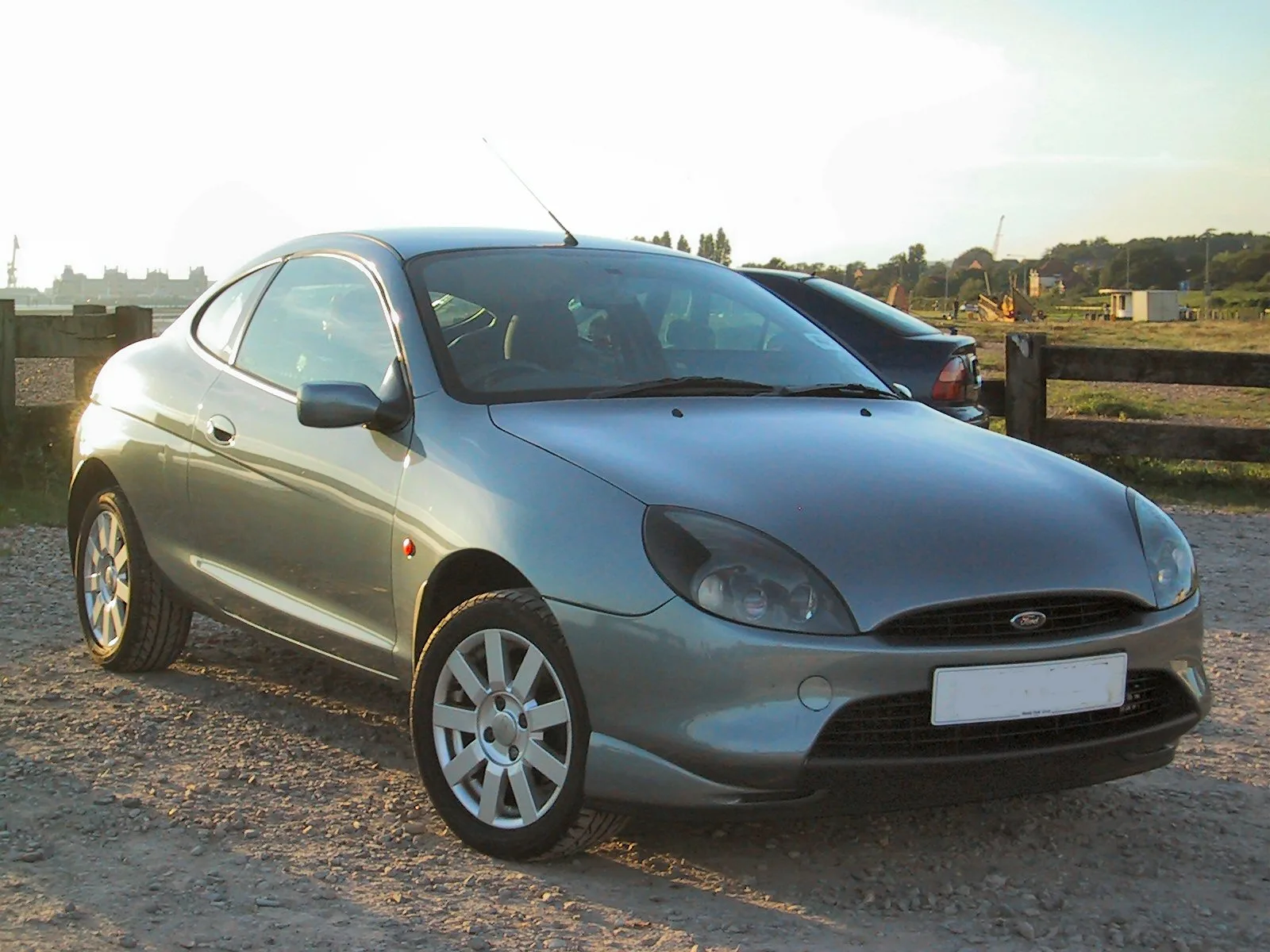
A three-door coupe on Fiesta running gear, built in Cologne from 1997 to 2001, with a limited Racing version that still draws enthusiasts.
The Ford Puma was a three-door, front-wheel-drive coupe built by Ford Europe in Cologne from June 1997 to 2001. It used the Mark IV Fiesta as its base and belonged to Ford's New Edge design family. The 500-unit Ford Racing Puma is its best-known variant.
The Ford Puma was a three-door coupe that Ford Europe sold from 1997 until 2001. It rode on the Fiesta's running gear and was built at Cologne. A limited Racing version later gave the model a second life among enthusiasts.
What was the Ford Puma?
The Puma was a 2+2 coupe that Ford based on the Fiesta chassis, with four seats and front-wheel drive. Ford Europe produced it from June 1997 to 2001, and it was a three-door car throughout its life. Its engines, body and suspension were new, although the chassis came from the Fiesta.
Its four seats and 2+2 layout set it apart from the Fiesta hatchback beneath it. The body was styled to sit within Ford's New Edge family, the design strategy first seen on the 1996 Ford Ka.
The Puma was judged less controversial than the Ka when it first appeared. Its cat-like design cues and well-proportioned body won critical praise from reviewers.
A three-door Fiesta-based coupe from Cologne, with a 500-car Racing version that still draws enthusiasts.
How was the Puma developed?
Development began in 1993, when Ford's then chief executive Jacques Nasser and design director Claude Lobo discussed a 2+2 coupe on the Fiesta chassis. The design team worked in the Paintbox CAD system, which let them render 2D and 3D models.
The first design, the Lynx concept car, was shown at the 1996 Geneva Motor Show. The production car followed at the 1997 show in the same city.
Underneath, it was a Mark 4 Fiesta, but with a new body, stiffer suspension, a wider track and a close-ratio gearbox. Its engines were co-developed with Yamaha, a partnership that shaped the powertrain range.
Where was the Puma built, and how many were sold?
Assembly took place at the Niehl works in Cologne, Germany. Cars were built there from 1997 until production ended in 2001, and roughly 133,000 Pumas were made across all models, including the Racing version, during that relatively short production run, which took the car from launch to discontinuation.
The 1.7-litre VCT engine had an unusual supply chain, and the 1.6-litre arrived late in the production run. Partly machined blocks travelled from a Valencia works in Spain to Japan for coating, then returned to Cologne for final assembly.
UK registrations tell the later story. The peak of 52,950 cars has fallen to 7,493 as of Q3 2023, and 5,457 of those carry a statutory off-road notification.
What engines did the Puma use?
The Puma offered four engine options, each a 16-valve Sigma unit sold under the Zetec-SE name. The choices were a 1.4-litre from 1997 to 2000, a 1.6-litre from 2000 to 2001, the 1.7-litre VCT, and a Tickford-tuned 1.7-litre used only in the Ford Racing Puma.
Nikasil-coated cylinders in the 1.7-litre engines meant owners had to use 5W30 semisynthetic oil.
Every 1.7-litre Puma had traction control at low speed, plus antilock brakes. ABS was optional on the 1.4-litre car.
What special editions did Ford sell in the UK?
Ford sold three UK special editions: the Millennium from 1999 to 2000, the Black from 2000 to 2001, and the Thunder from 2000 to 2002. Each came in a small run, from 1000 cars to 2000, and each had its own paint, interior and badging.
The Millennium Edition marked a 1999 Design Council award for Ford's first computer-designed British car. It had Zinc Yellow paint and Alchemy Blue leather with Recaro seats, and a numbered badge and keyring could be bought from Ford, although the cars were not automatically numbered.
The Puma Black used Panther Black paint, Midnight Black leather and F1-inspired alloy wheels. The first plan was for 1000 cars, but demand led Ford to build an extra 600.
The Thunder came in Moondust Silver and Magnum Grey, 1000 of each, and it was among the final 2000 Pumas built. Moondust Silver was offered throughout the production run, while Magnum Grey was reserved for the Thunder. Every Thunder had a six-disc CD changer and multi-spoke alloys similar to those on the Fiesta Zetec-S.
Registrations peaked at 899 for the Millennium in 2001 Q4, at 1579 for the Black in 2003 Q4, and at 1908 for the Thunder in 2002 Q4.
What made the Ford Racing Puma special?
The Ford Racing Puma began as the ST160 concept, first shown at the 1999 Geneva Motor Show. Ford's Boreham rally team turned the idea into a limited road car, and 500 were built, each numbered on the inlet manifold. The team was a specialist unit, not the group that engineered the standard Puma.
Ford said the car carried know-how from its race and rally programmes into a road car. The original plan was for 1000 units, with 500 for Germany and 500 for the UK, but only the UK cars were made, and Tickford of Daventry carried out the conversions.
The car cost GBP 23,000 when new. A Subaru Impreza with more power, four-wheel drive and a rally pedigree could be bought for at most GBP 21,000 with its optional Pro Drive pack, so fewer than half of the Racing Pumas sold to customers.
Ford offered the unsold cars to senior managers through its MRC scheme, which let them stay registered and be converted. Because so few were sold new, the Racing Puma has held its value better than the standard car.
Every Racing Puma left the factory in metallic Imperial Blue, a colour reserved for a small group of models, including the Escort Cosworth and the Mk1 Focus RS. The regular Pumas in the UK never got it.
How did the Racing Puma differ mechanically?
The Racing Puma used an Alcon four-piston motorsport braking system with 295 mm (11.6 in) front discs. Those brakes could pull 1.1g in the dry, against 0.7g for the standard car with its smaller 258 mm (10.2 in) discs. The comparison was with the regular Puma, not with rival sports cars.
The calipers came without protective rubber boots, so the brakes needed regular full servicing. The inner faces of the calipers were unpainted aluminium and could corrode.
The body was widened with lightweight aluminium front and steel rear overhangs, plus a front air splitter and a wider bumper. The 17 x 7.5 in wheels with 215/40 tyres widened the car from 1674 mm to 1770 mm.
Boreham's specialist division developed the suspension, and Stig Blomqvist spent months fine-tuning the handling. The result was a firm ride that favoured circuits over rough roads.
The original target was 180 bhp from a turbocharged 1.7-litre, but rising costs forced a naturally aspirated engine instead. Camshafts, the air intake, a Janspeed exhaust and new engine software added 30 hp, enough for 100 km/h (62 mph) in 7.8 seconds and a top speed of 203 km/h (126 mph).
Ford Puma specifications
| Model | Detail |
|---|---|
| Standard Puma, production | June 1997 to 2001; roughly 133,000 built |
| Standard Puma engines | 1.4-litre, 1.6-litre and 1.7-litre VCT |
| Standard brakes | 0.7g; discs 258 mm (10.2 in) by 22 mm (0.9 in) thick |
| Racing Puma brakes | 295 mm (11.6 in) front discs; 1.1g in the dry |
| Racing Puma weight | 1,174 kg (2,588 lb) |
| Racing Puma width | 1674 mm to 1770 mm with 17 x 7.5 in wheels |
| Racing Puma engine | Naturally aspirated; 30 hp added; 100 km/h (62 mph) in 7.8 seconds |
| Racing Puma top speed | 203 km/h (126 mph) |
| Rally kit engine | 1596 cm3 Zetec SE; 150 kW (200 bhp) at 9000 rpm |
| Rally kit brakes | 355 mm (14.0 in) front discs; 260 mm (10 in) rear discs |
| Rally kit fuel tank | 55-litre FIA bag tank |
What was the Puma's rally version?
Ford also produced a Puma kit car built specifically for rallying, and it was never intended for road use. It used a Zetec SE all-alloy four with 16 valves, and a Hewland six-speed sequential gearbox sent power to the front wheels.
The kit added a limited-slip differential, MacPherson strut front suspension, ventilated front discs from Alcon, 355 mm (14.0 in) across, and a welded steel roll cage. The front and rear wheel arches and bumpers were made of composite.
Its wheels were 7 x 17 in tarmac alloys, or 6 x 15 in alloys for gravel, and the fuel carried in a 55-litre FIA bag tank beneath the rear floor.
How did Ford market the Puma?
The pan-European launch campaign starred Steve McQueen, who was cut into a modern Puma in San Francisco using clips from the film Bullitt. The campaign ran across Europe, not only in Britain. Its advertising won many industry awards and featured in all-time top 10 ad charts.
Both commercials were directed by Paul Street. In Q4 2004 Ford reused the McQueen footage for its first 2005 Mustang advert in the US.
How did production end for the Puma?
The Puma was sold only in Europe and nowhere else. Production ended in 2001, and no new small coupe was offered to take its place, leaving no direct successor for its niche. Stock sales ran into the following year, as covered below.
Stock sales meant that some Pumas were still being sold in 2002, after the production line had stopped. Ford introduced the StreetKa instead, a Fiesta-based convertible with two seats that borrowed the Puma's transmission and suspension.
The name returned in 2019 as a crossover model.
What awards did the Puma win?
Top Gear gave the Puma its Car of the Year honour in 1997 for its driving feel. The Design Council gave it a Millennium Products award in 1999, recognising it as the first Ford designed in Britain entirely on computer and in record time.
The Ka and Focus received the same Millennium award, and their special editions were built in the same quantity. Those editions had black leather interiors rather than the Puma's Alchemy Blue.
The awards span the car's life, from its launch year to its later years as a used buy. What Car? magazine honoured the Puma several times. The 1.7 took the Used Sports Car of the Year title in 2001, the Best Used Sporting Car under GBP 10,000 award in 2004, and a Gem For Under GBP 1,000 award in 2011.