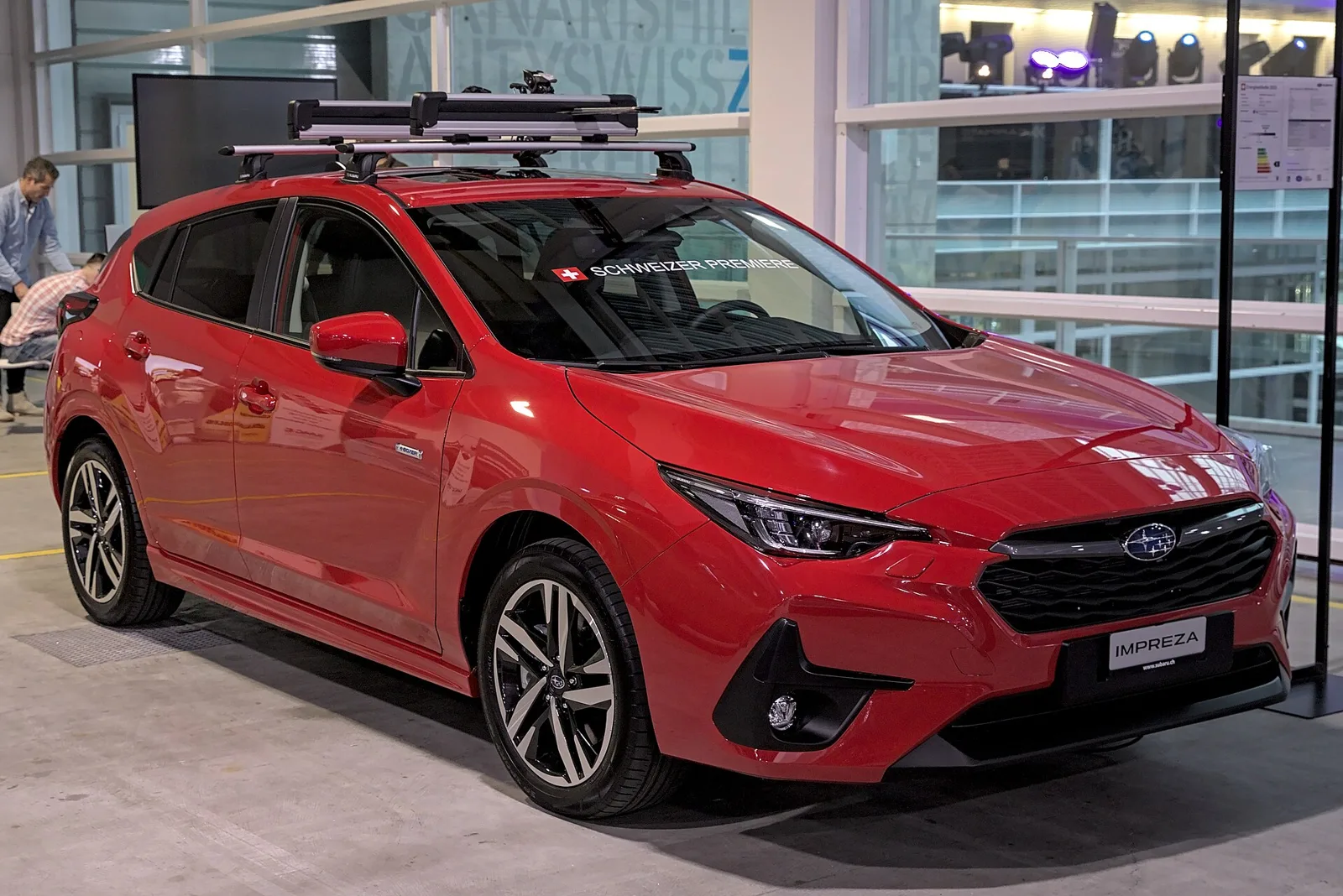
From the 1992 launch to the sixth generation, the Impreza kept its boxer engine, built the WRX and STI line and picked up rally titles along the way.
The Impreza is a compact car from Subaru, first sold in 1992 and now in its sixth generation. Subaru built it around a flat-four boxer engine and offered front-wheel or all-wheel drive. Turbocharged WRX and STI versions added rally credentials, and the sixth generation arrived in 2023.
The Subaru Impreza is a compact car that Subaru has built since 1992, when it replaced the Leone and brought in the EJ engine series. It has always relied on a boxer engine, and it has been offered with front-wheel or all-wheel drive depending on the market. The sixth generation, revealed in November 2022, is the current model.
Where did the Subaru Impreza come from?
The Impreza was announced on 22 October 1992 and went on sale in Japan that November. It borrowed a shortened version of the Legacy floor pan, and early cars came as a four-door sedan or five-door wagon. Its working name was nearly Loyale, and enthusiasts later nicknamed it Scooby.
Subaru kept the boxer layout and set the flat-four in line with the transmission. That placement lowers the centre of gravity and limits body roll compared with offset engines. Opposing pistons largely cancel each other's movement, so the engine needs no counterweighted harmonic balancer, and equal-length front driveshafts keep torque steer in check.
The first generation came with 1.5, 1.6, 1.8 and 2.0 litre naturally aspirated engines. A 2.2 litre unit reached North America for the 1995 model year, and Subaru later made all-wheel drive standard across North America from 1997. That gave the car a clear point of difference in the compact class, where most rivals were front-wheel drive.
Body variety arrived early. A coupe ran from 1995 to 2001 and was called the Impreza Retna in Japan, while the Outback Sport, an off-road styled wagon, reached North America in 1994. Subaru also built a retro-styled Casa Blanca wagon limited to 5,000 units, but its styling was controversial and sales stayed low.
A boxer-engined compact that carried a rally reputation into a sixth generation with standard driver aids.
How much power did the first WRX make?
The WRX debuted in November 1992 with 240 PS (177 kW; 237 hp) from a turbocharged four-cylinder. The name stands for World Rally eXperimental, and every WRX has carried all-wheel drive. By the third generation, the 2.5 litre turbo made 227 hp (169 kW).
The STi badge first appeared in late 1993 on Version 1, which took production WRX cars and had STi modify them. Early STi versions were sold only in Japan, and the first one produced 250 PS (184 kW; 247 hp). The factory built about 100 cars a month from February 1994, and the lightweight Type RA cut soundproofing, air conditioning and anti-lock brakes to save weight.
How the STi and special editions developed
Limited runs became a recurring theme. In 1998 Subaru of Japan built the 22B STi, a widebody coupe with a 2.2 litre engine, to mark the company's 40th anniversary and a third straight manufacturer's title. All 400 Japanese cars sold out within hours, and 24 more went to export markets.
The name is a puzzle worth unpicking. The 22 refers to the 2.2 litre engine, the B is Subaru's internal code for turbo, and 22B is also hexadecimal for 555, a nod to State Express 555, the WRC sponsor from 1993 to 2004. The bodywork was widened by 80 mm (3.15 in), and the car weighed 1,270 kg (2,800 lb).
The S-series cars followed at a steady pace. The S201 of 2000 was a limited run of 300 cars producing 305 PS (224 kW; 300 hp), with many STi catalogue parts fitted. The S202 of 2002 offered 320 PS (235 kW; 315 hp) from 400 units, and the S203 of 2004 added a larger turbo for a run of 555 cars.
Why is the 22B still talked about in the UK?
Prodrive modified 16 of the 22Bs sent to the UK, fitting longer gear ratios and UK-specification lights. Another 50 had already been imported privately, so the official cars waited until 1999 to be registered under the Single Vehicle Approval scheme. That delay is part of the car's story in Britain.
The 22B also earned a reputation in snow, where its four-wheel drive and quick clutch made it easy to control. Those qualities suited the car's purpose, a road-going homologation special built for a rally manufacturer that had just won its third straight title.
Which rally titles did the Impreza win?
The Impreza gave Subaru three consecutive World Rally Championship constructors' titles from 1995 to 1997. Colin McRae took the drivers' championship in 1995, Richard Burns in 2001 and Petter Solberg in 2003. Subaru later announced its withdrawal from the series in December 2008, and the Impreza still ties the Lancia Delta for the most WRC event wins.
The programme began with a partnership formed with Prodrive in 1989 to turn the car into a competitive rally machine. The Impreza made its WRC debut in 1993 and immediately produced a podium. Carlos Sainz gave it its first win at the 1994 Acropolis Rally, a result that set the tone for the years ahead.
How did the Impreza perform beyond the championship?
A modified WRX STI driven by Tommi Makinen set a 7:55 lap of the Nurburgring Nordschleife in April 2010, a record for a four-door car. Mark Higgins set an Isle of Man TT lap record in a stock Impreza in 2011, and the car took class wins at the 2011 24 Hours of Nurburgring and the Bathurst 12 Hour in 1994, 2007 and 2009.
Other series welcomed the chassis too. A Cusco-run Impreza raced in Super GT from 2005 to 2008 as the only four-wheel-drive entry, and Nobushige Kumakubo won the 2006 D1 Grand Prix season in a rear-wheel-drive Impreza GDB. Those results show how far the platform travelled from its rally origins.
The Impreza also won Targa New Zealand three times, one more chapter in a long run of event wins that stretched across several continents.
Where did the Impreza serve as a police car?
Several police forces used the Impreza, mostly the WRX for high-speed traffic and highway work. Estonia bought 18 Impreza GX in 2003, Singapore took eight in 2006, and France's gendarmerie put 73 WRX into service on the motorways in March 2006.
Australia and the UK were early adopters. Victoria Police rolled out four unmarked Imprezas in 1998, and Humberside Police became the first UK force to run them, with Prodrive upgrades that year. Those roles suited a car whose pace and all-wheel drive were built for fast roads.
Across the range, most forces chose the WRX, in both marked and unmarked form.
How safe is the Impreza?
The Impreza has earned strong safety results in several markets. The Insurance Institute for Highway Safety awarded its top Top Safety Pick+ rating in 2013, while the third-generation car scored 34.66 out of 37 points with ANCAP for occupant protection, a full five-star result. The fifth generation became the first Japanese-brand car with a pedestrian airbag fitted as standard.
EyeSight, the driver-assistance system, uses two cameras on either side of the rear-view mirror. It offers lane departure warnings and pedestrian detection, and it helped the Impreza build its reputation for active safety as well as passive protection.
What changed in the fifth and sixth generations?
The fifth generation, unveiled in March 2016, was the first model built on the Subaru Global Platform and came as a sedan or hatchback. Subaru said it was 95 percent new compared with the fourth generation. Its revised 2.0 litre FB20 boxer made 152 hp in North American specification, and the car won the Car of the Year Japan award in 2016.
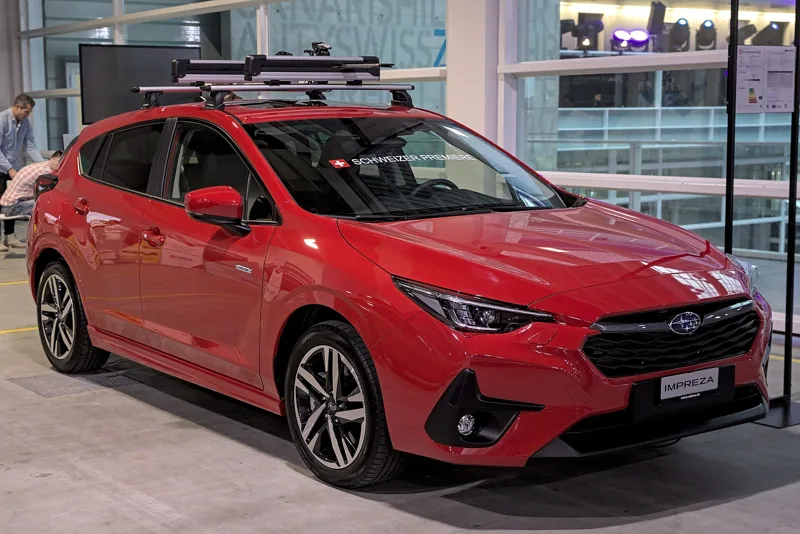
The sixth generation removed the sedan and the manual gearbox, leaving a hatchback paired with a continuously variable transmission. It gained standard EyeSight and automatic emergency braking, and it took the dual-pinion steering rack from the WRX. The 2.5 RS returned with a 2.5 litre FB25D engine making 182 hp, the first revival of that model since it was discontinued in 2005.
Subaru also sold a crossover-styled version of the fourth generation. The XV, which debuted at the 2011 Frankfurt Motor Show, gave buyers a raised and more rugged take on the Impreza's running gear.
How did the fifth generation sell in Japan?
Japanese buyers placed 11,050 orders for the fifth generation soon after its launch, well above a monthly target of 2,500 units. Customers switching from other brands made up 51 percent of those orders, a sign that the car was attracting new buyers rather than only loyal ones.
North American models were built for the first time at Subaru of Indiana Automotive in Lafayette, Indiana. Models for markets outside North America are built in Japan, and the Crosstrek continues to come from Japanese plants.
What are the Impreza specifications?
The table lists core figures for the reference cars that define each era of the Impreza, from the 1992 launch and the 22B to the sixth-generation RS. Because the range spanned sedans, wagons, hatchbacks and performance models, each row names the version it applies to rather than giving one figure for the whole line.
| Specification | Detail |
|---|---|
| Launch | Announced 22 October 1992; Japanese sales from November 1992 |
| Engine layout | Boxer flat-four, 1.5 to 2.5 litres |
| First WRX output | 240 PS (177 kW; 237 hp) |
| 22B STi | 2.2 litre EJ22G, 280 PS (206 kW; 276 hp), 1,270 kg (2,800 lb) |
| Third-generation WRX | 227 hp (169 kW) from 2.5 litres; 0 to 100 km/h in 5.8 seconds |
| Fifth-generation 2.0 litre | 152 hp in North American specification; 28 mpg-US city, 38 mpg-US highway |
| Sixth-generation RS | 2.5 litre FB25D, 182 hp, 178 lb-ft (241 Nm) |
| Sixth generation revealed | 17 November 2022 |
Those figures show how the Impreza's output moved up and down as the range changed. The early WRX started at 240 PS (177 kW; 237 hp), the third generation sat at 227 hp (169 kW), and the sixth-generation RS offered 182 hp, while the fifth-generation 2.0 litre made 152 hp in North American trim. Read together, the numbers show a car whose headline power did not follow a straight line.
Frequently asked questions
How much power did the 22B STi make?
The 22B used a 2.2 litre EJ22G engine rated at 280 PS (206 kW; 276 hp). Only 400 cars were sold in Japan, with 24 more built for export.
Has the Impreza always been all-wheel drive?
No. Front-wheel and all-wheel drive versions were offered from the start, and Subaru made all-wheel drive standard in North America from 1997. Some markets now sell only all-wheel drive cars.
When did the Impreza name leave the WRX?
Subaru dropped the Impreza name from the WRX and WRX STI in 2014. The cars kept the Impreza chassis and body, with only the name removed.
How many police forces used the Impreza?
Several did. Estonian police bought 18 Impreza GX in 2003, the French gendarmerie took 73 Impreza WRX in March 2006, and the Singapore Police Force took eight in 2006.
Does the Impreza hold its value?
An iSeeCars study named the Impreza the lowest-depreciating sedan in the United States after five years. That makes it a useful reference point for buyers thinking about resale value.
_Auto_Zuerich_2023_1X7A1263.jpg)