How H.F.S. Morgan's Malvern Link garage became a century-old maker of ash-framed sports cars, from cyclecar racers and the 4/4 to the BMW-powered Plus Six and Supersport.
Morgan Motor Company is a British sports car maker founded in Malvern Link in 1910 by H.F.S. Morgan. It began with three-wheelers, moved to the 4/4 in 1936, and today builds ash-framed cars, including BMW-powered Plus Six and Plus Four models.
Morgan Motor Company is a British maker of traditional sports cars, built in Malvern Link and still majority-owned by the European investment group InvestIndustrial. Founded in 1910, it is known for ash-framed bodies and a design that has stayed close to its origins. It makes about 630 cars a year today.
Who founded Morgan and how did it start?
Henry Frederick Stanley Morgan, known as H.F.S. Morgan, quit his railway job in 1904 and helped start a garage that sold and serviced motor cars in Malvern Link. By 1909 he had built a car for his own use, the seed of the company's later models.
The first car was a single-seat three-wheeled runabout, powered by a Peugeot twin-cylinder engine from an abandoned motorcycle project. It had a backbone chassis, an idea Morgan retained for all later three-wheelers, and it used as little material and labour as possible.
A cyclecar racer from 1913 that still builds ash-framed sports cars in the same Malvern Link town a century later.
Why did Morgan start with three-wheelers?
Three-wheeled vehicles avoided the British car tax by being classed as motorcycles. Early Morgans were two-seat or four-seat three-wheelers, which made them cyclecars, and that status gave them a tax advantage over small cars such as the Austin 7.
Interest in the runabout led Morgan to patent the design. He showed single-seat and two-seat versions at Olympia in 1911 and became convinced that demand lay with the two-seater. The company was registered as a private limited company in 1912, with Morgan as managing director and his father as its first chairman.
How did Morgan build its early racing reputation?
In 1912 a Morgan single-seater set out to win the Light Car and Cyclecar trophy for the greatest distance in an hour at Brooklands. It covered 55 mi (89 km) and was narrowly beaten by a GWK, but the car returned later that year to reach nearly 60 mi (97 km).
The marque's breakthrough came in 1913, when W. G. McMinnies won the Cyclecar Grand Prix at Amiens in France at an average speed of 42 mph (68 km/h). That car became the basis of the Grand Prix model of 1913 to 1926, which in turn evolved into the Aero and Sports models.
How did the three-wheelers sell after the First World War?
After the war Morgan introduced an easily changed rear wheel that customers had been seeking. The 1921 Popular, which ran a JAP engine of 8 hp (6.0 kW; 8.1 PS) and had a poplar body, sold for 150 pounds, and by 1923 the name had changed to Standard.
Electric headlamps and electric starting followed in the 1920s, while prices steadily fell. By 1929 the Standard and Family sold for 87 pounds 10 shillings, and in 1933 the Family was priced at only 80 pounds, a sign of how hard the company was working to keep its cars affordable.
Why did Morgan's three-wheelers face competition?
By 1930 cheap four-wheeled cars were multiplying, led by the 100 pound Ford Popular. Morgan responded by fitting Ford engines to its own cars, and three-wheelers still enjoyed an annual tax of just 4 pounds, half the tax on an Austin 7, provided they stayed under 8 cwt.
Morgan's F-Series three-wheelers arrived in 1933 with a new pressed-steel chassis and a four-cylinder Ford Sidevalve engine. Production of the Ford-engined three-wheelers continued until 1952, when the three-wheeler era came to an end.
What was the 4/4 and why did it matter?
Morgan's first four-wheeler was released in 1936 and designated the 4/4, because it had four cylinders and four wheels. Its 34 hp (25 kW; 34 PS) 1,122 cc Coventry Climax engine powered a two-seater that sold for 185 guineas, or 194 pounds 5 shillings.
The 4/4 proved popular, and a four-place model was added in 1937, with a drophead following in 1938. A 4/4 entered at Le Mans in 1938 led to factory replicas with a fold-down windscreen and cycle fenders, priced at 250 pounds.
How did the Plus 4 and Plus 8 change the range?
The Morgan +4 was introduced in 1950 as a larger-engined car than the 4/4, using a 2,088 cc Standard Vanguard engine. Later +4s used Triumph TR2, TR3 and TR4A engines before production was suspended in 1969.
Faced with fewer large four-cylinder engines, Morgan began fitting the Rover V8 in 1968, creating the +8. Its displacement grew from the 2.1 litres of the Triumph TR4 unit to 3.5 litres and later 4.0, and the car could reach 60 mph from rest in 5.6 seconds.
In 2004 the Roadster replaced the departing Plus 8 with a traditional look and a Ford V6. The Mondeo-based engine later grew to 3.7 litres and 280 bhp (209 kW; 284 PS), and the company called the latest version the Roadster 3.7.
What was the Aero 8 and its relatives?
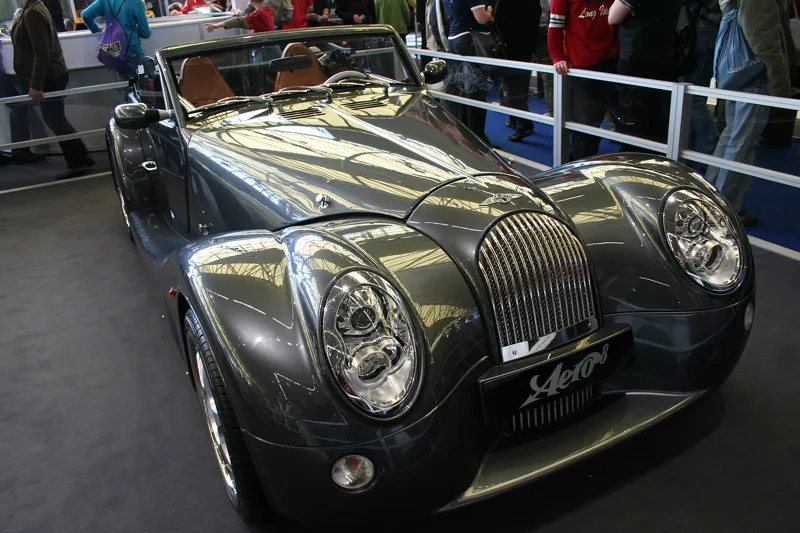
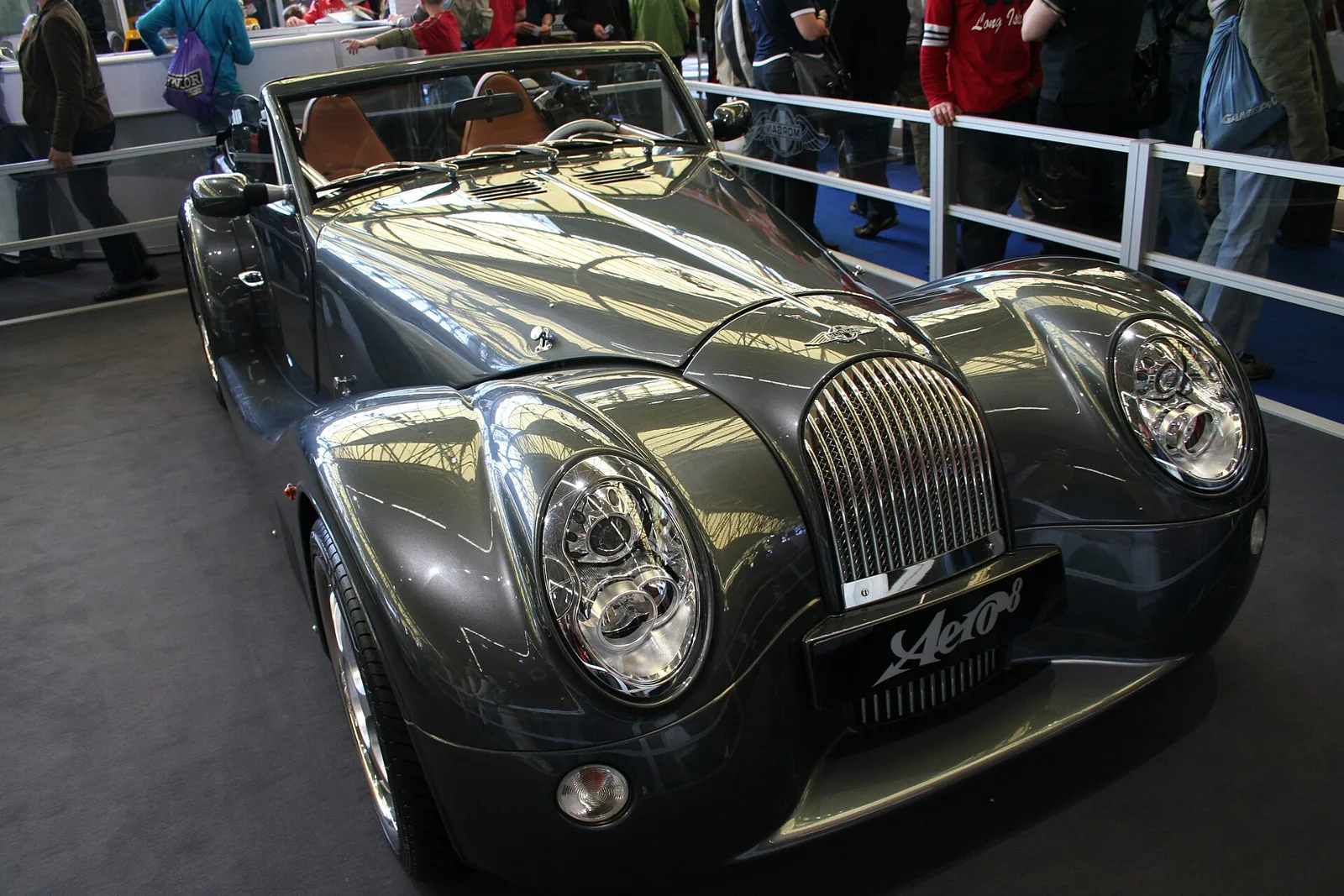
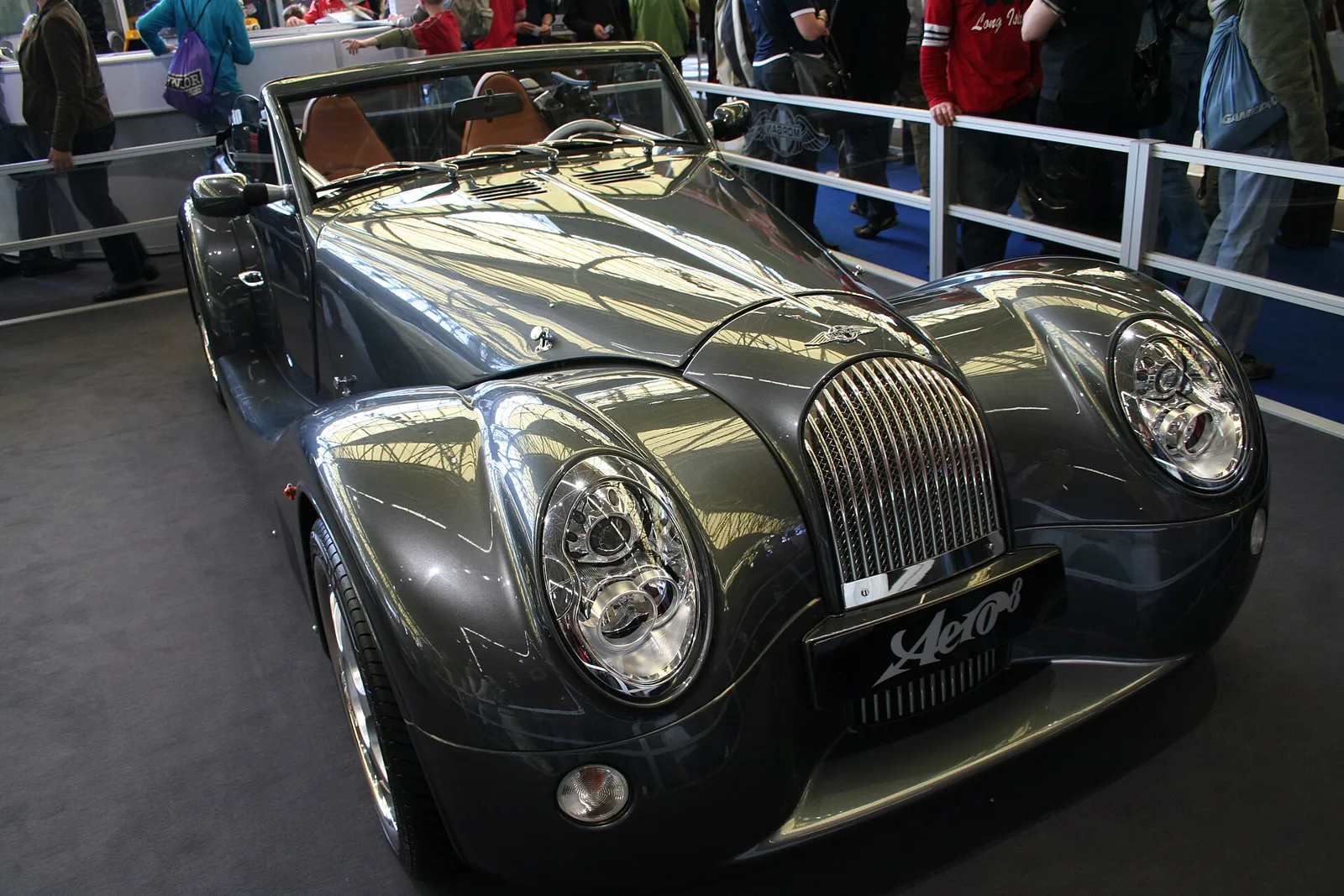
The Aero 8 arrived in 2000 with an ash body substructure over a metal chassis, which was aluminium in the Aero 8. It used a BMW V8 engine and was lighter than a BMW M3, even though it was heavier than traditional Morgans. Autoweek described its performance as supercar-like.
Later variants included the Aeromax coupe, a limited edition of 100 units built between 2008 and early 2010, and the Aero SuperSports, a targa-roofed car sharing the Aeromax chassis. The Aero Coupe and Plus 8 followed on the same bonded aluminium chassis.
How did Morgan build the Plus Six and Plus Four?
The Plus Six was announced at the Geneva Motor Show in March 2019. The car departed from the classic layout, dropping the ladder frame and sliding pillars for a bonded aluminium structure. Its front wheels use double wishbones and the rear a multi-link arrangement.
The Plus Six was powered by a BMW B58 turbocharged six producing 335 bhp, with an eight-speed ZF automatic. The Plus Four, revealed online in March 2020, used a BMW B48 turbocharged four producing 255 bhp, with a manual or automatic gearbox.
What was the Morgan 3-Wheeler?
Morgan announced its 3 Wheeler at the Geneva Motor Show in 2011. The production car used an S&S engine rather than the Harley-Davidson V-twin first mentioned, and its kerb weight was tested at 550 kg (1,213 lb), above the original estimate.
Top Gear featured the car in a track-day comparison and named it Not-A-Car of the Year in 2011. The 3 Wheeler sold successfully in the United States until production ended in 2019, when it was succeeded by the Super 3.
How did Morgan struggle with the United States?
For part of the 1950s and 1960s the United States was Morgan's largest market and took up to 85% of production. The first wave of US safety and emissions rules in 1971 changed that, and many imported cars were converted by dealers, making them grey-market vehicles.
In 2006 a request for an airbag exemption was refused, and the import of classic Morgans ceased. The Plus Four finally became available to US buyers in 2025 after a five-year effort to homologate the car.
What has happened to Morgan's ownership?
For most of its history the company was owned by the Morgan family. Peter Morgan ran it until a few years before his death in 2003, and a four-man management team took over after Alan Garnett resigned as chairman in 2006.
In 2010 the old company became dormant and its assets were sold to Morgan Technologies. A 6 million pound government grant followed in 2016, and a press release dated 5 March 2019 announced that InvestIndustrial had acquired a majority stake. Matthew Hole became managing director in October 2024.
What is the Supersport 400?
The Supersport was revealed in March 2025 at the company's Pickersleigh Road factory, hosted by Richard Hammond and broadcast online. It features a new CXV aluminium platform and a contemporary redesign of the marque's classic look.
In April 2026 Morgan launched the Supersport 400, the most powerful car the company has built, with 402bhp and a top speed of 180mph. It sits at the top of a range that now runs from three-wheelers to BMW-powered sports cars.
How did Morgan's coupes and limited cars develop?
The +4+ was a fibreglass coupe built from 1964 to 1967 on the +4 chassis. Its lighter body and reduced drag improved performance in every respect, but traditional enthusiasts did not embrace the departure, and only 26 of the fifty planned cars were built.
A two-seat +4 Competition followed from October 1965 to April 1967, and only 42 were built, with about 11 surviving. The Plus 4 Super Sports returned in 2014 as a limited edition, with just 60 cars made, all right-hand drive.
The Aero family grew in the late 2000s. The Aeromax coupe was followed by the Aero SuperSports, a targa-roofed car launched at the 2009 Pebble Beach show, and the Aero Coupe, which arrived at the end of 2011 and is not sold in the United States. The company announced the cancellation of the SuperSports and Coupe in March 2015.
Which Morgan projects never reached production?
The Plus E was an electric version of a classic Morgan, developed with Zytek and Radshape and funded by the UK government. It was displayed at the 2012 Geneva Motor Show, but it was never produced and the project was abandoned.
The Eva GT was a planned 2+2 grand tourer on the Aero SuperSports chassis, with a BMW N54 twin-turbo six rated at 302 bhp. Deposits were taken from 2010, but the car was cancelled, and dealers confirmed the end of the project in 2013.
How did Morgan cars perform in competition?
Morgan built its name on racing. The 1913 Grand Prix win was followed by success in the MCC reliability trial, which the company entered until 1975. In 1927 Morgan earned eleven gold medals and three silvers from fourteen entrants at the MCC London-Edinburgh Trials alone.
Clive Lones and C. T. Jay won the 1929 Cyclecar Grand Prix at Brooklands in a 750 cc car, averaging 64.7 mph (104.1 km/h). In 1930 Gwenda Stewart reached 113 mph (182 km/h) in a race-tuned Super Sports.
A Plus Four Super Sports won a class at Le Mans decades ago, and in 2012 a Pescarolo Sport prototype was branded as a Morgan. The Aero 8 GT also raced in the 2008 Britcar 24 Hours at Silverstone.
How did the 1990 Troubleshooter episode affect Morgan?
In 1990 Sir John Harvey-Jones examined the company for his television programme Troubleshooter. He recommended modernising production and clearing the order backlog, but Morgan rejected the advice, arguing that traditional methods were part of its appeal.
The company kept its waiting list, which helped it through recessions and protected its exclusivity. Sales rose after the programme, and Harvey-Jones said he was pleased to have been proved wrong in Morgan's case.
What are the key Morgan figures?
| Item | Detail |
|---|---|
| Founded | 1910, Malvern Link |
| First three-wheeler | Built for personal use in 1909 |
| First four-wheeler | 4/4, released in 1936, 34 hp (25 kW; 34 PS) |
| Plus 8 | Rover V8, from 1968; 0-60 mph in 5.6 seconds |
| Aero 8 | BMW V8 engine, introduced in 2000 |
| Plus Six | BMW B58 turbocharged six, 335 bhp |
| Plus Four | BMW B48 turbocharged four, 255 bhp |
| Supersport 400 | 402bhp, top speed of 180mph (April 2026) |
| Output | 630 cars per year (September 2025) |
| Employees | Approximately 220 |