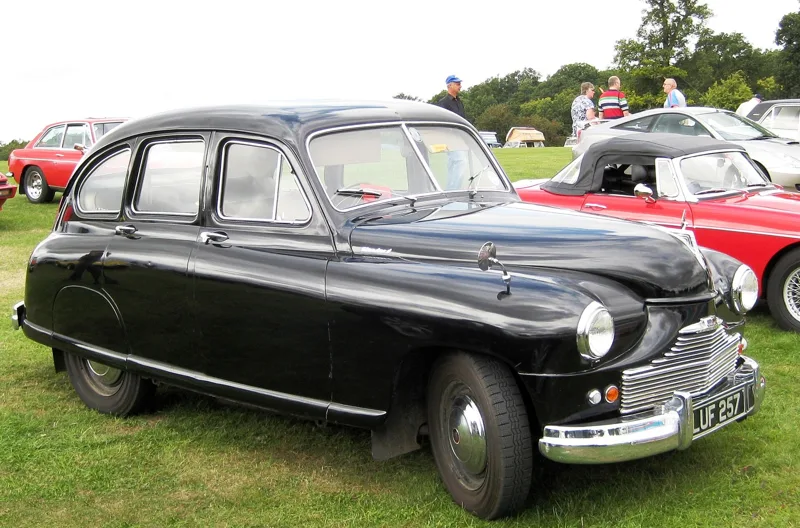
A Coventry-built postwar saloon named after a Royal Navy battleship, with four phases of development, a diesel option and a Sportsman performance model.
The Standard Vanguard was a saloon built by the Standard Motor Company in Coventry from 1947 to 1963. Designed mainly for export, it took its name from the Royal Navy battleship HMS Vanguard and went through four phases of development, including a diesel option and the Sportsman performance model.
Built in Coventry by the Standard Motor Company, the Vanguard appeared in 1947 and was discontinued in 1963. It was Standard's first postwar model, with a completely new body, and it was designed to sell around the world. Its name, Vanguard, recalled a famous Royal Navy battleship, and the car stayed on sale through four distinct phases of development.
Why was the Vanguard named and launched?
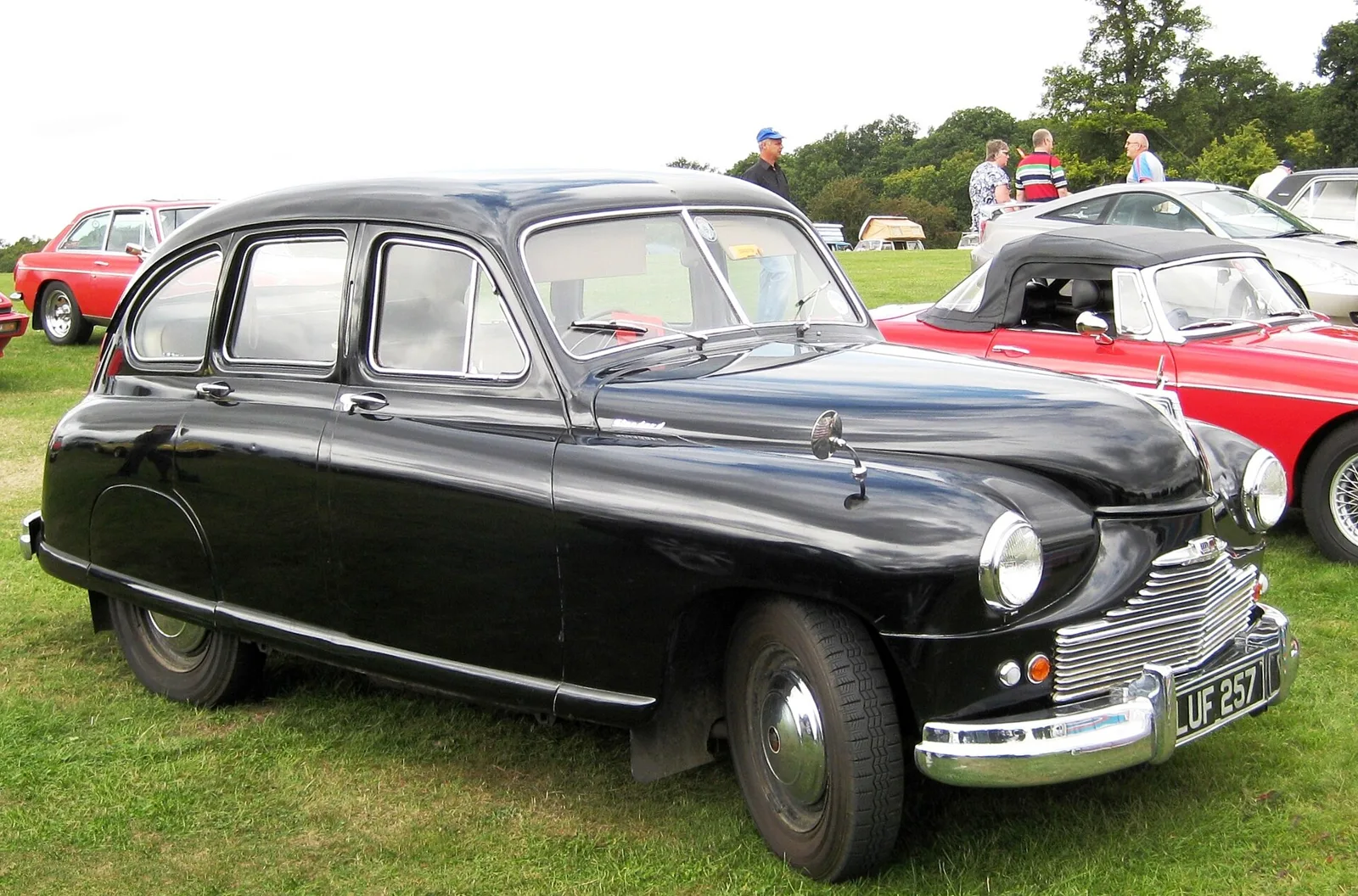
The Vanguard was designed in 1945 and announced in July 1947. It bore no resemblance to the company's earlier models, and it was the first car to carry the new Standard badge, a stylised representation of griffin's wings. The company intended it mainly for export, which was the postwar priority in Britain.
The name recalled HMS Vanguard, the last battleship of the Royal Navy, which was launched in 1944 amid much media attention. Standard had to negotiate extensively with senior Royal Navy personnel to use the name. Many buyers at home and in English-speaking export markets had recently served in uniform, so a naval name carried real resonance.
The car was first shown at the Brussels Motor Show, in February 1948. Production started in mid-1948, but all output went abroad. In September an estate car and a utility pick-up were announced, followed by a 12 cwt delivery van.
A postwar export saloon built for the world's markets, named after a battleship and remembered for its four-phase development.
What was the Phase I Vanguard like?
The Phase I car had a conventional chassis with a slab-sided body mounted on it. The chassis members were pressed-steel channels welded into a box with cruciform bracing. The front end was independently sprung on coil springs, while the rear had a live axle on leaf springs. Both ends carried anti-roll bars.
Stopping power came from hydraulic brakes with 9-inch (228 mm) drums at every corner. To maximise cabin room, the gear change was a column lever, first to the right of the wheel and later to the left. The engine was an overhead-valve unit with an 85 mm bore and 92 mm stroke, fed by a single Solex carburettor.
The Phase I engine developed 68 bhp (51 kW) at a compression ratio of 6.7:1. It used wet cylinder liners and was essentially the same unit that Standard made for the Ferguson TE20 tractor, adapted for car use. The same engine served the whole range until the Six arrived in 1960.
The three-speed gearbox had synchromesh on all forward ratios. A Laycock overdrive was announced late in 1949 and reached buyers in June 1950, costing just under 45 pounds sterling including purchase tax. It operated on second and third gears, which in effect created a five-speed box.
The Vanguard shared the honour of the first Laycock fitment with the Triumph Renown. Early units worked by cable on top gear until 1954, when a solenoid was added and the overdrive covered the top two gears.
How did the Vanguard sell in export markets?
After the war cars were in short supply, creating a seller's market. The Vanguard was meant to earn export income, especially in Australia, and restricted availability helped attract willing buyers. Almost everything built in the first two years was shipped abroad, and home deliveries only became significant in 1950.
West Germany was another important market. In that slowly recovering market, the Vanguard sold 405 units in 1950, ranking third among imported cars. Its sales that year accounted for more than 70 percent of British cars sold in West Germany, while rivals had been caught out by the lack of dealers and parts.
The body style was also adapted for commercial use. The estate arrived in 1950, and a panel van with a 12 long cwt payload of 1,344 lb (610 kg) was offered alongside a pickup. The Royal Air Force used these three models extensively, and the 12-cwt van was the most common variant.
What did the Phase II Vanguard change?
The Phase II was unveiled in Geneva in March 1953 as a contemporary ponton three-box saloon. Boot capacity rose by 50 percent over the Phase I, and a larger rear window improved visibility. The grille was extended to encompass the sidelights, and the Swiss importer AMAG assembled Phase I cars for its market before that.
Mechanically there were few changes. The clutch became hydraulic, the compression ratio rose to 7.2:1, the front anti-roll bar was dropped, and wider 6.00x16 tyres improved road holding. A Phase II tested by The Motor without overdrive reached 80 mph (130 km/h) and ran 0-60 mph in 19.9 seconds.
Was there a diesel Vanguard?
Standard was the first British carmaker to offer a diesel, fitted at the factory, starting in February 1954. The engine was a Standard-built 20C unit developed for the Ferguson tractor. Tractor diesels were limited to 2,200 rpm, but road-going versions had no limiter and delivered 60 bhp (45 kW) at 3,800 rpm.
Performance was modest, with a ceiling of roughly 65 mph (105 km/h). The engines retained the tractor's manual decompressor and over-fuelling systems, which had to be operated when starting from cold. The Motor tested the diesel in 1954 at 66.2 mph (106.5 km/h), reaching 50 mph in 31.6 seconds and returning 37.5 miles per imperial gallon on the test.
In all, 1,973 diesel Vanguards were built. The diesel never matched the petrol cars for speed.
How did the Phase III Vanguard differ?
The Phase III went on show at the British International Motor Show in October 1955, and it was a radical change because it eliminated the separate chassis. The front suspension was independent on coil springs, bolted to a substantial sub-frame that also carried the steering gear, and semi-elliptic leaf springs were used at the rear.
The new body was lower, had more glass and used a one-piece curved windscreen in place of the old two-piece flat design. The wheelbase grew by 8 in (203 mm), a heater became standard, and the seats were covered in Vynide with leather on request. The car was lighter than the model it replaced, and the gearing was changed to improve economy.
The Motor tested an overdrive Phase III in 1956 and recorded a ceiling of 83.7 mph (134.7 km/h) and 0-60 mph in 21.7 seconds, with 25.9 miles per imperial gallon on the test. That car sold for 998 pounds sterling, taxes included. In 1957 the Australian-built Phase III received a facelift with a new mesh grille and fins on the rear guards.
What was the Vanguard Sportsman?
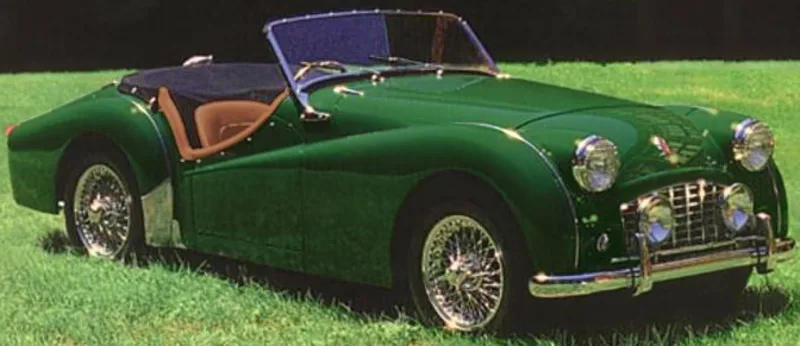
The Vanguard Sportsman was a performance model announced in August 1956. It had a tuned engine rated at 90 bhp (67 kW), with a compression ratio of 8.0:1, twin SU carburettors and better pistons. The engine's features were similar to those of the Triumph TR3 sports car, although the manifold and carburettor set-up was angled differently.
Other changes included a final drive ratio lowered to 4.55:1 for stronger acceleration, with brake drums enlarged to 10 in (254 mm). The Sportsman had a squarer front grille, which gave it a slightly higher and squarer appearance than the standard car. Just 901 were made by 1958, and around 50 more followed to special order, with a 1994 test by Popular Classics citing a total of 962.
A Sportsman with overdrive tested by The Motor in 1956 reached 90.7 mph (146 km/h), accelerated from 0-60 mph in 19.2 seconds and returned 25.6 miles per imperial gallon, while its cost was given as 1,231 pounds sterling. The test car cost 1,231 pounds sterling including taxes.
How did the Ensign and Vignale versions differ?
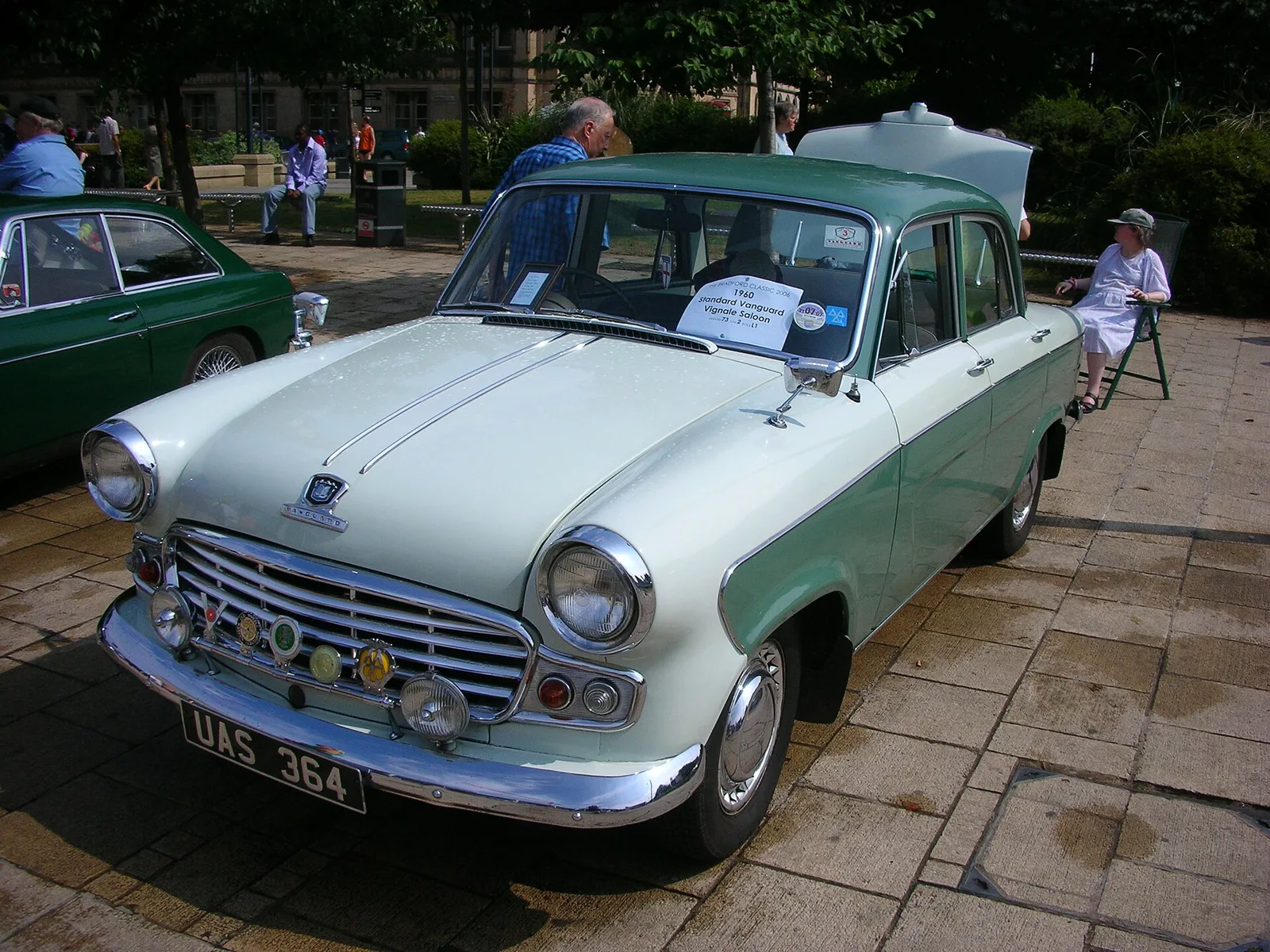
The basic Standard Ensign was announced in October 1957 with a 1670 cc engine and a restyle by Michelotti. It shared its body with the Vanguard Series III but had a cheaper specification, including a mesh grille and a simplified dashboard. It was the first Vanguard-based car to have a four-speed gearbox, with the lever moved to the floor.
Production of the Ensign reached 18,852 cars by 1961, and many were bought for company fleets and the armed forces. A diesel Ensign was announced in January 1960 with the compact P4C 1.6-litre engine from Perkins, which claimed about 50 mpg. An Ensign De Luxe followed in 1962 and 1963 with a 2138 cc engine and an estate option.
The Vignale facelift, designed by Michelotti and the coachbuilders Vignale, was introduced at the October 1958 Earls Court Motor Show. Its windscreen and rear window were deeper, and it had a revised grille and trim. The four-speed floor change became standard, while overdrive and an automatic were offered as options.
What was the Vanguard Six?
The last of the Vanguards was introduced at the end of 1960 with a six-cylinder 1,998 cc engine with pushrod valves. This was the unit later installed in the Triumph 2000, and it produced 80 bhp (60 kW) at 4500 rpm with twin Solex carburettors. Externally, the Six differed from the Vignale only in its badging.
In The Motor's 1960 test the Six managed 87.2 mph (140.3 km/h), with 0-60 mph arriving in 17.0 seconds. Australia also built coupe utility and van versions.
Why did the Standard name disappear?
Leyland bought Standard-Triumph in 1960, and the Vanguard Six's engine was developed into the Triumph 2000 with new funding. The Ensign and Vanguard gave way to the Triumph 2000 in 1963, and the Standard brand vanished from Britain after six decades.
The Australian subsidiary had introduced a coupe utility version of the Phase I in 1950, using the same 2088 cc four-cylinder engine. Utility versions were produced in Australia until 1964, and in the UK the Vanguard utility sold as a pick-up, mostly to the Royal Air Force.
What are the Standard Vanguard specifications?
| Specification | Detail |
|---|---|
| Maker | Standard Motor Company, Coventry |
| Production years | 1947 to 1963 |
| Phase I engine | Overhead-valve, 85 mm bore, 92 mm stroke, 68 bhp (51 kW), 6.7:1 |
| Phase II compression | 7.2:1 |
| Phase III engine | 2,088 cc, 68 bhp (51 kW), 7.0:1 |
| Sportsman engine | 90 bhp (67 kW), 8.0:1, twin SU carburettors |
| Diesel engine | Standard 20C, 60 bhp (45 kW) at 3,800 rpm |
| Vanguard Six engine | 1,998 cc, 80 bhp (60 kW) at 4500 rpm |
| Overdrive | Laycock de Normanville, from June 1950 |
| Wheelbase increase, Phase III | 8 in (203 mm) |
| Standard badge | Introduced on the Phase I, 1947 |