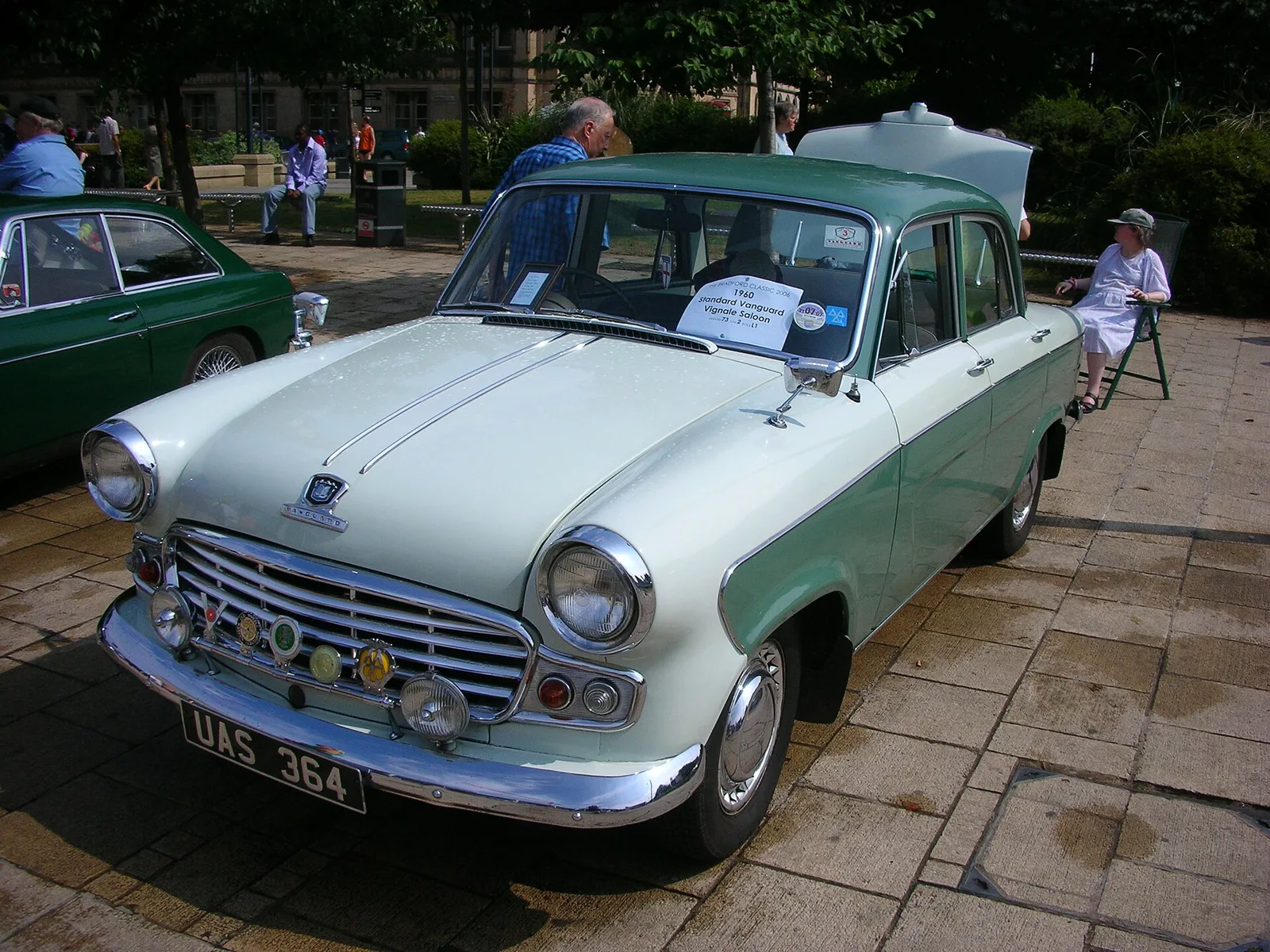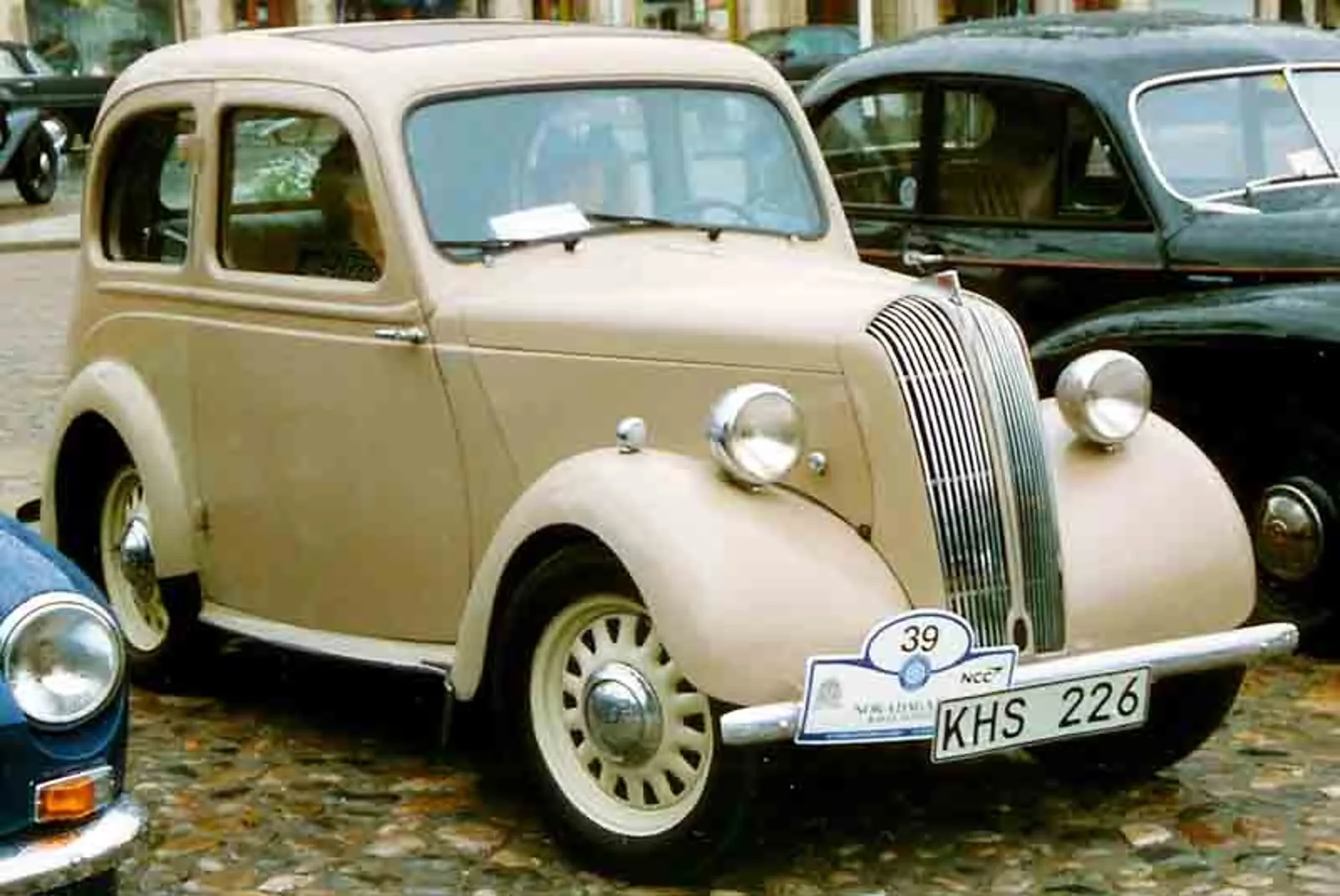
An upright, upscale 1250 cc saloon that cost more than a Chevrolet in America, and the stripped-down 803 cc Eight that came after it.
The Triumph Mayflower was an upscale 1250 cc family car sold from 1950 to 1953 that missed its sales targets. The Standard Eight was the line of small Standards, from the 1938 Flying Eight to the basic 803 cc Eight of 1953, which the Triumph Herald replaced in 1959.
The Triumph Mayflower of 1949 to 1953 was an upscale 1250 cc small saloon that listed in the United States at $1750, more than the $1629 asked for a basic two-door Chevrolet. It missed its sales targets, and Standard replaced it in 1953 with the deliberately basic 803 cc Standard Eight. Before both came the Flying Eight of 1938 and the 8 hp of 1945.
What was the Standard Flying Eight of 1938?
Standard launched the Flying Eight in late September 1938, just before the Earls Court Motor Show that October. It was the smallest of the Standard Flying family, and apart from the engine it was a new design. It also marked the company's first step into the smallest tax class, the 8 hp car.
The chassis frame was new, with box-section side members, and the front wheels were independently sprung on a transverse leaf spring. That made the Flying Eight the first British 8 hp family car with independent front suspension. An updated Flying Ten and a Flying Twelve received the same chassis features at the same time.
The engine grew out of the earlier Flying Nine and Ten unit but gained a counterbalanced crankshaft and an aluminium cylinder head. To fall into the 8 hp class, the bore was cut to 57 mm while the stroke stayed at 100 mm, which left a swept volume of 1,021 cc and a quoted 31 bhp at 4,000 rpm. A three-speed gearbox was fitted, and Bendix mechanical brakes were operated by cables.
Two bodies were offered from the start: a two-door all-steel saloon and an open tourer with two or four seats. Fisher & Ludlow made the saloon bodies at a brand-new factory in Tile Hill, Coventry. Carbodies made the tourers at Holyhead Road, Coventry, probably assembling the cars there too. The tourer had cut-down door tops and a windscreen that folded flat. Around the turn of 1938 and 1939, four to five months after launch, a drophead coupe joined them, built by Mulliners of Birmingham. The idea probably came from Mulliners rather than from Standard.
The prewar production ledger has not survived, so figures are best estimates. The saloon and tourer prototypes, registered DDU 514 and DDU 516, both date from 15 February 1938. Series production of saloons at Canley seems to have started in early September 1938, and it is probable that 23,069 right-hand-drive saloons had been built for the home market by the end of August 1939. Open tourers numbered about 1,500, in two batches of 1,000 and 500, built from early November 1938 until about July 1939. Dropheads were certainly under 1,000, with only one proper batch of 500 identified.
Export cars went out as knocked-down kits. Denmark took 550 left-hand-drive sets, 500 of them saloons and 50 tourers, for assembly by the importers, Bohnstedt-Petersen AS of Copenhagen. Kits also went to Australia, where Mortlocks of Perth assembled them and fitted locally built Richards bodies to the open tourers. How many Australian cars resulted is unknown. Canley kept building Flying Eights until the first weeks of 1940. The highest chassis number known today is 33433, on a saloon, while the Glass Guide quotes 34,601 as the last prewar chassis number.
The Autocar tested the saloon in its issue of 30 September 1938 and the drophead on 26 May 1939. Both reached a top speed very close to 100 km/h (62 mph). Standing-start acceleration from 0 to 50 mph took 26.2 seconds for the saloon and 25.3 seconds for the drophead, which weighed 26 kg (57 lb) less. Prices began at 125 pounds for the tourer and rose to 129 for the saloon, 139 for the saloon de luxe and 159 for the drophead.
The Mayflower listed in America for $1750, more than a basic two-door Chevrolet.
What was the post-war Standard 8 hp?
The little Standard returned fast after the war. The first 8 hp models, now without the Flying name, appeared within ten days of VE Day, and the car is sometimes called the Standard 4/8A. The one major mechanical change was a four-speed gearbox. The bore went down slightly to 56.7 mm, giving 1,009 cc and cutting the tax rating from 8.06 to 7.98, because the rules for rounding off the figure had changed. A tax rating of this sort is a formula applied to the engine, not a measure of how hard it works, and the quoted output fell to 28 bhp at 4,000 rpm.
Bonnet louvres were gone, which is the easiest way to tell it from a Flying Eight. The Carbodies tourer was dropped. Its successor was really a simplified drophead coupe: low door tops, removable sidescreens and a windscreen frame that no longer folded. Estate cars were made in 1948 alone and never went on general sale. Standard pitched the car against the Austin 8 and Morris Eight at 314 pounds. One shows up on screen: a Standard 4/8A Tourer is driven by the leads in the 1951 film The Man from Planet X.
Once this car had run its course, the group's next small model was the Triumph Mayflower. A new Standard Eight appeared only after the Mayflower fell short of its sales targets.
What was the Triumph Mayflower?
The Triumph Mayflower was a small, upscale family car built from 1949 to 1953 by the Standard Motor Company and sold through its Triumph subsidiary. It had a 1250 cc engine and was noted for sharp, upright "razor-edge" lines. It was announced on 28 September 1949, the first day of the Earls Court Motor Show, although deliveries did not begin until the middle of 1950.
Standard's managing director, Sir John Black, chose that look because he thought it would suit the American market. It echoed the Triumph Renown and, more distantly, the style still used by Bentley and Rolls-Royce. The shape had a practical benefit, since the upright body could seat four people in comfort in a small car. There were complaints, though: the rear seat was narrow and constrained by the rear axle.
Leslie Moore, who headed body design at Mulliners of Birmingham, drew the shape, helped by Walter Belgrove of Standard. Fisher and Ludlow built the shells at Castle Bromwich, Birmingham. The Mayflower was Standard's first unitary-construction car, and the first for the old Triumph company that Standard had bought out. In a unitary body the shell itself carries the loads, so no separate chassis is needed.
Under the bonnet was a version of the prewar Standard Flying Ten side-valve engine, updated with an aluminium cylinder head and a single Solex carburettor. It developed 38 bhp (28 kW) at 4,200 rpm. The three-speed gearbox, with a column shift and synchromesh on all forward ratios, came from the Standard Vanguard. Up front the Mayflower had independent suspension with coil springs and telescopic dampers, and at the rear a solid axle on semi-elliptic leaf springs, again Vanguard-based. Lockheed hydraulic brakes were fitted.
Triumph built nine prototypes. One, known as X488, was tested by the factory over 5,000 miles across Europe in 1950, which included the rooftop test track of Imperia Automobiles in Belgium. In production, ten drophead coupes were built in 1950. In Australia, Standard Motor Company (Australia) Limited made a coupe utility at its Port Melbourne plant in Victoria. Some 150 were built from Mayflower saloon kits imported from the United Kingdom, with the bodywork modified to form a rear load area with a timber floor and side panels. It was introduced in 1952.
Why did the Mayflower miss its sales targets?
A Mayflower tested at Brooklands by The Motor in 1950 reached 101.2 km/h (62.9 mph) and covered 0 to 50 mph in 26.6 seconds. Fuel consumption came out at 10.0 L/100 km (28.3 mpg imp). The test car cost 505 pounds including taxes.
That price put it in a different market from the Morris Minor. The 1,250 cc, 914 kg Mayflower faced an 803 cc, 775 kg Morris Minor that was less well equipped and aggressively priced, advertised that year at 382 pounds. Abroad the gap looked worse. In America it cost more than a basic Chevrolet, and a Ford Anglia, similar in size, power and engineering, was offered at a rock-bottom $948.
Testers liked the car anyway. Low performance notwithstanding, it won over Tom McCahill of Mechanix Illustrated and the writer known as The Scribe at Autocar. Even so, an upscale small car did not find a ready market, and sales fell short of what Standard expected. In a press release of early February 1952 Standard announced the replacement, adding that it would probably reach showrooms only in 1953.
What was the 1953 Standard Eight?
The new Standard Eight was a completely different kind of car. It was a unit-construction body powered by the new Standard SC engine, which had overhead valves, and the only body style was a four-door saloon. The 803 cc engine gave slightly less power than the larger side-valve unit it replaced, 26 bhp at 4,500 rpm, and in 1957 that was raised to 30 bhp at 5,000 rpm. The four-speed gearbox had synchromesh on the top three ratios, with optional overdrive from March 1957, and Girling hydraulic drum brakes did the stopping.
To keep prices down, the Eight was very basic at launch. It had sliding windows, a single windscreen wiper and no external boot lid at all. To reach the boot you folded down the rear seat, whose backrest was split in two, an idea that saloons would copy from the late 1980s onward to stretch luggage space into the cabin. The 1954 De luxe added wind-up windows, the Gold Star of 1957 added an opening boot lid, and from mid-1955 every Eight finally had wind-up windows. At launch the car cost 481 pounds including taxes on the home market.
The Motor tested an Eight in 1953 and recorded a top speed of 98 km/h (61 mph) and 0 to 50 mph in 26.5 seconds. Fuel consumption was 6.6 L/100 km (43 mpg imp).
What happened to the Mayflower and the Eight?
From the end of Mayflower production in 1953, no small saloon with the Triumph name was available in the United Kingdom until the Triumph Herald in 1959. The Herald also replaced the Eight that year, and it used a slightly enlarged version of the same engine. In the United States, the Standard Ten saloon and the Standard Companion estate were sold as Triumphs. The Ten itself, introduced in 1954, shared the Eight's bodyshell and running gear and outlived it, continuing until 1961.
The Mayflower left some marks. Its front suspension reappeared on the Triumph 20TS prototype and, in modified form, on the Triumph TR2. The car is also the subject of a well-known painting, The Car, by the Australian artist John Brack. Collectors can find it in die-cast form from Mikansue (1980s), Lansdowne (2006) and Oxford Diecast in 00 scale (2008).
How do Standard's small cars compare?
| Model | Years | Engine | Power | Gearbox | Quoted price |
|---|---|---|---|---|---|
| Flying Eight | 1938 to 1940 | 1,021 cc side-valve | 31 bhp at 4,000 rpm | 3-speed | 129 pounds (saloon) |
| 8 hp | from 1945 | 1,009 cc side-valve | 28 bhp at 4,000 rpm | 4-speed | 314 pounds |
| Triumph Mayflower | 1949 to 1953 | 1250 cc side-valve | 38 bhp at 4,200 rpm | 3-speed, column shift | 505 pounds including taxes |
| Standard Eight | 1953 to 1959 | 803 cc overhead-valve | 26 bhp at 4,500 rpm, 30 bhp from 1957 | 4-speed | 481 pounds including taxes |