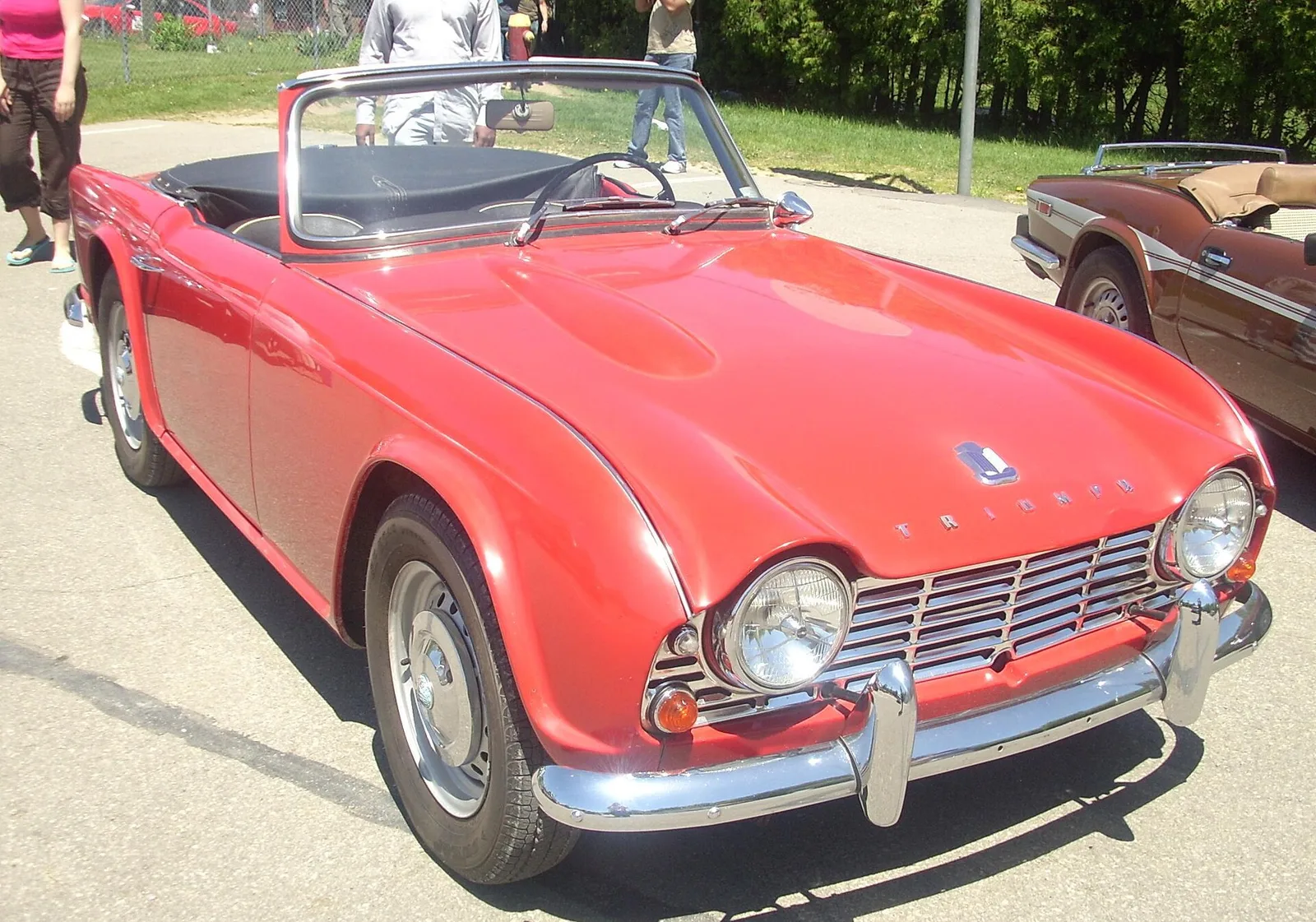
Italian styling, wind-down windows and a 2,138 cc four-cylinder engine turned the TR3's chassis into a true convertible for export buyers.
The Triumph TR4 was a British sports car built from 1961 to 1965 as the successor to the TR3A. Michelotti styled its body, which gave the car wind-down windows, and its 2,138 cc four-cylinder engine powered a racing career in America. About 40,253 were built, most for export.
Triumph's TR4 arrived as a refreshed TR with a body that finally let the windows wind down. Designed by an Italian stylist, it carried over much of the TR3's chassis and drivetrain, and most of the cars built went to export markets, above all the United States.
How did the TR4 come about?
The TR4 grew out of a plan to replace the TR3 that began as early as 1956. Triumph was short of capital and had lost its chief stylist, so it turned to Giovanni Michelotti for a new body, and the result was a car based on the Zest prototype.
Managing director Alick Dick invited Michelotti to design a concept for the company. His answer was the TR3 Speciale, known as the TR Dream Car. Vignale built it on an unmodified TR3 chassis, and its styling drew on American fashions of the day, with tailfins, a full-width grille, lidded headlamps set into the wing tops and two-tone paint. It was first shown at Geneva in March 1957.
Triumph judged the Speciale too expensive to put into production, but it handed Michelotti the new Triumph Herald to design. Later in 1957 Standard-Triumph asked him for a serious proposal for a revised TR. The resulting prototype, code-named Zest, was built on a TR3A chassis and was complete by 1958.
Zest had a full-width body, with headlamps recessed at the sides and mounted high in the grille, standing above the bonnet. The bonnet was shaped into cowls over the lamps.
Michelotti gave the TR wind-down windows and a true convertible body for the export market.
What were the 20X engine and the Zoom body?
Triumph's Competitions department was developing a high-performance engine labelled 20X, a dual overhead camshaft inline four expected to produce 160 hp (119 kW). Later it was nicknamed Sabrina after the actress Norma Ann Sykes. The 20X needed a chassis that was four inches wider in track and six inches longer in wheelbase than the TR3.
In late 1958 Michelotti was commissioned to style a body for the 20X test chassis. The new shape, named Zoom, was full width, with tall doors that held wind-down windows, and with its headlamps moved up onto the wing tops. Two prototypes existed by 1959: a convertible and a coupe with a removable roof panel.
Three Triumph TRS race cars wearing the Zoom body, with 20X DOHC engines, were entered at Le Mans in 1960. They staged a formation finish but were unclassified, having failed to cover the mandatory distance. Revised and entered again in 1961, they placed ninth, eleventh and fifteenth overall, which earned Triumph the team award for manufacturers.
Mid-1960 found Triumph weighing two possible TR successors, Zest and Zoom, which together carried a programme cost of 676,000 pounds. Zest was originally intended to follow the TR3, while Zoom was considered as an upmarket model. The cost of producing a detuned 20X engine killed the Zoom project as a new TR.
Management decided that neither car suited the target market. The TR4 ultimately rested on Zest, though it took the wider track and the hardtop option from Zoom.
What did the TR4 look like?
The TR4 looked like a squarer, more modern sports car than the TR3. Its new body, built at Triumph's Speke factory, dropped the cutaway doors and sloping boot lid of earlier TRs, and its taller doors allowed wind-down windows, making it a true convertible. The squarer tail gave the car a roomy boot.
A power bulge sat off-centre on the bonnet, making room for the engine's two carburettors. Early cars had a short bubble, while cars after chassis CT 6429 had a longer one.
An optional hard top was available. It had a fixed glass backlight with an integral rollbar and a detachable centre panel, aluminium on the first 500 units, steel thereafter. The roof system was first seen on one of the Zoom prototypes, and it came five years before the Porsche 911/912 Targa.
Owners could also choose a vinyl insert and frame in place of the rigid panel. The rigid panel could not be stowed inside the car, but the vinyl version could. Factory catalogues listed the rigid top and backlight as a Hard Top kit, with the vinyl option sold as the Surrey top.
Inside, the update brought fascia vents that could be adjusted, plus a steering column that could collapse. These additions were considered essential to stay competitive with rivals, particularly in the United States, where most TR4s were sold.
What engine and gearbox did the TR4 use?
The TR4 used the Standard wet-liner inline four from the TR2 and TR3, enlarged from 1,991 cc to 2,138 cc. It had two valves per cylinder, pushrod operation and a four-speed manual gearbox with synchromesh on all forward gears, plus optional electric overdrive.
| Specification | Detail |
|---|---|
| Engine | 2,138 cc inline four, pushrod, two valves per cylinder |
| Bore | 83 mm to 86 mm (3.268 in to 3.386 in) |
| Carburettors | Pair of SU H6 or pair of Zenith-Stromberg CD175, depending on production period |
| Gearbox | Four-speed plus reverse, optional Laycock de Normanville overdrive |
| Wheelbase | 88.1 in (2,238 mm), unchanged from the TR3 |
| Track | 4 in (102 mm) wider at the front; 2.5 in (64 mm) wider at the rear than the TR3 |
| Front suspension | Upper and lower wishbones, telescopic dampers |
| Rear suspension | Live axle, semi-elliptical springs, lever-arm dampers |
| Steering | Rack and pinion |
| Wheels | 15x4.5 inch disc as standard; 48-lace wire wheels optional |
| Production | 40,253 built, 18 July 1961 to 6 January 1965 |
The smaller 1,991 cc engine came at no extra cost for owners intending to contest the under-two-litre racing classes of the era. The factory fitted either SU or Zenith-Stromberg carburettors, depending on when the car was built.
The TR3 had not synchronised first gear, so the TR4's fully synchronised gearbox was a real improvement. The optional overdrive worked on second, third and fourth gears, giving an effective seven-speed close-ratio gearbox.
Chassis, suspension and wheels
The TR4 retained the TR3's ladder frame, braced in a cruciform pattern at its centre. Its wheelbase stayed at 88.1 in (2,238 mm), but the tracks were wider, and the front suspension geometry was revised during production. A smooth upper wishbone marked the revised geometry, and the front brake caliper and pads were also changed.
Rack and pinion steering replaced the cam and lever arrangement used on the earlier TRs. At the rear, a live axle sat on semi-elliptical springs with lever-arm dampers.
The standard wheels were 15x4.5 inch discs. Optional 48-lace wire wheels came in three finishes: body colour (rare), matte silver stove-enamelled with chrome spinners (the most common choice), or chrome. Tyres were most often 590-15 bias ply, with radials optional. American Racing alloy wheels, made from magnesium and aluminium, were offered in the US in 15x5.5 and 15x6 inch sizes.
How many TR4s were built?
Triumph built 40,253 TR4s in three and a half years, from 18 July 1961 to 6 January 1965. Of these, 37,661 went to export markets, mainly the United States, and only 2,592 were sold at home. The export figures show how much the car depended on American buyers.
Cars were finished at the Canley-Fletchamstead plant outside Coventry. Complete Knock-Down kits were also assembled at Mechelen in Belgium and at Borgo Panigale in Italy, in a plant that belonged to Ducati.
American dealers worried that buyers might not accept the updated styling, so a short run of TR3s, usually called TR3Bs, was built for the US market in 1961 and 1962. They had the TR3A body and chassis, but they carried the TR4's 2,138 cc engine and fully synchronised gearbox.
Triumph's other sports cars sold in far larger numbers. The TR2 sold 8,635 over three years from 1953 to 1955, the TR3 sold 74,800 from 1955 to 1962, the TR6 sold 94,500 from 1968 to 1976, and the TR7 sold 111,500 from 1975 to 1981.
As of the second quarter of 2022, about 953 TR4s were licensed with the DVLA, and a further 216 were registered as SORN, meaning they were declared off the road. A small number of TR4s also served as Fast Pursuit Cars with police forces, including Manchester City and Southend-on-Sea.
How did the TR4 perform in racing?
The TR4 enjoyed a string of racing successes in America, largely thanks to Kas Kastner, an engineer based in California, and his leading driver, Bob Tullius. Kastner was service supervisor for Triumph in California.
In 1961 the car numbered CT 7L, piloted by George Waltman and Nick Cone, took its class at Sebring and finished 30th overall. In 1962 a TR4 won the E production national championship. The SCCA then reclassified the car to D production, a class Tullius won in 1963 and 1964.
Kastner and Mike Cook, from Triumph's advertising department in New York, convinced the factory to send three fresh TR4s to the 1963 Sebring 12-hour race. Preparation began in California in September 1962, and the cars flew to Florida for the March race. They finished 22nd, 24th and 35th of 65 entries, and took the first, second and fourth places in the 2.5 GT class.
That effort laid the foundation for the Triumph Competition Department under Kastner, and it helped publicise the car. A privateer TR4 finished last in the 1964 Sebring 12-hour race, but Kastner returned in 1966 with four prepared TR4As, three of which won their class.
Charlie Gates, in a car Kastner had prepared, also took the 1965 SCCA D modified title at Daytona, beating Ferraris and other exotics. Vintage racing kept the car busy, and as late as 1991 one took an SCCA class title.
Did the TR4 compete in rallying?
The works team entered three TR4s in the 1964 Canadian Shell 4000 rally. The works cars had reinforced chassis members and aluminium body panels, both aimed at adding stiffness and cutting weight, and Kastner prepared their engines in New York before they received lightweight magnesium wheels.
The rally cars did not place well, but the surviving examples are now quite valuable. One is owned by Neil Revington, proprietor of Revington TR in the UK. Across Europe and Britain the TR4 earned a reputation as a rally car in the early and mid 1960s, and privateers still run replicas in vintage rallies.
Australian hill-climbs, club rallies and circuit meetings all saw plenty of TR4s.
What was the TR4A?
The TR4A replaced the TR4 in 1965. It looked almost identical but had a reworked chassis, independent rear suspension and a wider track front and rear. Around a quarter of the US-market TR4As kept a live axle instead. Changes to exterior trim and interior fittings completed the update.
The independent rear suspension was the headline change, with a wider front and rear track. An estimated 25% of US cars reverted to a live axle on a slightly modified TR4A chassis.
What was the Dove GTR4?
A total of 43 Dove GTR4 and GTR4A fixed-head coupes were built for L. F. Dove Ltd., a car dealer in Wimbledon, London. Harrington Motor Bodyworks converted standard TR4s, and the firm was known for its Harrington Alpine, a Sunbeam conversion built along the same lines.
The Dove was conceived as a more weatherproof alternative to the drophead TR4, giving the dealership a way into the market for GT cars. The name carried an accent over its final letter, though the accent is not typically pronounced.
Each car had a water-jacket heater to help cold starts. Tinted swing-down acrylic visors were fitted to order, and two jump seats sat behind the front seats in matching upholstery. Some models had a wood-rimmed wheel, and a fully balanced engine built by Jack Brabham Motors or Laystall Engineering was available as an option.
Every Dove was built to order, so details varied from car to car. The price was 1,250 pounds, which was expensive for the time. In-gear pickup between 80 mph and 100 mph (130 to 160 km/h) was strong against the drophead TR4, and Autocar published a road test on 7 June 1963, with Autosport following on 12 July 1963. One example was exported through Australian Motor Industries in Melbourne, and up to a dozen cars are still thought to survive.