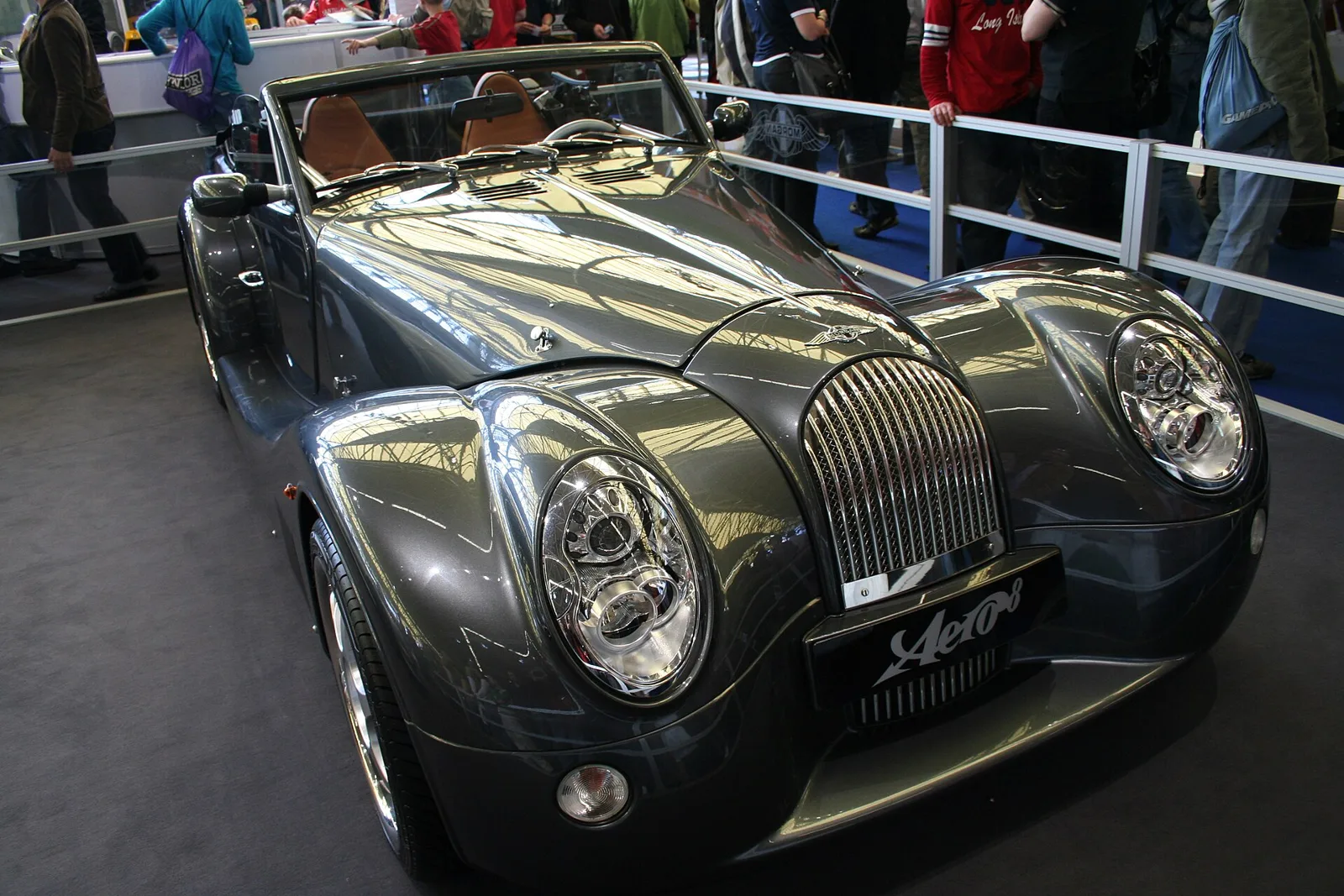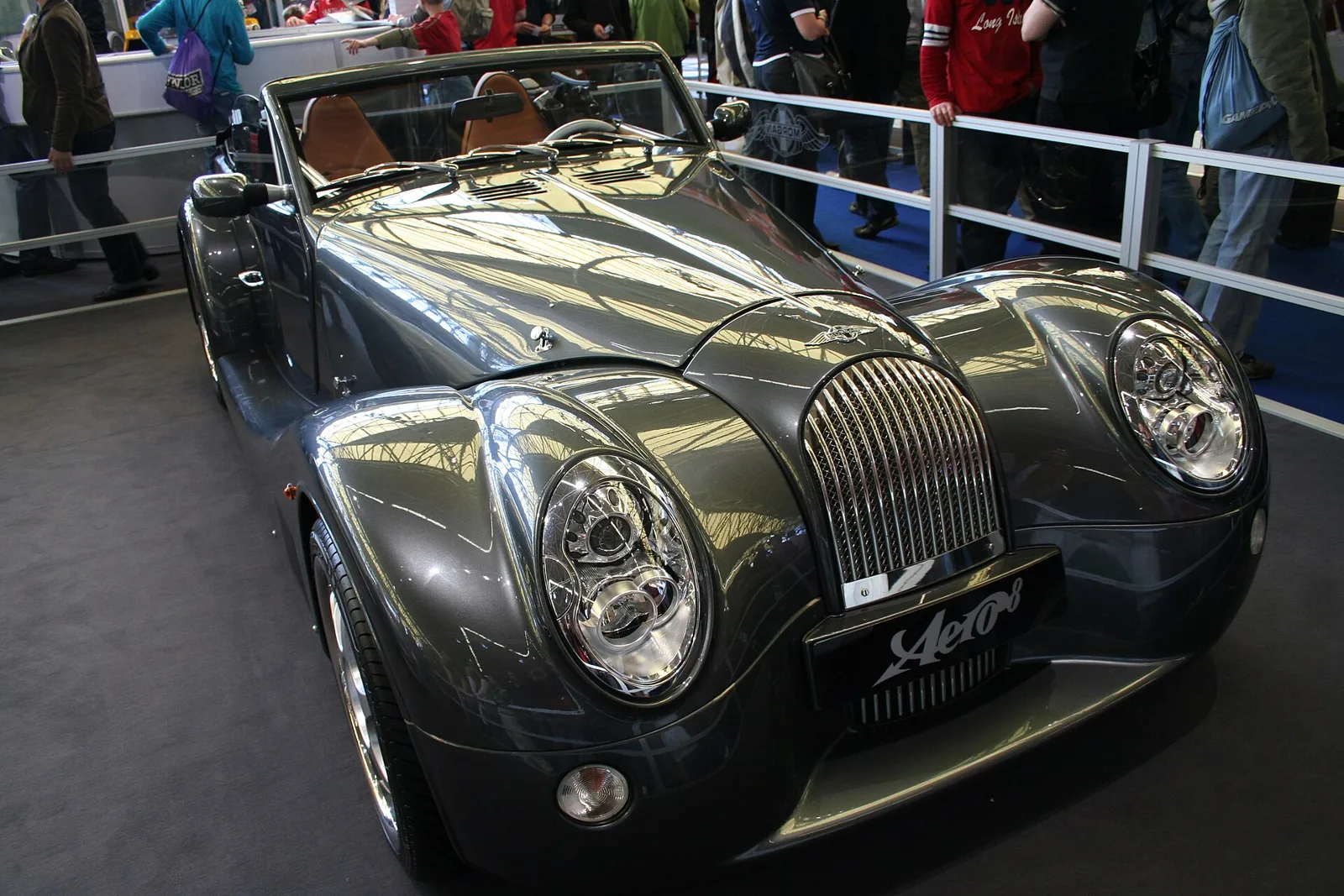
Morgan's first aluminium-chassis sports car, built from 2000 to 2018 with BMW V8s, cross-eyed headlamps and Le Mans appearances.
Built in Malvern Link, England, between 2000 and 2018, the Aero 8 combined an aluminium chassis with BMW V8 power. Its family of variants included the AeroMax, Supersports, Plus 8 and GTN, and it raced at Le Mans in 2002 and 2004.
Morgan's Aero 8 arrived in 2000 as the marque's first car with an aluminium chassis and stayed in production until 2018. Its BMW V8 engines, cross-eyed headlamps and Le Mans appearances still make it one of the most discussed Morgans of its era.
What is the Morgan Aero 8?
The Morgan Aero 8 was a sports car built by Morgan Motor Company at its factory in Malvern Link from 2000 to 2018. It was the first new Morgan design since 1964 and was touted as the company's first supercar, with a bonded aluminium chassis rather than the wooden body tub of traditional Morgans.
Charles Morgan unveiled the first Aero models at the Geneva Motor Show in 2000, calling the project the biggest development programme the company had ever undertaken. That programme included racing in the FIA GT series and a partnership with BMW.
Design work was shared out. Chris Lawrence designed the chassis, Matthew Humphries drew the AeroMax, Aero Supersports and Aero Coupe, Radshape worked on the chassis and Superform on much of the body panels. Norman Kent of Survirn Engineering made the tooling for the aerodynamic wings.
Morgan tested the car extensively. Endurance running took place at BMW's L'Autodrome de Miramas proving ground, and wind tunnel work was done at MIRA, which was another first for the company.
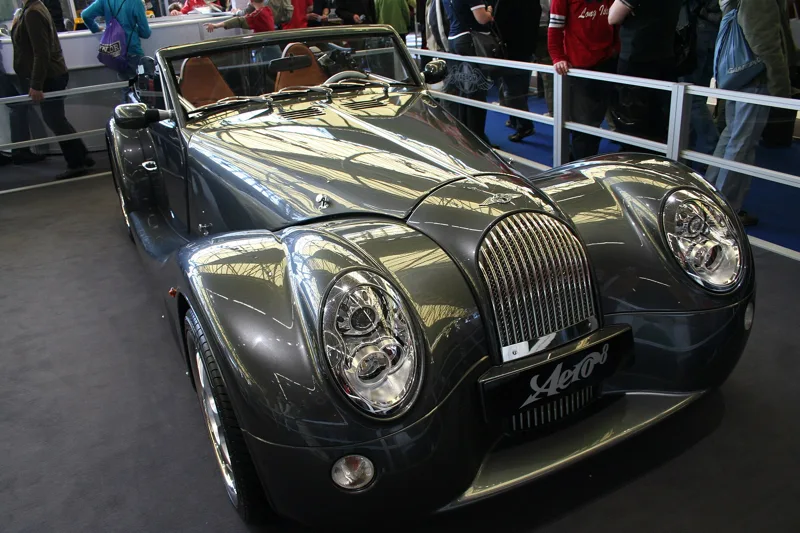
The first aluminium-chassis Morgan, with BMW V8 power and a headlight design that split opinion.
Why was the Aero 8 a break from Morgan tradition?
The Aero 8 used a bonded aluminium chassis with pre-formed elements, a sharp break from the aluminium-skinned wooden body tub that Morgan had built for decades. Handwork still went into the car, so the build kept some of the company's craft history.
The chassis had elements of an ash frame to link it to the traditional cars. Chris Lawrence's design borrowed features from racing cars of the period, including in-board shock absorbers, double wishbones at every corner, a flat floor, centre lock magnesium wheels and rose-jointed suspension.
The Series 1 had no anti-roll bars, an oddity for a modern sporting car. A limited-slip differential was fitted, but there were no other stability or traction aids, so the driver had total control of the car.
The car weighed 1100 kg, and its performance was described as on a par with Ferraris, Porsches and TVRs of the day. Its interior added a turned aluminium dashboard, an unusual asymmetric layout and a custom Mulberry case for a removable glovebox.
Why does the Aero 8 have cross-eyed headlights?
The cross-eyed look came from reversed VW Beetle headlamps, chosen because they gave the front wings the right angle. Aerodynamic needs led Morgan to put the leading edge of the front wings ahead of the radiator, which created room for a front splitter. Chris Lawrence spotted the idea.
Porsche lights were tried first, and the new Mini units were a favourite, but BMW did not want its new headlights to debut on the Aero, so neither option was used.
The look was criticised, and the company later changed it. From 2005 the Series 3 adopted Mini headlamps, with wing and front panel changes that resolved the squint of the earlier cars.
Around 210 Series 1 cars were built, with many smaller changes made along the way.
What engines powered the Aero 8?
The Aero 8 used BMW V8s throughout its life. The first car had a 4.4 litre M62 V8, which gave 282 hp (210 kW; 286 PS) and was paired with a 6-speed Getrag gearbox, and from 2007 the Series 4 used the 4.8 litre N62 V8 with an optional ZF automatic.
The Series 2 and 3 used a 4.4 litre N62B44 with a DIVA inlet manifold, the world's first continuously variable length inlet manifold, producing 333 bhp (248 kW) at 6,100 rpm and 331 lb-ft at 3,600 rpm.
The Series 4 engine, a 4.8 litre N62B48, produced 362 bhp (270 kW) and 370 lb-ft (502 N-m) of torque. That was a 13% power increase, giving a power-to-weight ratio of 315 bhp per tonne. The lighter car passed the Euro 6 standard, which heavier BMW saloons with the same engine could not meet.
The optional ZF 6HP26 six-speed automatic came with a sport manual mode, and Morgan said it gave better performance than the manual because of its lock-up clutch and low power loss design.
Factory output was up to 14 cars a week, counting both Aeros and traditional models.
How did the Series 2 and Series 3 differ?
Series 2 launched at the 2004 Los Angeles Motor Show as the first Aero made for sale in North America, and it was also called the Aero America. Series 3 followed in 2005 with new Mini headlamps and wing changes.
Series 2 moved the petrol tank to meet US rear impact rules, raised the boot lid and swapped the folding roof for a pram-style one. The asymmetric dashboard of Series 1 gave way to a conventional design, although the fly-off handbrake stayed. Somewhere near 60 cars were built, in both left-hand and right-hand drive.
Series 3 kept the interior and mechanical platform of Series 2, but its new front design went on to be used on the AeroMax and later Aero models. About 200 Series 3 cars were produced.
Did the Aero 8 race?
Yes. The Aero 8 ran at the 24 Hours of Le Mans in 2002 and 2004, and the 2004 12 Hours of Sebring ended with a 20th overall finish and 10th in the GT class. The Aero 8 GT3 car was built by AUTO GT.
The 2009 centenary year brought a factory entry in FIA GT3 with the Aero Supersports. The AutoGT team, sponsored by Banque Baring Sturdza, included former Renault F1 drivers Jean Pierre Jabouille and Jacques Laffite. At Silverstone, car number 100 took pole and won the first race, and car number 101 took pole and won the second.
With a custom gearbox and a slightly enlarged engine the car was competitive at once. Its low-revving V8 and side exhausts made a deep, loud, NASCAR-style sound. The rules changed after a year, which made it hard to run the car in 2010.
The Aero 8 also raced at the 2003 Bathurst 24 Hour, where it retired with a rare BMW engine failure, and it has been used in the British GT Series. One of the racing cars remains with the factory and can be seen on the factory tour.
What was the Aero 8 GTN?
The GTN was a 2004 limited-edition run-out model of the Series 1, with a 4619cc Alpina BMW engine producing 330 bhp (246 kW). It was a nod to the Aero GT and Le Mans racing cars, and only eleven were built, all in BMW blue and silver.
It had a carbon-fibre hardtop, the first hardtop on any Aero, along with a custom Mota-Lita steering wheel, carbon fibre trim and performance side exhausts. Richard Hammond showed its performance on Top Gear in Season 5 Episode 5.
The GTN managed 0-60 mph in 4.3 seconds and a top speed of 175 mph (266 km/h). Semi-slick AO48 tyres were fitted as standard to black OZ centre lock magnesium wheels.
What were the AeroMax and Supersports?
The AeroMax was first shown at the 2005 Geneva Motor Show as a bespoke car for a Morgan customer, and it became a limited run of 100 built from 2008 to 2009. The Aero Supersports was a targa-roofed development of that platform, shown in 2009.
The AeroMax design by Matt Humphries, then a 21 year old Coventry University graduate working at the factory, had an Empire Line or Art Deco influence that people compared with classic Bugattis. It was named after Charles Morgan's son Max.
The AeroMax became the first Morgan priced above GBP 100,000 when it listed at GBP 110,000, and it sold out within a few months.
The Supersports shares its chassis, engine and transmission with the Series 4. Its fuel filler sits on the rear wheel arch, and its boot is smaller because the targa panels could not fit a larger one. Charles Morgan visited Jay Leno's Garage in one.
The Aero Coupe, built from 2012 to 2016, used the same design with a fixed roof in place of the targa panels.
What was the Plus 8?
The Plus 8 was introduced in 2012 on the Aero 8 platform, with the 4.8 litre engine and a choice of manual or automatic gearbox. It kept the traditional body shape and interior with central dials, removable side-screens and a traditional soft-top, though it had no boot.
Morgan updated the Plus 8's rear suspension to match the Aero when the Series 5 arrived. Cars built in 2015 generally have Series 4 rear suspension, and cars built from 2016 have the Series 5 suspension.
Morgan describes the Plus 8 as the lightest V8 passenger car approved to European safety standards in the world.
When the supply of BMW 4.8 litre engines ran short, Morgan built a final batch of 50 Plus 8 models labelled Plus 8 50th Anniversary, marking 50 years of the Rover-based Traditional model moving onto the Aero platform.
A 2014 Plus 8 Speedster styled the car as a traditional cafe racer, with minimal aero screens like those on Caterhams and a steel-look alloy wheel.
How did the Series 5 and CX replace the Aero?
Morgan announced the Series 5 at the Geneva Motor Show in March 2015, and it was built from 2016 to 2018 with a soft top and the 4.8 litre BMW V8. The Aero chassis was then retired in favour of the CX aluminium platform.
The Series 5 had a completely new front and rear suspension with anti-roll bars, outboard wishbones and coil-over units. The rear was closer to the Supersports boat tail, and the fabric roof stored in the rear parcel slot, giving a flat rear deck.
The final run of eight Aero GTs had vents in the front wings, canards and an enhanced rear venturi. Priced at GBP 145,000, a substantial rise on the Series 5 list price, they sold out quickly.
The CX name means 110 in Roman numerals, because it was introduced in the 110th year of Morgan's business. The CX brought a new range of BMW powertrains. Shortly after the CX-based PlusSix arrived, InvestIndustrial, an Italian venture capital company, took a majority share in the business.
What was the Plus 8 GTR?
The Plus 8 GTR was a 2021 special project of nine cars, built from chassis bought at the sale of Bristol's assets in 2020. Bristol had announced a Bullet on the Series 5 platform in 2016, but only one prototype was built.
Morgan bought back the rolling chassis from Bristol's administrator before the liquidation auction. It named the car after Big Blue, the Plus 8 that raced in the 1990s.
Each of the nine cars had its BMW 4.8 litre V8 reworked and tuned to 375 bhp, with a 6-speed manual or automatic and a removable hardtop.
What are the Aero 8 specifications?
| Specification | Detail |
|---|---|
| Series 1 engine | 4.4 litre BMW M62TUB44 V8, 282 hp (210 kW; 286 PS) |
| GTN engine | 4619cc Alpina BMW V8, 330 bhp (246 kW) |
| Series 2 and 3 engine | 4.4 litre BMW N62B44 V8, 333 bhp (248 kW) |
| Series 4 and 5 engine | 4.8 litre BMW N62B48 V8, 362 bhp (270 kW) |
| Transmission | Getrag 6-speed manual or ZF 6HP 6-speed automatic |
| Chassis | Ultra-stiff aluminium alloy, double wishbones, Eibach coil springs, Koni dampers |
| Brakes | Cast iron discs, AP Racing 6-pot calipers at the front and 2-pot at the rear |
| Wheels | 8.5J x 18 and 8.5J x 19, PCD 114.3 mm, five holes |
| Series 1 performance | 0-62 mph in 4.8 seconds; top speed 160 mph (257 km/h) |
| Series 4 performance | Estimated top speed 170 mph (270 km/h); 0-100 km/h in 4.3 seconds manual, 4.1 automatic |
| Series 1 weight | 1100 kg |