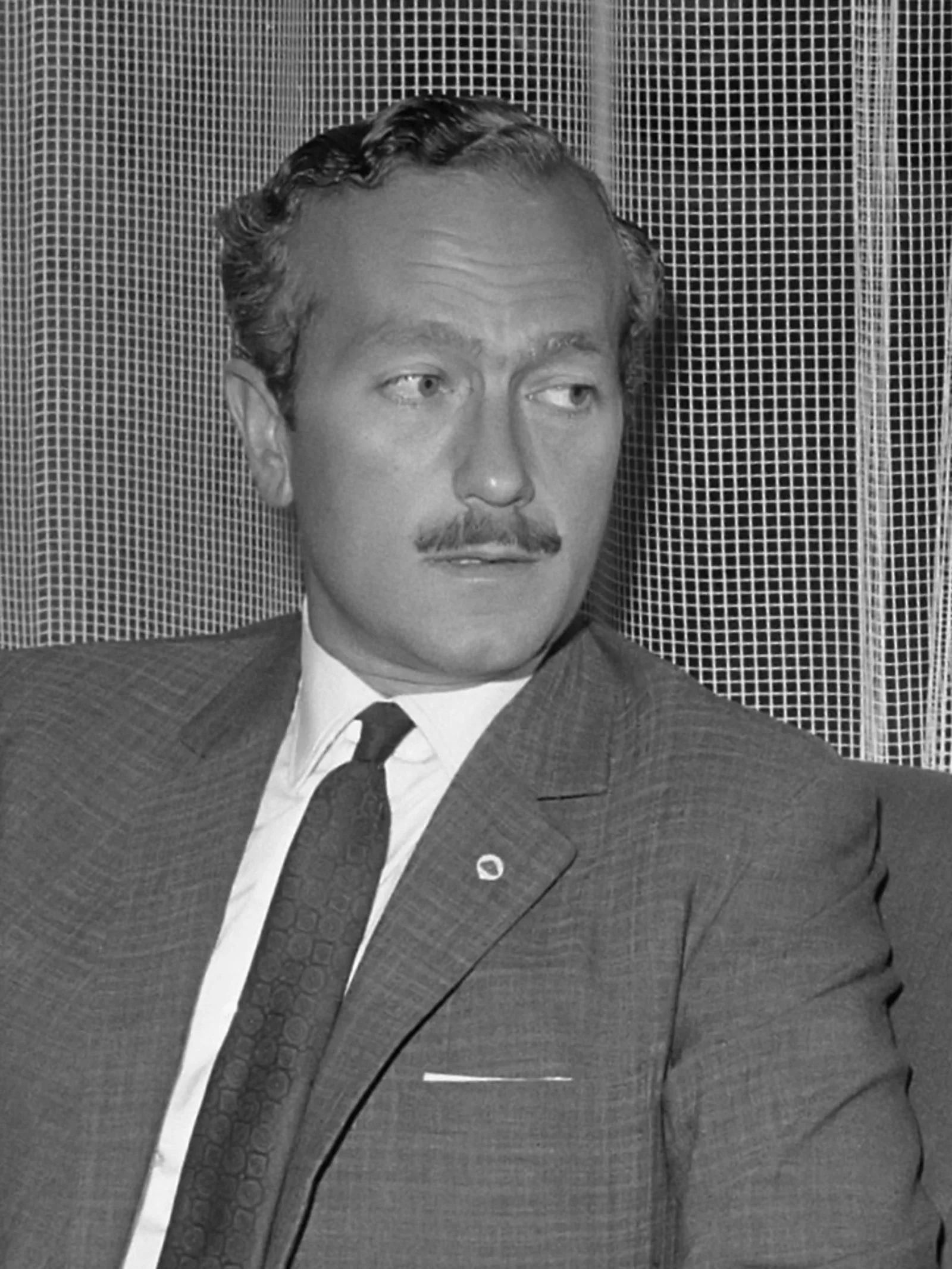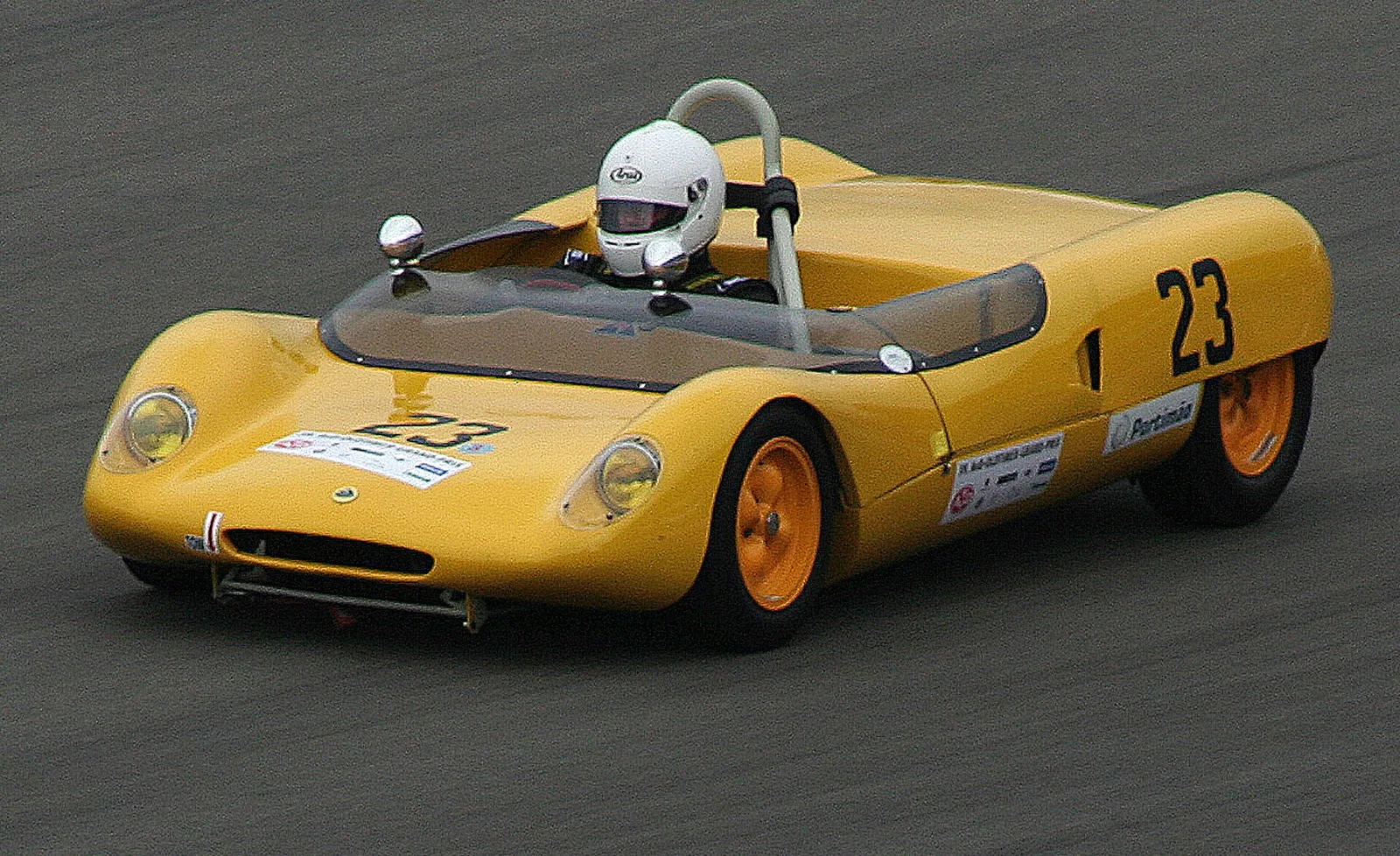
Colin Chapman's small-displacement racer from 1962: a Nurburgring surprise, a Le Mans scrutineering row and a long life in historic racing.
The Lotus 23 was a 1962 sports racer designed by Colin Chapman for FIA Group 4 racing. It carried its engine behind the driver, won a notable debut at the Nurburgring and remains a popular vintage car with many replicas built since.
The Lotus 23 was a small-displacement sports racing car designed by Colin Chapman for FIA Group 4 competition in 1962 and 1963. Its engine sat amidships behind the driver, and its fibreglass-bodied layout earned it a reputation as a giant-killer in its class.
The car is remembered for a stunning Nurburgring debut, a notorious rejection at Le Mans, a rival design that came out of the dispute, and a long afterlife in historic racing and replicas.
What was the Lotus 23 built to do?
The Lotus 23 was built for FIA Group 4 sports racing in 1962 and 1963. Colin Chapman designed it as a small-displacement racer with a nominal two-seat cabin and its engine mounted behind the driver. Unlike the Lotus 15 and 17 that came before it, the 23 used this amidships layout.
The engine was originally intended for units from 750 cc to 1300 cc, paired with a Renault four-speed transaxle. In production, most cars used a five-speed Hewland gearbox instead.
The amidships arrangement matched the configuration Chapman had developed on the Lotus 19, and the 23 carried that layout into its own class.
A small-displacement two-seater that shocked the Nurburgring, was turned away at Le Mans and still races in vintage events today.
How did the Lotus 23 meet FIA rules?
To satisfy the rules, the 23 had a luggage bay behind the driver's right shoulder, a wiper, a horn, headlight and tail light pairs, a rear number plate light, a cable-operated handbrake and room for one spare tyre under the front bodywork.
The chassis was a wider take on the Lotus 22 space frame, with a fibreglass body. The frame was mostly made by Arch Motors, and its parts carried the AM serial number.
Round steel tubes in the frame served a second purpose. The upper left pipe carried water to the front radiator, and the lower right side pipe and part of the rear cockpit tube returned it. Oil ran through a similar loop, so the frame itself acted as a cooler.
Most race organisers of the period banned antifreeze because it could make the track slippery, so the cooling had to work on water alone. The frame was large enough that some cars ran too cool in sprint races without a thermostat.
What suspension and brakes did the 23 use?
The front used double wishbones with outboard coil and damper units, a Triumph upright made by Alford and Alder and Triumph Herald rack and pinion steering. The rear had a top link, reversed lower wishbones and top and bottom radius arms.
Brakes were outboard Girling discs that were not ventilated. Ball joints sat at the tie rod and the front wishbone ends, while rose joints were used on the inner ends of the rear lower wishbones. The other suspension joints were rubber, mounted on short pipes welded onto the arms.
The halfshafts used Metalastic rubber doughnuts on their inner ends, so they carried no cornering force. Side loads went through the lower wishbone and the top I-arm link, which joined the frame's upper side tube to the upright.
Many suspension arms were shared with the Lotus 22, but the rear radius arms were angled differently in plan view. The two cars therefore could not swap that part, despite their family resemblance.
Which gearboxes and engines did the 23 use?
The 23 was designed around a Renault four-speed transaxle, but most cars ran a five-speed Hewland Mk.III. That gearbox was built from the Volkswagen magnesium alloy transaxle case, turned upside down, with straight-cut gears and dog rings. It was the most common choice in production cars.
On the Mk.III the shifter rod ran to the tail of the chassis. Because the rod was left largely exposed, a driver following closely could tell when the car shifted.
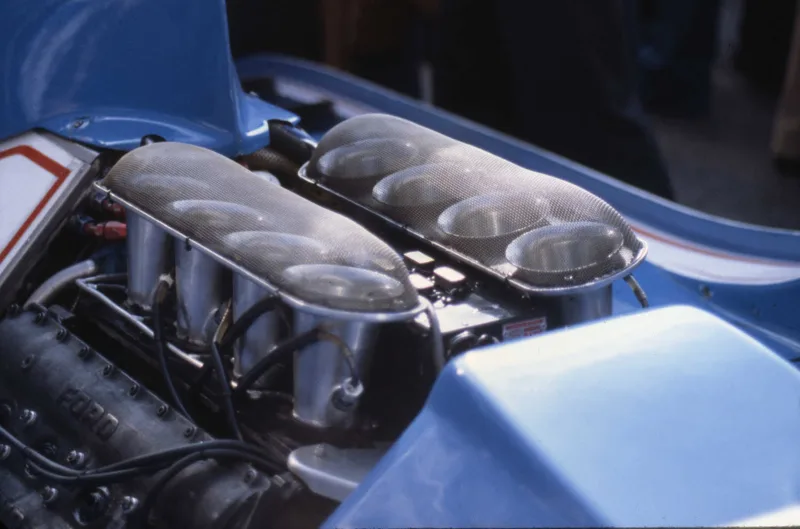
Engines varied across the car's life. The debut car used a 1.5-litre Cosworth Mk.X developed from the Lotus TwinCam, while privateers often ran a 997 cc pushrod Cosworth Mk.III. The chassis later needed extra tubes to take bigger engines.
The 23B's frame received extra tubes to cope with the torque of 1.6-litre TwinCam-based Cosworth Mk.XII and Mk.XIII engines. Smaller engines used the five-speed Hewland Mk.IV, and the carburettors were fed from a cold air box.
What changed in the 23B?
The 23B arrived in 1963 with its gear lever relocated to the driver's right, and its radiator and oil cooler combined into one unit. The lower fifth of that unit acted as the oil cooler, so one radiator core served both circuits.
Larger engines paired with the five-speed Hewland Mk.V, while smaller ones used the Mk.IV. Both gearboxes shared GKN differential gears from the Ford Zephyr.
The 23B proved especially effective, frequently beating cars from larger classes. Its narrow tyres, however, limited grip as the cars grew more powerful, and that shortcoming set up the next version.
How did the 23C differ from the 23B?
The 23C used wider Formula Two tyres on six-stud magnesium wheels front and rear, with body wing extensions to cover them. It was developed because the narrow tyres of the 23B limited grip against larger cars. The rear wings were cut away so the whole tyre and wheel showed in side view.
The original 23 and the 23B had four-stud front and six-stud rear wobbly-web wheels. The narrower front wheel and its tyre doubled as the spare. The 23C switched to six studs at both ends, which made the spare arrangement different too.
How did the Lotus 23 debut at the Nurburgring?
The Lotus 23 made its debut on the Nordschleife on 27 May 1962, in the 1000 km of Nurburgring. Jim Clark drove the car in the rain and built a lead of 27 seconds over Dan Gurney's Porsche after the first lap.
The 100 bhp (70 kW) car, with its 1.5-litre Cosworth Mk.X engine, shot away from a field of Aston Martin, Ferrari and Porsche machinery. Some of those cars had almost four times the Lotus's power.
Exhaust fumes from a damaged manifold overcame Clark on lap 12 of the 44-lap race, and he crashed out.
A second car, powered by a 997 cc Mk.III, was entered by Ian Walker Racing with Peter Ashdown and Bruce Johnstone at the wheel. It finished eighth overall and won the 1-litre sports car class, beating the winners of the 3-litre prototype and 1-litre prototype classes by three laps.
Why did Lotus 23s fail Le Mans scrutineering?
Two Lotus 23s were entered for the June 1962 Le Mans race, but they failed scrutineering on several technical grounds. The problems included windscreen height, fuel tank capacity, turning circle, ground clearance and the spare tyre rule. Most of these were fixed almost at once with a tall makeshift windscreen.
The spare tyre dispute centred on the rear wheels. The French scrutineers argued that a spare must cover a flat on either wheel, and a 23 with four-stud rears could not change a rear flat with the front spare.
Overnight, the factory machined four-stud rear hubs and flew them to Le Mans, but the scrutineers rejected the car again. They argued that the six-stud arrangement reflected the strength the original design needed, so the four-stud version was unsafe.
Mike Costin, Lotus's engineer at the event, put forward structural analysis showing that the change fell within the margin built in to accommodate the more powerful Cosworth Mk.IV and Mk.VII engines. The officials and the ACO stood firm.
What happened to the 23 with four-stud rears?
One of the two cars with four-stud rears was sold on the spot, without its engine, to Bernard Consten, the one-litre class winner. The sale came with a lease on the engine and a support deal, and Chapman set one condition: keep the four-stud configuration for more than one season.
Consten kept to that condition and won the Clermont-Ferrand 6 Hours and the 1000 km of Montlhery that year, with the studs, hub and wheel all intact. The result did not change the verdict at Le Mans.
How did Team Lotus respond at Le Mans?
Team Lotus stayed for the whole of the 1962 event and earned a class win in the 1.3-litre GT category, plus the Index of Performance prize, the latter with a Lotus Elite that David Hobbs and Frank Gardner drove. Both prizes came from the 1962 event that had excluded the 23s.
The organisers then made matters worse by admitting a mistake and offering compensation to the 23 entrants once the race was over. Chapman proposed a figure that was more than the officials were prepared to accept, and it was rejected.
Gerard Crombac, a journalist sympathetic to Lotus, reported the affair in a French publication and attended the meeting as interpreter. He noted that the Ferrari 246SP and 268SP shared the ground clearance issue, yet ran unaltered after the Ferrari team threatened to pull out.
Chapman then vowed that Lotus would never race at Le Mans again. The company kept that promise until 1997, long after Chapman died in 1982.
Who did Chapman blame for the Le Mans row?
Chapman believed the setback was caused by Rene Bonnet, the French contender for the Index of Thermal Efficiency prize. Jean Redele of Alpine had ambitions of beating Bonnet's team in thermal efficiency at Le Mans, and the idea that emerged was for Lotus to help Alpine rather than race directly.
Instead of racing directly, Lotus staff designed a two-seat prototype for Alpine. Len Terry, Bob Dance and Keith Duckworth worked on it, using the Lotus 23 as a starting point. The original design fell foul of the 1963 Le Mans rules, so its frame was swapped for a steel backbone like Alpine's.
The steel backbone design became the Alpine M63. The M64 of 1964 kept Terry's original frame, and both could fit British six-stud Wobbly Web wheels.
In 1964 Alpine won the thermal efficiency award with the M64, which also broke the distance mark for the 1150cc prototype class. An M63B finished second. Alpine later became the overall winner at Le Mans in 1978.
How many Lotus 23s were built?
About 130 examples were made in period, including the 23B and 23C. Many more cars were assembled later from replacement and reproduction parts, so the current estimate is between 200 and 400 cars, excluding the Xanthos and Noble replicas.
Enthusiasts began remanufacturing parts in the early 1980s, which made original restorations possible. A register was set up for the car, and it became part of the Historic Lotus Register in the UK.
From 2007 some race organisers and the Historic Motor Sports Association began restricting replica cars from competition.
What replicas of the Lotus 23 exist?
Several replicas exist, including the Xanthos 23 from 1999, which is an exact copy of the 23B, and the Noble 23 from 1996, built with a wider track. The C23 from Mamba Motorsport and the Tiger Racing ERA30 are further variations on the design.
The Xanthos 23 came from Xanthos Sports Cars, a Liverpool outfit run by Lotus specialist Kelvin Jones. The frame copies the 1960s original, and the engines are Lotus-Ford Twin Cam or Cosworth derivatives, typically with Hewland gearboxes. Xanthos now operates from Niagara Falls in Canada, offering complete cars and parts.
Lee Noble's version departed further from the original, yet it proved successful in racing. Over 60 cars were built, with Lotus TwinCam or Renault V6 power. Later versions moved to an Alfa Romeo unit, and then to the C23 built by Mamba Motorsport near Oxford, which used Ford Duratec engines.
The Portuguese LusoMotors kit-car company, with dynamics engineering support from Joao Matoso, showed its reinterpretation called LM23 at NEC 2009. The UK-based Tiger Racing ERA30 draws on the 23 but runs wider tyres and bigger brakes on a slightly larger chassis.
Is the Lotus 23 still raced today?
The Lotus 23 remains a fixture of vintage racing in Europe and the US. The original cars proved competitive, durable and popular in their own day, and the family still turns up in historic events. Some organisers have restricted replicas since 2007.
The 23B in particular frequently upset bigger-class rivals.
What are the Lotus 23 specifications?
| Specification | Detail |
|---|---|
| Class | FIA Group 4 sports racer |
| Built | 1962-1963 |
| Engine range (intended) | 750 cc to 1300 cc |
| Engine position | Amidships, behind the driver |
| Debut engine | 1.5-litre Cosworth Mk.X, 100 bhp (70 kW) |
| Gearbox (most cars) | Five-speed Hewland Mk.III |
| 23B gearbox | Five-speed Hewland Mk.V for larger engines, Mk.IV for smaller |
| Front suspension | Double wishbones, Triumph upright, Triumph Herald rack and pinion |
| Brakes | Outboard Girling non-ventilated discs |
| 23C wheels | Six-stud magnesium, wider Formula Two tyres |
| Period production | About 130 cars, including 23B and 23C |
| Current estimate | 200 to 400 cars, excluding Xanthos and Noble |