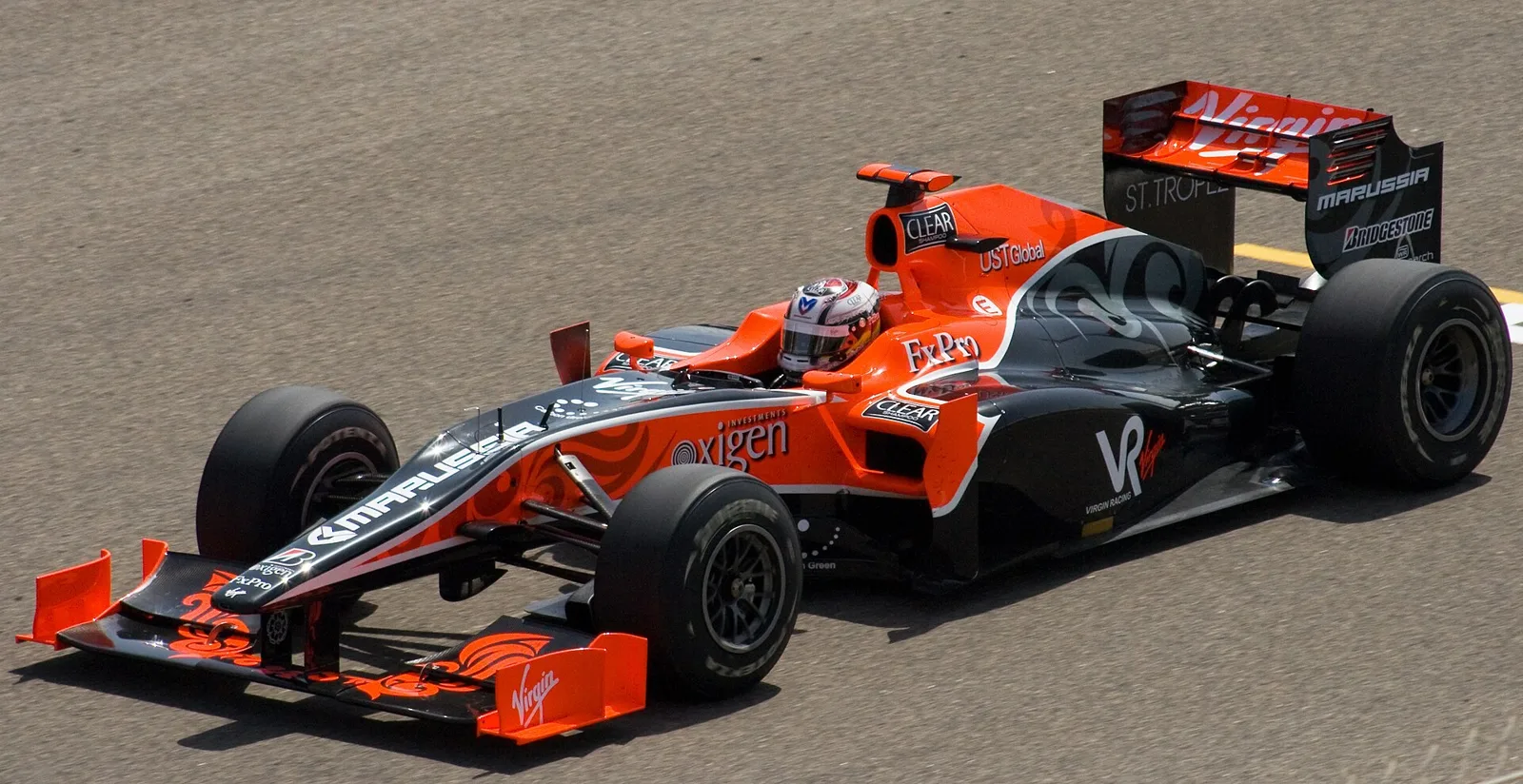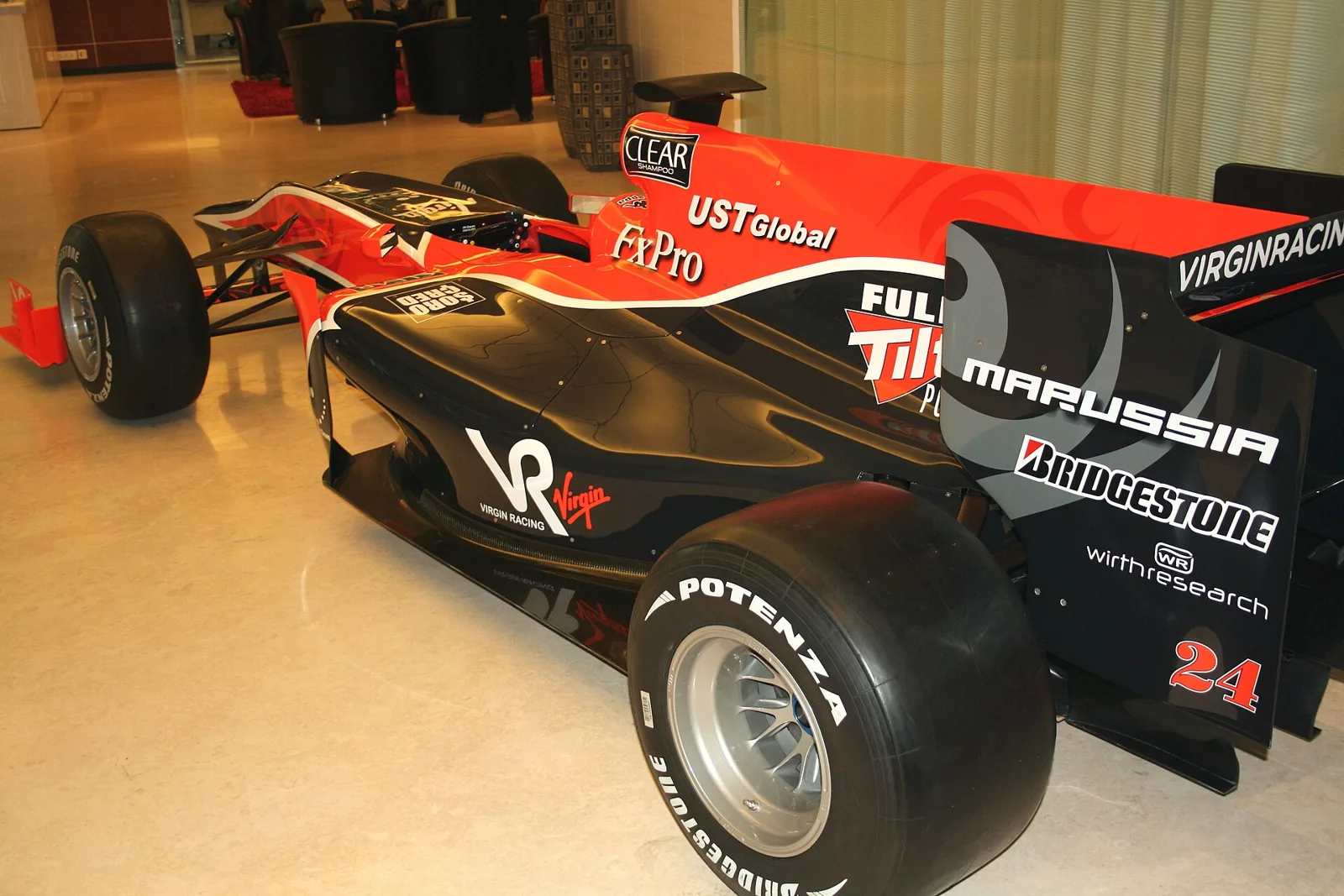
A Branson-backed entry built on computer modelling rather than a wind tunnel, two winless seasons without a point and a Russian takeover that turned it into Marussia.
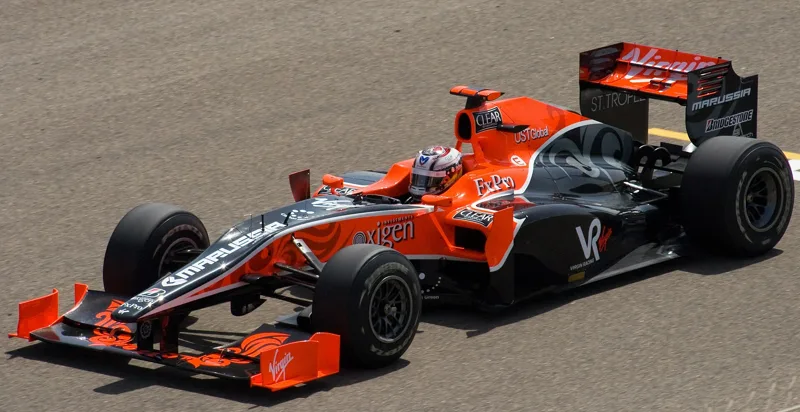
Virgin Racing started life as Manor Grand Prix and took the Virgin name after Richard Branson's group bought into the team at the end of 2009. Its car, the VR-01, was designed using computational fluid dynamics alone, and the team finished last in the Constructors' Championship in 2010 and 2011 without scoring a point.
Virgin Racing was a Formula One team built from the Manor Grand Prix entry, and it competed in 2010 and 2011 with Virgin's backing. It scored no points in either season and finished last both times before it was renamed Marussia F1 Team at the end of 2011.
How did the team come together?
The entry began as a tie-up between Manor Motorsport, which ran the cars, and Wirth Research, which designed them. Alex Tai was the first team principal, Graeme Lowdon became director of racing, John Booth took the sporting director role, and Nick Wirth, a former Simtek owner, was technical director.
Branson had already shown interest in Formula One earlier in 2009, when Virgin was reportedly bidding for the former Honda Racing F1 Team. He argued that the sport needed a more economically efficient and environmentally responsible image, and the Manor entry offered a way to show it.
Car preparation and racing operations ran from Dinnington in South Yorkshire, while Wirth Research designed and built the VR-01 from Bicester in Oxfordshire before moving to larger premises in Banbury in July 2010.
Branson's group invested at the end of 2009 and the team became Virgin Racing. Within a month of the partnership being launched, Tai left and Booth moved into the team principal's chair, with Lowdon stepping up to chief executive.
The budget was a selling point. Virgin Racing carried the lowest operating budget on the 2010 grid, at 40 million pounds, and Booth had pitched the newcomers on a cost cap built around television income of 30 million pounds. The squad also planned a driver academy that would feed drivers into GP3 and beyond.
The new entries had been courted as insurance against a breakaway series in 2009. Once that threat receded, the Virgin squad chose to go ahead within the financial framework it had set for itself, and that decision defined its first two seasons.
A team that bet on computer modelling instead of a wind tunnel, and found the results were not yet good enough.
What was the VR-01, and why was it different?
The VR-01 was built around modelling work done on computers instead of in a wind tunnel. Wirth made the call to design the aerodynamics with CFD alone, and Booth predicted that wind tunnels would soon be redundant because front-wing development moved too quickly for them.
The car was launched on the team's website on 3 February 2010 and completed its first track run at Silverstone the next day, with Timo Glock at the wheel. On the first day at Jerez Glock completed five laps in wet conditions, and on the second he managed eleven laps before the front wing failed. Trouble followed at the Jerez group test, where the front wing failed on the second day and running had to be abandoned for lack of spare parts.
Hydraulics were a recurring weakness. A fault returned during the final pre-season test in Barcelona and forced a redesign of components before the opening race in Bahrain. Booth later said that the system controlled four or five major components, so any small fault could stop a car.
The fuel tank was another concern. Reports said the VR-01's tank was too small for the car to finish a race at full speed, and the FIA allowed a larger tank for Australia. A longer chassis was then brought to the Spanish Grand Prix, but only one reached Barcelona because of air travel disruption caused by the 2010 eruptions in Iceland.
How did the 2010 season unfold?
In Bahrain both cars were troubled from the start. Di Grassi retired on lap three with a hydraulic problem, and Glock lost third and fifth gears before retiring too. In qualifying, di Grassi had headed the two Hispania cars by almost three seconds, so the pace was encouraging even though the race was not.
The first finish arrived in Malaysia. Di Grassi came home fourteenth on a fuel-conservation strategy, the team's first classified result. Spain then brought the first double finish, with Glock and di Grassi placed eighteenth and nineteenth, and di Grassi was the last driver to cross the line.
Britain brought a larger update, and the team qualified ahead of both Hispania cars. Di Grassi retired with a hydraulic failure, while Glock finished ahead of both Hispanias, which was the clearest sign so far that the car had found some pace.
The season also had painful moments. Di Grassi crashed heavily on the way to the grid in Japan and later crashed in Korea while trying to pass a Hispania. In Korea Glock was running in the points area in wet conditions until a collision with Sebastien Buemi ended his race in the pits.
A twelfth place for Glock in Korea would have lifted the team to tenth in the Constructors' Championship, because none of the other new teams had finished that high. His retirement ended that hope, and Hispania picked up fifteenth places in Singapore and Japan, finishing ahead of Virgin in the table despite a slower car.
John Booth was not satisfied with di Grassi's pace against Glock, and he scouted an alternative. Jerome d'Ambrosio became the reserve driver and took over di Grassi's car in the first Singapore practice session, ending the session only a little slower than Glock.
Bernie Ecclestone was unimpressed with the newcomers in November 2010, describing them as an embarrassment and suggesting that Branson should put more money in. Booth replied that Branson had taken a risk by joining a start-up that could have gone horribly wrong.
At the final round in Abu Dhabi, di Grassi said the team had managed more than 50 laps on one set of tyres, which he described as a mission accomplished. Hispania still finished ahead of Virgin in the standings, despite having a slower car.
| Season | Drivers | Constructors' position | Points |
|---|---|---|---|
| 2010 | Timo Glock, Lucas di Grassi | Last | None |
| 2011 | Timo Glock, Jerome d'Ambrosio | Last | None |
How did ownership and the team's name change?
On 11 November 2010 Marussia acquired a controlling stake and guaranteed the team's future until 2014. Marussia's engineering director said the squad would race with a Russian licence in 2011, making it the second Russian team in the sport after Midland.
The new owners also promised to upgrade the team's CFD facility so it would become the third largest of its kind in the world. Virgin had already bought a 20% share as part of its sponsorship.
The 2010 partners list was varied, with tyre supplier Bridgestone, the IT services firm UST Global, the clothing brand Kappa, the FX trader FxPro and the Russian sports car maker Marussia among the names on the car. Lloyds Banking Group put 10 million pounds into the team in December 2009, and Full Tilt Poker signed a sponsorship deal in May 2010.
Pat Symonds was retained as a technical consultant, but he could not be employed directly until his ban expired at the end of 2013. The ban stemmed from his role in the 2008 Singapore Grand Prix race-fixing affair.
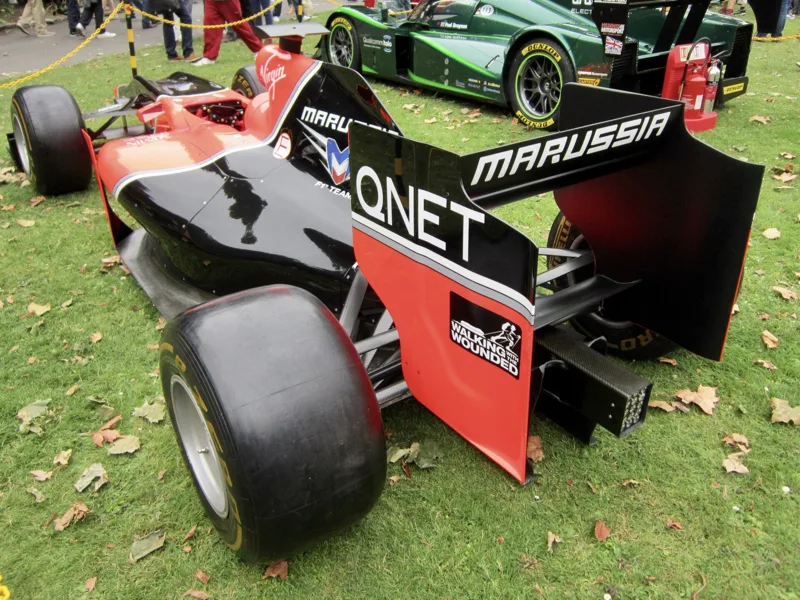
The name changed on 31 December 2011, when the team became Marussia F1 Team. Virgin stayed involved, and its logos were set to appear on the 2012 car.
Some of the sport's stranger episodes involved the team's owners. Tony Fernandes, the Air Asia boss who also ran the Lotus team, beat Branson in a bet in December 2009, and the loser was to work as a stewardess for the winner's airline for a day. Branson's flight was delayed repeatedly before it finally took place on 13 May 2013.
What did the 2011 season look like?
The MVR-02 was designed to match the length of the original VR-01 while keeping the full-size fuel tank, and its nose air intake echoed the one on Marussia's road car, the B2. The MVR-02 kept the CFD-only approach, but the team dropped KERS because its chief designer said the gains did not justify the cost. Effort went instead into the hydraulics and gearbox, which had caused so many problems in 2010.
Jerome d'Ambrosio replaced di Grassi alongside Glock. The team's first race of the year was in Australia, where the track was in poor condition, and Glock was forced into a long stop in the garage. He completed less than ninety percent of the race distance, so he was not classified, while d'Ambrosio finished sixteenth on track and moved up to fourteenth after two Sauber disqualifications.
The team's best results stayed modest. Glock finished sixteenth in Malaysia, his first classified finish of the year, while d'Ambrosio took twentieth in Turkey after a long repair. Glock took fifteenth in Italy, the last of the finishing cars.
At the first Indian Grand Prix the two cars set the slowest qualifying times, and Glock was allowed to start only because of his practice pace. He retired after two laps when Kamui Kobayashi ran into him, while d'Ambrosio finished sixteenth.
In June 2011 the team ended its relationship with Wirth Research after a review led by Pat Symonds found that the CFD-only approach had not yielded the expected results. The squad then turned to McLaren Applied Technologies for simulators, technical facilities and a wind tunnel.
Glock's comments on the radio at the German Grand Prix caused a stir, and he later tried to present them as a joke. He announced that he would remain with the team until 2014.
What is the legacy of Virgin Racing?
Virgin Racing's legacy is a clear example of a newcomer that set out to use a new method and then found the method was not enough. Its CFD experiment was abandoned within two seasons, and the team's identity passed to Marussia, which had secured the squad's future only until 2014.
Booth argued that Branson had backed a start-up that could easily have gone wrong, and he pointed to the new backers he had brought in during the team's first months. The team's story shows how much the sport's newcomers depended on a single owner and a small set of partners. Its achievements in those two years were measured in finishing positions rather than points, which is a grim statistic for any squad.