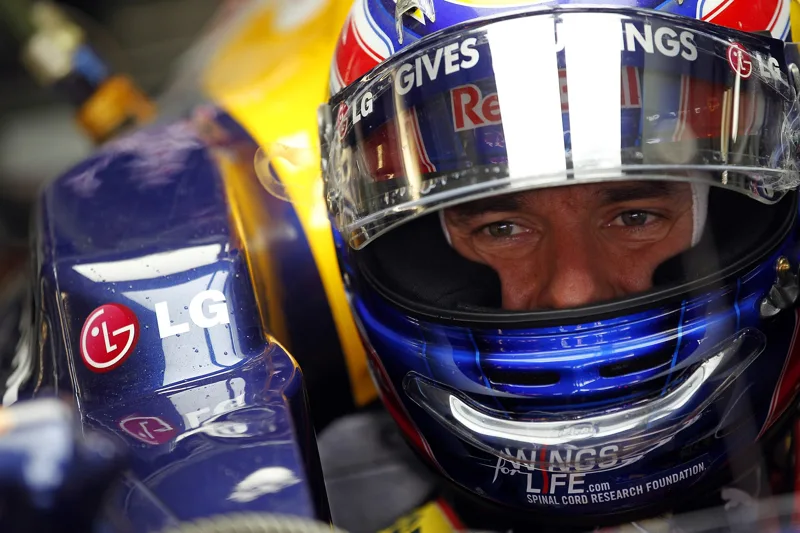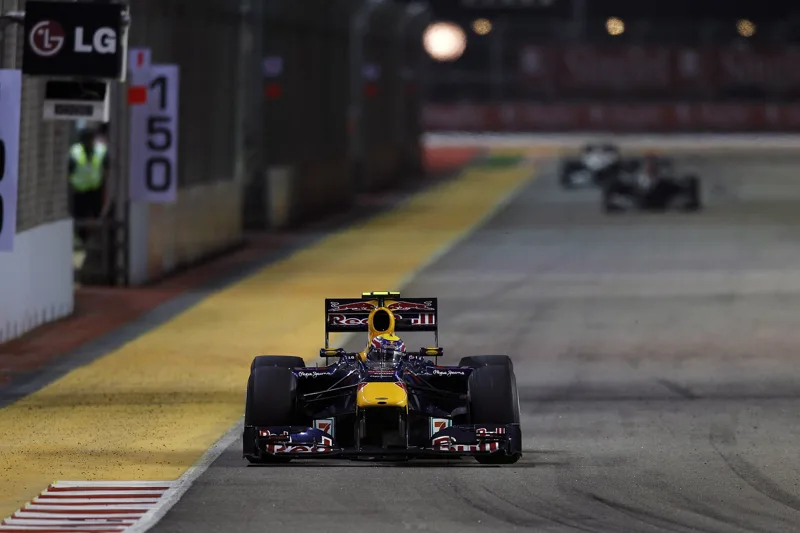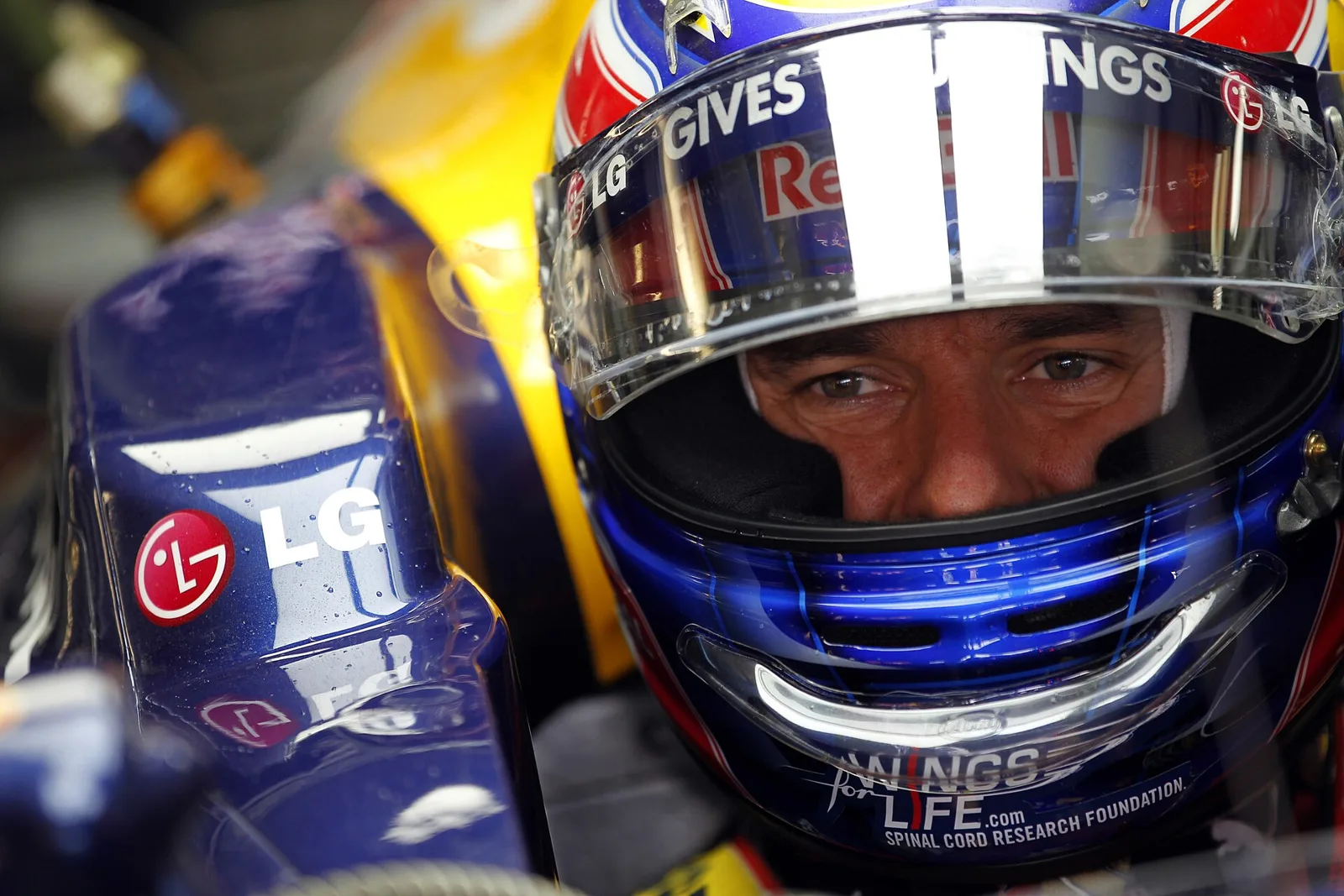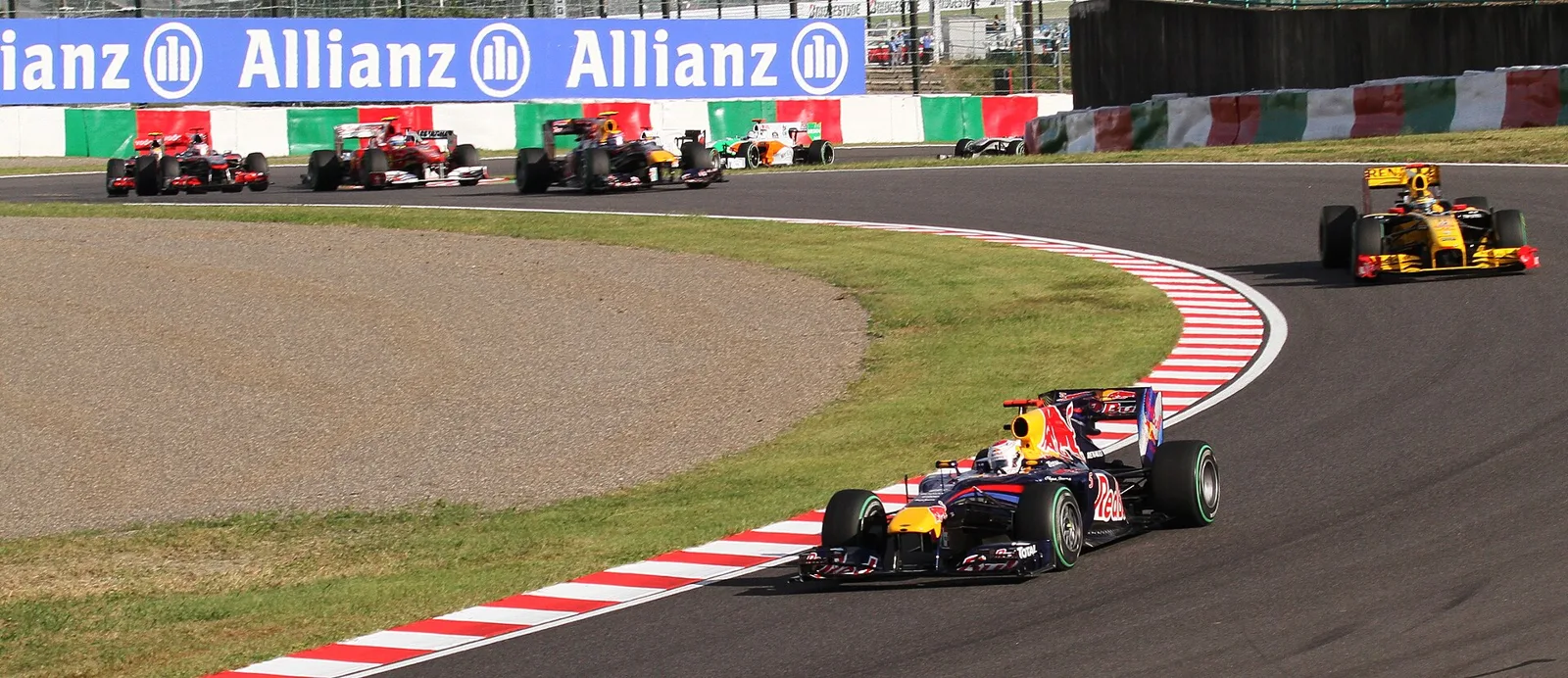
Sebastian Vettel won from pole at Suzuka after qualifying was moved to race morning, with Webber second and Alonso third.
The 2010 Japanese Grand Prix was a Formula One motor race held on 10 October 2010 at the Suzuka Circuit in Mie, Japan. Red Bull driver Sebastian Vettel won the 53-lap race from pole position, with teammate Mark Webber second and Fernando Alonso third in a Ferrari.
Sebastian Vettel won the 2010 Japanese Grand Prix from pole position at Suzuka, after qualifying had been moved to race morning because of torrential rain. Teammate Mark Webber finished second and Fernando Alonso was third in a Ferrari. Vettel's third win of the season left Webber 14 points clear of Alonso at the top of the drivers' standings.
Why was the 2010 Japanese Grand Prix significant?
Staged at Suzuka on 10 October 2010 before 190,000 spectators, the race was round 16 of 19 and the 26th running of the Japanese Grand Prix in the championship. Red Bull's first and second cars were fighting for the title, and the race gave the team a chance to decide the constructors' order.
The weekend was unusual because qualifying had been delayed by weather and the grid order was set only on race morning. That made the start a crucial moment for both Red Bull drivers and for the chasing Ferrari.
A race-morning qualifying session, a first-lap double clash and a Vettel win that left Webber 14 points clear.
What was the championship position before the race?
Webber led the drivers' championship with 202 points, ahead of Alonso on 191, Lewis Hamilton on 182, Vettel on 181 and Jenson Button on 177. In the constructors' table Red Bull led with 383 points, McLaren had 359, Ferrari 319 and Mercedes 168.
Alonso had won the Italian and Singapore Grands Prix, leaving him 11 points behind Webber. He said the last four rounds would test him mentally, and he saw a top-three finish in Japan as vital. Hamilton had failed to finish the previous two Grands Prix, and Button was 25 points behind Webber but felt Suzuka suited his style, even though he had never won there.
What changed on the track and in the teams?
Red Bull's technical director, Adrian Newey, moved the RB6's front brake calipers to a vertical position to reduce the risk of mechanical failures. Ferrari added a small wing to its diffuser, while McLaren introduced a new front wing and lengthened exhausts. McLaren used the standard version for qualifying and the race.
For the 2010 race the kerbs had been changed. A 25 mm kerb was installed at the Denger One and Spoon corners, the exits to those corners were extended, and artificial grass was laid behind the Casio Triangle chicane. Conveyor belts were also fitted to tyre walls that had lacked them.
Driver changes were limited. Sakon Yamamoto replaced Christian Klien at Hispania, and Jerome d'Ambrosio replaced Lucas di Grassi at Virgin for the first practice session. Paul di Resta did not run in the first practice session for Force India.
What happened in practice?
In the dry first practice session Vettel set the fastest time of 1:32.585, with Webber 0.048 seconds behind and Kubica third. Hamilton lost control at the quick downhill Denger corner, bottomed out and hit the tyre wall, and his car had to be taken back to the pits by tractor.
In the second session Vettel set the overall fastest lap of 1:31.465 on the soft tyres with 20 minutes remaining. Schumacher ran wide on the kerb at Denger, and Hamilton had to miss most of the session while his car was rebuilt.
On the Saturday, rain returned and the final practice session was held in heavy rain and low visibility. Rivers ran across several turns, and the teams were reluctant to send drivers out. Jaime Alguersuari set the fastest time of 1:55.902, with Timo Glock second. Hamilton said the track was undriveable, and Ross Brawn said he would be disappointed if qualifying were held in such weather.
Why was qualifying moved to race day?
Qualifying was delayed three times by the weather, and the safety car was used several times to assess the track. The race director, Charlie Whiting, then moved the session to Sunday morning on safety grounds, because light was fading. Drivers including Button, Hamilton, Schumacher and Vettel agreed that they could not control their cars in torrential rain.
On Sunday the weather was clear and sunny, and the session began at 10:00. The FIA surveyed the teams with CCTV in every garage rather than requiring parc ferme conditions, so teams could adjust their cars until qualifying ended.
Vettel took pole with a lap of 1:30.792, which he then improved by seven-thousandths of a second in the final session. It was his eighth pole of the season and the 13th of his career. Webber was 0.078 seconds slower, and Hamilton was provisionally third before car trouble in the final session. Robert Kubica was fourth, Alonso fifth and Button sixth.
Rosberg was seventh, Barrichello eighth and Hulkenberg ninth, while Schumacher was 10th with an improperly working F-duct. Heidfeld, Massa, Petrov and Kobayashi took 11th to 14th, and Sutil, Alguersuari and Liuzzi completed the next group. Buemi failed to get past the first part because of a mechanical floor fault.
After qualifying McLaren changed Hamilton's gearbox because of abnormal oil pressure, which dropped him five places to eighth. The Williams team protested that Hamilton had blocked Hulkenberg, but the stewards found no breach of the regulations.
How did the race unfold?
The race started at 15:00 local time in sunny conditions, with the air at 25 to 27 degrees C and the track between 32 and 36 degrees C. Di Grassi crashed on his formation lap at the 130R corner and could not start, so 24 cars lined up. Amateur footage appeared to show Vettel almost jumping the start.
When the lights went out Vettel made a brisk getaway and kept the lead into the first corner. Kubica passed Webber for second, but he could not challenge Vettel. Two accidents further back brought out the safety car. Petrov collided with Hulkenberg and speared into the outside barriers, and Massa, given less room by the slow-starting Rosberg, lost control and hit the side of Liuzzi's car. Liuzzi and Massa were unhurt.
Several drivers, including Rosberg, Trulli, Glock and Senna, pitted for hard tyres under the safety car. On the third lap Kubica retired when his right-rear wheel came off, because the wheel nut had been loosened by incorrect wheel gun settings. The safety car came in at the end of lap six, and Vettel led Webber and Alonso.
Rosberg ran wide attempting to pass Buemi at 130R and dropped to 13th. Schumacher overtook Barrichello, and Kobayashi passed Alguersuari for tenth and then Sutil for ninth. Sutil went off at the final corner on lap 16 but kept ninth.
What happened in the middle stint?
Pit stops began on lap 19, when Sutil and Heidfeld switched to hard tyres. Barrichello pitted on the 21st lap, and Hamilton pitted on lap 23 and fell to seventh behind Kobayashi. Schumacher pitted on lap 24, and Vettel and Alonso stopped on lap 25, which gave Webber the lead for the moment.
Button had been on the same tyres for longer, so he led after his strategy kept him out. Red Bull was told that Button might delay his stop until the final lap to slow them, but he could not set the times needed to do so. Button finally pitted from the lead at the end of the 38th lap, and Vettel retook the lead while Webber returned to second.
Hamilton radioed that he could not use third gear, possibly because of a dog-ring breakage, and had to finish in fourth. Button passed him for fourth at the hairpin on the 44th lap when Hamilton ran wide. Sutil's oil pipe failed at 130R, and he spun on his own oil and retired in the pit lane.
On lap 48 Rosberg's left-rear wheel detached as he climbed towards the Esses, and he hit the turn five tyre wall at about 210 km/h. He was unhurt, and his car remained upright. Kobayashi then passed Barrichello for eighth on the following lap, and Heidfeld for seventh on the 50th lap.
How did the race finish?
| Position | Driver | Team | Note |
|---|---|---|---|
| 1 | Sebastian Vettel | Red Bull | Pole position; third win of the season |
| 2 | Mark Webber | Red Bull | 0.905 seconds behind; fastest lap |
| 3 | Fernando Alonso | Ferrari | Third place |
| 4 | Jenson Button | McLaren | Passed Hamilton on the 44th lap |
| 5 | Lewis Hamilton | McLaren | Limited by the loss of third gear |
| 6 | Michael Schumacher | Mercedes | Best result since the Turkish Grand Prix |
| 7 | Kamui Kobayashi | Sauber | Home race; passed Barrichello and Heidfeld late on |
| 8 | Nick Heidfeld | Sauber | Passed by Kobayashi on the 50th lap |
| 9 | Rubens Barrichello | Williams | Passed by Kobayashi on the following lap |
| Tenth | Sebastien Buemi | Toro Rosso | Finished in the points |
Webber's lead over Alonso grew to 14 points, 220 to 206, and Vettel moved up to third, tied with Alonso on 206. Hamilton dropped to fourth with 192, and Button stayed fifth on 189. In the constructors' table Red Bull extended its lead over McLaren to 45 points, and Ferrari stayed third on 334, with three races left in the season.
What did the drivers and teams say?
Vettel said the win was down to the team, which had not slept between Thursday and Saturday, and that the lack of qualifying had let them rest. Webber said he was delighted with second place, but the circuit layout had stopped him passing his teammate.
Hamilton admitted he had feared his gearbox noise would end his race, but he was satisfied to finish and remained confident about the title. Button said the soft tyres had been old and that the data would be useful for the future.
What did the stewards decide?
The stewards investigated both first-lap collisions. They held Petrov responsible for the accident with Hulkenberg and gave him a five-place grid penalty for the Korean Grand Prix. They decided that the Liuzzi and Massa collision was a racing incident. They had earlier found no evidence to penalise Hamilton for blocking Hulkenberg in qualifying.
Massa said he had seen Sutil on the left and tried to move right, but Rosberg was also heading left, and the corner gave him no room. Liuzzi said Massa had come into his side like a bullet and had no control. Renault's Eric Boullier thought Kubica could have finished on the podium had he not retired.
How did the championship change?
Webber's 220 points put him 14 ahead of Alonso at the top, and the title fight remained a three-way contest with Vettel, Hamilton and Button still in range. Hamilton's fifth place dropped him from third to fourth, while Button stayed fifth. The gap between Red Bull and McLaren in the constructors' table reached 45 points.