Lewis Hamilton led from the first corner after the start and took the Drivers' Championship lead, as Mark Webber's pole did not translate into victory on a day of changing weather.
Lewis Hamilton won the 2010 Belgian Grand Prix for McLaren at Spa-Francorchamps on 29 August 2010, from second on the grid. Mark Webber finished second for Red Bull Racing and Robert Kubica third for Renault.
The 2010 Belgian Grand Prix was a Formula One race held on 29 August 2010 at the Circuit de Spa-Francorchamps in Wallonia, Belgium, before a crowd of 60,000. It was the 13th round of the championship. Lewis Hamilton won the 44-lap race for McLaren after starting second, ahead of Mark Webber for Red Bull Racing and Robert Kubica for Renault.
What was the championship position before Spa?
Webber led the Drivers' Championship with 161 points after winning the Hungarian Grand Prix. Hamilton was 157 points behind in second place, and Sebastian Vettel was on 151. Jenson Button stood fourth on 147 points, while Fernando Alonso of Ferrari was fifth on 141.
Red Bull led the Constructors' Championship with 312 points, followed by McLaren on 304 and Ferrari on 238. Mercedes were fourth on 132 points, and Renault fifth on 106. The race was the first after a four-week gap, which included a mandatory two-week shutdown for every team.
Hamilton led from the first corner after the start and took the Drivers' Championship lead.
What had changed at the circuit and in the cars?
The Circuit de Spa-Francorchamps measures 7.004 km (4.352 mi) and has 19 turns. Before the race, bumps were added to the run-off area at the Les Combes chicane, similar to those already in place at Monza, Catalunya and Valencia. The aim was to stop drivers damaging their cars if they left the track. La Source received a larger area of artificial grass and a 50 mm (2.0 in) kerb to deter drivers from cutting the corner.
Several teams made changes to their cars. Ferrari brought a new rear wing with less downforce for Felipe Massa, alongside a revised diffuser and floor. Red Bull altered the brake discs on its RB6, and McLaren fitted a new front wing to Button's MP4-27. Renault introduced a version of McLaren's F-duct system, which the team kept after being impressed in practice. Williams and Force India also brought new wings and a new floor respectively.
Bridgestone supplied the soft and medium dry compounds, along with intermediate and full wet tyres. Hispania Racing kept Sakon Yamamoto in its car, instead of bringing back Karun Chandhok, and Paul di Resta did not take part in the first practice session at Force India.
How did the practice sessions go?
Heavy rain fell on the circuit around midnight before the first session. Although the track was wet, grip was reasonable, although some drivers aquaplaned when the rain briefly increased. Lightning came about 50 minutes in, and the rain eased with 20 minutes left. Alonso set the fastest time of the session, a 2:00.797 late on, ahead of Hamilton, Robert Kubica and Sebastian Vettel.
The second session started on a damp track that gradually dried. Drivers ran wet tyres at first and then moved to dry compounds. Alonso led again with a 1:49.032, but the session was marked by incidents. Vitantonio Liuzzi lost control at the Rivage chicane, and Timo Glock crashed sideways into the barrier at Liege corner. Spectators climbed the catch fence, forcing the stewards to stop the session for ten minutes while race director Charlie Whiting drove the safety car to inspect the area.
More overnight rain left the track damp for the final session on Saturday, but slick tyres were used after 20 minutes. A downpour arrived with 15 minutes left, catching out several drivers. Webber set the quickest lap at 1:46.106, almost three seconds quicker than the best time from Friday. Vettel stopped at the pit lane entry with his car stuck in gear because of an air box fault, and marshals moved the car into the pit lane for retrieval.
How did qualifying settle the grid?
Qualifying was split into three parts. The first lasted 20 minutes and eliminated cars finishing 18th or lower. The second lasted 15 minutes and removed cars finishing from 11th to 17th. The final ten-minute session decided the top ten and pole. Cars in the final session could not change tyres before the race, so they started on the set used for their quickest lap.
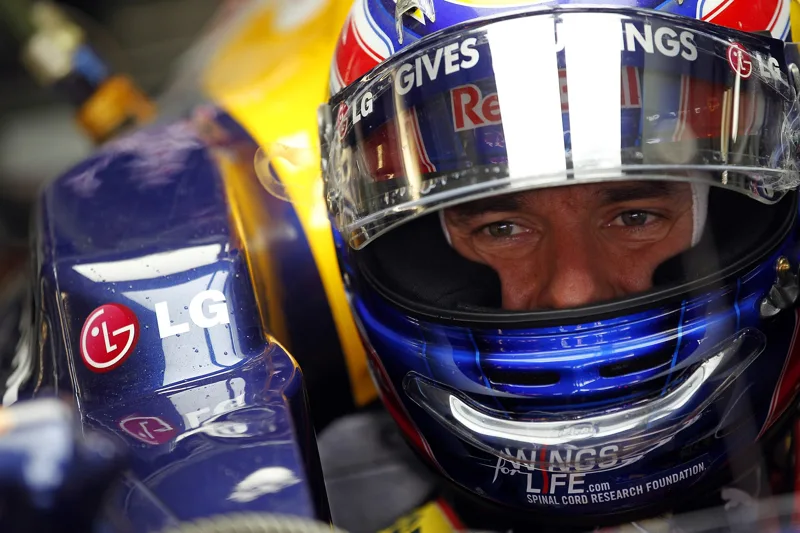
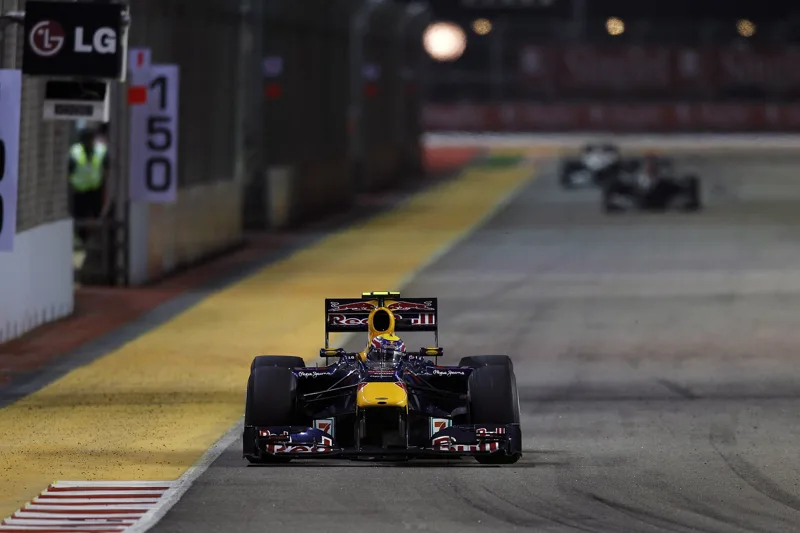
Qualifying began in clear weather, but showers fell on parts of the circuit and made the surface uneven. Webber took his first pole since the Turkish Grand Prix with a lap of 1:45.778, set late in the third session. It was his fifth pole of the season and the sixth of his career, and it was the 12th time in 13 races that Red Bull had taken pole. Hamilton's first timed lap came on old soft tyres, and he set a second time on new tyres before the rain returned.
| Position | Driver | Team | Note |
|---|---|---|---|
| Winner | Lewis Hamilton | McLaren | Second on the grid, led from the first corner |
| Second | Mark Webber | Red Bull Racing | Pole position, 1.571 seconds behind |
| Third | Robert Kubica | Renault | Third on the grid, his final Formula One podium |
| Fourth | Felipe Massa | Ferrari | Sixth on the grid |
| Fifth | Adrian Sutil | Force India | Eighth on the grid |
| Sixth | Nico Rosberg | Mercedes | Stayed out longer, ahead of his teammate |
| Seventh | Michael Schumacher | Mercedes | Started far back after penalties |
| Eighth | Kamui Kobayashi | Sauber | Just over a second behind Rosberg and Schumacher |
| Ninth | Vitaly Petrov | Renault | Set no qualifying time after a spin in the first part |
| Tenth | Vitantonio Liuzzi | Force India | Promoted when Alguersuari received a time penalty |
Why were there grid penalties after qualifying?
Five drivers received grid penalties after qualifying. Schumacher was demoted ten places for his part in the incident with Barrichello at the Hungarian Grand Prix. His teammate Rosberg dropped five places after a gearbox change, fitting a unit that had sat unused for four races.
Sebastien Buemi was demoted three positions for blocking Rosberg during the second session, and Timo Glock lost five places for illegally blocking Yamamoto in the first session. Pedro de la Rosa lost ten places after changing his car's engine for the ninth time in the season, which exceeded the eight engine switches permitted.
At the pre-race briefing, Whiting and the stewards' adviser Nigel Mansell warned that gaining places on the first lap by using the run-off at La Source, as Raikkonen had done the year before, could lead to a penalty.
How did the race start?
The 44-lap race started at 14:00 local time in front of 60,000 people. The forecast warned of a 60 per cent chance of showers between 14:00 and 15:00, and the air was between 14 and 16 C (57 and 61 F), with the track between 17 and 21 C (63 and 70 F). Every driver except Barrichello, Rosberg and Schumacher began on soft tyres. Massa had been slightly out of position on the grid, but he was not punished.
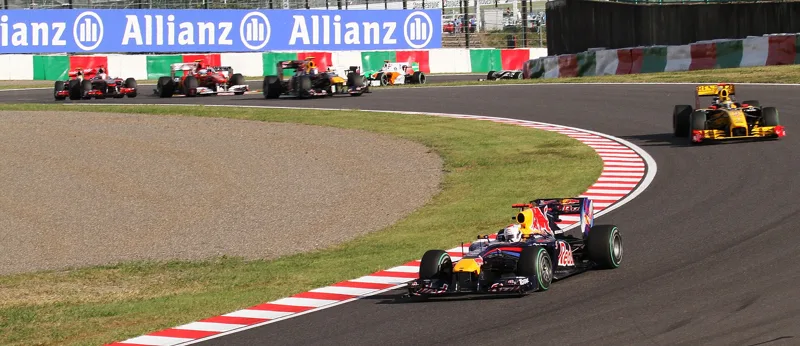
Hamilton took the lead from Webber, who had a slow start, into the La Source hairpin. Webber let his engine revs fall too low, which put his Renault engine into anti-stall mode, and he dropped to sixth. Kubica was second and Button third at the first corner. Hamilton held off Kubica on the outside into Les Combes, while Button could not get past the Renault.
Sutil briefly overtook Webber for sixth but ran wide at Les Combes. A light shower fell as the first lap ended, and it made the back of the track damp through Blanchimont. Several drivers ran wide at the Bus Stop chicane through a loss of grip. Button tried to pass Kubica on the outside and suffered left-front wing damage that changed the balance of his car.
Barrichello was unable to stop his Williams in the greasy conditions and struck the side of Alonso's car. Alonso was able to pit for intermediate tyres, but Barrichello retired with car damage. The first-lap accident brought out the safety car at the end of lap two, while three drivers lower in the order pitted for intermediates.
How did the first safety car change the race?
The safety car came in at the end of lap three, and racing resumed with Hamilton leading Button. Hamilton ran wide at La Source and blocked Button from passing him for the lead. Vettel used the restart to pass Kubica for third at the same hairpin. By lap seven Hamilton had pulled 4.8 seconds clear of the field, because Button was struggling with the damage to his front wing.
Senna retired on lap six with rear-left suspension failure, after driving slowly into the pit lane with front wing damage. Vettel drew close to Button through the uphill section of Eau Rouge, but he hit his rev limiter on the Kemmel straight and the McLaren kept him at bay. Petrov passed Rosberg on the outside into Les Combes on the eleventh lap, and Schumacher then passed Rosberg for tenth, with the Mercedes pair's wheels touching.
Why did Vettel and Button collide?
Light rain began to fall on the sixteenth lap. Vettel tried to pass Button on the inside into the Bus Stop chicane, but he switched to the outside and hit a bump on the damp track. He could not correct the slide at high speed and struck the left-hand sidepod of Button's car. The contact exposed Button's radiator and ended his race.
Vettel pitted for a new front wing and dropped to 12th. The stewards decided to impose a drive-through penalty for the incident, and Vettel served it on the following lap before rejoining in 14th. The collision promoted Kubica to second and Webber to third in the order at that point.
Vettel's afternoon got worse on the twenty-sixth lap, when Liuzzi's front wing endplate punctured the left-rear tyre of Vettel's car after Vettel had overtaken him at the Bus Stop chicane. Vettel could not enter the pit lane and had to complete a full lap before stopping for soft tyres, which dropped him to 20th. Liuzzi pitted immediately for a new front wing.
What decided the leaders in the second half?
Sutil made the first scheduled stop for medium tyres on the twenty-second lap, and Red Bull responded by calling Webber in on the next lap. Kubica and Massa pitted on the twenty-fourth lap. Kubica rejoined ahead of Webber and held him off into Les Combes, a move that gave Kubica the place at the time.
Hamilton made his first stop on the twenty-fifth lap and kept the lead. By the thirty-first lap he led Kubica by 11.2 seconds, and Kubica was 2.3 seconds ahead of Webber in third. Light rain returned on the thirty-fourth lap, and drivers began moving to wet-weather tyres on the thirty-fifth lap, though the track was still only slightly wet and made the timing of the stops difficult.
On the thirty-fifth lap Hamilton could not slow enough in the slippery conditions, and his tyres locked as he slid into the gravel trap at Rivage. He touched the wall with his front wing, but he had enough traction to get out of the gravel and return to the track in the lead.
How did the race end?
The leaders pitted at the end of the lap, and Kubica had a difficult stop. He overshot his pit box after braking too late, and he glanced the legs of a team member while adjusting the switches on his steering wheel. That delay moved Webber into second behind Hamilton.
On the thirty-eighth lap the safety car came out for a second time, after Alonso ran wide at Les Combes and then into Malmedy. He lost control, crossed the track and hit the tyre wall, breaking his front-right suspension before coming to rest in the middle of the circuit. Alonso was forced to retire. The pack was released after the fortieth lap, and Hamilton led Webber and Kubica once racing resumed for four laps.
Hamilton won his third race of the season and the 14th of his career, at an average of 207.509 km/h (128.940 mph). Webber finished 1.571 seconds behind, and Kubica took third. Massa was fourth, holding off Sutil for fifth. The Mercedes pair of Rosberg and Schumacher finished sixth and seventh, after the team chose to keep both drivers out on track for longer.
Who else scored and what went wrong?
Kobayashi finished eighth, and Petrov was ninth. Alguersuari was provisionally tenth, but he was later given a 20-second penalty for cutting the Bus Stop chicane to pass Liuzzi. That dropped him to 13th and put Liuzzi into the final points place in tenth.
Button retired after the collision with Vettel, which was one of the most talked-about moments of the weekend. Vettel finished 15th after his puncture and collision, with Kovalainen just behind, while Glock lost performance on full wet tyres and took a new front wing after damaging a brake marker board on the first lap.
What did the result do to the championships?
The result returned Hamilton to the top of the Drivers' Championship on 182 points. Webber fell to second with 179 points, and Vettel remained third on 151. Button and Alonso were fourth and fifth on 147 and 141 points.
In the Constructors' Championship, McLaren's 329 points cut Red Bull's lead to a single point, with Red Bull on 330. Ferrari were third on 250, with Mercedes on 146 and Renault on 123, with six races left in the season.
How did the drivers and team bosses react?
Hamilton described the race as very tough, and he said the win made up for what had happened two years earlier. He had been nursing the car home and trying to keep a small gap between himself and Webber to bank the points. Webber accepted second and said that scoring points was vital when race wins were not available.
Vettel apologised for the collision with Button, insisting that he had not meant to destroy either race. Button called the incident strange and sad, and he said he had defended his line. McLaren's team principal Martin Whitmarsh said the collision was more like junior formulae than Formula One, and he thought a drive-through was a light punishment. Red Bull's Christian Horner argued that Button had braked early and that the contact was unintentional.
The stewards imposed no penalty on Alonso and Barrichello for their first-lap collision, which they treated as a racing incident. Barrichello said he was sorry to have hit Alonso. The FIA also opened an investigation into how Massa had started ahead of his grid slot without the error being spotted in time. Massa put it down to his height, which made the lines hard to see from the grid.