Fernando Alonso won the first Korean Grand Prix from third on the grid after a rain-delayed start, a long suspension and Sebastian Vettel's engine failure.
Fernando Alonso won the 2010 Korean Grand Prix for Ferrari at Yeongam on 24 October 2010, from third on the grid. Lewis Hamilton was second for McLaren and Felipe Massa third for Ferrari.
The 2010 Korean Grand Prix was a Formula One race held on 24 October 2010 at the Korea International Circuit in Yeongam, South Jeolla. It was the 17th round of the championship and the first Korean Grand Prix. Fernando Alonso won the 55-lap race from third on the grid for Ferrari, with Lewis Hamilton second for McLaren and Felipe Massa third.
What was at stake before the race?
Mark Webber led the Drivers' Championship into the event with 220 points. Alonso and Sebastian Vettel were tied for second on 206 points, while Hamilton was fourth on 192 and Jenson Button fifth on 189. With 75 points still available from three races, Hamilton or Button could still win the title, provided Alonso or Vettel won and neither McLaren driver scored.
Red Bull led the Constructors' Championship on 426 points, ahead of McLaren on 381 and Ferrari on 334. Mercedes (176) and Renault (133) were contending for fourth place.
Alonso won the first Korean Grand Prix from third on the grid, his fifth victory of the season.
Why was the new circuit so controversial?
Tensions between North Korea and South Korea rose after the South Korean corvette Cheonan sank in March 2010. Bernie Ecclestone warned that the race would be in jeopardy if the political situation worsened, and that it would be abandoned if the North Korean army crossed the border. The French Grand Prix at Magny-Cours was mooted as a replacement if the Korean race was cancelled.
Construction was also behind schedule, because 38 days of rain had fallen during the summer. On 27 September Ecclestone said he doubted the circuit would be ready. A final inspection took place on 11 October, and the FIA safety delegate Charlie Whiting certified the circuit on 12 October. The top layer of tarmac had been completed only ten days before the race, which left too little time for the oils and bitumen chemicals to be worn away. Circuit designer Hermann Tilke warned that the surface would be slippery.
The 5.615 km (3.489 mi) circuit runs anti-clockwise and has three long straights. Drivers generally liked the layout. Adrian Sutil praised its character, Michael Schumacher found it demanding, and Robert Kubica thought the entire layout was far better than the one at Abu Dhabi, although he found the first sector rather dull. The drivers did raise concerns about the pit lane entry at turn 17, which is taken at 240 km/h (150 mph) and can be tight if another car is entering the pits.
What changed on the cars for Korea?
Red Bull and Williams revised their brake ducts. Red Bull's ducts, changed for the third consecutive Grand Prix, brought back a small fin seen at Singapore, and for Korea two aerodynamic fins were fitted along with a larger duct. Williams changed the front ducts to improve airflow inside the tyres.
McLaren modified a version of its front wing first used at Singapore, adding a vertical gurney flap and an extra slot at the endplate to produce more downforce. The team also brought a new rear wing and tested a revised F-duct system, which had debuted at the Japanese Grand Prix in Suzuka. Ferrari revised its diffuser with curved profiles and one large middle plate to improve airflow from under the F10.
How did the practice sessions go?
The regulations provided three sessions, two of 90 minutes on Friday and one of 60 minutes on Saturday morning. The track was dusty for the first session, and grip was poor. Hamilton set the pace with a 1:40.887 lap, almost one-tenth of a second quicker than Kubica. Nico Rosberg and Schumacher were third and sixth fastest for Mercedes, separated by Vettel and Button.
Grip improved for the second session, when Webber set 1:37.942, the quickest time of the day, despite spinning late on. Alonso was second and Hamilton third, with Kubica fourth. Button, who spent most of the session in the garage with an overheated exhaust, finished fifth. Hispania's Sakon Yamamoto spun at turn 16 and stopped his car, which caused the session to be suspended.
After a Friday night briefing with Whiting, the apex at turn 16 was raised and the wall behind it moved back. A new apex kerb was built at turn 18 to stop dirt and stones building up on the track, and drivers were allowed to enter the pit lane from the racing line without a penalty. Bridgestone reported heavy tyre graining during Friday practice.
Kubica was quickest in the final session with 1:37.354, just 0.048 seconds ahead of Hamilton. Alonso and Webber were third and fourth, and Rosberg slowed at turn 15 and narrowly missed Alonso. The stewards investigated but decided not to penalise Rosberg. Vettel was 16th after running onto the grass.
Who took pole and why?
Qualifying was split into three parts. The first lasted 20 minutes and eliminated cars finishing 18th or lower, while the second lasted 15 minutes and removed cars from 11th to 17th. The final ten-minute part decided pole to tenth, and cars in that session had to start on the tyres they had used for their fastest lap. It was overcast. Soft tyres degraded heavily, so most drivers set their first laps on the harder tyres and switched to softs for the rest.
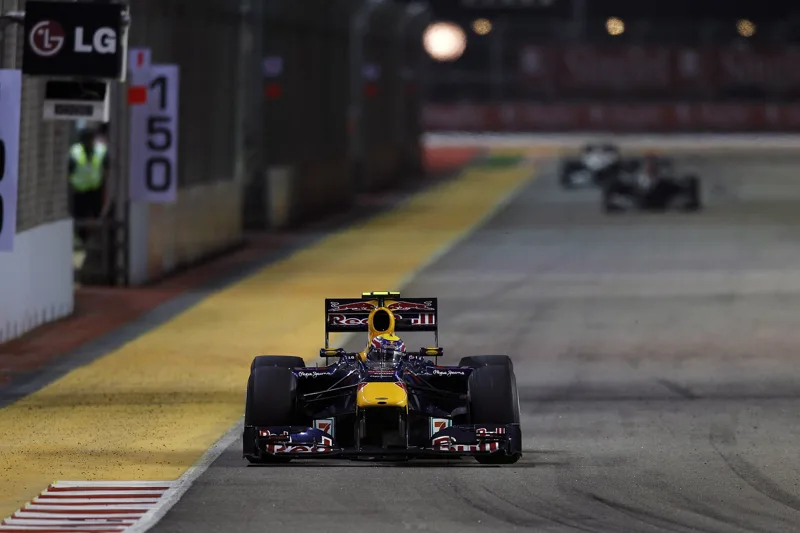
Vettel set a time of 1:35.585 on his second timed run to take pole, the ninth of his 2010 season. He felt he had lost time in the middle sector after a mistake. Webber was on the front row, 0.076 seconds slower, after he decided to do two more laps on a fresh set of option tyres in the third session. Alonso was third, and he said the grid position reflected what Ferrari could do. He was also keen to finish because rain had been forecast.
Hamilton set the fastest first-part time at 1:37.113 but fell to fourth in the final session. Rosberg was fifth for Mercedes, and Massa sixth for Ferrari, although Massa was unhappy to start on the dirty side of the grid after traffic in the third session. Button seventh was happy to be on the clean side, and Kubica eighth struggled with oversteer. Schumacher was ninth, and Barrichello tenth, after Schumacher had blocked him in the second session. Schumacher apologised, and the stewards reprimanded him.
| Driver | Team | Grid | Race result |
|---|---|---|---|
| Fernando Alonso | Ferrari | Third | Won, his fifth win of 2010 |
| Lewis Hamilton | McLaren | Fourth | Second, 14.9 seconds behind |
| Felipe Massa | Ferrari | Sixth | Third |
| Michael Schumacher | Mercedes | Ninth | Fourth, equalling his best result of the season |
| Robert Kubica | Renault | Eighth | Fifth |
| Sebastian Vettel | Red Bull Racing | Pole | Retired, engine failure on the forty-sixth lap |
| Mark Webber | Red Bull Racing | Second | Retired after a crash with Rosberg on the nineteenth lap |
| Nico Rosberg | Mercedes | Fifth | Retired after a crash with Webber on the nineteenth lap |
Why was the race started behind the safety car?
The race was scheduled for 15:00 Korea Standard Time, but rain continued to fall, so the start was moved to 15:10 local time. Standing water created heavy spray and poor visibility, which meant the race would begin behind the safety car. Every car was required to use full wet tyres, and there was no formation lap. Around 80,000 people attended.
Ferrari found a water leak in Alonso's car, and it was repaired in the hour before the race. On their reconnaissance laps, Massa, Senna and Glock all ran wide but avoided damage as they tested the wet compounds. Air temperature was 20 C (68 F) and the track 18 C (64 F).
The race started with drivers struggling for grip. After three laps behind the safety car, conditions had not improved, and the race was suspended. Light rain stopped the race from restarting for more than 45 minutes, while marshals and road sweepers cleared water and dirt from the track. The resin on the new surface had prevented water from soaking into the ground. Teams were allowed to adjust their set-ups, which had been optimised for dry conditions.
How did the early laps unfold?
The race restarted behind the safety car with the grid order unchanged. Schumacher, Liuzzi and Yamamoto briefly left the circuit but rejoined. Senna pitted at the end of the first lap. Once the field was allowed to overtake, Vettel led into the first corner with Webber close behind, and Rosberg took the inside line to pass Hamilton for fourth at the third corner. Button ran wide and fended off an attack from Schumacher.
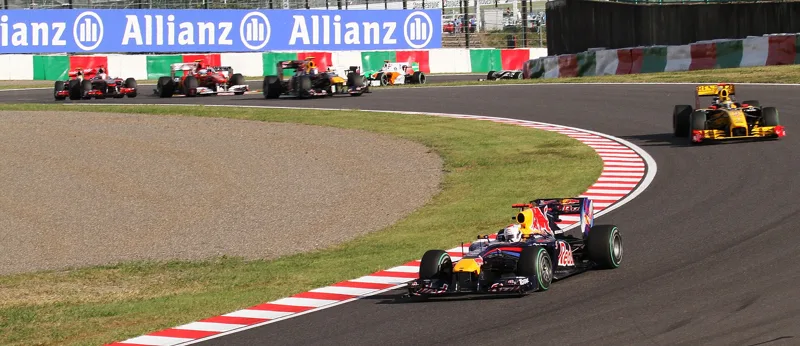
At the end of the first racing lap Vettel led Webber by 2.8 seconds, with Alonso, Rosberg, Hamilton, Massa and Button following. Alonso chose a cautious start and lost four to five seconds while building his pace. Sutil ran off the circuit and lost places to both Williams drivers. On lap two Webber lost grip running over the outside kerbing, spun into the wall between turns 12 and 13, and collected Rosberg. Both drivers retired, and the debris brought out the safety car again.
Kobayashi, Petrov, Heidfeld and Buemi all pitted for intermediate tyres under that safety car. It came in at the end of the twenty-third lap, with Vettel leading Alonso and Hamilton. Vettel began to pull clear, but on the twenty-fourth lap Trulli collided with Senna while trying a pass on the inside, and Trulli's front wing came off. He returned to the garage and retired on the twenty-eighth lap with a hydraulics failure, which had been caused by heavy power steering during the safety car period.
Vettel set the fastest lap of the race, 1:54.098, on the twenty-eighth lap and extended his lead over Alonso to 3.5 seconds. Di Grassi lost control on the twenty-seventh lap at turn 14 while passing Yamamoto, and he hit the wall and retired.
What changed in the middle of the race?
On the thirty-first lap Buemi tried to pass Glock on the inside into turn three, lost control under braking and rammed the side of Glock's car. Buemi suffered suspension and front wing damage and retired. The incident brought out a third safety car, and most drivers pitted for intermediates. Ferrari brought Alonso in as Vettel changed strategy, but a dropped wheel nut meant Alonso sat stationary for longer than usual, and he lost third place to Hamilton.
Ferrari told Massa to slow on his out lap to help Alonso reduce the damage from losing second. Glock returned to his pit box, where mechanics inspected his car and retired him. The safety car came in at the end of the thirty-fourth lap, and Vettel led the restart. Hamilton ran deep into the first corner, which let Alonso retake second, and Massa immediately began to pressure both of them.
The stewards then handed Kovalainen a drive-through for speeding in the pit lane, which he took on the thirty-ninth lap. Alonso set a new fastest lap of 1:50.257 on the forty-second lap and closed to 1.1 seconds behind Vettel. Further back, Sutil passed Heidfeld, then Kobayashi, before sliding off the track and rejoining 14th.
Why did the final laps become so dramatic?
With sunset approaching, the race director Whiting decided on the forty-third lap that the Grand Prix would run for only another 25 minutes. Fading light reduced visibility. Vettel said he could not see the braking point for turn one, while Hamilton told his team the light was fine. Drivers were dazzled by the gear-shift lights on their steering wheels.
On the forty-fifth lap Vettel lost half of his engine power through turn 17 and felt strong vibrations. At the start of the forty-sixth lap Alonso passed him on the inside to take the lead. Vettel then coasted to the main straight wall with smoke pouring from his engine and retired. Sutil tried to pass Kobayashi on the forty-seventh lap, slid into the side of the Sauber and retired with suspension damage. Hulkenberg spun on the fifty-second lap and pitted for new tyres after his engineer warned of a slow puncture. Barrichello ran wide on the same lap and dropped to seventh.
How did the race finish?
Alonso crossed the line on the fifty-fifth lap to win, his fifth victory of the season. His winning time was 2 hours 48 minutes 20.810 seconds, at an average of 109.997 km/h (68.349 mph). He had opened a gap of 14 seconds over Hamilton, who was struggling with worn tyres, and Hamilton finished 14.9 seconds behind in second. Massa completed the podium in third.
Schumacher finished fourth, equalling his best result of the season, and Kubica was fifth. Liuzzi, Barrichello, Kobayashi and Heidfeld were sixth to ninth, with Hulkenberg passing Alguersuari on the final lap to take tenth. Button was the last driver on the lead lap, and Kovalainen was 13th. Senna and Yamamoto were the last two classified finishers, in 14th and 15th, which was Hispania's best result of the season.
How did the drivers and teams react?
Alonso called it one of the best races of the year for Ferrari, and he said the wet conditions had made it one of the most difficult wins of his career. He added that he would not change his driving in the last two rounds. Hamilton said second was a great result, although he had lost time in the final third of the lap because of braking problems. Massa was happy to finish third despite poor visibility and struggling with his rear tyres.
Petrov had been seventh before he crashed into the wall on the forty-first lap, and he said the result was disappointing but encouraging. Barrichello, fifth before running wide on the fifty-second lap, said he had run out of tyre in the final five laps. Webber accepted that the the nineteenth lap accident was his mistake, while Rosberg could not understand why Webber had not braked. Former driver Gerhard Berger suggested that Webber had crashed on purpose, a claim Red Bull team principal Christian Horner rejected as absurd. Webber later apologised to Rosberg.
Vettel said Red Bull had done a near-perfect job until his engine failure on the forty-sixth lap. Renault's principal engineer Fabrice Lom apologised to Red Bull for the failure. Button said front tyre problems had caused him to lock up, and he called his race sad.
What penalties followed the race?
Buemi and Sutil were summoned to the stewards for their accidents. Both received five-place grid penalties for the next race at Interlagos. Sutil was also fined 10,000 dollars for driving with a brake problem he knew about. He said he had struggled with excessive brake force, which locked his tyres. Buemi said he had braked late and felt sorry for Glock.
Did the safety car start go down well?
The safety car start drew mixed reactions. Massa thanked Whiting for managing the situation well, while Schumacher, Petrov, Sutil and Buemi also agreed with the decision. Hamilton said the time under the safety car was not good for spectators or drivers, and he felt the track was dry enough for a normal restart. Martin Brundle thought the race should have started earlier, while Button said it should have been stopped before visibility worsened.
What did the result mean for the title?
Alonso returned to the top of the Drivers' Championship on 231 points, and Webber dropped to second, 11 points behind him. Hamilton moved ahead of Vettel into third, and Button stayed fifth. Red Bull kept the Constructors' lead despite its drivers failing to finish, but McLaren stayed second on 399 points and Ferrari closed to within 25 points of them with two races left.
Vettel later said his team had the fastest car in the two remaining races, and he remained confident of winning. He went on to win the Drivers' Championship by four points. Webber's manager Flavio Briatore later described the Korean Grand Prix as one of the clearest missed chances of Webber's bid for the title.