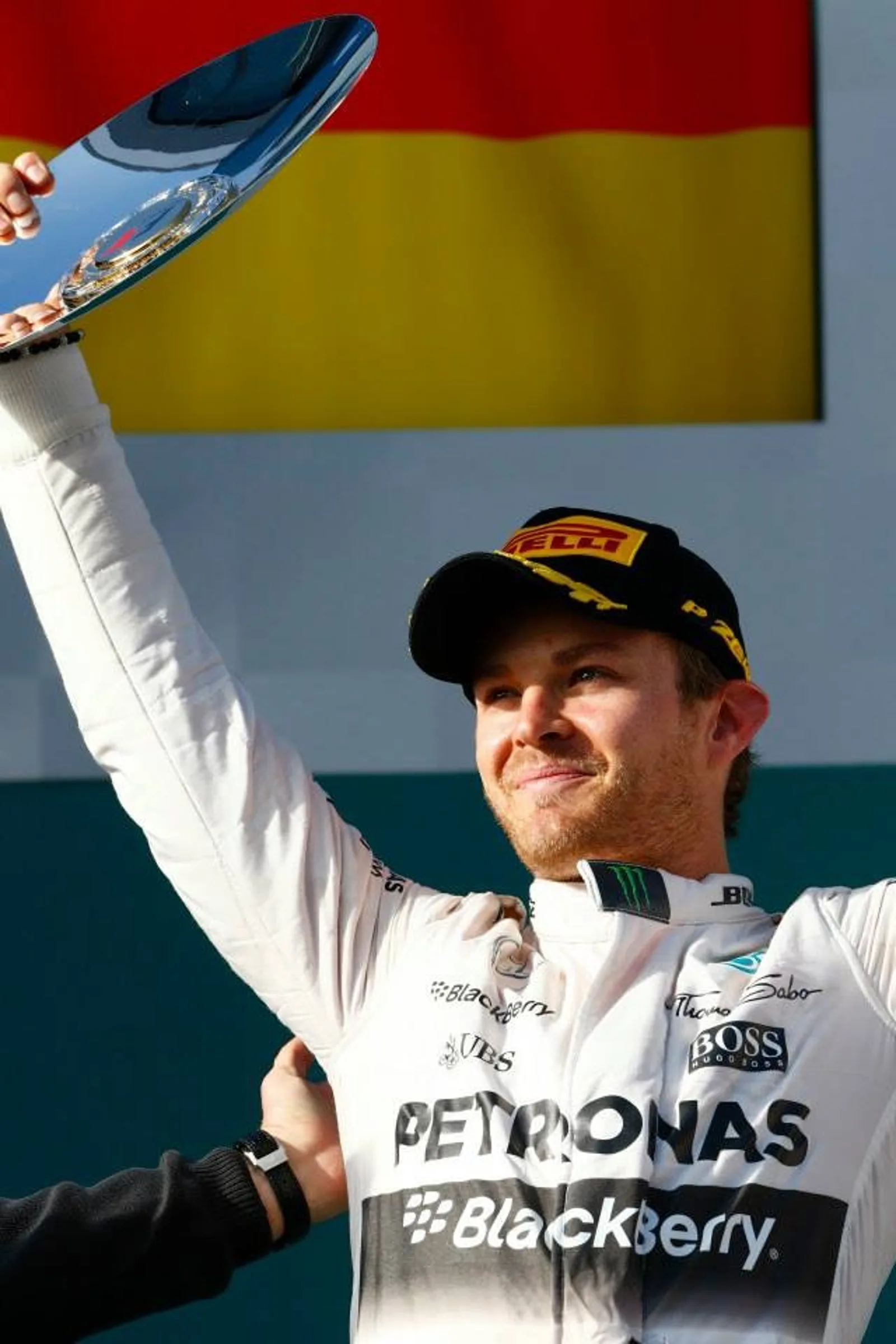
From karting in Monaco to the 2016 world title, a career built on careful preparation, close work with engineers and a decision to walk away at the peak.
Nico Rosberg was a German-Finnish driver who competed in Formula One from 2006 to 2016 and won the 2016 world championship with Mercedes. He finished his career with 23 Grand Prix wins from 206 starts and retired days after the title.
Nico Rosberg is a German-Finnish former driver whose Formula One career ran from 2006 to 2016. He won the world championship in 2016 with Mercedes, finishing with 23 Grand Prix wins from 206 starts, then retired within days of the title.
The son of 1982 champion Keke Rosberg, he grew up largely in Monaco, progressed through karting and junior formulae, and reached Formula One with Williams before joining Mercedes in 2010. His long rivalry with teammate Lewis Hamilton defined much of his time at the team.
How did Nico Rosberg start in racing?
Rosberg began competitive karting at six and won the Cote d'Azur Mini-Kart Regional Championship in 1996. He later took French national titles, at 12 he won a French national karting title, the youngest ever to do so, and moved to Italy in 1998 so he could compete internationally. After moving into car racing at 16, he won the 2002 Formula BMW ADAC championship.
His parents allowed the ambition on one condition: he had to keep his grades up at school. His early results helped him persuade his father to become his manager, and the family relationship shaped much of what followed in his career.
The 1999 season brought second place in the Italian Junior Karting Championship; in 2000 he raced for TeamMBM.com before finishing his karting career with a third place at Kerpen in 2001.
A scientific driver who lost the 2014 title on the final day and then won the 2016 championship on his own terms.
How did Rosberg reach Williams and Formula One?
Rosberg moved through the Formula 3 Euro Series and then won the inaugural GP2 Series title with ART Grand Prix in 2005. Williams signed him as a test driver that April and then as a race driver for 2006, making him the first son of a former champion to race for the team since Damon Hill.
The seat at ART cost him an estimated 850,000 pounds in his GP2 year, which showed how expensive the step up could be. Williams paid him 500,000 pounds for his first season and gave him a test that he scored more highly than any driver before him.
His attitude to the job impressed the team. He worked on his communication with engineers, followed the Formula One technology closely and chose to stop reading the news so that negative coverage would not affect his focus.
What did Rosberg achieve at Williams?
Rosberg's time at Williams ran from 2006 to 2009. His best season was 2008, when he took his first podium with third at the Australian Grand Prix and then finished second at the inaugural Singapore race. In 2009 he led the opening 15 laps in Malaysia, and he ended the year seventh with 34.5 points.
His debut year ended seventeenth with four points. He scored points at the European Grand Prix that season, but he was outpaced by teammate Mark Webber, and he made errors from inexperience while driving an unreliable car. He set the fastest lap at the 2006 Bahrain Grand Prix, a record for the youngest driver to achieve that feat at the time.
In 2007 Alexander Wurz was his teammate, and Rosberg scored 20 points for ninth overall, with a best finish of fourth at the Brazilian Grand Prix. McLaren tried to sign him to replace Fernando Alonso, but Williams rejected the approach and extended his contract instead.
Why did Rosberg move to Mercedes?
Mercedes took over Brawn GP and raced under its own name from 2010. The team offered Rosberg a seat alongside seven-time champion Michael Schumacher, and he confirmed his exit from Williams that October. He took car number four, after Schumacher asked for number three for superstitious reasons.
Ross Brawn mentored him at the team, but Rosberg was wary of Schumacher, given Brawn's history with the German at Ferrari. Rosberg finished third at the Malaysian, Chinese and British Grands Prix in 2010 and outqualified Schumacher fifteen times to four. He finished seventh with 142 points.
2011 was harder. The MGP W02 wore its Pirelli tyres quickly, and although Rosberg led the Chinese and Belgian Grands Prix, he was never better than fifth in the rest of the year. He ended the year seventh with 89 points.
How did Rosberg win races at Mercedes before 2016?
Rosberg took his first pole and first win at the 2012 Chinese Grand Prix, and he finished ninth overall that year with 93 points. In 2013 he won the Monaco Grand Prix and the British Grand Prix, and in 2014 and 2015 he finished as runner-up to Lewis Hamilton with 317 and 322 points.
In 2012 he challenged Mark Webber for the lead at Monaco before settling for second. In 2013 he led every lap from pole at Monaco, the first win there by a world champion's son. Mercedes had used team orders to keep him behind Hamilton at the Malaysian Grand Prix, and that decision left him frustrated.
The 2014 title fight was decided at the final race in Abu Dhabi, where an energy recovery system failure on his car cost him the points he needed. In 2015 he won in Spain, Monaco and Austria, then took six consecutive poles and three final wins in Mexico, Brazil and Abu Dhabi. Retirements in Italy and Russia, plus two wet-track mistakes at the United States Grand Prix, also cost him.
What were Rosberg's Formula One results by season?
Rosberg's results moved from a tentative debut with Williams to a steady run of points, then a Mercedes peak. The table sets out his championship finish and points for each season, with the key result of each year.
| Season | Team | Result |
|---|---|---|
| 2006 | Williams | Seventeenth with four points; seventh in Bahrain |
| 2007 | Williams | Ninth with 20 points; fourth in Brazil |
| 2008 | Williams | Thirteenth with 17 points; first podium in Australia |
| 2009 | Williams | Seventh with 34.5 points; fourth at Germany and Hungary |
| 2010 | Mercedes | Seventh with 142 points; third in Malaysia, China and Britain |
| 2011 | Mercedes | Seventh with 89 points; no higher than fifth after China and Belgium |
| 2012 | Mercedes | Ninth with 93 points; first win in China |
| 2013 | Mercedes | Sixth with 171 points; wins at Monaco and Britain |
| 2014 | Mercedes | Runner-up with 317 points; wins in Australia, Monaco, Austria, Germany and Brazil |
| 2015 | Mercedes | Runner-up with 322 points; six consecutive poles late in the year |
| 2016 | Mercedes | World champion by five points |
How did Rosberg win the 2016 world title?
Rosberg won the first four races of 2016 and built a lead, but Hamilton struck back after a high-speed collision at the Spanish Grand Prix. Rosberg then won in Belgium, Singapore and Japan to enter the Abu Dhabi finale 12 points ahead. He needed to finish third or better and did so with second place, winning the title by five points.
His preparation was methodical. He stopped reading the news, studied sleep with a specialist and worked with a sports psychologist for several hours a week. He changed his gloves to sharpen his starts, stripped paint off his helmet to save weight, and kept up his go-karting.
Mid-season Niki Lauda, then Mercedes non-executive chairman, visited him in Ibiza to help him regain his confidence. Rosberg changed his diet, cut out sugar and avoided alcohol, and he went on to win the races that decided the title.
Why did Rosberg retire after winning the title?
Rosberg announced his retirement on 2 December 2016, five days after the championship. He felt he had reached the top of his sport, did not want his driving skills to fade, and wanted more time with his young family. No reigning champion had stepped away since Alain Prost did in 1993, and Valtteri Bottas took his place at Mercedes.
He had begun to consider retiring after the 2016 Japanese Grand Prix, and he discussed it with his wife before Abu Dhabi. He told his manager first and then telephoned Toto Wolff, rather than telling the team principal in person because he was apprehensive about the reaction.
What did Rosberg do after leaving Formula One?
After retiring, Rosberg became an investor in electric mobility, joining Formula E as a long-term shareholder from 2018. He launched the Greentech Festival trade fair in Berlin in February 2019 and set up the non-profit Rosberg Philanthropies in 2022, focusing on environmental protection and children.
He also joined the management team of Robert Kubica in September 2017 to help the Polish driver attempt a return after a severe 2011 rally crash. He reduced that role in April 2018. From the 2018 season he analysed Formula One races for Sky Sports F1, RTL and Sky Italia, and he founded a young drivers academy with his old karting mentor, Dino Chiesa.
In late 2020 he founded Rosberg X Racing for the all-electric Extreme E off-road series. The team won the inaugural constructors' title, although it narrowly missed retaining it in 2022, and in December 2024 Rosberg announced that the team would cease operations as the series was replaced by Extreme H.
What was Rosberg's driving style?
Rosberg had a scientific, technical approach. He fine-tuned his car in detail, preferred oversteer to understeer like his father, and prepared meticulously for qualifying and races. He lacked a flamboyant technique, but his strong work ethic and close work with engineers made him one of the sport's most thorough drivers.
Journalists described him as articulate and precise, with a dry wit and a reserved private manner. Colleagues at Williams nicknamed him Britney, after the singer, because of his blonde hair. Motorsport pundit Will Buxton called his speed seemingly effortless and his precision metronomic.
He chose car number six under FIA rules from 2014, a number that was lucky for his wife and his father. He also changed his helmet from yellow to dark grey after eight years, with a design that included chrome and personal symbols.
What is Rosberg's legacy?
Rosberg is remembered as the 2016 champion who beat Lewis Hamilton to the title in his final season. He and his father are the second father and son to win world titles, after Graham and Damon Hill. His reputation also rests on his later investment in clean technology and his philanthropy.
His awards include the Lorenzo Bandini Trophy in 2011, the FIA Pole Trophy in 2014 for the most pole positions that season, and the Laureus breakthrough prize in 2017. The FIA Hall of Fame added him in December 2017.
Endorsements took him to Mercedes-Benz, Laureus, UBS, Heineken and others, and he raised money for children's charities in Germany through events. His career remains a case study in how a driver can plan an exit as carefully as a race.