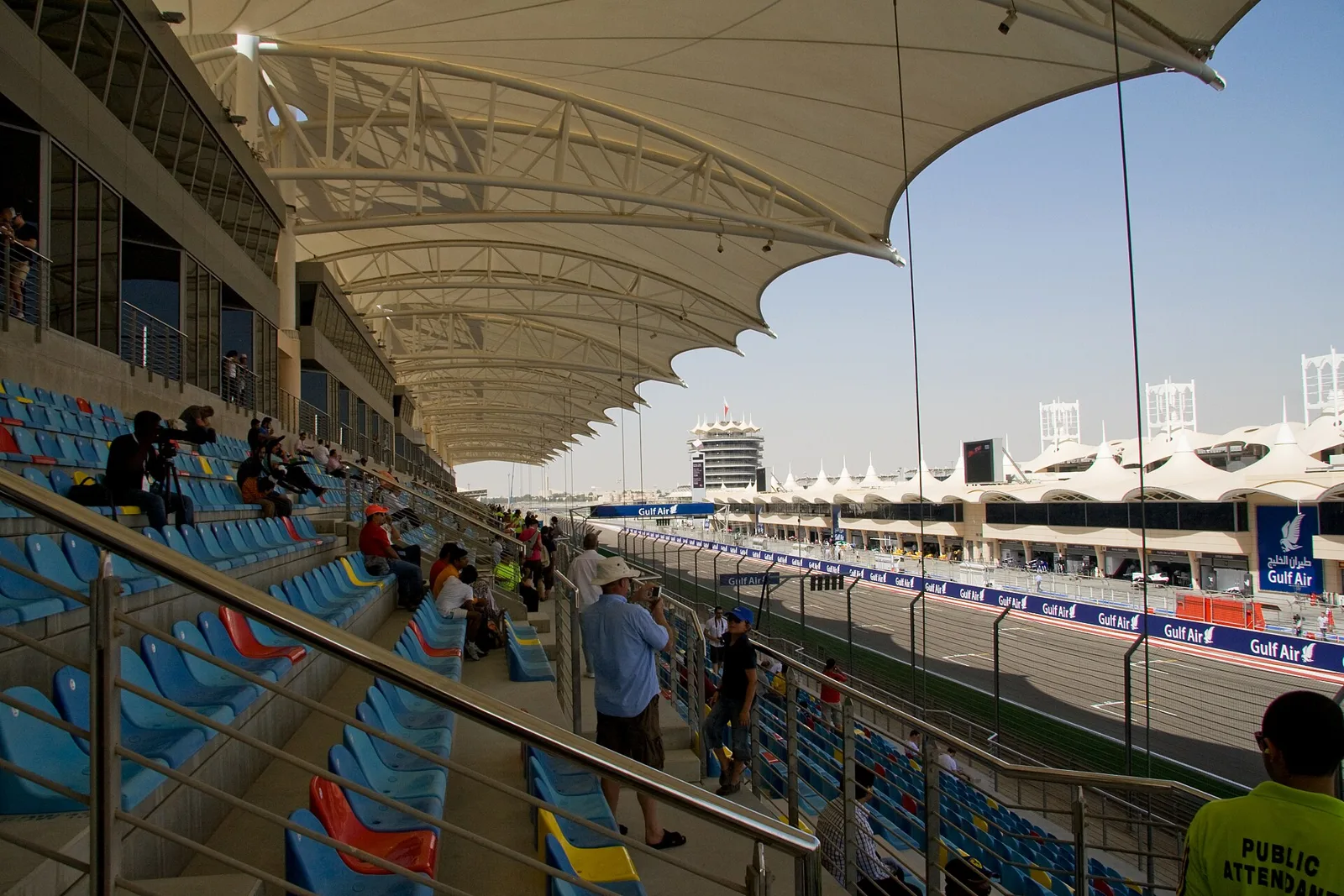
Fernando Alonso won on his Ferrari debut year, Vettel's pole gave way to a power problem on lap 34, and a new, longer Bahrain layout opened the 2010 championship.
Fernando Alonso won for Ferrari in Bahrain on 14 March 2010, the opening round of the season. Felipe Massa took second, and Lewis Hamilton was third for McLaren. Sebastian Vettel led until a power problem on lap 34 dropped him to fourth.
The 2010 Bahrain Grand Prix was held at the Bahrain International Circuit on 14 March 2010, the seventh Bahrain race and the opening round of the season. Fernando Alonso won for Ferrari, his first victory for the team and his first Formula One win since the 2008 Japanese Grand Prix. Felipe Massa was second and Lewis Hamilton third, after Sebastian Vettel lost a commanding lead on lap 34.
Who won the 2010 Bahrain Grand Prix?
Fernando Alonso took the win for Ferrari, a result that gave the team a strong start to the year. He was the sixth driver to win his first Grand Prix in a Ferrari, joining Juan Manuel Fangio, Giancarlo Baghetti, Mario Andretti, Nigel Mansell and Kimi Raikkonen in that list.
Massa finished second, which was a useful result on his return to full-time racing after the head injury he had suffered at the 2009 Hungarian Grand Prix. Hamilton completed the podium for McLaren. Mark Webber qualified sixth but finished eighth, and Michael Schumacher's first race back for Mercedes ended in sixth, one place behind his teammate Nico Rosberg.
Jenson Button completed his first race for McLaren, after moving from Brawn GP, and he finished seventh. It was also the Grand Prix debut of Nico Hulkenberg, who finished fourteenth for Williams. The race was an early signal that Ferrari were back in contention.
A lengthened layout, a new points table and a power problem that handed Ferrari its first win of the new era.
Why did Vettel lose the lead?
Vettel started from pole, which he took late in the third qualifying session ahead of the Ferraris of Massa and Alonso. He led every lap until lap 34, when a power issue forced him to give up the lead to Alonso. Massa and Hamilton then passed him too, leaving Vettel fourth at the flag.
The problem was later identified as a spark plug issue. Vettel had been two seconds ahead of Alonso and three seconds ahead of Massa before his car began to slow. He spent the rest of the race trying to hold off Rosberg, and he managed to keep fourth place ahead of him.
The result was the first sign that the new season would be decided by reliability as much as pace. Red Bull's pole-sitter, who had been dominant in the closing races of 2009, went from the front of the field to fourth in a few laps.
How did the new season begin?
The race marked the opening round of a season with several changes. Bahrain hosted the opening round for the first time since 2006, and the race took place on a lengthened layout of the track. The new Endurance layout proved unpopular with drivers and teams, and it has not been used again since.
Three new teams made their debuts. Hispania, Virgin and the Malaysian-owned Lotus were the new entries, and Mercedes returned after Daimler took over Brawn GP at the end of 2009. Sauber also returned, having competed as BMW the previous year.
The points system was also overhauled. The 10-8-6-5-4-3-2-1 scoring used from 2003 to 2009 gave way to a top-ten table of 25-18-15-12-10-8-6-4-2-1, the most radical revamp since the World Championship began in 1950.
What did the race mean for the title?
Alonso and Ferrari led their respective championships with maximum points after the opener. Massa's second place gave the team a useful start, and Hamilton's podium put McLaren among the early contenders. Vettel's retirement from the lead had shown that reliability would matter.
The race also brought back an old rule. Refuelling during pit stops was banned again, after it had been allowed since 1994, which made the race the first since 1993 without refuelling in its pit stops. The grid of 24 cars was the largest since the 1995 Japanese Grand Prix, and Formula One's new format was under scrutiny from the start.
How did the new teams perform?
The three new teams struggled. Their six cars occupied the last six places in qualifying, and only one car, the Lotus of Heikki Kovalainen, finished the race. Jarno Trulli's Lotus was also classified, although he was last of the finishers.
Karun Chandhok, who had been unable to take part in free practice because of a hydraulic problem, qualified 24th, which was ten seconds slower than Alonso. Timo Glock was the fastest of the newcomers in qualifying, but he was still 2.7 seconds adrift of Jaime Alguersuari in eighteenth place.
Chandhok's race ended early when he hit a bump he did not know existed and damaged his front wing. Lucas di Grassi retired when his Virgin's hydraulics gave up. Bruno Senna's Hispania debut ended when his engine overheated at the end of the main straight, so the debutants struggled to make the race meaningful.
How did the race start and develop?
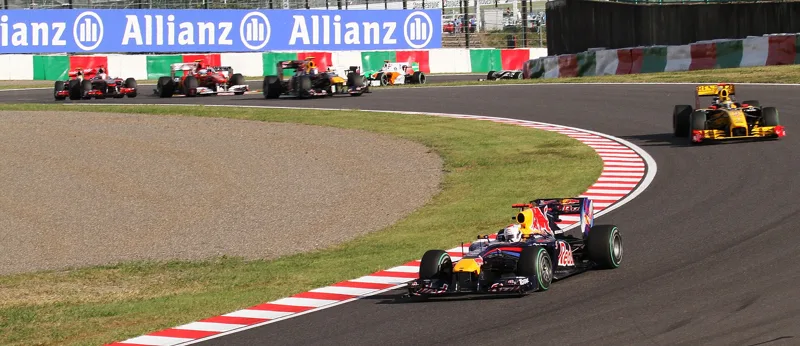
The first corner brought a problem for Mark Webber, whose engine released oil smoke. That triggered a sequence of events that left Adrian Sutil and Robert Kubica spinning and falling to the back of the field. The first lap was otherwise clean, and Vettel converted his pole into the lead.
Alonso passed his teammate Massa for second, and both Mercedes drivers gained a place. Rosberg ran fourth ahead of Hamilton, while Schumacher beat Webber to sixth. Vitaly Petrov was the biggest mover in the field, climbing from seventeenth to eleventh in the second Renault.
The race became one of attrition. Glock lost third and fifth gears, Kobayashi suffered a hydraulic failure, and Petrov damaged his front-right suspension after hitting a kerb too hard. Six drivers had retired during the first seventeen laps, and at the front Vettel and the two Ferraris quickly pulled clear of the rest.
The first round of pit stops also proved to be the only round. Vettel had built enough of a lead to stop the Ferraris from leap-frogging him, and the McLaren team gained a place for both drivers in the stops. Pedro de la Rosa's race ended on lap 23 with a hydraulic problem.
Why did the Ferrari pair pass Vettel?
Vettel continued to lead comfortably for much of the race, two seconds ahead of Alonso and three ahead of Massa. He then began to slow noticeably, and the team later identified the cause as a spark plug problem. Both Ferraris and Hamilton passed him in the late stages.
Vettel then spent the rest of the race holding off Rosberg, who was pressing hard for fourth. He managed to keep the place and salvage fourth overall. Alonso went on to win the race, and his first Ferrari win came after a long wait since the 2008 Japanese Grand Prix.
The overall picture was one of a team recovering its footing. Massa finished second on his first full-time race back, and Ferrari scored a one-two on the day.
| Position | Driver | Team | Note |
|---|---|---|---|
| 1st | Fernando Alonso | Ferrari | First win for the team; first F1 win since 2008 Japanese GP |
| 2nd | Felipe Massa | Ferrari | Return to full-time racing after 2009 Hungarian injury |
| 3rd | Lewis Hamilton | McLaren | Completed the podium |
| 4th | Sebastian Vettel | Red Bull | Led until lap 34; power problem |
| 6th | Michael Schumacher | Mercedes | First race of his return |
What did commentators say about the new Formula One?
The race attracted criticism of the new Formula One, and it was echoed by several personalities in the sport. McLaren team boss Martin Whitmarsh said the community had to work together to improve it. David Coulthard suggested that two pit stops could be made mandatory, arguing that this would increase the potential for mistakes and spectator interest in the pits.
Alain Prost disagreed with the criticism, saying that after a few races the top drivers would come to like the new format. The new section of the circuit also drew criticism from drivers and fans, who felt the added corners offered little in the way of passing opportunities. Formula One later reverted to the original Grand Prix Circuit for the 2012 race.
The race also used a revised stewards' panel under new FIA regulations, and it included a former driver for the first time in such a role.