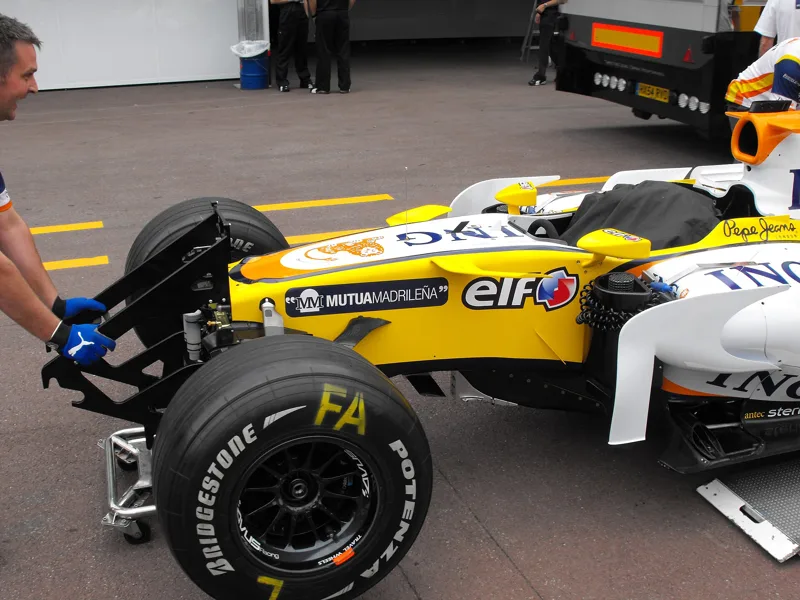
Fernando Alonso turned fourth on the grid into a win, while a lap-two clash between the title rivals and a disputed penalty shaped the weekend.
Renault's Fernando Alonso won the 2008 race at Fuji after starting fourth. BMW Sauber's Robert Kubica finished second and Ferrari's Kimi Raikkonen third, in the 16th round of the season held on 12 October. It was Renault's last win as a constructor.
The 2008 Japanese Grand Prix was held at Fuji Speedway on 12 October 2008 as round 16 of the Formula One season. Fernando Alonso won from fourth on the grid for Renault, Robert Kubica took second for BMW Sauber and Kimi Raikkonen finished third for Ferrari. The win gave Renault its final Formula One victory as a constructor.
Who won the 2008 Japanese Grand Prix?
Alonso won the 67-lap race from fourth on the grid, the last win Renault would take as a constructor. Robert Kubica held off a determined attack from Raikkonen in the closing laps to take second for BMW Sauber, and Raikkonen finished third for Ferrari.
Alonso's victory was his second in succession, following his win at Singapore two weeks earlier, when he had started from 15th. That Singapore result had been his first Formula One win since rejoining Renault, after a season with McLaren in 2007. He would not win again until the 2010 Bahrain Grand Prix.
For Kubica, second place was a strong result for BMW Sauber, a team that had struggled to improve its car since the start of the year. Massa's seventh place narrowed the gap to Hamilton in the Drivers' Championship to five points, and Ferrari took a seven-point lead over McLaren in the Constructors' Championship with two races left.
A fourth-place start, a lap-two clash between title rivals and a penalty that the whole paddock argued about.
What was the championship picture before Fuji?
Lewis Hamilton led the Drivers' Championship with 84 points, ahead of Felipe Massa on 77 and Robert Kubica on 64. Kimi Raikkonen had 57 points and Nick Heidfeld 56. With three races remaining, every driver in the top five was still in contention for the title.
In the Constructors' Championship McLaren-Mercedes led with 135 points, one point ahead of Ferrari, a position McLaren had taken at the previous race. BMW Sauber were third with 120 points. Renault had 51 points, five ahead of Toyota, and its aim for the final races was to secure fourth place in the standings from its rival.
Massa's position had been damaged at Singapore, where a botched pit stop had sent him from first to the back of the field. His gap to Hamilton had gone from one point to seven in a single race, and he argued that the situation could easily swing back just as quickly. Ferrari gave up its pit-stop light system at that point and went back to the commonly used lollipop man.
How did the Make Cars Green campaign feature at Fuji?
At Fuji the FIA started the Formula One element of its Make Cars Green drive, and the tyre grooves were painted green to encourage eco-friendly driving. Max Mosley, the FIA president, said the organisation wanted motor sport investment to produce technologies that would help the public at large.
Bridgestone brought two tyre compounds, as is normal for a Formula One race. The softer of the two carried a single white stripe down one of the grooves, so the teams could tell them apart at a glance. The race-day conditions were expected to stay consistent throughout,.
How did practice set the scene?
Friday's practice ran in dry and sunny conditions, and Lewis Hamilton was quickest in the first session at 1:18.910, less than two-tenths of a second faster than Massa. Timo Glock was fastest in the second session, and Saturday's damp morning session was led by Robert Kubica.
Heikki Kovalainen was just off Massa's pace in the first session, and Raikkonen, Fernando Alonso and Nelson Piquet rounded out the top six, all within a second of Hamilton. Honda tried its new traffic light system for the first time, which tells drivers when they can pull away from a pit stop.
Saturday morning ran on a damp surface with little grip, and numerous drivers ended up in the run-off areas after sliding wide. Kubica set the quickest time at 1:25.087, while Hamilton managed only eleventh. Force India's Adrian Sutil and Giancarlo Fisichella spent most of the session in their garage with mechanical problems.
How did qualifying set the grid?
Hamilton took pole with a lap of 1:18.404, his sixth of the season, and Raikkonen joined him on the front row after being fastest for most of the final session. Massa was pushed back from a provisional third to fifth as Kovalainen and Alonso set late laps to fill the second row.
Qualifying ran in three parts. A first 20-minute session eliminated cars that finished 16th or lower, a 15-minute second session removed those placed 11th to 15th, and the final session set positions one to ten. Cars that failed to reach the final session could refuel before the race, while the top ten could not,.
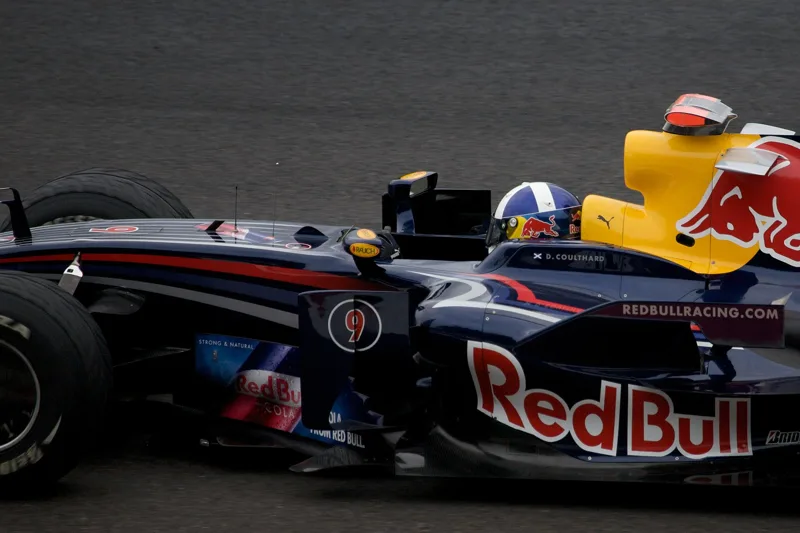
Kubica took sixth, ahead of Jarno Trulli and Timo Glock in the Toyotas, while the Toro Rosso pair of Vettel and Bourdais came next. David Coulthard qualified 11th to beat his teammate Webber, and Piquet split the two Red Bulls in 12th. Kazuki Nakajima took 14th, the only Japanese driver in the field,.
Heidfeld managed only 16th, ten places behind his BMW teammate Kubica, after struggling with the set-up of his car for most of the first session. Honda's Barrichello and Button lined up in the ninth row, in front of the company's home crowd. Sutil qualified 19th, comfortably ahead of his teammate Fisichella by 0.8 seconds.
What happened at the start?
Hamilton locked his front wheels at the first corner, ran wide and forced Raikkonen off the line. Contact with Kovalainen followed, and all three drivers dropped down the order. Kubica led after the corner, avoiding the collisions that caught out other cars as the track was still cold.
Raikkonen had got ahead of Hamilton down the first straight, but Hamilton tucked into his slipstream and swerved to the inside at the corner. The braking error that followed meant that Raikkonen had nowhere to go, and the sequence of contacts left the McLaren and Ferrari drivers at the back of the leading group.
Behind them, Fisichella ran into the back of Barrichello and scattered carbon fibre across the track. Coulthard collided with Bourdais and then Piquet, damaging his suspension and sliding into the barriers after the second corner. Nakajima left the track trying to avoid Coulthard, rejoined after losing his front wing, and pitted at the end of the lap for a new one.
At the end of the first lap Kubica led Alonso, Kovalainen, Trulli, Massa, Hamilton and Raikkonen. Glock stopped twice before retiring with handling trouble from a broken seat fixing. Sutil's day ended on lap nine with a puncture from carbon fibre shards.
How did the lap-two collision change the race?
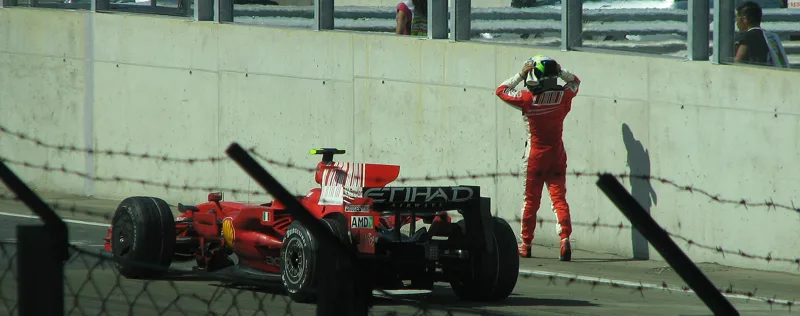
On lap two Massa braked late into the turn 10 chicane, briefly let Hamilton past, and then ran over the kerbs on the exit and hit the McLaren driver's car. Hamilton was spun by the contact, made an early pit stop for tyres and fuel, and dropped to 18th. Massa continued in seventh, a position that would become important later.
The stewards handed out drive-through penalties on lap 17. Massa was penalised for the collision and Hamilton for forcing Raikkonen off into turn one. Hamilton took his penalty immediately, while Massa pitted on the next lap and came in again on lap 20 to serve his, which dropped him to 14th, one place ahead of Hamilton.
Massa then recovered through the field. He overtook Button to take 12th one lap after his penalty, and he set the fastest race lap on lap 55 at 1:18.426. On lap 65 he passed Webber for eighth, using a move around the outside into the end of the pit lane that Webber could not defend.
How did Alonso control the second half?
Alonso lapped consistently in the low 1:19 range and set the fastest lap of the race on lap 41 at 1:19.101, which extended his lead over Kubica. He made his second stop on lap 43 and fitted the softer tyre, which gave him the pace to stay out front.
Kubica complained of understeer over the team radio and made his second stop on lap 46, two laps ahead of Raikkonen. Several other drivers, including Trulli, Bourdais, Vettel and Piquet, made their final stops over the following laps, and their teams had given them enough fuel to finish. The order at the front was settled once the last stops were complete.
Raikkonen attacked Kubica on the approach to turn one on lap 52, but Kubica blocked and defended his position. On the following lap Raikkonen out-braked him into the corner and drew alongside, and Kubica held the inside line through turn three. Raikkonen went off at the run-off area and rejoined behind the BMW, and he faced similar challenges over the next two laps before Kubica defended successfully.
Why did the Massa and Bourdais collision lead to a penalty?
Late in the race Massa tried to pass Bourdais as the Toro Rosso left the pit lane in seventh place, and the two cars collided at the first corner. Massa spun, rejoined behind Bourdais, and the stewards opened an investigation that they said would be decided after the race. The verdict came forty minutes after the chequered flag.
The stewards gave Bourdais a 25-second penalty for the collision, which dropped him from sixth to tenth and promoted Massa to seventh. Bourdais said he had done everything he could to avoid Massa, and that Massa had squeezed and turned as if he had not been there. Massa denied responsibility and said he had already entered the turn when he was hit from behind, which spun him round.
The penalty was widely criticised in the media. GrandPrix.com called it bizarre, and James Allen of ITV described it as ridiculous, especially given that FIA race director Charlie Whiting had said before the race that cars leaving the pit lane would have right of way. The French newspaper L'Equipe said both drivers had held their lines and that the incident was a racing accident.
Mark Blundell, a former Formula One driver, argued that ex-drivers should sit in on stewards' meetings, because nobody can judge what a driver is thinking without having driven in a race. His idea later became reality, as the 2010 season introduced a system in which a former driver acted as a steward at each Grand Prix.
How did the British press react to Hamilton's start?
Much of the British press criticised Hamilton's aggressive move into the first corner. Edward Gorman of The Times described it as impetuosity and untamed aggression, and Hamilton himself said he had made a mistake and had paid for it. The incident also cost Hamilton any chance of a points finish that afternoon.
The BBC's Andrew Benson said Hamilton was still in a strong position but would need to cut out the mistakes that had marked his season if he was not to lose the title again. La Gazzetta dello Sport in Italy pointed to his usual excessive aggression at the start,.
Hamilton had called Massa's touch as deliberate as it could be, but Massa rejected the accusation. He said he had two wheels on the gravel and could not stop the car, and that Hamilton had pushed him onto the gravel. Simon Arron of The Daily Telegraph called the accusation unworthy and unwise, arguing that the contact was simply a racing incident, and most of the media agreed that the contact was unintentional.
Where did the title race stand after Fuji?
Hamilton stayed ahead of Massa in the Drivers' Championship, five points clear with two races left. In the Constructors' Championship Ferrari moved seven points ahead of McLaren, because McLaren failed to score and Ferrari finished third and seventh. Massa's seventh place at Fuji had kept him within striking distance.
Massa's seventh place kept the title open going into the final two races, although Hamilton's lead was still intact. Kubica said that his second place was better than the win he had taken at the Canadian Grand Prix earlier in the season, and he described the podium as a great result for BMW Sauber at a very difficult moment.
Raikkonen was a bit disappointed. He said that losing the lead at the first corner had not helped, and that Kovalainen's contact had left his car with handling problems, which stopped him from improving on his third-place finish.
| Position | Driver | Team | Note |
|---|---|---|---|
| 1st | Fernando Alonso | Renault | Fourth on the grid; Renault's last win as a constructor |
| 2nd | Robert Kubica | BMW Sauber | Held off Raikkonen in the closing laps |
| 3rd | Kimi Raikkonen | Ferrari | Joined Hamilton on the front row; lost ground at the first corner |
| 4th | Nelson Piquet Jr | Renault | Alonso's teammate, finished fourth |
| 5th | Jarno Trulli | Toyota | Ahead of Bourdais and Vettel on the road |