Only seven of the 22 starters finished the first race of 2008, after three safety car periods, a host of crashes and a disqualification.
The 2008 Australian Grand Prix was held on 16 March 2008 at the Melbourne Grand Prix Circuit and was the first race of the Formula One season. Lewis Hamilton won from pole for McLaren, with Nick Heidfeld second and Nico Rosberg third in his first podium. Only seven of the 22 starters finished the 58-lap race.
Lewis Hamilton won the 2008 season opener in Melbourne from pole position, and his McLaren team took the lead of both championships at the end of the day. Only seven of the 22 starters finished, after three safety car periods and a long list of collisions and mechanical failures. Nick Heidfeld was second and Nico Rosberg third, for the first podium of his career.
Who was in the field, and what had changed for 2008?
Eleven teams and 22 drivers started the season, and the grid kept almost the same shape as the year before. Alonso had moved back to Renault, and Heikki Kovalainen had joined McLaren in his place. Kimi Raikkonen stayed at Ferrari, with Felipe Massa alongside him.
Super Aguri, alone among the teams, stayed away from the final pre-season test.
The race also marked a change in the rules. Traction control had been banned by the FIA at the end of 2007. The race was the first in seven years to run without traction control, a gap that stretches back to 2001.
Hamilton led all but five laps, and only seven cars were still running at the flag.
What did the test sessions tell the teams?
The final mass test before the season took place at the Circuit de Catalunya in Montmelo from 25 to 27 February. Super Aguri did not attend. Hamilton set the fastest time on the first day at 1:22.276, and Trulli was fastest on the final day at 1:20.801, which was the fastest time of the whole test.
The test was the last chance for teams to settle their 2008 cars before Melbourne. Traction control had been banned at the end of 2007, so every car on the grid had to be set up without it.
How did practice go for the teams?
Raikkonen, the defending champion, set the fastest time in the first practice at 1:26.461. Hamilton and Massa were four-tenths of a second slower, and Piquet Jr. caused a brief red flag after spinning at the Ascari corner. Hamilton then lapped faster than Raikkonen in the second practice, with a time of 1:26.559, and Webber was second, nine-tenths of a second behind.
Coulthard was fifth in the second session, three-tenths behind Kovalainen. In the third session the BMW Sauber team topped the times, with Kubica ahead of Heidfeld, while Alonso was third and Rosberg fourth. Many teams put their cars on soft tyres for that session, in preparation for qualifying.
Who was fastest in qualifying at Melbourne?
Hamilton took his seventh career pole position, at 1:26.714 in the third session. Robert Kubica was a tenth of a second behind him, and Kovalainen was third. Massa was fourth, four-tenths slower than Hamilton.
Heidfeld, Trulli, Rosberg and Coulthard completed the top eight. Raikkonen had a fuel pump problem at the end of the first session, and Ferrari could not fix it before the second session. He qualified 16th.
Webber spun with a brake failure in the second session and was 15th. Vettel had an oil pump failure and set no time in the third session. Glock was demoted from ninth to 19th after two five-place grid penalties, one for a gearbox change and one for impeding Webber. Adrian Sutil spun and stalled on his final lap in the first session and damaged his chassis.
How did the first lap change the race?
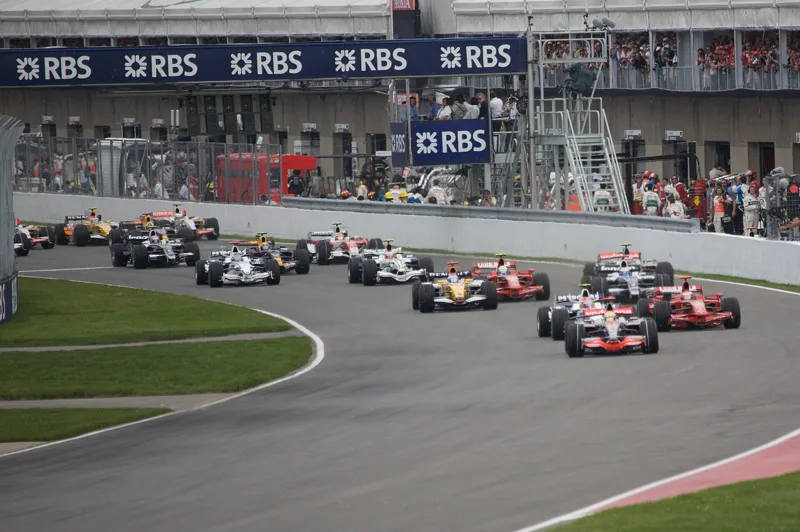
Vettel stalled on the grid and lost several places. Massa spun at the first corner while racing Kovalainen and damaged his front wing against the barriers. Piquet Jr. made contact with Fisichella at the first corner, and Fisichella retired.
At turn three Webber, Davidson, Button and Vettel all made contact and retired. Nakajima drove into the spinning Vettel and lost his front wing, and he had to pit for a new one. The accidents brought out the safety car.
Hamilton held the lead into the first corner, with Kubica behind him in second. By the end of the first lap Hamilton still led, followed by Kubica and Rosberg, and Raikkonen had climbed from 15th to eighth.
What happened in the middle of the race?
Sutil retired with hydraulic failure on lap 10. Trulli was forced out with electrical problems during the first round of pit stops. On lap 26 Massa attempted to pass Coulthard, and the two collided, which forced Coulthard to retire. Massa retired with engine failure three laps later, and a second safety car was deployed.
The race restarted without a safety car on lap 30. Raikkonen made an ambitious move on Kovalainen at turn three, ended in the gravel, costing several places. A dozen laps later he spun again at the same corner while chasing Glock. Sato retired on lap 34 with a transmission problem.
On lap 44 Glock ran wide onto the grass, and his car bottomed out over two large bumps. The second lifted it into the air, and it came down hard enough to damage the suspension. Glock spun twice and came to rest against the wall, and the safety car came out for a third time.
The same lap brought the most unusual moment of the race. Barrichello left his pit stop before the fuel hose had been removed, after a false signal from the chief mechanic. Several mechanics suffered minor injuries, and he was given a ten-second stop-and-go penalty for the pit stop taken while the pit lane was closed.
How did the Ferrari cars fare?
Raikkonen's qualifying ended 16th, after a fault his team could not repair in time. In the race he climbed from 15th to eighth on the first lap, and he kept working through the field until his car's problems returned.
He ran wide and lost places when he tried a move on Kovalainen at turn three, and later spun in the same corner while attempting to pass Glock. Ferrari's second engine failure of the race came on lap 54, when he drove slowly into the pit lane and retired. Massa had a worse first lap, spinning at turn one while racing Kovalainen and damaging his front wing against the barriers.
How did the safety car periods shape the race?
The race had three safety car interruptions. The first came after the opening-lap accidents at turn one and turn three, and the second after Massa and Coulthard collided on lap 26. Those periods bunched the field and gave Raikkonen the chance to recover places he had lost.
Glock's suspension broke on lap 44, bringing a third safety car period, and the race restarted under green flags on lap 47. The third period was also the one that came when Barrichello's pit stop went wrong, and by then several cars had already retired.
Key moments in the race
| Lap | Event |
|---|---|
| 1 | Massa spins and Fisichella retires; Webber, Davidson, Button and Vettel are out at turn three |
| 10 | Sutil retires with hydraulic failure |
| 26 | Massa and Coulthard collide; the second safety car is deployed |
| 30 | The race restarts without a safety car |
| 34 | Sato retires with a transmission problem |
| 44 | Glock breaks his suspension and retires; the third safety car comes out |
| 48 | Kubica retires after a collision with Nakajima |
| 54 | Raikkonen retires with Ferrari's second engine failure |
| 56 | Bourdais retires from fourth with an engine failure |
How did Bourdais make his debut?
Sebastien Bourdais was competing in his first Formula One race. His afternoon ended on lap 56 with an engine failure, while he was running in fourth place, which was a painful end to a strong start.
He was classified seventh despite not finishing, because he had completed 90% of the race winner's distance. That gave him two points on debut.
Who finished, and who was disqualified?
Hamilton won, having led all but five laps. Heidfeld was second and Rosberg third, with the Williams driver taking his first podium. Kovalainen was fifth, which gave McLaren the points it needed to lead the Constructors' Championship.
Seven cars finished the race, but Barrichello was disqualified from sixth for ignoring a red light at the pit exit. Bourdais finished on the lead lap in his debut race and was classified seventh with two points. Raikkonen was classified eighth after completing 90% of the winner's distance, though he had retired on lap 54.
Nakajima was the last car to finish. After the race he was given a ten-place grid penalty for the next race in Malaysia, after colliding with Kubica under safety car conditions.
What did the podium mean for Heidfeld and Rosberg?
Heidfeld's rostrum was his first since the 2007 Hungarian race, and he was relieved to keep Rosberg behind him at the end. He believed Rosberg had been fuelled longer than he actually was, and he credited his pit crew for getting him out ahead.
Rosberg's third place was his first podium, and he said he was looking forward to similar results through the year. He described the car as solid, with room to develop it as the season went on.
What did the first race mean for the championships?
After one race Hamilton led the Drivers' Championship with 10 points, ahead of Heidfeld on 8 and Rosberg on 6. McLaren picked up 14 points in the Constructors' Championship, five points ahead of Williams, while BMW Sauber were third on 8 points.
Hamilton said he felt fantastic and that the race had been physically easier than he expected. He called it great preparation for Malaysia, and the team's pit-stop crew had earned his praise for two strong stops.
Heidfeld was delighted with his first podium since the 2007 Hungarian Grand Prix. He was relieved to have kept Rosberg behind him, since the Williams driver had pitted earlier than expected. Rosberg said he was looking forward to a good year, with a solid car and room to develop it.