The Ardennes circuit that grew from a fast early road course into one of Formula One's most feared and most loved tracks.
This Belgian venue measures 7.004 km (4.352 mi) and sits in the Ardennes near Stavelot. It started out on public roads, and a rebuild in 1979 turned it into a permanent circuit. The current layout's official lap record stands at 1:44.701, from 2024.
Spa-Francorchamps is a 7.004 km (4.352 mi) race track in Wallonia, Belgium, that began life as a public-road course. It first hosted a Grand Prix in 1925, and it was rebuilt as a permanent track in 1979. The circuit is best known for the Raidillon de l'Eau Rouge, a blind climb that many drivers rank among the hardest corners in motor sport.
Spa sits in the Ardennes forest, so the circuit has always combined fast running with unpredictable weather. Its history is a story of danger and reform: a fast old road course, fatal accidents in the 1960s, a boycott, a cancelled race and then a shorter modern layout that Formula One returned to in 1983.
How long is the Circuit de Spa-Francorchamps?
The current circuit is 7.004 km (4.352 mi) long and lies a short drive southeast of the town of Spa. The track was shortened to a permanent layout in 1979 and has been reshaped several times since. Its hilly, fast character has survived those changes, and speeds above 330 km/h (210 mph) are still possible on the straights.
The change in 1979 was the biggest in the circuit's history. The old road circuit had run past houses, trees, electric poles and fields, and in its final form it measured 14.100 km (8.761 mi). Organisers replaced it with a 6.947 km (4.317 mi) permanent circuit, which kept Blanchimont and the Eau Rouge area at the heart of the lap.
The start and finish line moved in 1981 from the downhill straight before Eau Rouge to the straight before La Source. A major renovation followed in 2007. Work began on 6 November 2006, finished in May 2007 and cost around 19 million euros. The Bus Stop chicane was moved back towards Blanchimont, which freed space for a new pit lane and gave the main straight more length.
| Layout | Length | Period | Notes |
|---|---|---|---|
| Original road circuit | 14.100 km (8.761 mi) | Until the 1979 change | Ran through villages, fields and public roads |
| Permanent circuit | 6.947 km (4.317 mi) | From 1979 | Start/finish moved in 1981 |
| Current circuit | 7.004 km (4.352 mi) | Present layout | Reworked in the 2007 renovation |
| Motorcycle variant | 6.985 km (4.340 mi) | From 2022 | Jacky Ickx corner bypassed |
A blind climb, a fast old road course and a shorter modern track that still asks everything of its drivers.
Why was the original Spa circuit so dangerous?
The original circuit was a high-speed road course where most corners were taken above 290 km/h (180 mph) with little margin for error. Before 1970 it had almost no safety measures, and apart from a few straw bales it differed little from an ordinary road. A driver who ran wide had no real runoff and no reliable barrier to stop the car.
Its reputation was earned in blood. During the 1960 weekend in Belgium, Chris Bristow and Alan Stacey lost their lives within a 15-minute span, and a bird struck Stacey in the face before his accident. Stirling Moss was badly hurt in practice at Burnenville. Ten car racing fatalities were recorded at the track during the 1960s, and five of them came in the last two years before the boycott.
Formula One drivers stayed away from the 1969 race, and Armco barriers were added to the most exposed sections. The 1970 race still failed to satisfy the drivers, and the 1971 event was cancelled because the mandatory safety measures had not been installed. Formula One stayed away until 1983, when it returned to the modern circuit.
The Masta Kink, a high-speed left-right chicane between two long straights, was removed from Formula One after the 1970 season. Jackie Stewart crashed there in 1966 when his BRM ended upside down near a farmhouse, with fuel spilling onto him. He later said it may have been the hardest corner he raced on, harder even than Eau Rouge.
What is Raidillon de l'Eau Rouge?
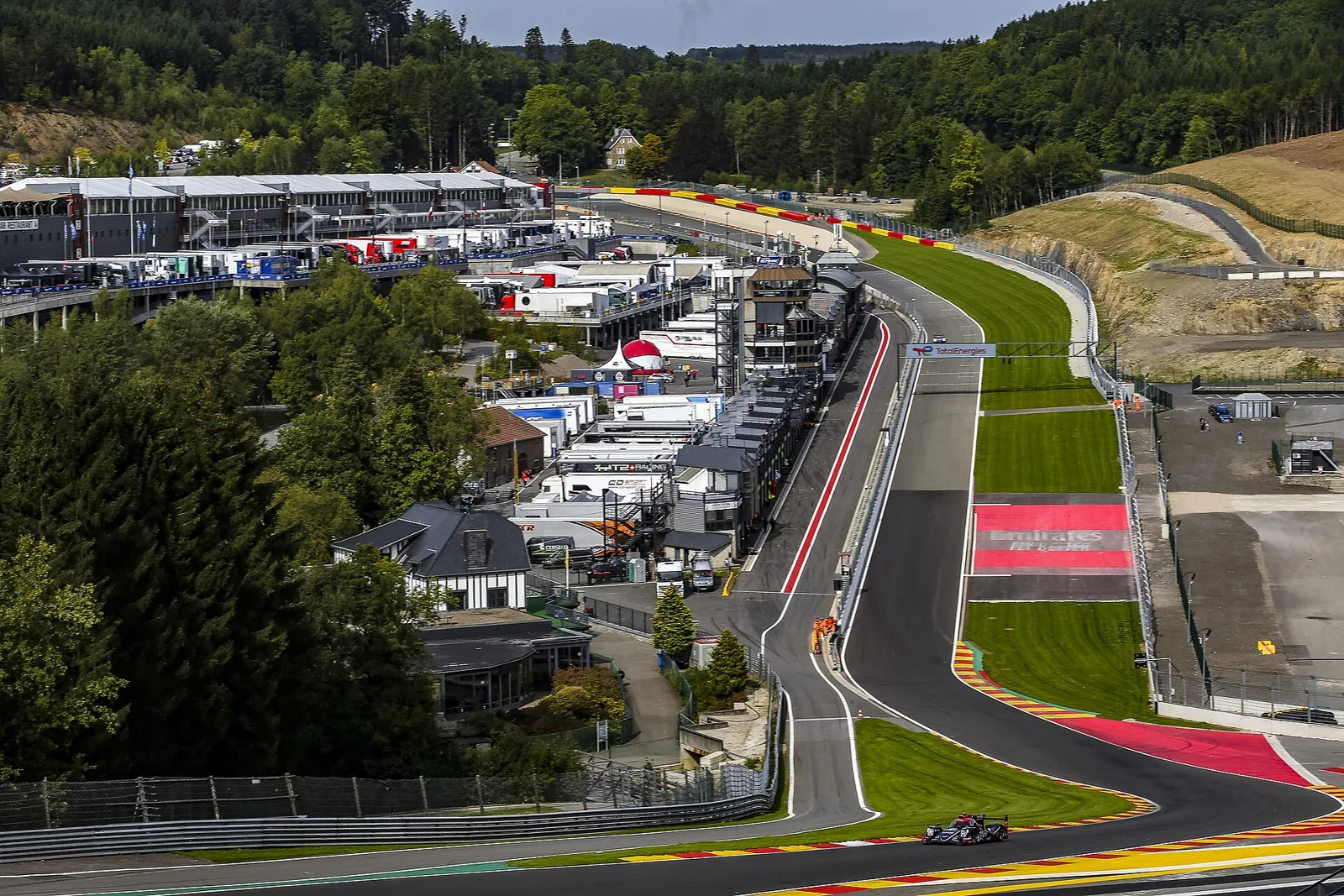
Raidillon de l'Eau Rouge is the section that follows the La Source hairpin, dropping to the Eau Rouge stream and then climbing steeply through a left-right-left sweep over a blind crest. Drivers cannot see the exit as they go over the top, which makes the corner a test of nerve as well as skill. It is widely regarded as the defining corner of the circuit.
The corner rewards commitment. Touring cars take it at 160-180 km/h (99-112 mph), while Formula One cars with high downforce can exceed 300 km/h (190 mph). A loss of control usually means the rear of the car steps out, and the impact that follows is often sideways into the barrier, which is why so many crashes here have been serious.
Several well-known drivers have crashed there. Stefan Bellof was killed in a Porsche sportscar, Guy Renard crashed a Toyota Corolla GT during the 1990 24 Hours, and Alex Zanardi crashed a Lotus in 1993 Belgian Grand Prix practice in an accident that ended his season. Jacques Villeneuve had a heavy crash near the top in 1999 qualifying, and his team-mate Ricardo Zonta had a similar accident later in the same session.
The entry was obstructed with stacked tyres in 1994, after Roland Ratzenberger and Ayrton Senna died at Imola, and the layout returned to normal the following year. Small changes to the corner came for the 2002 race. A grandstand was later planned at the top of the climb as part of the 2022 works.
What changed after the 2019 Formula 2 crash?
After the 2019 Formula 2 crash that killed Anthoine Hubert, the circuit committed to more runoff, a set of gravel traps and a wider redevelopment of the Raidillon area. The works were completed in March 2022 and followed a run of serious accidents in the years before.
Hubert's car struck the tyre barrier on the Kemmel straight after a chain of contacts that began when Giuliano Alesi lost control on the climb after a puncture. The car was deflected into the path of Juan Manuel Correa, who was seriously injured. The feature race was abandoned, the next day's sprint was cancelled, and the Formula One race still went ahead.
Concern grew further after a W Series qualifying session in rain, where six cars collided at Raidillon. The next day Lando Norris aquaplaned into the tyre barrier at the same corner during Formula One qualifying. Several drivers, including Toto Wolff, publicly called for changes to the section.
In October 2020 the circuit announced gravel traps at La Source, Raidillon, Blanchimont, Les Combes and Stavelot, with larger runoff at some corners. The traps formed part of an 80 million euro upgrade that also made the circuit suitable for motorcycle racing. The works were completed in March 2022, and the circuit was shortened to 6.985 km (4.340 mi) for motorcycles because the Jacky Ickx corner was bypassed.
Serious incidents have continued. Pietro Fittipaldi broke a leg at Raidillon in 2018, Jack Aitken broke his collarbone there during the 2021 24 Hours of Spa, and Dilano van 't Hoff died after a crash at the same section in 2023.
What makes Blanchimont and the Jacky Ickx corner notable?
Blanchimont is the last fast left-hander before the chicane that leads onto the pit straight, and it has existed in both the old and modern layouts. The corner that is now called the Jacky Ickx corner, named in 2018 in tribute to the former racer, sits at turn 11 of the Formula One layout.
Blanchimont has produced violent accidents. In 2001 Luciano Burti lost his front wing after a clash with Eddie Irvine's Jaguar, left the track at 298 km/h (185 mph) and hit the tyre wall. In 1997 Tom Kristensen crashed a Formula 3000 car there, and in 1992 Ayrton Senna stopped his own car to help Erik Comas after a heavy crash during Friday practice.
The runoff at Blanchimont is narrower than at other corners taken at that speed, and behind the barriers is a 7-8 metre drop. That combination is why the approach has been a recurring subject of safety debate.
Drivers once called turn 11 Speakers corner, after the point where the public address announcer could first see the cars emerging from the forest beyond Eau Rouge. Motorcycles use a shorter variant of the corner today.
What are the lap records at Spa-Francorchamps?
Sergio Perez set the current-layout benchmark at 1:44.701 in a Red Bull Racing RB20 at the 2024 race. Oscar Piastri's 1:40.510, driven in a McLaren MCL39 during the 2025 sprint qualifying session, is the unofficial all-time figure.
Records on the old circuit were much slower and remain part of its story. The race lap record was 3 minutes and 13.4 seconds, set by Henri Pescarolo in a Matra at the 1973 Spa 1000 km at an average of 262 km/h (163 mph). The fastest recorded time on the old layout was Jacky Ickx's pole position in the same race, 3 minutes and 12.7 seconds in a Ferrari 312PB.
Eighteen world championship races were held on the original configuration before the 1979 change. Each one was a test of commitment, because the fast road course gave drivers little time to recover from a mistake.
Which racing takes place at Spa today?
Spa is best known for endurance racing, including the 24 Hours of Spa and the 6 Hours of Spa-Francorchamps for the World Endurance Championship. It also hosts Formula One, Formula 2 and Formula 3 rounds, GT championships and motorcycle events, plus the Uniroyal Fun Cup 25 Hours, which ranks among the longest races anywhere.
The circuit has held a Grand Prix every year since 1985, apart from 2003 and 2006. It was part of the 2023 Formula One calendar, and in October 2023 its contract was extended to 2025.
The calendar is busy. The April programme also includes classic endurance events, and the summer months bring GT and touring car series that keep the circuit in use through the season.
Why is the weather at Spa so hard to predict?
Spa lies in the Ardennes, where rain can fall on one part of the circuit while another stretch stays dry, and conditions can change within a single lap. The area has a cool, damp climate with frequent cloud, and several Formula One races have been decided by wet track conditions.
Formula One has seen the problem repeatedly. The 1998 race produced a 14-car pileup on a waterlogged track, and in 2008 rain fell during the final laps of a race that had been dry until then.
Weather stations in Stavelot and Malmedy record similar oceanic climates with some continental influence. Snowfall is quite common in winter, while summer temperatures most often stay in the low 20s. The endurance event falls in spring, while the Formula One race arrives in late summer, so the hottest conditions rarely coincide with the big races.