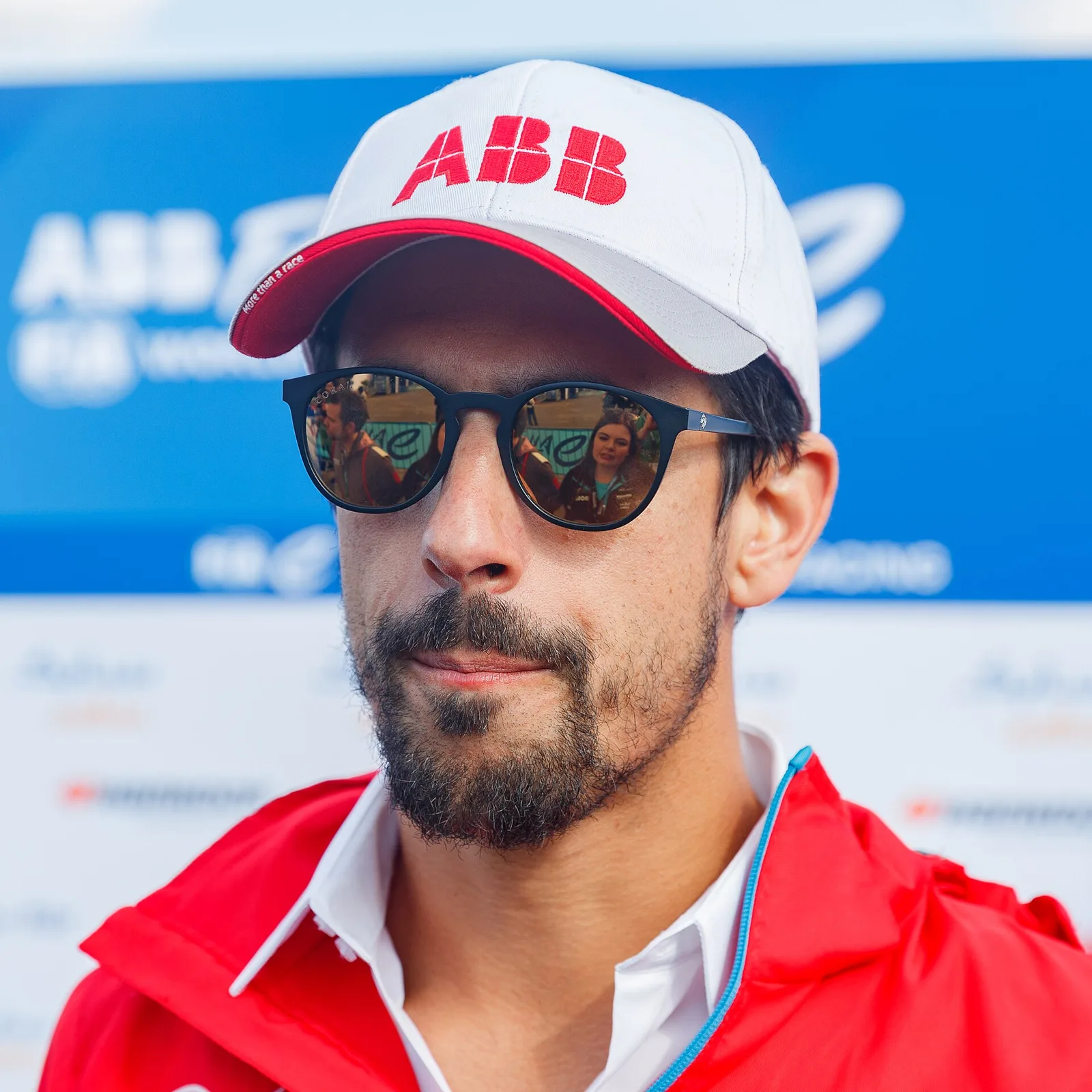
From Brazilian karting to Virgin's difficult 2010 Formula One season, a long Audi endurance run and the 2016-17 Formula E title.
A Brazilian driver from Sao Paulo, di Grassi raced in Formula One for Virgin in 2010, won the 2016-17 Formula E title with Audi and finished runner-up in the 2016 World Endurance Championship. He announced his retirement in 2026, after thirteen Formula E race victories.
Lucas di Grassi moved from Brazilian karting into Formula One, then into endurance sports cars and electric racing. That route ended with the 2016-17 Formula E Drivers' Championship and a retirement announced in 2026.
Who is Lucas di Grassi?
Di Grassi is a Brazilian former driver, born in Sao Paulo on 11 August 1984. He raced in Formula One with Virgin Racing in 2010, won the Formula E Drivers' Championship in 2016-17 and was runner-up in the World Endurance Championship in 2016.
His career combined driving with development work. He helped develop the Dallara GP2/08 chassis for the GP2 Series, tested tyres for Pirelli and served as a reserve driver for Renault, which gave him a wider view of how racing cars were built.
From a Sao Paulo karting start to a Formula E title, a career that crossed single-seaters, sports cars and electric racing.
How did di Grassi start racing?
He began karting at the age of ten, on the invitation of his father Vito. Di Grassi won a karting series in Sao Paulo in 1997, finished fifth overall in the Formula A World Championship in 2000 and took the Pan American Kart Championship that same year.
Before his formal start, his uncle owned a go-kart shop, and di Grassi drove karts there between the ages of seven and eight.
Car racing followed in 2002 with Formula Renault 2.0 Brazil. He won two races that season and finished seven points behind the champion, Sergio Jimenez.
How did the junior formulae years go?
Di Grassi moved to Formula 3 Sudamericana in 2003 and finished second in the championship. He then raced in British Formula Three in 2004 with Hitech Racing, winning both races at Thruxton, and in 2005 he moved to the Formula 3 Euro Series, where he won the Macau Grand Prix.
The 2003 season was cut short. He took one victory and eleven podium finishes, then missed the final six races after a neck injury from an accident in Curitiba. He still finished second behind Danilo Dirani.
In 2004 he moved to the United Kingdom. Two wins at Thruxton marked the high point of the year, but the rest of the season was harder, and he finished eighth in the British Formula Three standings.
In 2005 he joined Manor Motorsport for the Formula 3 Euro Series. An accident at the Hockenheimring saw his car roll into the tyre barrier after contact with a rival's wheel, but he recovered and He finished the year by winning the Macau Grand Prix from third on the grid.
Did di Grassi win a GP2 title?
No. He finished runner-up to Timo Glock in the 2007 GP2 Series, after a first win at Istanbul in the fourteenth round. He was third in 2008 with two wins, and in 2009 his only win came in the Istanbul sprint race.
He signed with ART Grand Prix in December 2006 for the 2007 season and scored points consistently through the year. His first GP2 win came late in the campaign, but Glock moved ahead of him and took the title.
In 2008 he joined Campos Racing from round four and took two wins. He ended the season third, ten points behind Giorgio Pantano,.
For 2009 he drove for Racing Engineering alongside Dani Clos. The Istanbul sprint win was his only victory of that campaign,
Was he a Formula One test driver before 2010?
Yes. Di Grassi was a Renault test and reserve driver across 2008 and 2009, and he stood by for the Singapore Grand Prix in 2009 after Romain Grosjean fell ill. The role kept him close to the top level of the sport while he raced in GP2.
In November 2009 he tested the Honda RA108 at Circuit de Catalunya and lapped within half a second of Bruno Senna's pace. Honda then withdrew from Formula One after the 2008 financial crisis,.
The FIA also banned in-season testing for Formula One teams, which ended his in-season testing work with Renault.
What was his 2010 Formula One season like?
Di Grassi raced for Virgin Racing in 2010, partnered by Timo Glock, and finished the season 24th with no points. His best result was fourteenth at Sepang in Malaysia, and he crashed out of the Korean race on lap 26.
He was announced for Virgin Racing on 15 December 2009. The early races were hard, with retirements from Bahrain and Australia caused by hydraulic problems. In China a clutch failure ended his race after nine laps.
Results improved only in patches. He finished 19th at the Turkish Grand Prix after managing an engine problem, and his Italian race ended with a suspension failure with three laps left.
He ended the season without a point. On 19 December he won the Desafio Internacional das Estrelas karting event, but two days later Virgin announced Jerome d'Ambrosio alongside Glock for 2011, leaving di Grassi without a drive.
How did Pirelli tyre testing shape his career?
After Formula One he became Pirelli's official tyre tester on 6 July 2011, developing tyres for the 2011 season and beyond. He drove the company's Toyota TF109 in five test sessions that year, then ran four development tests in 2012 with Jaime Alguersuari in a Renault R30.
The role gave him a working link to tyre development. He attended race weekends and collected information on tyre performance, alongside his sports car programme.
Talks with Peugeot, who were considering him for a sports car seat, collapsed in January 2012 when the manufacturer withdrew from sports car racing because of financial difficulties.
Which endurance results defined his sports car career?
Di Grassi's sports car career began with the 2012 24 Hours of Nurburgring, which ended after eleven laps. Later that year he made his World Endurance Championship debut at the 6 Hours of Sao Paulo, finishing third overall, and by 2016 he had become the series runner-up.
His first WEC race was at Sao Paulo, where he raced for Audi Sport Team Joest alongside Tom Kristensen and Allan McNish. The same year he took part in the Gold Coast 600, finishing eleventh in race one, and in Macau he finished second in an AF Corse Ferrari 458 GT3.
In 2013 he finished second overall at the 12 Hours of Sebring and third at both the 6 Hours of Spa-Francorchamps and the 24 Hours of Le Mans. The Le Mans result came in an experimental Audi, shared with Oliver Jarvis and Marc Gene.
In 2014 he finished second at Spa-Francorchamps and second at Le Mans. The 2015 season brought fourth in the drivers' standings with 99 points, and the 2016 campaign ended with him as runner-up on 147.5 points.
The 2016 season also brought his first outright WEC win at Spa-Francorchamps and a third-place finish at Le Mans.
How did his Formula E career begin?
Di Grassi tested the Formulec prototype in August 2012 at Circuit de l'Eure near Paris. He was announced for the inaugural Formula E season on 13 February 2014, driving for Audi Sport ABT alongside Daniel Abt, and he won the first all-electric race in Beijing that year.
Promoter Alejandro Agag had sought his technical expertise as a driver to help develop the electric race car.
In the 2014-15 season he scored six podium finishes, the most of any driver, and finished third in the championship, eleven points behind Piquet. A disqualification in Berlin for illegal front wing endplates took away a win he had earned on track.
The 2015-16 season opened with a win at Putrajaya and a championship lead. He was then disqualified at Mexico City for being underweight, and the title eventually went to Sebastien Buemi by two points.
Why did di Grassi win the 2016-17 Formula E title?
He won the 2016-17 Drivers' Championship with Audi Sport ABT, using a Mexico City win and a pole and victory at Montreal among his results. The title was his first in the series. Sebastien Buemi was his main rival across that campaign, and the final round decided the title race.
The Mexico City win came earlier in the season, and the closing double-header at Montreal then settled the championship.
The Montreal finale was decisive. He took pole for the first ePrix and won it, and Buemi had a poor race in both rounds, which left the title with di Grassi.
What happened in his later Formula E seasons?
After the title di Grassi finished second in 2017-18 with 144 points and third in 2018-19 with 108 points. He later moved to Venturi, then Mahindra, and returned to ABT before announcing his retirement ahead of the 2026 Berlin ePrix.
In 2017-18 he won seven consecutive podium finishes, a run that helped Audi take its first Teams' Championship.
In 2019-20 he finished sixth overall with 77 points without winning a race. In 2020-21 he took the Puebla ePrix after Pascal Wehrlein was disqualified.
His time at Venturi in 2021-22 brought fifth overall with 126 points. With Mahindra in 2022-23 he took pole and finished third at Mexico City, and his return to ABT CUPRA in 2023-24 produced 23rd with four points.
In 2024-25 he finished second at Miami, behind Pascal Wehrlein, and ended the season 17th in the drivers' standings. Across his Formula E career he scored thirteen race victories.
How do his results compare season by season?
| Season | Series | Team | Result |
|---|---|---|---|
| 2003 | Formula 3 Sudamericana | Avellone | Second, one win, eleven podiums |
| 2004 | British Formula Three | Hitech Racing | Eighth, two wins at Thruxton |
| 2007 | GP2 Series | ART Grand Prix | Runner-up to Timo Glock |
| 2008 | GP2 Series | Campos Racing | Third, two wins |
| 2009 | GP2 Series | Racing Engineering | One win, Istanbul sprint |
| 2010 | Formula One | Virgin Racing | 24th, no points |
| 2012 | World Endurance Championship | Audi Sport Team Joest | Third at Sao Paulo |
| 2014 | World Endurance Championship | Audi Sport Team Joest | Second at Spa-Francorchamps and Le Mans |
| 2015 | World Endurance Championship | Audi Sport Team Joest | Fourth, 99 points |
| 2016 | World Endurance Championship | Audi Sport Team Joest | Runner-up, 147.5 points |
| 2014-15 | Formula E | Audi Sport ABT | Third, six podiums |
| 2016-17 | Formula E | Audi Sport ABT | Drivers' Champion |
| 2017-18 | Formula E | Audi Sport ABT | Second, 144 points |
| 2018-19 | Formula E | Audi Sport ABT | Third, 108 points |
| 2019-20 | Formula E | Audi Sport ABT | Sixth, 77 points |
| 2021-22 | Formula E | Venturi | Fifth, 126 points |
| 2022-23 | Formula E | Mahindra Racing | Pole and third at Mexico City |
| 2023-24 | Formula E | ABT CUPRA | 23rd, four points |
| 2024-25 | Formula E | ABT | 17th, second at Miami |
What else has di Grassi done beyond racing?
Di Grassi founded Smarter Driving, a fuel conservation non-governmental organisation, in 2007. His wider work covers fuel conservation, clean air and electric mobility. In 2018 he was appointed clean air ambassador for the United Nations Environment Programme. These causes stayed central to his public work after he left the cockpit.
In July 2020 he was announced as co-founder of the ESkootr Championship.
His standing in the sport was recognised in several ways. He was one of six drivers shortlisted for the 2017 Autosport International Racing Driver Award, and readers of Grande Premio voted him Brazilian Driver of the Year.