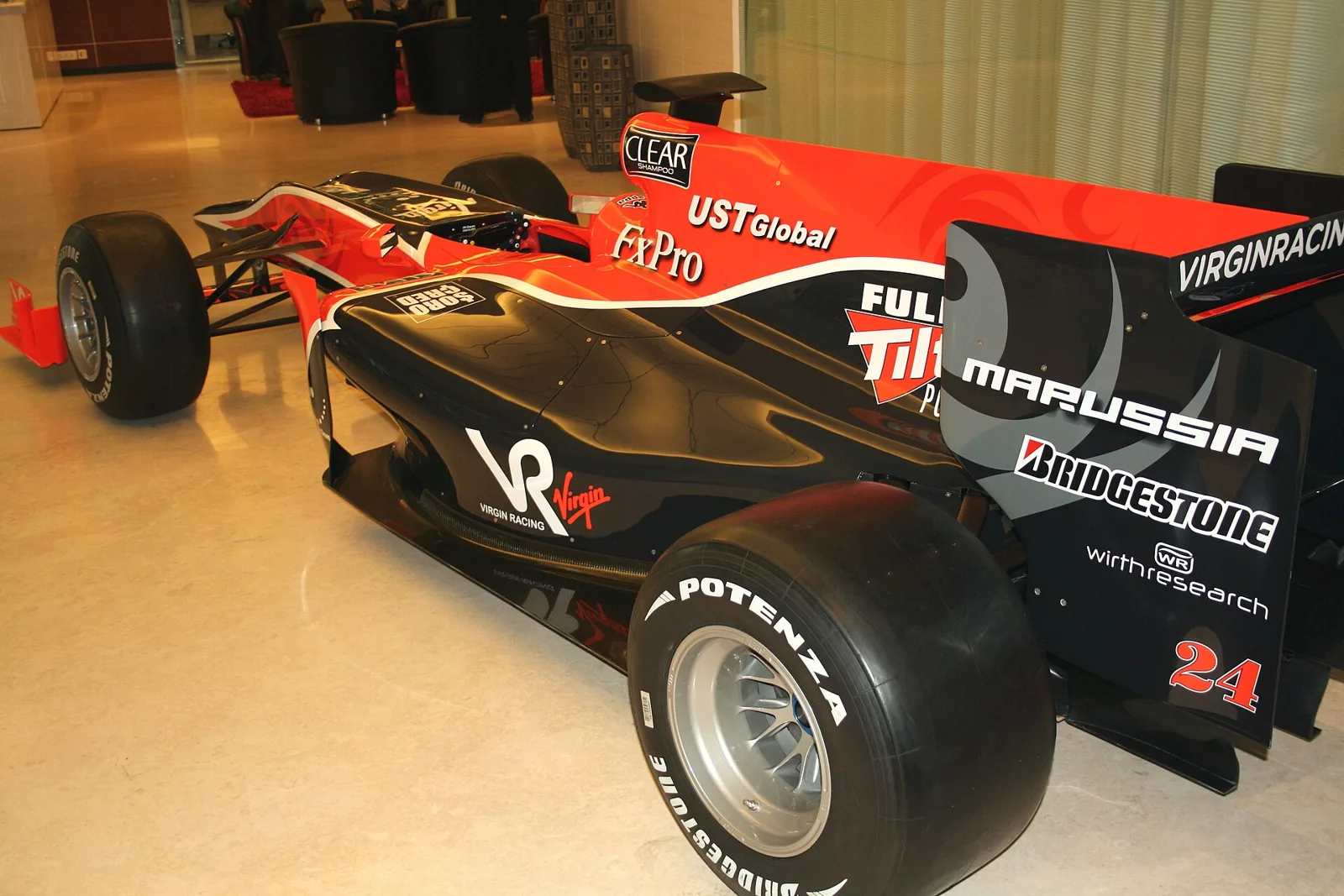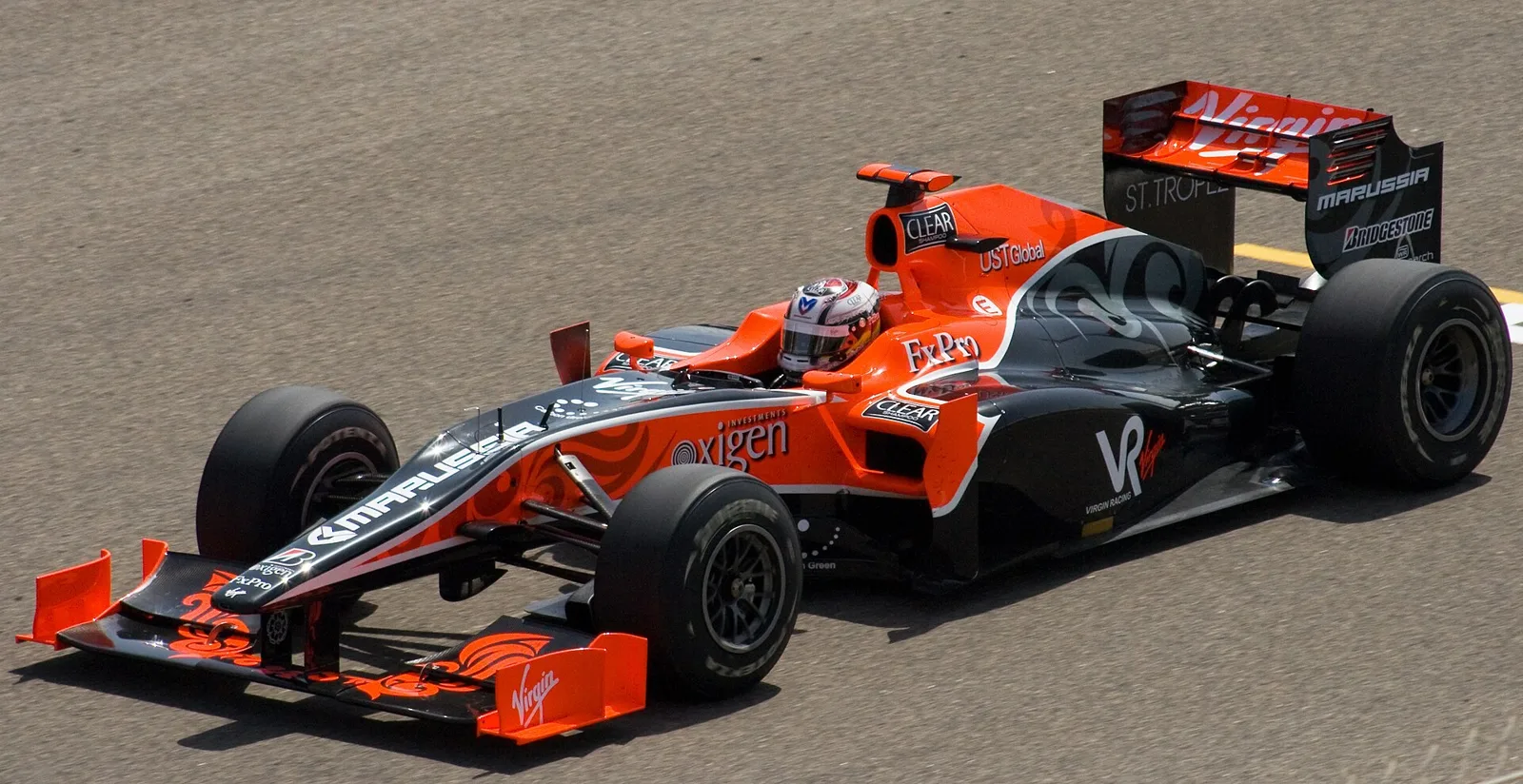
A 2010 Formula One car designed without a wind tunnel, built by a new team on a small budget and driven through a season of hydraulic trouble.
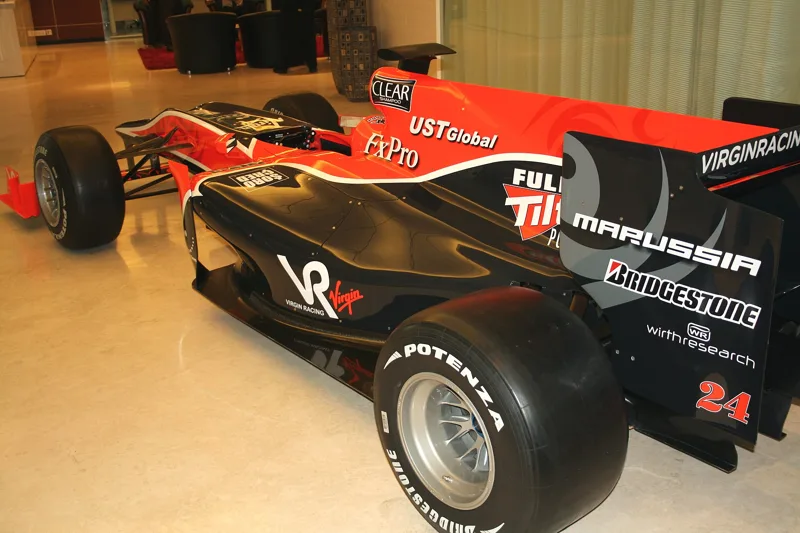
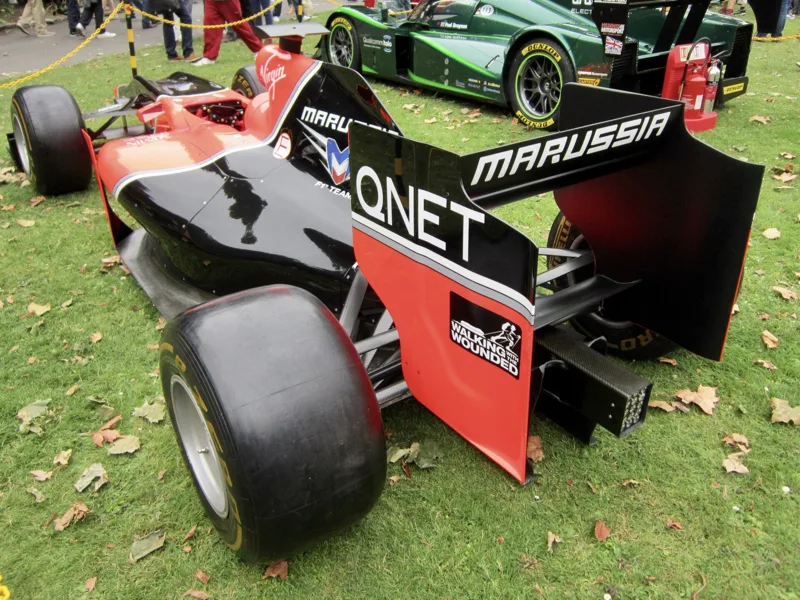
The Virgin VR-01 was the 2010 Formula One machine from Nick Wirth's drawing board for Virgin Racing, driven by Timo Glock and Lucas di Grassi. Its design relied wholly on computer fluid simulation, with no wind tunnel programme. The car suffered hydraulic problems, but it gave the team its first classified finish in Malaysia.
The Virgin VR-01 was Virgin Racing's first Formula One car, a 2010 design by Nick Wirth that was developed without any wind tunnel work. Timo Glock and Lucas di Grassi drove it through a season of hydraulic and reliability trouble, although it produced its first classified finish and two double finishes. The car's story is also about a new team trying to win a place on a crowded grid.
How did Virgin Racing come into Formula One?
Virgin Racing was built on a Manor Grand Prix team, after Richard Branson took an 80% stake in 2009 and the team was renamed. The car was designed by Wirth Research, while Manor Motorsport ran the cars and Virgin handled the commercial side. That three-way partnership carried the team through its first season.
Branson's interest in Formula One began earlier. In February 2009 Virgin was reported to be bidding for the former Honda team, and Branson argued that the sport needed a more economical and environmentally responsible image. Virgin had also sponsored the new Brawn GP for 2009 before Mercedes-Benz bought the team at the end of that season.
Manor Grand Prix had been formed by linking Manor Motorsport with Wirth Research. Graeme Lowdon was chief executive, John Booth was team principal, and Nick Wirth, a former owner of the Simtek team, was technical director. Booth recalled being introduced to Wirth when the budget cap concept appeared, at a time when the sport was expected to bring in around 30 million pounds of television money a season.
The timing was awkward. The team was meeting prospective sponsors at Silverstone during the 2009 British Grand Prix, the same day Formula One seemed close to splitting over commercial disputes. The new teams were a kind of insurance policy for the sport's leaders. When a breakaway proved no more likely than it had been for three decades, the newcomers had to decide whether to go on, and Virgin chose to continue within the financial framework it had set for the old regulations.
The buyout completed the picture. Branson invested in an 80% stake in Manor Grand Prix, and the team was renamed Virgin Racing. Its operations were run from Dinnington in South Yorkshire, while Wirth Research designed and built the VR-01 from Bicester. From July 2010 the design operation was based in Banbury, Oxfordshire, in bigger premises.
Virgin's operating budget was the smallest of the 2010 teams, at forty million pounds. Branson said that money was not everything, and that the team hoped to prove what engineering, good drivers and a warm relationship with the public could achieve.
A car designed entirely on computers, built on a small budget, and driven through a season of hydraulic failures.
Why did the VR-01 skip the wind tunnel?
Wirth chose to develop the car's aerodynamics using computational fluid dynamics alone, with no wind tunnel reference. Booth predicted that wind tunnels would soon be a thing of the past, because the pace of front-wing development left no room for the hours a tunnel would need. Later upgrades seemed to support that view.
The choice was tied to the budget. The team kept its spending in line with its own plan, and only Wirth's CFD capability made that workable. By its designers' account it was the first grand prix car drawn up purely through computer simulation, a claim that set it apart from its rivals on the grid.
The approach had costs. Auto, Motor und Sport claimed the tank could not hold enough fuel for a full race, which prompted a request to the FIA to change the chassis. A reworked chassis, with a longer underbody and new bodywork, was due at the Spanish Grand Prix. It was later clarified that the car would struggle with heavy fuel consumption rather than being unable to race at all.
Hydraulics were another problem. Booth explained that the high-pressure system meant even a tiny flaw could stop the car, because it controlled four or five of the major components. Every new team had similar trouble, and Virgin was no exception.
Who were the drivers and what did pre-season bring?
On 17 November 2009 Virgin confirmed Timo Glock as its lead driver. He had been expected to join Renault, but he chose a guaranteed drive with Virgin even though the car might be less competitive. He signed for two years, with a one-year extension offer. Lucas di Grassi, a long-time Brazilian GP2 regular, joined him, and a newspaper reported that di Grassi had brought 5 million pounds of sponsorship with him. Booth was an important reason for di Grassi's decision, because he wanted to work with the team principal.
Pre-season testing was rough. The car cleared its crash tests, then ran at Silverstone for the first time on 4 February, with Glock at the wheel. At the group test at Jerez from 10 to 13 February, Glock completed five laps on a wet first day, then eleven laps before the front wing failed. Spare parts ran out, which ended that day's running early. The front wing mounting was modified before di Grassi made his first Virgin appearance in Jerez.
Another session was disrupted by hydraulics, and Glock managed only ten laps on the first day. On the next day he covered 72 laps without mechanical problems, although the weather stayed wet. Di Grassi took over for the last two days. The hydraulic problem returned at the final pre-season test at Catalunya, and the team had to redesign the affected components before Bahrain.
How did the 2010 season start?
The opening rounds were rough. In Bahrain Glock qualified 19th, the highest of the new teams, but both cars were out by lap 17 after hydraulic and gearbox trouble. Malaysia was more encouraging, with a 14th place for di Grassi that became the team's first classified finish.
The Bahrain weekend began with a scare. During final practice Glock's front-left wheel came loose, because an airgun had been under-torqued, and the wheel rolled off down the track and into a barrier. Glock toured back to the garage on three wheels. Earlier in the weekend he had been the first newcomer to dip under two minutes around the 6.299 km circuit, with a time of 1min 59.245sec.
In qualifying, di Grassi headed the two Hispania cars by just under three seconds, with a lap of 2:00.587. In the race, di Grassi's hydraulics failed on lap three, while Glock lost third and fifth gears and retired on lap 17.
Australia brought a pit-lane start for both cars, after the team changed fuel collectors that had caused problems in qualifying. Glock qualified 21st and di Grassi 22nd, and the car ran with more fuel than the team would have liked. Di Grassi's hydraulics failed on lap twenty-nine, and Glock was retired on the 45th lap when a loose camber shim disturbed his rear suspension.
Malaysia's qualifying was disrupted by a heavy storm, which kept McLaren and Ferrari drivers in the pits while others set banker laps. Glock qualified 16th and di Grassi 24th. Glock lost a place early on and ended his race on lap three after contact with Jarno Trulli. Di Grassi, running in fuel conservation mode, passed rivals from Lotus and Hispania to finish 14th, the first finish of his Formula One career and the first for Virgin.
What happened in China and Spain?
In China Glock began from the pit lane because the jack had not been removed in time for the warm-up lap. He never started, because his engine failed. Di Grassi's race ended on lap eight with clutch failure.
Spain brought a longer chassis with a bigger fuel tank, a new fuel feed system and a shark fin engine cowling. The planned shipments were disrupted by volcanic ash from an Icelandic eruption, so only one chassis reached Barcelona, and it was used by Glock. The team was also penalised after failing to notify the FIA of changes to its gear ratios. Glock qualified 22nd and di Grassi 23rd, and the team scored its first double finish, with 18th and 19th, as the last two classified finishers.
In Turkey di Grassi ran a stretched-wheelbase VR-01, a change made after the volcanic disruption. The Cosworth engines suffered problems, but Virgin again finished in pairs, beating HRT and Lotus, though only Karun Chandhok from those rivals was classified.
Which races went wrong for Virgin?
Several races ended in trouble. In Canada Glock retired with a steering rack leak on lap fifty-five, and di Grassi finished five laps down after falling back from tenth. At Valencia Glock collided with Ayrton Senna on lap 37, puncturing his tyre, and then picked up a 20-second penalty for failing to obey blue flags. Di Grassi finished 17th there.
Britain brought the big update Virgin had been waiting for, and the cars qualified ahead of both Hispania entries and split the Lotus cars. Di Grassi retired on lap nine with hydraulic failure, while Glock finished ahead of the Hispanias.
Japan was a mixed round. Di Grassi was quicker than Glock in qualifying, yet he crashed heavily at 130R, fishtailing across the run-off and into the wall. Glock finished 12th, ahead of both Hispanias but behind the two Lotus cars. In Korea, di Grassi crashed on the 26th lap while trying to pass Sakon Yamamoto. Glock was heading for 12th in very wet conditions until Sebastien Buemi collided with him on lap thirty-one. Glock was taken back to the pits and retired.
How did the season end for Virgin?
Virgin finished behind Hispania Racing in the constructors' standings, although the Hispania car was slower on paper. Hispania picked up a string of 15th places, and Virgin's early unreliability, along with the failure to finish 12th in Korea, decided the order. Glock and di Grassi had only two 14th-place finishes between them, while the Hispania drivers had three.
At Abu Dhabi di Grassi took new tyres under a safety car and stretched that set to the flag. He called it a feeling of mission accomplished. Glock retired. Bernie Ecclestone had called the new teams cripples in November 2010, and Booth defended Branson against the suggestion that he should put more money into the team.
Jerome d'Ambrosio took over the seat from di Grassi for 2011. D'Ambrosio had been the Belgian reserve driver, and he drove di Grassi's machine during opening practice at Singapore, finishing just over 0.2 seconds off Glock.
Specification and results at a glance
| Item | Detail |
|---|---|
| Designer | Nick Wirth, technical director |
| Season | 2010 Formula One World Championship |
| Drivers | Timo Glock and Lucas di Grassi |
| Budget | Forty million pounds, the lowest operating budget in 2010 |
| Design method | Computational fluid dynamics only, no wind tunnel |
| First finish | 14th, di Grassi in Malaysia |
| Best finish | 12th, Glock in Japan |
| Double finishes | Spain (18th and 19th) and Turkey |
| Team position | Behind Hispania Racing in the constructors' standings |