Formula One's first night race in Singapore ended with Fernando Alonso winning from 15th on the grid, a result later overshadowed by the Crashgate affair.
The 2008 Singapore Grand Prix was won by Fernando Alonso for Renault from 15th on the grid. It was Formula One's first night race and the first held in Singapore, and the result was later linked to the Crashgate affair.
The 2008 Singapore Grand Prix was Formula One's first night race and its first event in Singapore. Fernando Alonso won for Renault from 15th on the grid after a race disrupted by a safety car period. The result was later overshadowed by the Crashgate affair, which has remained one of the sport's best-known controversies.
What was the 2008 Singapore Grand Prix?
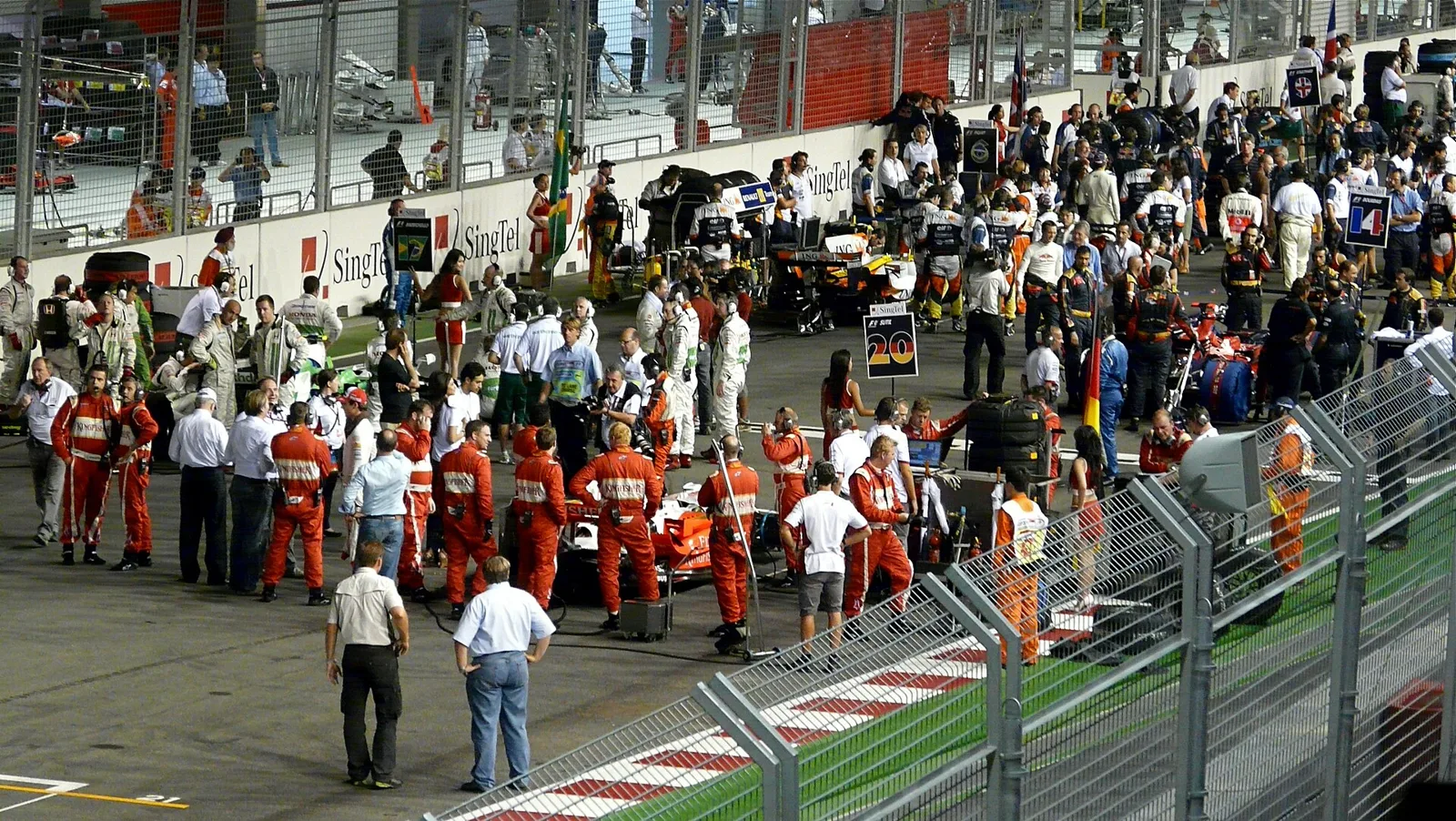
The meeting took place on the new Marina Bay Street Circuit on the evening of 28 September 2008, with the start at 20:00 local time. Its night start was chosen with European television audiences in mind. The 61-lap event was the first Formula One race held after dark.
It was also the first time Singapore had hosted a Formula One race. The last Singapore Grand Prix had been a Formula Libre event in 1973, so the 2008 meeting was a fresh start for the city-state's place in the sport.
Talks about a Singapore race began in early 2007, with a night start in mind to suit European audiences. The race was approved in May 2007, and construction of the complex began that August.
A night race, a fuel-hose error and a 15th-place start: Singapore 2008 gave Alonso a win that history would later read very differently.
How was the night race lit and built?
Construction of the grandstands and track complex began in August 2007, roughly a year before the race. The lighting system used nearly 1600 light projectors, spaced four metres apart and suspended 10 metres above the track. The combined output reached 3000 lux, around four times what a standard football stadium uses.
The generators supplied an estimated three megawatts of power.
The unusual start time changed how teams worked. Engineers and drivers woke around midday, began work in the late afternoon and stayed up until about 4am. Most drivers and teams praised the track and the arrangements made by the local authorities.
Concerns did remain. The high bumps on the kerbs of the Turn 10 chicane drew complaints, and concerns were also raised about safety measures for rain during the race.
How did practice go on a new street circuit?
Practice on 26 September produced a mixed set of results. In the first session Hamilton led the timesheets, with the Ferraris of Massa and Raikkonen next and Kovalainen behind them. Mark Webber damaged his front suspension in a crash at Turn 18.
The final corner caused several problems. Rubens Barrichello crashed backwards into the barriers there, and Jarno Trulli spun at the same corner before driving into the pits the wrong way. Trulli was fined 10,000 euros for his misconduct.
Alonso was fastest in the second session, pushing Hamilton into second with his final flying lap. He returned to the top in the third session, with Hamilton and Massa behind him. Bumps on the track caused drivers to narrowly avoid accidents, and Fisichella damaged his Force India front wing after the car launched off the kerbs at Turn 10.
How did qualifying set the grid?
Raikkonen was quickest in Q1, with Kovalainen and Hamilton close behind. Alonso's early exit in Q2 meant he would start 15th, which shaped the whole race. Piquet, Bourdais, Barrichello, Sutil and Fisichella were all knocked out in that session. Fisichella set no time after hitting the barriers at the third turn with a punctured tyre.
Barrichello was impeded by Heidfeld on his flying lap and pulled into the pits. Heidfeld lost three grid slots for obstructing Barrichello, and Barrichello received a 10,000 euro fine for entering the pit lane unsafely that did not use the deceleration zone.
In the second session Massa led, with Kovalainen and Raikkonen next. Alonso was eliminated early in that session when a fuel feed problem stopped his car before he could set a time. Hamilton only just reached the final session after a mistake on his penultimate run.
Massa took pole in the final session, six-tenths of a second faster than Hamilton, a result he described as his best qualifying of the season. Hamilton, Raikkonen and Kubica completed the first two rows. Kovalainen qualified fifth and regretted his tyre choice, while Rosberg and Nakajima finished the top ten.
How did the race start?
Piquet spun at Turn 23 during the warm-up lap but recovered and took his grid slot. At the start Massa, Hamilton and Raikkonen kept their positions through the first corners. Kubica and Kovalainen touched at the third corner, and Kovalainen lost two places to Vettel and Glock.
Trulli was running a heavy fuel load and held up a train of cars behind him. Rosberg finally got past on lap seven, and Nakajima and Alonso followed soon after. Massa was then more than three seconds clear of Hamilton after ten laps, with Raikkonen a further seven seconds back.
On the twelfth lap Alonso became the first driver to pit, switching from super-soft to soft tyres and rejoining at the back. Two laps on, Piquet lost the car at Turn 17 and hit the wall, which he put down to his hard tyres.
What happened in the pits under the safety car?
The pit lane was opened once the cars were behind the safety car, and almost every driver pitted. Massa left the Ferrari box with the fuel hose still connected and ran into the path of Adrian Sutil, who avoided him narrowly.
The Ferrari crew raced down the pit lane to remove the hose, and Massa rejoined at the rear. Rosberg led the way, with Trulli and Fisichella next, then Kubica and Alonso, followed by Webber, Coulthard and Hamilton. Rosberg and Kubica received 10-second stop-go penalties for refuelling while the pit lane was closed. Massa served his penalty and rejoined in last place, and Kubica dropped behind him after pitting from fourth.
Ferrari's team principal Stefano Domenicali said the error was human rather than a flaw in the electronic signalling system. He argued that the system saved drivers reaction time compared with a standard lollipop, and that a human error of that kind could have happened with a lollipop too.
How did Alonso win from 15th on the grid?
Alonso's win came from a two-stop strategy. He started from 15th, and the safety car periods helped move him through the field. He credited the result to the team's strategy and a bit of luck. Fisichella made his only stop a lap later, and Alonso moved into second and third behind Trulli.
Trulli kept the lead for four further laps, then pitted for the only time, passing the top spot to Alonso. Alonso made his last stop a lap later and still rejoined at the front, just ahead of Coulthard and Hamilton.
Coulthard lost momentum, and Hamilton overtook the Red Bull at the seventh turn. Both cars then pitted at the end of the lap. Alonso credited the win to the team's strategy and a little luck, and he said the two-stop plan was chosen over a one-stop because of the difficulty of passing on the track and the risk of brake problems.
After 45 laps Alonso led Glock by just over six seconds, with Rosberg a further eleven seconds back in third. Glock pitted and rejoined fifth, while Trulli retired with a mechanical failure a few laps later.
How did the final laps unfold?
Webber's race ended on lap 29 when his gearbox failed. Red Bull said later that a brief electrical spike from an underground tram passing nearby caused the gearbox to select two gears together. The city-state's railway operator denied the allegations.
Massa spun at Turn 18 and tapped the tyre wall without much damage. Seconds afterwards Sutil went off at that corner too, breaking his front suspension and triggering a second safety car.
Alonso pulled away from Rosberg and Hamilton, who was looking to take advantage of Massa's problems. With four laps left Raikkonen crashed at the Turn 10 chicane while chasing Glock, and that promoted Nakajima into the points. Alonso kept his lead and took his first win since returning to Renault.
Rosberg held on to second and Hamilton finished third. Massa finished 13th, and his points gap to Hamilton grew to seven. The result also meant that Ferrari failed to score for the first time since the 2006 Australian Grand Prix, and that McLaren took the constructors' lead.
Who finished where in Singapore?
| Position | Driver | Team | Note |
|---|---|---|---|
| First | Fernando Alonso | Renault | Won from 15th on the grid; Renault's first win since his return |
| Second | Nico Rosberg | Williams | Career-best result despite a stop-go penalty |
| Third | Lewis Hamilton | McLaren | Extended his championship lead to seven points |
| Seventh | David Coulthard | Red Bull Racing | Final points of his career |
| Thirteenth | Felipe Massa | Ferrari | Pit release penalty; points gap to Hamilton grew to seven |
How did the result affect the championship?
Hamilton's third place put him seven points clear of Massa, who failed to score. With neither Ferrari scoring, McLaren moved to the top of the constructors' table on 135 points. Renault also climbed above Toyota into fourth in the constructors' order.
Hamilton's margin was small enough that the year was still open. He went on to win the title by one point after an overtake on Timo Glock in Brazil, a finish that later became central to the Massa debate.
Nakajima scored his final points, and Coulthard took his last points of a long career. Heidfeld was classified for his 25th consecutive race, a streak that broke Schumacher's record.
How did the paddock and fans react?
Commentators and many people inside the sport welcomed the staging of the race, and the organisation was widely seen as excellent. Several drivers grumbled about the bumps away from the racing line, which made passing hard on a barrier-lined street course.
Locally, Sunday's race on the MediaCorp Channel 5 drew bigger audiences than the Beijing Olympics opening ceremony a month earlier. Sunday's race reached 789,000 viewers at a 17.8 per cent rating, while the Beijing opening drew 765,000 viewers at 17.3 per cent. The race was estimated to reach a global TV audience of about 400 million.
How is the Singapore race linked to Crashgate?
Piquet crashed on lap 14, and at the time he blamed the heavy fuel load for the difficulty he had with the car. Alonso was one of four drivers who had stopped for fuel before the safety car came out.
Piquet later told the FIA that he had been instructed to stage the crash by Briatore, the team boss, and Symonds, the engineer. The FIA World Motor Sport Council heard the case in Paris on 21 September 2009, where Renault admitted that the crash had been deliberate.
The initial sanctions were heavy. The Renault team received a suspended two-year disqualification, Briatore was banned from FIA events for life, and Symonds was banned for five years. Briatore and Symonds took the FIA to French courts, and on 5 January 2010
Alonso has always maintained that he knew nothing of the plan. In a 2023 interview, Ecclestone said he and then-FIA president Max Mosley had been aware of the matter during 2008. He also believed Massa should have been the 2008 champion, and Massa was reported to be looking at legal options over the title.