How a 1964 prototype became four straight Le Mans winners, from the Mk I to the all-American Mk IV, and why its name still matters.
Ford's GT40 is a 1960s mid-engined racer built to beat Ferrari at Le Mans. It won the race from 1966 to 1969, using 7.0 litre Mk II and Mk IV cars and an updated 4.9 litre Mk I, and its name stands for grand touring.
The Ford GT40 was a mid-engined racing car that Ford built in the 1960s to beat Ferrari in the great endurance races. It debuted in 1964, won the 24 Hours of Le Mans from 1966 to 1969, and its 1967 win is still the only Le Mans victory in which the drivers, team, chassis, engine and tyres all came from the United States.
Where did the Ford GT40 come from?
The GT40 came from Henry Ford II's wish to beat Ferrari at Le Mans. After talks to buy Ferrari collapsed in 1963, Ford hired Lola's design talent and John Wyer's team to build a mid-engined sports racer in England. The first chassis was delivered on 16 March 1964, and the car was shown in New York soon afterwards.
Ferrari had won the 24 Hours of Le Mans six years running, from 1960 to 1965, and Ford wanted to end that run. Ford spent several million dollars on an audit of Ferrari's factory and on legal negotiations. Enzo Ferrari cut the talks off at a late stage after a dispute over open-wheel racing, and Ford turned to its own racing division to find a Ferrari beater.
Ford first considered Lotus, Lola and Cooper. Lola was chosen because its Lola Mk6, also known as the Lola GT, already used a Ford V8 and had made a noted showing at Le Mans in 1963, even though it did not finish. Eric Broadley agreed to a one-year collaboration with Ford, and the deal included the sale of two Lola Mk6 chassis.
The development group was built around Broadley, Roy Lunn and John Wyer. Lunn had designed the mid-engined Mustang I concept car, which made him the only engineer in Dearborn with experience of that layout. Harley Copp oversaw the team, which started work at the Lola factory in Bromley before moving to Slough, near Heathrow Airport, at the end of 1963. Ford then set up Ford Advanced Vehicles (FAV) Ltd to run the programme under Wyer.
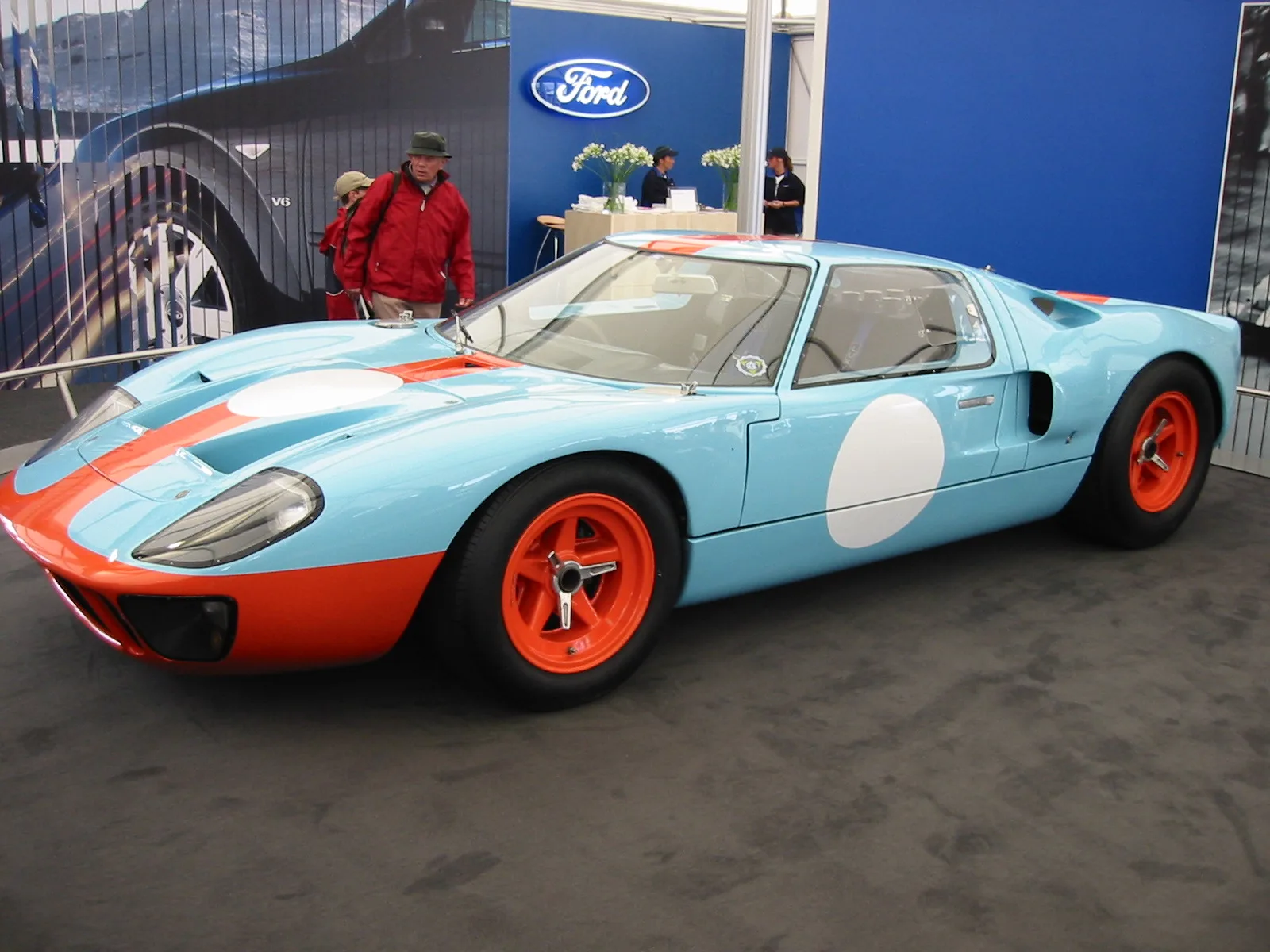
Abbey Panels of Coventry built the chassis, and Fibre Glass Engineering of Farnham produced the body mouldings. The first car, GT/101, was unveiled in England on 1 April 1964. A completed car for competition use cost 5,200 pounds. The name carried its own explanation: GT stood for grand touring, and the 40 was the car's height in inches at the top of the windscreen, the minimum the rules allowed.
Built to beat Ferrari at Le Mans, the GT40 won four years running and gave Ford a place among the great endurance racers.
How was the GT40 powered?
The first cars used a 4.7 litre (289 cu in) V8 derived from the Ford Fairlane, fitted with a Colotti transaxle. Later racers ran a 7.0 litre (427 cu in) big block. A separate aluminium block DOHC version, the Ford Indy V8, won the 1965 Indianapolis 500.
The early Colotti gearbox was overstressed and was replaced by a ZF five-speed on the Mk I. The Mk II then used a four-speed gearbox built by Kar Kraft, Ford's performance division, in place of the overpowered ZF.
How did the GT40 start its racing career?
The GT40 first raced in May 1964 at the Nurburgring 1000 km, where it retired with suspension failure after holding second place for a time. Three weeks later all three entries at Le Mans retired, although one car led the field from the second lap until its first pit stop.
A season of poor results under John Wyer followed, and Ford handed the programme to Carroll Shelby after the 1964 Nassau race. Shelby complained about the cars' condition, though they had been packed up straight after the race. Shelby American's first win came early in 1965, when Ken Miles and Lloyd Ruby took a car to victory at the Daytona 2000 km.
A month later at Sebring, Miles and Bruce McLaren finished second overall behind a Chaparral, and first in the prototype class. The rest of the 1965 season was disappointing.
Why did the GT40 win Le Mans in 1966?
The GT40 Mk II won Le Mans in 1966 with a 1-2-3 finish, ending Ferrari's run of wins. The win came from the 7.0 litre (427 cu in) cars, which had been developed through 1964 and 1965 and were now raced in greater numbers, with several teams running them.
Holman Moody and Shelby American both modified the Mk I to take the big-block Ford FE engine from the Galaxie, which was used in NASCAR at the time. The conversion became the Mk II, and by the 1966 season three teams were racing it at Le Mans with drivers including Chris Amon, Bruce McLaren, Denny Hulme and Ken Miles.
The season had already gone well. At Daytona in February 1966 the Mk IIs finished first, second and third. In March at Sebring the GT40s took the top three places again, with the X-1 Roadster first. The June race at Le Mans gave the team the result it had been chasing.
The finish was not simple. The No 1 car of Ken Miles and Denny Hulme held a four-lap lead until a pit stop for replacement brake rotors, after the wrong set had been fitted a lap earlier. The rotors had been taken by the crew of the No 2 car. With the McLaren and Amon car close behind, Ford told the drivers the cars would finish side by side as a tie, but the organisers ruled that the McLaren car had started about 60 feet (18 m) further back and so had covered more ground. McLaren's car was declared the winner.
Ford also faced an uncomfortable choice over its two drivers, one of whom had been hard to work with. What happened on the last lap is still debated. Either Miles slowed to let McLaren pass as a protest, or McLaren accelerated before the line. Neither driver had much chance to explain, because Miles died in August 1966 and McLaren in 1970, both while testing new cars.
What went wrong with the J-car?
The J-car was a GT40 prototype with an aluminium honeycomb chassis and a flat-topped bread-van body. In August 1966 Ken Miles lost control of it at Riverside, where the chassis shattered and the car burned, and he was killed. The aerodynamics were later blamed for the crash, because the body created too much lift.
The J-car got its nickname from the FIA's Appendix J regulations of 1966. The whole car weighed 1,207 kg (2,660 lb), some 136 kg (300 lb) less than the Mk II. Even so, the team kept running the Mk II because it had proven reliability. After Miles's death the car was dropped, and the team began a complete redesign.
How did the Mk IV win Le Mans in 1967?
The Mk IV was a redesigned GT40 with the 7.0 litre engine in a new chassis and body built in the United States. It won the 1967 Le Mans race with Dan Gurney and A. J. Foyt, and it also won the 1967 Sebring 12 Hours, the only two races it contested.
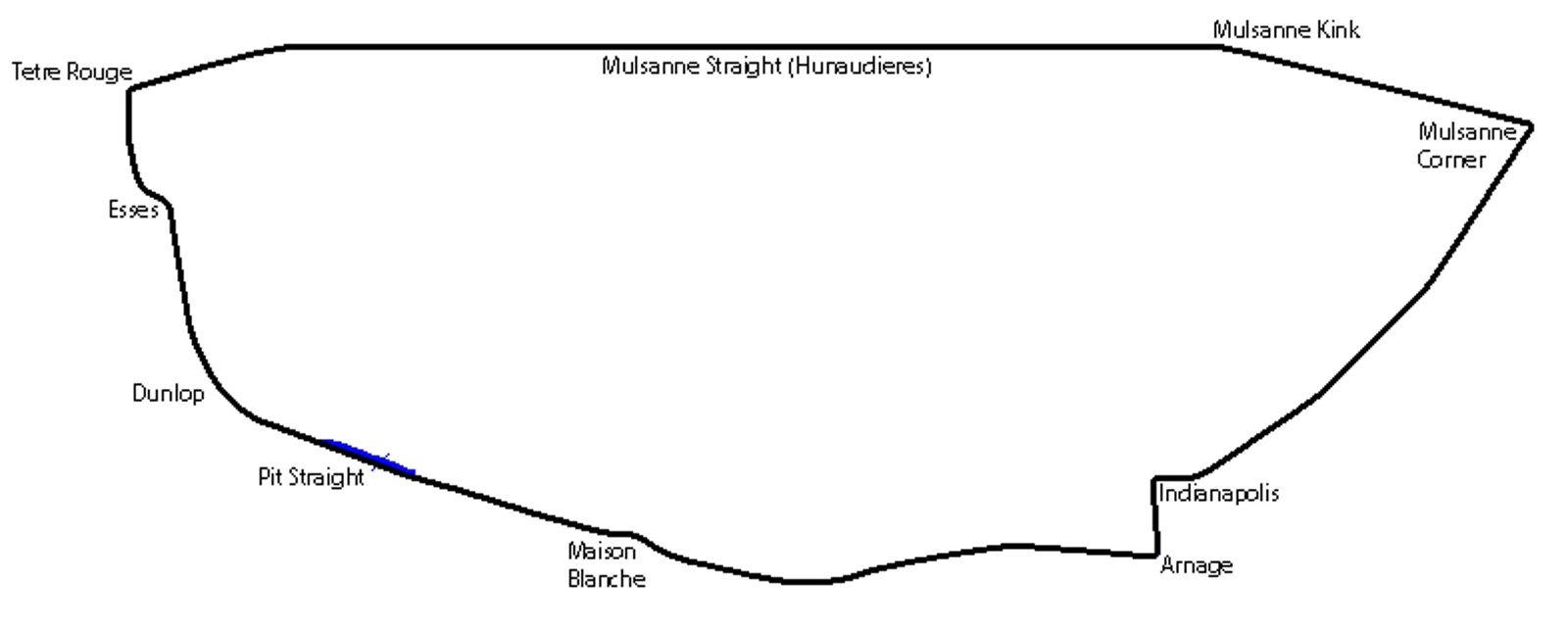
Kar Kraft, Ford's performance division in Detroit, built the Mk IV chassis. It was the most American of all the GT40s, and it carried a steel-tube roll cage after the Miles accident. The cage made the car safer, but its weight cancelled much of the advantage of the honeycomb tub. The long, streamlined body gave the car exceptional top speed, which suited Le Mans, and it was the fastest car in the field on the Mulsanne Straight.
Ford tested the car on a rig that simulated the Le Mans circuit. The design was revised after weeks of simulated laps. Dan Gurney, who was unusually tall for a racing driver, asked for a bubble over the seat, and he and A. J. Foyt coasted into the Mulsanne hairpin in practice to save the brakes. Their slower recorded lap times led to a false belief in the team that the cars had been set up badly.
The Mk IV was also heavy. It weighed 270 kg (600 lb) more than the Ferrari 330 P4, and combined with its speed this put extra stress on the brakes. At Le Mans, Mario Andretti crashed heavily at the Esses and escaped with minor injuries, a result many credited to the roll cage.
Why did an old Mk I win Le Mans in 1968 and 1969?
From 1968 the FIA limited prototypes to 3.0 litres, which ruled out the 7.0 litre Ford and the big Ferrari 330P4. John Wyer's team entered an updated Mk I with a 4.9 litre (302 cu in) V8. It won Le Mans in 1968, and the same chassis won again in 1969.
The 3.0 litre limit matched the Formula One rule in force since 1966. Group 4 sports cars with engines of up to five litres could still race.
The team bored the 4.7 litre engine out to 4.9 litres and fitted O-rings between block and head to stop the head gasket failures common in the 4.7. The result was a Windsor 302 cu in (4.9 L) V8 with four Weber carburettors, rated at 317 kW (425 hp; 431 PS) at 6,000 rpm.
The 1968 race was a difficult one for the other entries, many of which had teething problems or unproven engines. Four of the five GT40s entered retired. The lone survivor was the Gulf-liveried car of Pedro Rodriguez and Lucien Bianchi, which won with a clear lead over a rival Porsche. The GT40 also won four other World Championship rounds that year, which gave Ford the 1968 International Championship for Makes.
The 1969 race was closer. Jacky Ickx and Jackie Oliver held off a 3.0 litre Porsche 908 by a few seconds in the same chassis, GT40P/1075. Ickx was a rookie at Le Mans and walked to his car, strapping in well behind the field, to protest against the traditional start. He went on to win the race five more times in later years, mainly with Porsche turbos.
What were the main GT40 versions?
The GT40 family ran from the Mk I to the Mk IV, with a street-legal Mk III and later Mk V continuation cars alongside them. Each version reflected the rule changes and results of its time. The Mk IV reused the Mk II's 7.0 litre engine in a new J-car chassis.
Mk I
The Mk I was both the first and last GT40 type to race. Early prototypes used a 4.2 litre (255 cu in) alloy V8, while production cars used the 4.7 litre (289 cu in) engine from the Mustang. About 31 road-going Mk I cars were built at Slough, with wire wheels, carpet and a cigarette lighter as the main changes from the racers.
Mk II
The Mk II used the 7.0 litre (427 cu in) big block and won Le Mans in 1966. For 1967 it was upgraded to Mk IIB specification, with redesigned bodywork and twin Holley carburettors that added 11 kW (15 hp; 15 PS). The Mk IIB won the 1967 Reims 12 Hours, but a batch of faulty input shafts put nearly every Ford out of the Daytona race that year.
Mk III
The Mk III was a street-legal version of the Mk I, with its 4.7 litre engine detuned to 228 kW (306 hp; 310 PS). Only seven were built, four of them right-hand drive. The cars had four headlamps to meet US lighting rules, a larger rear for luggage, softer shock absorbers and a centre-mounted gear lever. Many road buyers chose a Mk I from Wyer Ltd instead.
Mk IV
Nine cars were built to J-car specification, with six finished as Mk IVs and one as the G7A. The Mk IV was the only version built entirely in the United States, and one example was later rebuilt to Group 7 rules as the Ford G7 for the Can-Am series, though without success.
Mk V
Safir Engineering and JW Engineering built a limited further run of Mk V cars, continuing the chassis numbering from GT40P-1090. Most were close to the Mk I, although five big-block cars were built with easily removed door roof sections, numbered GT40P-1128 to GT40P-1132.
What were the GT40 specifications?
| Version | Engine | Key figure | Notable result |
|---|---|---|---|
| Mk I | 4.7 litre (289 cu in) V8 | About 31 road-going cars built at Slough | Le Mans wins in 1968 and 1969 with John Wyer's team |
| Mk II | 7.0 litre (427 cu in) big block | Galaxie-derived Ford FE engine | 1-2-3 finish at Le Mans in 1966 |
| Mk III | Detuned 4.7 litre, 228 kW (306 hp; 310 PS) | Seven built, four right-hand drive | Street-legal version of the Mk I |
| Mk IV | 7.0 litre (427 cu in) V8 | 1,207 kg (2,660 lb) complete car | Le Mans winner in 1967, with 1st and 4th finishes |
| Mk IV straight-line speed | 7.0 litre (427 cu in) V8 | Highest speed on the Mulsanne Straight | Fastest in the field at Le Mans in 1967 |
Were continuation GT40s and replicas built?
Yes. Since the 1970s enthusiasts have wanted more GT40s than the original run could supply, so continuation models and replicas have appeared, some licensed and some modernised. The GT40/R Competition is a continuation built by Superformance with Pathfinder Motorsports, and it is the only GT40 continuation licensed by Safir GT40 Spares, which holds the trademark.
A GT40/R run by Pathfinder with a Holman Moody engine won the 2009 US Vintage Grand Prix and the Governor's Cup at Watkins Glen.
Other builders focus on kits or modern upgrades. Southern GT in Swanmore, UK, builds Mk I and Mk II cars in kit form or fully built. CAV GT began as a kit and is now factory-built in Cape Town, South Africa. Everrati's GT40 uses a Superformance body with a 700-volt electric architecture, which Everrati estimates gives 800 PS (588 kW).
How is the modern Ford GT linked to the GT40?
The modern Ford GT is a reinterpretation of the GT40, built by Ford from 2004. It was larger and wider than the original, and it lost the 40 from its name after a trademark dispute with Safir GT40 Spares, the company that owned the GT40 name.
Ford wanted to buy the trademark rather than license it, and the talks broke down.
A GT90 concept appeared at the North American International Auto Show, and a GT40 Concept followed in 2002. The production car was assembled at Wixom, Michigan, and painted by Saleen. Its body stood 76 mm (3 in) taller than the original car, which was 1020 mm (40 in) high. Safir had asked for 7.5 percent of the retail price on each car, and Automotive News reported a demand of $40 million for the trademark.
A second-generation Ford GT was unveiled in 2015 with a twin-turbocharged V6, a carbon fibre monocoque and active aerodynamics. It then raced in the World Endurance and United SportsCar championships, and a road version followed a year later.
What is the GT40 remembered for?
The GT40 is remembered as the car that ended Ferrari's run at Le Mans and gave Ford four straight overall wins. Its 1967 result remains the only all-American victory at the race, which makes it a landmark in American motorsport as well as European endurance racing. Its reputation has held up through replicas, a modern Ford GT and film.
The car has a place in popular culture too. A Mk I painted silver appeared in a 1965 episode of The Avengers, where the villains used it as a high-powered laser platform. The 2019 film Ford v Ferrari tells the story of its development and its 1966 Le Mans race.