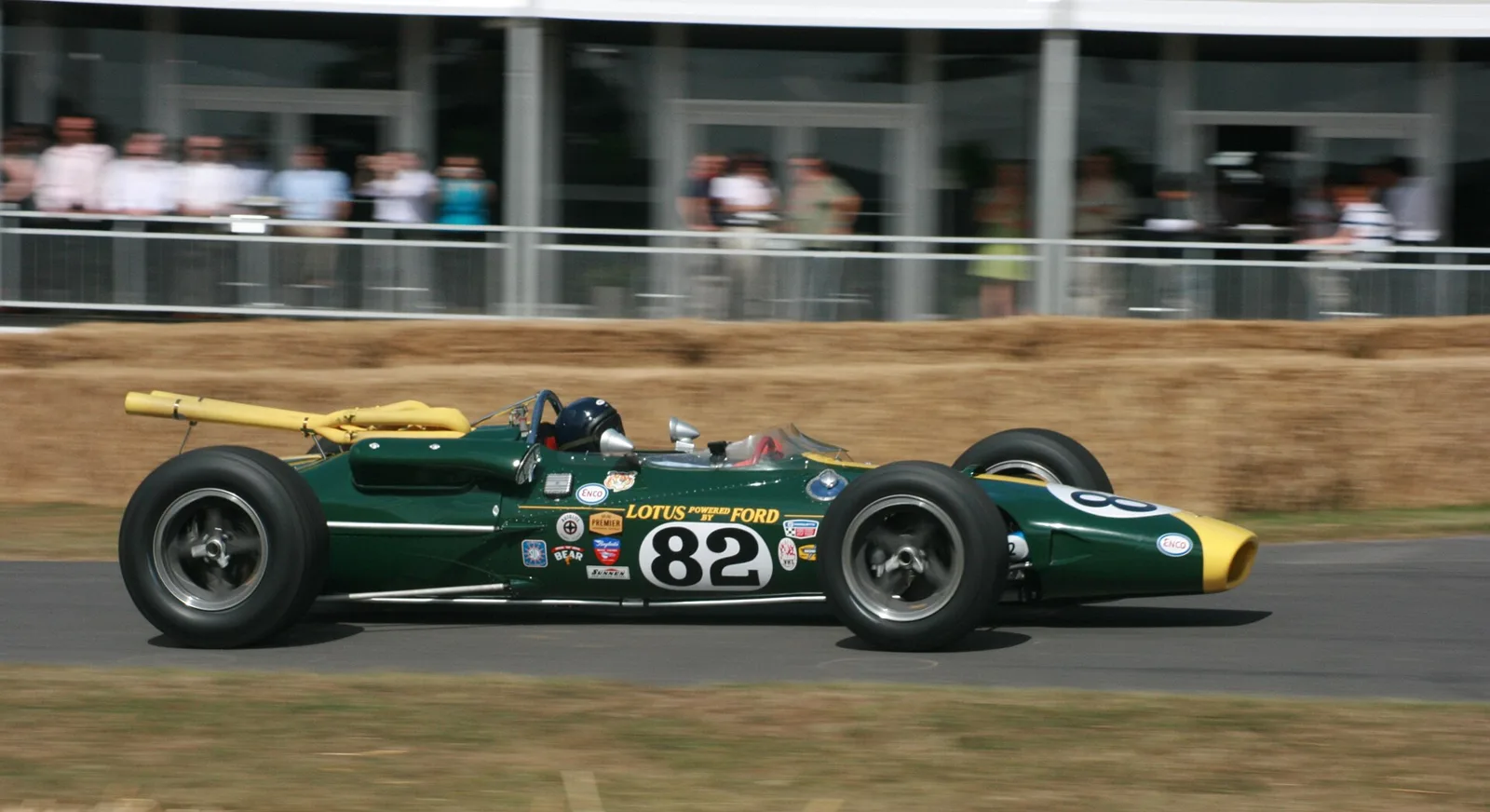
Jim Clark led 190 laps in a Lotus 38 to give Team Lotus victory, the first win for a rear-engined car, as the field became mostly rear-engined for the first time.
Team Lotus took the 1965 Indianapolis 500 with Jim Clark at the wheel of a Ford-powered car that put its engine behind the driver. Clark led 190 laps, and the win opened the rear-engine era at the Speedway.
Jim Clark won the 49th International 500-Mile Sweepstakes on Monday, May 31, 1965, giving Team Lotus victory with a rear-engined car. Only six of the 33 starters still had front engines, making it the first 500 in which most of the field was rear-engined. Clark's Lotus 38, powered by a Ford V8, was the first rear-engined car to win the race.
Who won the 1965 Indianapolis 500?
Jim Clark won the 1965 Indianapolis 500 for Team Lotus, leading 190 laps in a Lotus 38 that dominated the field. He had started on the front row and was the first foreign-born winner since Gaston Chevrolet in 1920. Clark was a Scot, and he had also won the pole in 1964.
Clark's 190 laps were the most led by any driver since Bill Vukovich, who led 195 in 1953. He led three times during the race, and by the finish only eleven cars were still running. Clark also went on to win the 1965 World Championship, making him the only driver to win the Indianapolis 500 and the Formula One title in the same year.
A rear-engined Lotus won, and the front-engined era at Indianapolis was nearly over.
Why did rear-engined cars matter in 1965?
The rear-engined cars had been building towards this moment for five years. The Lotus 38 broke the front-engined run at the top of the leaderboard, and with only six of the 33 starters still running front engines, 1965 was the first race with a majority of rear-engined machines.
The movement predated the 1964 British Invasion led by the Beatles. Front-engined roadsters were rapidly becoming obsolete, although two of them still finished in the top ten this year.
Team Lotus had Jim Clark and Colin Chapman, and their Ford-powered design had the DOHC Ford Indy V8 at its heart. Their win was the first at the Speedway for a rear-engined car.
What rule changes applied for 1965?
USAC did not ban gasoline for 1965, but it introduced rule changes that pushed teams towards methanol. A new minimum car weight of 1,250 pounds was set, and every car had to make at least two pit stops. On-board fuel capacity was cut to 75 gallons.
Conventional pump gasoline gave better mileage than methanol, so gasoline cars had traditionally made a single fuel stop after lap 100, ideally between lap 120 and lap 125 of 200. Methanol cars needed two or three stops to complete the full 500 miles, so the new minimum of two stops removed much of the gasoline advantage.
The tanks had to hold rubber bladders and sit on the left side, behind the driver, and fuel crossover tubes were banned in front of the driver. Pressurised fuelling rigs were outlawed, and every fuelling rig from 1965 onward had to be gravity fed.
The Agajanian team chose a blend of methanol and gasoline. Chief mechanic Johnny Pulson and driver Parnelli Jones believed the blend left them short of power, and Jones blamed it for costing them a chance to win. He had to make a third pit stop, and in the final five laps he nursed the car home on very little fuel.
Jones kept Mario Andretti at bay, finishing only five seconds ahead, and then his tank ran dry on the cool-down lap. The car stopped on the backstretch and was pushed back to the pits.
How did qualifying change in 1965?
A new blind draw set the qualifying order for Pole Day for the first time, replacing a first-come, first-served queue. Each entry could still make up to three attempts across the four scheduled days, so the draw did not guarantee every car a run on Pole Day.
Before 1965 teams queued down the pit lane, and some claimed their places the night before. The scramble to roll cars into line had often led to heated exchanges and collisions. Cars that were still in the order when the track closed, whether because of rain or at the 6 o'clock gun, had to wait until the next round. That technicality was corrected in 1971.
Pole Day on May 15 was a record-setting day, as drivers broke the 160 mph barrier. Mario Andretti set 159.406 mph early on. Later, Clark became the first driver over 160 mph, with laps of 160.772 mph and 160.973 mph, and his four-lap average of 160.729 mph tentatively put him on pole.
A. J. Foyt, the defending winner, was the fastest driver of the day. His first lap of 161.958 mph set a new one-lap track record, and his four-lap average of 161.233 mph won him the pole, his first at Indianapolis. Bobby Unser, a day after his practice crash, qualified eighth in a year-old Novi back-up car, and nineteen cars qualified on Pole Day.
Strong winds kept most cars off the track on Sunday May 16, and only Don Branson and Arnie Knepper qualified. Jim Hurtubise returned to qualify at 156.860 mph (252.442 km/h) on May 22, and he was the fastest of eleven qualifiers that day, despite being badly burned in a crash at Milwaukee in 1964.
Bobby Johns, a NASCAR regular, skipped the World 600 to drive as a teammate to Clark. He qualified 22nd, third fastest that afternoon. On Bump Day, May 23, Rodger Ward failed to qualify after a crash and three blown engines during the month, and he was too slow in the final 15 minutes.
What happened in practice?
Practice was disrupted by a crash that put Foyt's Lotus-Ford out of action. Clark was the first driver over 150 mph on May 3, and Foyt later set an unofficial track record of 161.146 mph. Foyt raised his practice speed to 155 mph after the chief steward lifted the speed limits.
On May 5 Foyt crashed on the backstretch after a magnesium hub carrier broke. The next day USAC parked all of the Lotus-Fords and Lola cars while the magnesium parts were tested and improved. They returned on May 10, and both Foyt and Clark were soon turning laps over 158 mph.
On the eve of pole day, Ebb Rose spun in turn one ahead of Bobby Unser, who was driving the new four-wheel drive Novi entered by Andy Granatelli. The cars collided, and Unser's car spun into the outside wall. Rose was unhurt, and Unser was taken to hospital for X-rays but was not seriously injured.
What role did the Wood Brothers play?
Ford brought in the Wood Brothers, a NASCAR crew, to handle the pit stops for Team Lotus. Their contribution has been considered overstated in some accounts, because Clark's Lotus-Ford was thought capable of winning without them. They adapted quickly to the open-wheel equipment, and they were known for fast pit work in NASCAR.
The work they did was largely routine refuelling, since the tyres did not need changing. Clark made only two stops all day, and the speed of the refuelling was credited to a specially designed gravity-fuelling rig with a venturi tube.
Before the race the crew worked the new fuel hose nozzles in and out of the couplings to get them moving freely.
How did the race unfold?
Foyt started from pole, but Clark led the first lap and then took the lead back on lap three. Heavy attrition followed, with 17 cars out before the halfway point. Clark gave up the lead to make a pit stop on lap 65, and Foyt led laps 66 to 74 before Clark regained the lead on lap 75.
An early retirement came from Jim Hurtubise, whose transmission broke on the opening lap. Foyt took the lead on lap two, and the early laps looked as if they would become a duel. Clark retook the lead on lap three and pulled away from the field.
Lloyd Ruby spun but was able to continue. His heavily flat-spotted tyres took a minute and a half to change in the pits. The only accident of note involved Bud Tingelstad, whose wheel came off before he hit the outside wall in turn three.
Foyt dropped out after 115 laps with a broken gearbox. Clark led at the halfway point and kept the lead for the rest of the race. Only eleven cars were still running at the finish, and Parnelli Jones ran out of fuel on the final lap and pushed his car to the line.
Mario Andretti, who ran no lower than sixth all afternoon, finished third and took the Rookie of the Year award. Gordon Johncock was fifth after a late battle with Al Miller, and Eddie Johnson came home tenth. Two front-engined roadsters still reached the top ten. The race was slowed by only three yellow lights, for a total of 13 minutes.
What were the main race results?
Clark won, Parnelli Jones took second after running out of fuel, and Mario Andretti finished third as the top three. Johncock and Johnson completed the top ten behind them, and Foyt's pole position was the fastest qualifying effort of the month.
| Finish | Driver | Note |
|---|---|---|
| 1st | Jim Clark | Lotus 38; led 190 laps; first rear-engined winner |
| 2nd | Parnelli Jones | Agajanian team; ran out of fuel on the final lap |
| 3rd | Mario Andretti | Rookie; ran no lower than sixth all afternoon |
| 5th | Gordon Johncock | Rookie; late duel with Al Miller |
| 10th | Eddie Johnson | Finished among the top ten with two front-engined roadsters |
| Pole | A. J. Foyt | Four-lap average 161.233 mph; first pole at Indianapolis |
Jones's second place is remembered for the fuel blend that his team had chosen, which he blamed for the lost chance to win. Foyt, who started from pole, did not reach the flag.
How was the race broadcast?
The race was carried on the IMS Radio Network, with Sid Collins as chief announcer for his 14th year. It was also shown live on closed-circuit television in about 180 venues, and ABC's Wide World of Sports showed an edited tape on June 5.
The radio broadcast ran four and a half hours, with a 30-minute pre-race segment, and it was carried by over 800 affiliates. An estimated 100 million listeners were reached worldwide, and foreign translations were heard in Spanish, Portuguese, French and Italian.
Donald Davidson, who had visited the booth in 1964, joined the crew full-time as race historian. Jack Shapiro, a nine-year veteran who was absent from the crew, had died the previous summer at 37. Charlie Brockman anchored the closed-circuit and ABC coverage, and Rodger Ward returned as analyst for the ABC edition.