A. J. Foyt won the 48th running, but a seven-car crash that killed two drivers and halted the race is what the day is remembered for.
A. J. Foyt took the chequered flag on Saturday 30 May 1964 in the 48th running. The day is best known for a seven-car crash that took the lives of Eddie Sachs and Dave MacDonald, and it was the last win by a front-engined roadster.
The 1964 Indianapolis 500 was the 48th International 500-Mile Sweepstakes, held on Saturday 30 May 1964 at the Indianapolis Motor Speedway. A. J. Foyt won it, but the race is remembered for a fiery seven-car accident that killed Eddie Sachs and Dave MacDonald. It was also the last win for a front-engined roadster, and Foyt's second of four Indy 500 victories.
Why is the 1964 race remembered?
The 1964 Indianapolis 500 is remembered for the crash on lap two, which began when Dave MacDonald's car went out of control. Seven cars were drawn into the incident, and Sachs and MacDonald both died. It was the first time the race had been halted by an accident.
Dave MacDonald's car went into a spin leaving turn four while he was trying to get past Jim Hurtubise and Walt Hansgen down low on the track. It slid across the track into the inside wall, and the gasoline in its tank ignited. The car then slid back across the track, bringing in seven more cars. Johnny Rutherford, whom MacDonald passed on the first lap, later recalled thinking that MacDonald would either win or crash.
Ronnie Duman's flaming car struck the pit lane wall, and he was burned. Bobby Unser came into contact with Duman's car from behind, then with Johnny Rutherford's left rear tyre, and went into the outside wall. Stevenson and Norm Hall were involved as well.
Sachs aimed for a gap along the outside wall, but the burning car slid into his path. He struck it broadside, causing a second explosion, and he died instantly. MacDonald was pulled from the wreckage alive but badly burned. He died at 13:20 at Methodist Hospital.
The crash was recorded in film and still images and shown around the world. It remains unknown whether Sachs died from blunt force trauma or from burns.
The win belonged to Foyt, but the day is remembered for the fire that took two drivers and stopped the race.
Why did Jim Clark's race end early?
Jim Clark started from pole in a Lotus 34 with a quad-cam Ford V-8 and took the lead at the start. He led 14 laps in total, but a tyre failure broke his suspension and he retired on lap 47.
Colin Chapman, who ran the Lotus team, had picked soft Dunlop compounds for qualifying. The rules required the same type of tyre for the race, and it wore quickly. Dan Gurney, Clark's team-mate, was later withdrawn after similar wear. Clark and Gurney also drove the last two cars to race at Indianapolis with Weber carburettors. Every other car in the field, and every car since, has used fuel injection.
What happened on Pole Day?
Pole Day was Saturday 16 May, and it produced a run of record speeds. Rodger Ward set the early pace at 157.563 mph (253.573 km/h), while Jim Clark finished the day on pole with a one-lap record of 159.337 mph (256.428 km/h). Clark was also the first foreign-born man to take pole since 1919.
| Driver | Run | Speed |
|---|---|---|
| Rodger Ward | One-lap record | 157.563 mph (253.573 km/h) |
| Rodger Ward | Four-lap average | 156.406 mph (251.711 km/h) |
| Bobby Marshman | Raised the record | 157.867 mph (254.062 km/h) |
| Jim Clark | One-lap record, second lap | 159.337 mph (256.428 km/h) |
| Jim Clark | Four-lap average, a record | 158.828 mph (255.609 km/h) |
Marshman then improved on that with 157.867 mph (254.062 km/h) before Clark's run settled the pole. Clark then crossed to Europe, where he won the Dutch Grand Prix the following weekend.
How did the early race unfold?
Bobby Marshman led during the early stages and at one point built a lead of as much as 90 seconds. He then became fixated on putting A. J. Foyt a lap down, and on lap 39 he went too low into turn one, bottoming out his car and retiring with a broken transmission oil plug.
Defending champion Parnelli Jones also retired. His car caught fire as he left his pit box and slammed the outside pit wall. Once Marshman, Clark and Jones had all retired, Foyt was left to cruise, and he led the final 146 laps.
Foyt made the whole 500 miles on one set of tyres. Goodyear supplied tyres for some entries but took part only in practice, and no car used its tyres in the race itself.
What was the Sears-Allstate Special?
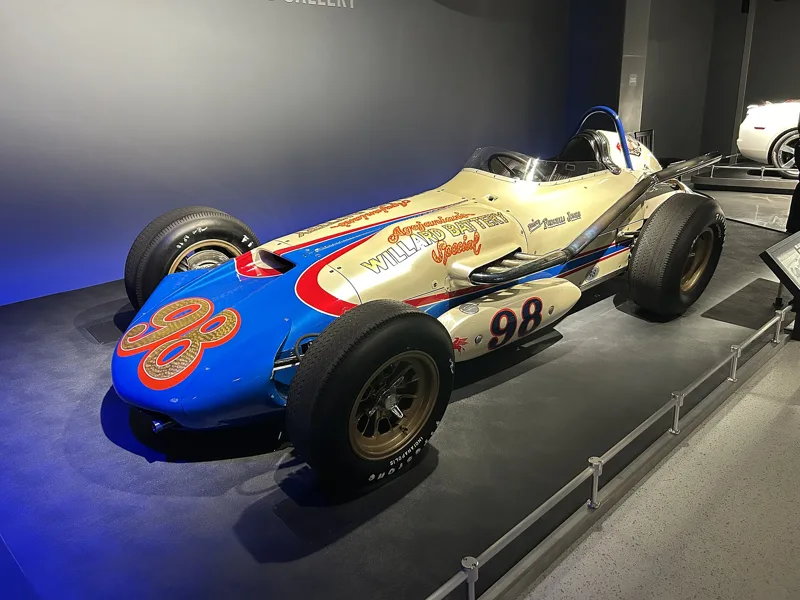
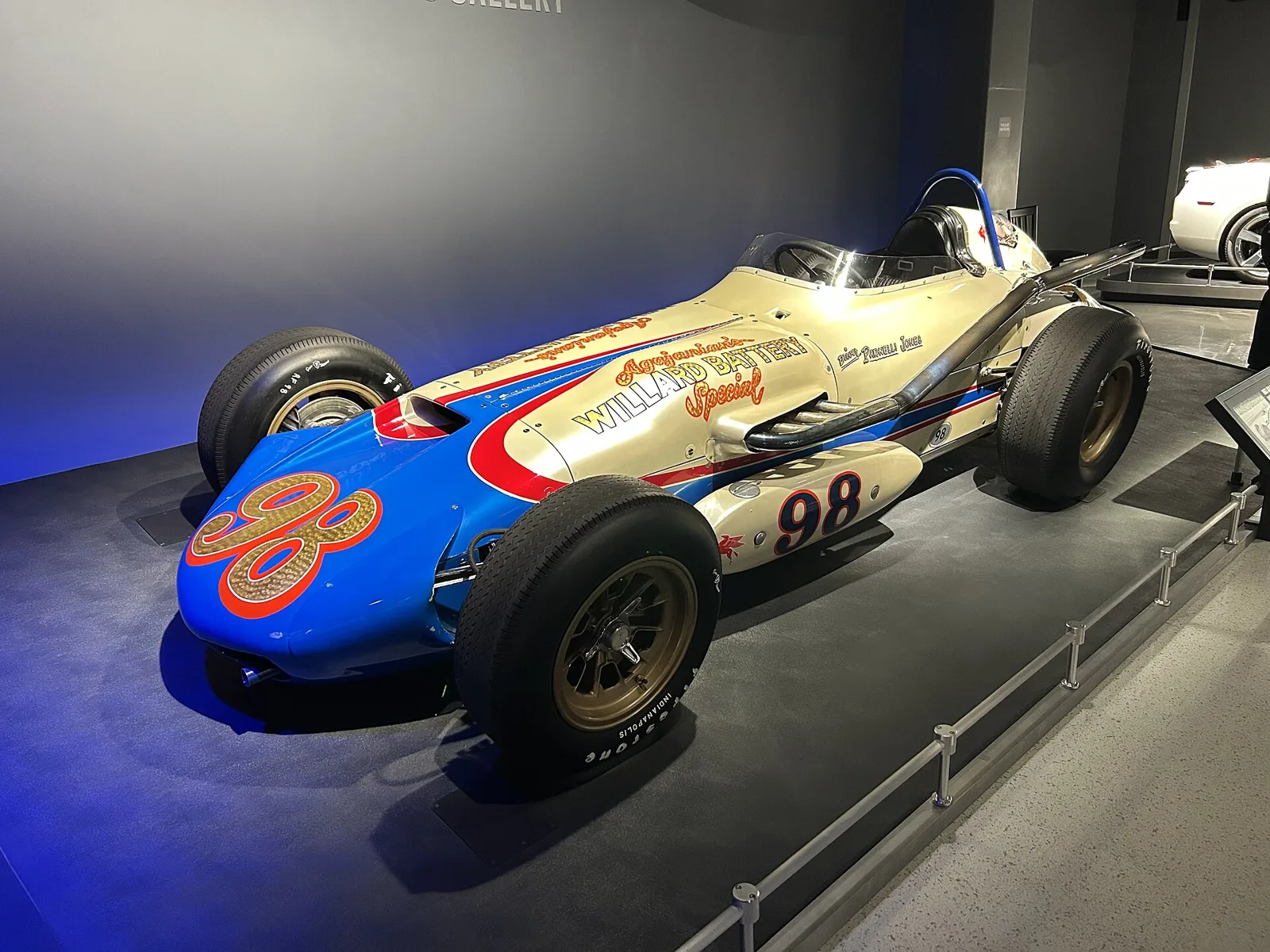
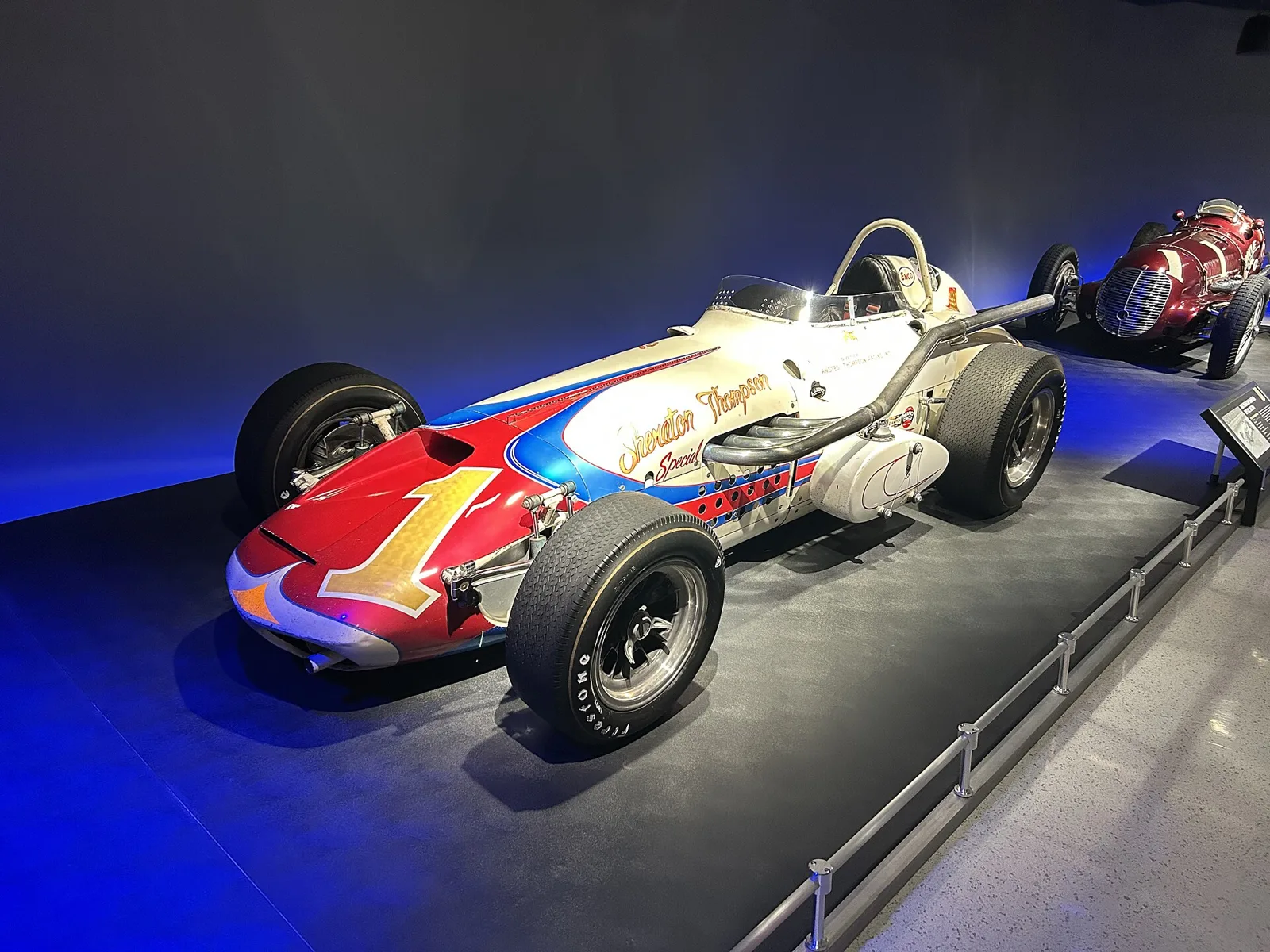
The Sears-Allstate Special was car number 83, owned and designed by Mickey Thompson and driven by Dave MacDonald. It was a rear-engined machine that first raced in 1963, and for 1964 it was given a streamlined body that enclosed the wheels.
USAC changed its rules for 1964, so the car had to run 15 in (380 mm) tyres instead of 12 in (300 mm) ones. The car ran Allstate tyres, made by Armstrong Tire and Rubber Co.
The bodywork around the wheels was meant to use aerodynamic effects to raise top speed, but it is believed the wheel covers, along with the body as a whole, made the car difficult to handle.
Fuel was carried in tanks in the sidepods, and USAC rules allowed exactly 75 gallons. Later accounts often described much larger tanks, some claiming 80 US gallons (67 imp gallons; 300 L). Those figures were wrong, and a story that Thompson planned a run without a pit stop is an urban legend. The crashworthiness of the car and its fuel cell was questioned at the time.
Why did the car handle so poorly?
The car's handling was seriously flawed from the start of practice. Masten Gregory said aerodynamic lift reduced steering response, and he crashed on 6 May and quit the team. The Thompson team then tested with wool tufts, which showed that the bodywork over the tyres was creating lift.
The body was cut away over the tyres as a result. MacDonald qualified without incident, and Eddie Johnson qualified the second team car. Graham Hill, who had tested the car in 1963, declined to race it because of its handling.
Other drivers were uneasy, and one account says Jim Clark urged MacDonald to leave the car. MacDonald tested on Carburetion Day, but accounts differ on whether he ever ran with a full load of fuel.
Did any famous names miss the race?
Yes. NASCAR driver Junior Johnson practised for the race but did not qualify, and Curtis Turner passed the rookie test before crashing in practice. Neither man started the race, and Turner's crash came in practice rather than in the race itself.
Those two stories are small beside the crash and the controversy, but they show the wider interest the race drew that year.
How did the crash change the rules?
USAC responded in part to media pressure by requiring cars to carry less fuel, and it wrote rules that effectively ended the use of gasoline from the 1965 season. The change led to methanol, with ethanol following from 2006. Gasoline returned in 2012 as E85, which is 85% ethanol and 15% gasoline.
Firestone also introduced its RaceSafe fuel cell in 1965, a design that drew on military helicopter technology. The time allowed for trailing drivers to finish the 200 laps was cut to about five minutes from 1964, an allowance that ran until 1974.
Did other crashes follow that season?
Yes. Fireball Roberts was badly hurt in a fiery crash at the World 600 six days before Indianapolis, and he died about a month later, on 2 July 1964. A week after Indianapolis, Jim Hurtubise was critically burned at Milwaukee, adding to the gloom in American racing.
How was the race broadcast?
The race was shown live from start to finish on closed-circuit television in theatres across the country for the first time, with Charlie Brockman as anchor. ABC's Wide World of Sports later ran filmed highlights, about a week after the race.
On radio, the IMS Radio Network carried the race with Sid Collins as chief announcer and Fred Agabashian as driver expert. Lou Palmer handled the winner's interview in victory lane. The radio programme included a 30-minute pre-race segment, and a young Donald Davidson visited the booth for an interview.
The broadcast reached 558 affiliates in the United States, a record. With WJAR-AM in Providence, Rhode Island, joining for the first time, there was at least one affiliate in every one of the 50 states.
Staff changes followed. Bernie Herman left the crew, Chuck Marlowe took over the backstretch position, and John DeCamp joined as statistician. Charlie Brockman left the radio team permanently in 1964 to anchor the MCA closed-circuit broadcast. Guests in the booth ranged from Pete DePaolo to Indiana's governor, Matthew E. Welsh.
How did Sid Collins's eulogy come about?
While the race was red-flagged, Tom Carnegie, the track's public address announcer, read out the official statement on Eddie Sachs's death, and the radio feed carried it. Silence followed for about five seconds, and then Sid Collins gave an unprepared eulogy that drew critical praise.
Collins later received over 30,000 letters asking for a transcript of the tribute. Sachs had taken consecutive poles in 1960 and 1961, and Collins had dated them a year late, so later rebroadcasts left that reference out.
What happened to the families afterwards?
The MacDonald family avoided visiting the Speedway for years, and closure came slowly. Rich MacDonald began researching his father's career, and his DaveMacDonald.net website has served as a tribute since 2003. He also met Sachs's son online, and the two families later met again at the track.
Indianapolis Star reporter Curt Cavin contacted MacDonald's family first and then Sachs's. Other contacts, most notably Angela Savage, helped the MacDonalds meet at the Speedway again.
In 2016, Sherry MacDonald, Dave's widow, and Rich MacDonald attended race day alongside Eddie Sachs III. The three took a photo near the crash site, at the wall that had been heightened and cleared of track boxes before 1974.
Earlier that year Rich MacDonald appeared on a podcast presented by Angela Savage, whose father Swede Savage was killed in the 1973 race. Her first visit to the race was celebrated in 2014 and has since become an annual trip.