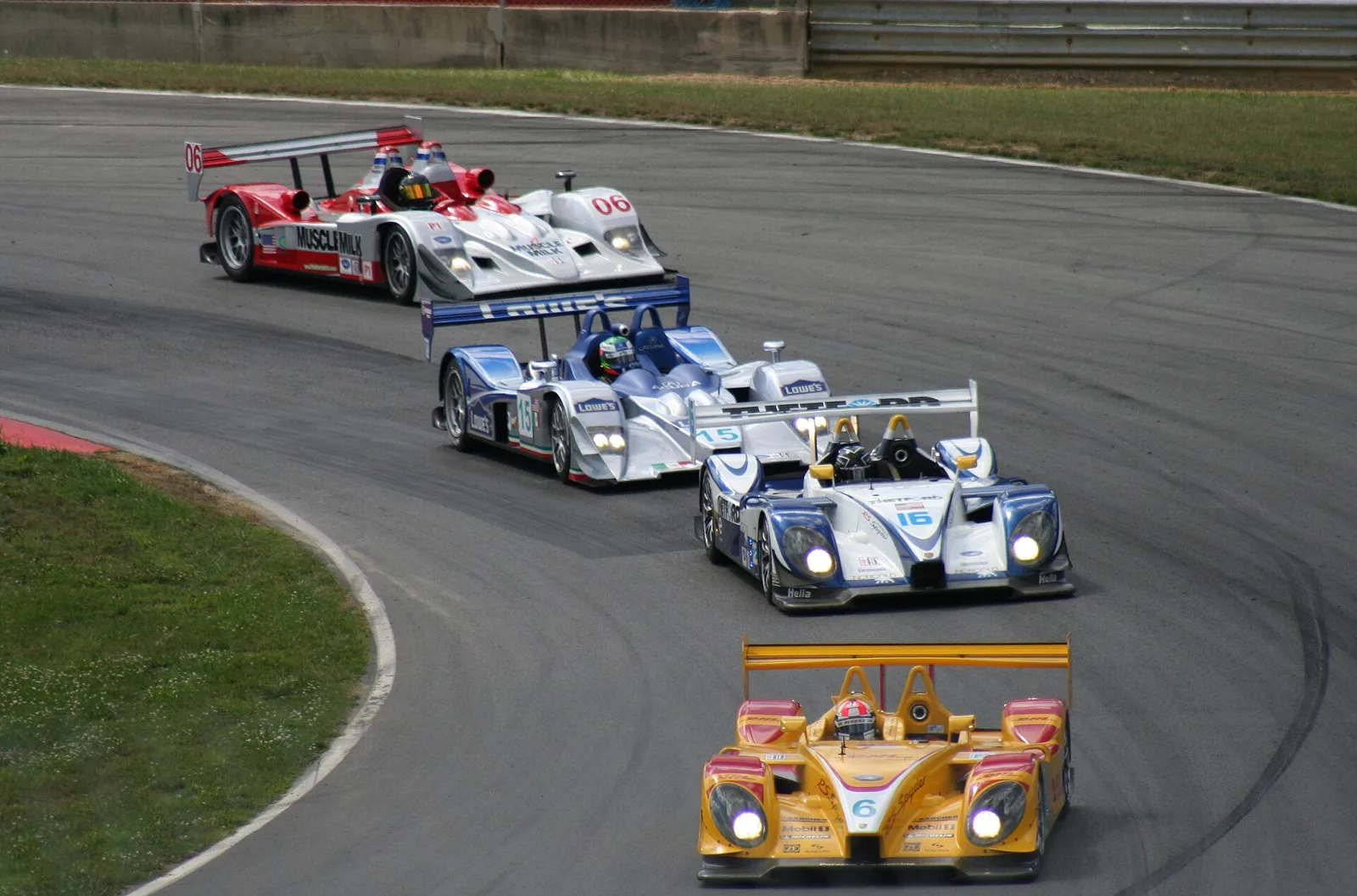
Three eras of endurance racing rules, from Group C replacements to tube-frame Daytona cars, and the chassis nearly every LMP2 team now runs.
Le Mans Prototypes are ACO-created sports prototypes, now in LMP2 and LMP3 classes. Daytona Prototypes were cheaper tube-frame cars for the Rolex Sports Car Series. LM GTE covered production-based grand tourers until 2023. The Oreca 07 became the standard LMP2 chassis, with over 100 victories since 2017.
Every year since 2017 the LMP2 class at the 24 Hours of Le Mans has been won by the same chassis, the Oreca 07. It has also taken nearly every class title in the world's major prototype championships, and over 100 victories in all. It was built to the 2017 LMP2 rules, which allowed only four chassis builders.
Behind it sits a tangle of class names. Le Mans Prototypes, Daytona Prototypes and the production-based LM GTE cars each followed different rules, grew up in different places and had different fates.
What is a Le Mans Prototype?
A Le Mans Prototype, or LMP, is a sports prototype devised by the Automobile Club de l'Ouest (ACO), with bodywork covering all the mechanical elements. LMPs race at the 24 Hours of Le Mans, in the FIA World Endurance Championship, the IMSA SportsCar Championship and the European, American and Asian Le Mans Series. As of 2026 the prototype ladder has two classes, LMP2 and LMP3.
| Class | Engine | Output and weight |
|---|---|---|
| LMP3 (2015 to 2019) | 5.0-litre Nissan VK50VE V8 | 310 kW (420 hp); 900 kg raised to 930 kg |
| LMP3 (2020 rules) | 5.6-litre Nissan | 340 kW (455 hp) |
| LMP3 (from 2025) | Twin-turbo 3.5-litre Toyota | 350 kW (470 hp); 1,000 kg limit |
| LMP2 (Oreca 07) | 4.2-litre Gibson GK428 V8 | 600 hp (450 kW; 610 PS); 930 kg |
| Daytona Prototype (2014 on) | Up to 5.5 L naturally aspirated, 3.5 L forced induction | 550 to 600 hp; 1,032 kg or 1,010 kg |
| LM GTE | 5.5 L naturally aspirated or 4.0 L turbo | Minimum 1,245 kg including driver |
| LMP1 and Hypercar | Open to hybrids | Maximum 500 kW (670 hp); minimum 1,030 kg |
The top class changed in 2021. The LMP1 category gave way to Le Mans Hypercar in the World Endurance Championship and at Le Mans, though non-hybrid LMP1 cars were allowed to run alongside it for 2021 and 2022. LMP1s were the fastest closed-wheel cars in circuit racing, if not as quick as open-wheel Formula One machinery. From 2023 Hypercars were joined by LMDh cars, so the WEC calls its top class Hypercar while IMSA calls it Grand Touring Prototype (GTP).
Names varied with the series. The FIA called its equivalents Sports Racers or Sports Racing Prototypes, IMSA used World Sports Cars, and the brief United States Road Racing Championship brought back the Can-Am name. Since 2004 most series have settled on Le Mans Prototypes.
Every year since 2017 the LMP2 class at Le Mans has been won by an Oreca 07.
How did the Le Mans Prototype class begin?
The first use of what became the Le Mans Prototype came at the 1992 24 Hours of Le Mans. The World Sportscar Championship offered only a small field of Group C cars, so older Porsche 962s were let in under Category 3 and small open-cockpit cars with production engines under Category 4.
The ACO then set out to replace Group C altogether. LMP1 meant large-displacement, custom-built, usually turbocharged engines, while LMP2 used smaller production-based units, and both were meant to be open cockpits. In practice the early LMP1 entries were former Group C cars, some still closed, including the Toyota 94C-V and Porsche 962C GTI.
Ferrari, Porsche and Mazda were among those embracing the formula, which ran to 1996. In 1997 came a European series for the cars, the International Sports Racing Series, with the FIA classifying them SR1 and SR2. America followed in 1998 when the new United States Road Racing Championship tried to break away from IMSA, calling its open-cockpit prototypes Can-Am.
That same year the IMSA GT Championship was cancelled, so the ACO allowed the American Le Mans Series, using the same classes as Le Mans. It also eliminated the small LMP2 class and created a closed-cockpit category called LMGTP.
How did LMP3 and LMP2 develop?
LMP3 appeared in 2015 as an entry class for young drivers and new teams, using closed-cockpit chassis from any licensed constructor, with costs capped for chassis, engine and upgrade kits. The first-generation cars came from Ginetta-Juno, Ligier, Norma, ADESS and Ave-Riley, all powered by the Nissan V8. Minimum weight was originally 900 kilograms, then raised to 930 kilograms because the powertrain proved heavier than expected.
The 2020 ruleset introduced new Ginetta, Ligier and Duqueine models plus the ADESS-03 Evo, with 5.6-litre Nissan engines. From 2025 the class moved to twin-turbocharged 3.5-litre Toyota engines, and a new set of cars arrived from the same four builders, the Ligier JS P325 and the ADESS AD25 among them. The extra power and cooling pushed the weight limit up to 1,000 kilograms.
For LMP2, the FIA issued new regulations in 2017 to limit costs, frozen through 2020. Gibson became the exclusive engine supplier with a naturally aspirated V8, and the four places for chassis builders went to Oreca, Dallara, Ligier's maker Onroak and the Riley Tech/Multimatic partnership, each with a closed cockpit. As a result all LMP2 cars are essentially the same.
In 2021 the class was deliberately slowed to preserve a gap to the new Hypercars: the Gibson was cut to 540 bhp and minimum weight rose by 20 kg to 950 kg, and a single aero kit became mandatory. European Le Mans Series teams kept the right to run different kits.
An earlier entry class had come and gone. The Le Mans Prototype Challenge, introduced in 2009, used identical Oreca FLM09 cars. It left the European Le Mans Series in 2014, and was dropped from the WeatherTech SportsCar Championship after 2017 because running a team cost about as much as in LMP2.
Why did LMP1 give way to Hypercar?
Audi left the World Endurance Championship at the end of 2016 and Porsche at the end of 2017, both after the Volkswagen emissions scandal. With the manufacturers gone, IMSA and the ACO agreed to merge their prototype rulesets into one class, given separate names by the two bodies. The merged class carries a different name in the WEC and in IMSA, and Hypercars may race in IMSA alongside their LMDh sister cars. Both are capped at 500 kW (670 hp) with a minimum weight of 1,030 kg (2,270 lb).
What was a Daytona Prototype?
A Daytona Prototype was a car developed for the Rolex Sports Car Series of the Grand American Road Racing Association (GARRA), named for the Rolex 24 at Daytona. For 2003 GARRA dropped its two open-cockpit classes, SRP-I and SRP-II, whose cars were mostly modified Le Mans Prototypes. They were technologically advanced and fast on the Mulsanne Straight, but that speed was considered extremely dangerous at Daytona, where concrete walls on the oval section stood at the fastest points.
Cost was the second aim. GARRA specified closed-cockpit tube-frame chassis instead of expensive carbon fibre, standardised the technology and forbade development during a season, which removed the spend on aero tweaks and private testing. It also controlled who could supply chassis and engines, required engines to be based on a road-going production unit, and barred major manufacturers from running teams. Smaller dimensions, especially length, produced a blunt nose that helped slow the cars down.
Each approved chassis could race for five years before GARRA reselected. Seven makers were approved from 2003 to 2007: Chase, Crawford, Doran, Fabcar, Multimatic, Picchio and Riley. In 2008 new designs were allowed, with Lola and Krohn Racing buying Multimatic's entry, Dallara buying Doran's and Cheever Racing taking over Fabcar's licence to build the Coyote.
The third generation arrived in 2012. The cockpit became nearly identical for every car, with a one-inch zone for individual styling, and a more upright nose let manufacturers add brand character. The Riley MkXXVI and the Corvette DP were the new cars.
Engines had to come from a major production manufacturer, though displacement could be altered to equalise the field. Approved units included a BMW 5.0 L V8, a Ford 3.5 L twin-turbo V6, an Infiniti 4.35 L V8, a Lexus 5.0 L V8, a Porsche 3.99 L flat-six, and Honda V6 engines. For 2007 all engines also had to use a standard ECU.
The debut came at the 2003 Rolex 24, where six Daytona Prototypes ran. A Corvette and a Mustang from the GTS class set the two fastest qualifying times, yet Grand-Am set aside the front three rows for the prototypes anyway. Only two finished, far behind a lower-class Grand Touring car. By 2004 the SRP cars were banned and 17 prototypes appeared at the opener, one of them winning outright. By 2006, because of the low cost, some races drew more than thirty entrants.
From 2006 to 2012 these cars were also allowed in Japan's Super GT, entering the GT300 class, where the Mooncraft Shiden took the team title in 2007. Once the Rolex series and the American Le Mans Series merged in 2014, they ran with the ALMS LMP2 cars as the main prototype class until 2016. At Indianapolis in 2014, Chevrolet and Ford powered examples managed laps under 1.20.
From 2017 the original tube-framed cars were replaced by Daytona Prototype International (DPi), built around the four LMP2 chassis the ACO had approved, wearing manufacturer-specific bodywork and approved engines. Each manufacturer is asked to pair up with a privateer team. The hope was that DPi cars would be eligible for Le Mans in LMP2, but disagreements between the ACO and IMSA prevented it.
What was LM GTE?
LM GTE, short for Grand Touring Endurance, was a set of rules maintained by the ACO and IMSA for production-based grand tourers at Le Mans and in the Daytona 24 Hours. It began as Group GT in 1999, was Group GT2 from 2005 to 2010, and was renamed LM GTE in Europe after the GT1 class was dropped for 2011.
The Porsche 911 GT3 RSR dominated the early years, with the Ferrari 360 Modena, F430 and Panoz Esperante also successful. From 2011 the Porsche 911 now had Ferrari's 458 Italia, the Aston Martin V8 Vantage, the Corvette, BMW's M3 and Z4, and the SRT Viper to beat. In 2015 the Porsche 911 RSR and Ferrari 458 were the two dominant cars, and in 2018/19 the leaders by points were the Porsche 911 RSR, Ferrari 488 GTE Evo and Ford GT.
To keep the cars close to showroom models, the ACO demanded a two-door road car with two or 2+2 seats that was legal on the road and available for sale. A big manufacturer needed to build at least one car a week and a small one a month, and the cars became eligible once 100 road cars (25 for a small maker) had been built. Engines were capped at 5.5 L naturally aspirated or 4.0 L turbocharged, and the SRT Viper won a waiver to 8.0L. Minimum weight was 1,245 kg including driver.
Four-wheel drive was banned, gearboxes had six speeds at most, and cars needed rear-view cameras and at least 150 cubic decimetres of luggage space. Carbon fibre, titanium and magnesium were banned except for parts such as spoilers and wheels. To tell them apart from faster prototypes at night, cars used yellow headlights outside the WEC. The ACO also held the right to adjust the Balance of Performance through weight, engine or aero.
At Le Mans the cars split into GTE-Pro and GTE-Am, the latter limited to cars at least a year old and restricted driver line-ups. Changes announced at the 2015 24 Hours for 2016 aimed to raise performance relative to GT3 cars while cutting cost and improving safety.
On 20 August 2021 the ACO announced that GT3 cars would replace GTE from 2024. The decline was plain: only four GTE cars ran in the WEC and three in IMSA in 2021. GTE Pro ran for the last time in 2022 and GTE Am in 2023. The final race for the regulations was the 2023 8 Hours of Bahrain, won by the Iron Dames Porsche 911 RSR-19 driven by Sarah Bovy, Rahel Frey and Michelle Gatting.
Why did the Oreca 07 become so common?
The Oreca 07 was built to the 2017 LMP2 rules and quickly became the default choice for teams entering the class, finding more buyers each year, including customers who switched from rival brands. Since 2017 nearly all teams in series with an LMP2 class have used it.
Oreca built it on the monocoque of the Oreca 05, which had been future-proofed for the new rules, partly so existing 05 owners could update their cars at reasonable cost. The goal was to maximise performance by focusing on energy and resource use. A running prototype first tested at Circuit Paul Ricard in late October 2016, and the early results met Oreca's simulation targets, leaving technical director David Floury optimistic. The design team was Floury, Christophe Guibbal as head of design and Jean-Philippe Pelaprat as technology engineer.
Its aerodynamics concentrate on conditioning and accelerating airflow through the sidepods towards the diffuser, instead of making large downforce right at the nose. Suspension is double wishbone with push-rods, using torsion bars at the front and coilovers at the rear. It weighs 930 kg (2,050 lb) as the rules require, and the 4.2-litre Gibson GK428 V8 makes 600 hp (450 kW; 610 PS), linked to a six-speed Xtrac sequential gearbox.
In 2020 output fell by 60 hp after a 35 mm intake restrictor and a reduced rev limit were applied following the Hypercar announcement, though 40 hp was later restored in the European series, where LMP2 is the top class. Oreca delivered its 100th chassis, technically the 99th since it skipped number 13, to Cool Racing for the 2022 running of Le Mans. That count includes every variant.
What has the Oreca 07 won?
It debuted at the 2017 24 Hours of Daytona and won for the first time in the 4 Hours of Monza that year. At Le Mans that year it became the first LMP2 car to lead the race, when Jackie Chan DC Racing's No. 38 inherited the lead in the 21st hour as five of the six LMP1 cars ran into trouble. Porsche's No. 2 919 Hybrid regained the lead with an hour left, and Oreca finished with a historic second and third.
The car's clear edge during 2017 led the ACO to let Dallara, Ligier and Riley/Multimatic develop extensive upgrade packages to catch up, while freezing Oreca's own development, to Oreca's disapproval. The 07 kept winning anyway and is used by all LMP2 teams in the IMSA, European and Asian Le Mans Series.
It also spawned rebadged and modified versions. The Acura ARX-05 was a DPi built by Honda Performance Development and Oreca with a 3.5-litre twin-turbo V6, which Team Penske won titles with in 2019 and 2020. The Alpine A470 was an Oreca 07 under another badge, run in the WEC for four years. The Aurus 01 raced with G-Drive in the European Le Mans Series for three years and four victories before the team withdrew amid sanctions after the invasion of Ukraine. The LMP1 Rebellion R13 became the Alpine A480, which finished second overall four times against Toyota.
What comes after the Oreca 07?
A fresh LMP2 rulebook is planned for 2028, and Gibson is expected to carry on as engine supplier. The Oreca 07 is due to be succeeded by the Oreca 09, built to meet those rules. LMP3 has already moved on, with its 2025 engine and car changes, and the two LMP classes are what remain under Hypercar and GTP at the top of the prototype ladder.