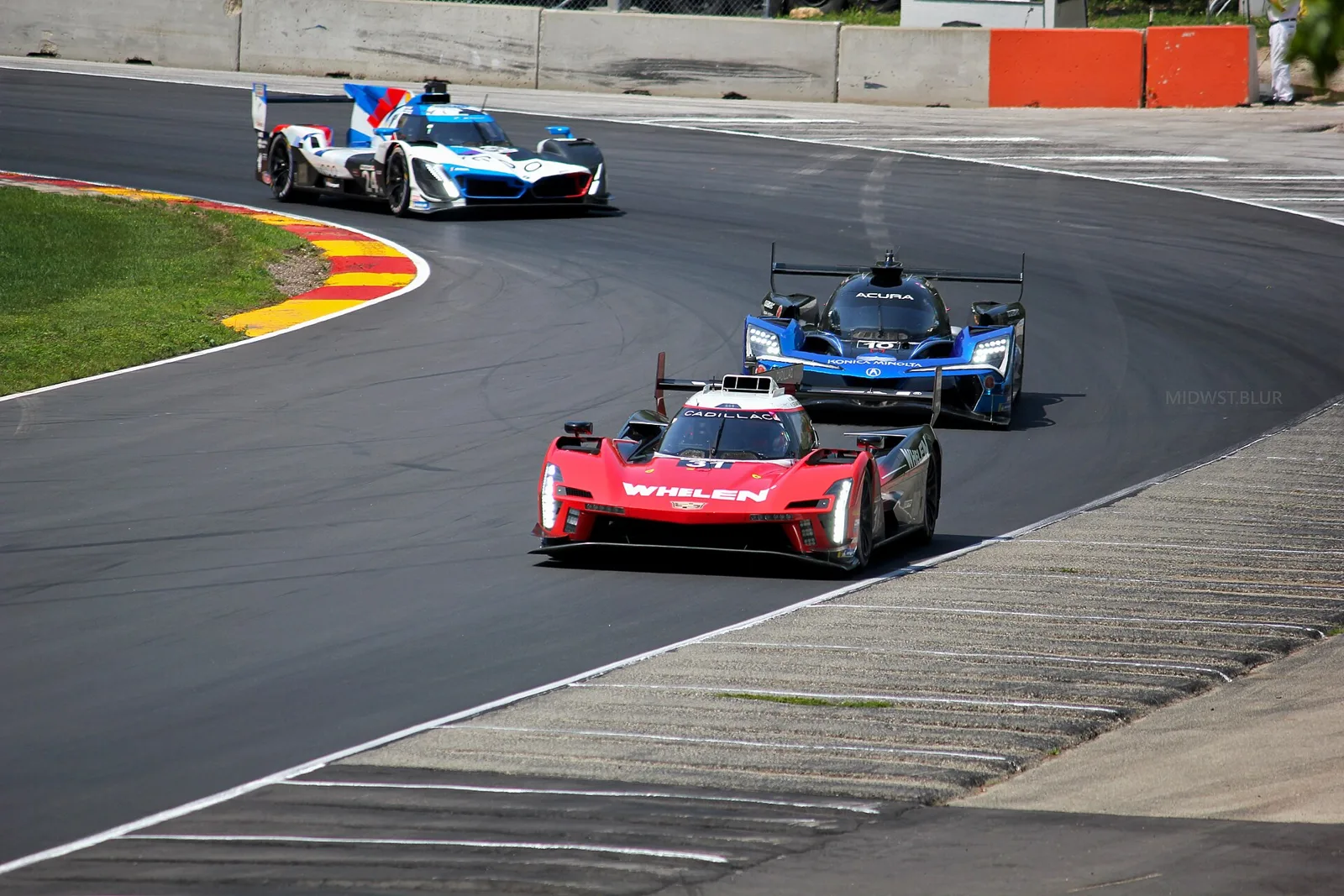
How a hybrid prototype class built with Le Mans organisers replaced Daytona Prototype International, and how the Rolex 24 at Daytona is run.
IMSA's GTP class is the top category of the IMSA SportsCar Championship in North America. Since 2023 it has used LMDh and Le Mans Hypercar prototypes with hybrid power, so the same cars can race at the Rolex 24 at Daytona and in the World Endurance Championship.
The fastest sports cars in America now race under a rulebook written jointly with the organisers of Le Mans, and the name on the class is borrowed from the 1980s. That class is GTP, short for Grand Touring Prototype, and since 2023 it has let a single type of hybrid prototype contest the Rolex 24 at Daytona in January and the 24 Hours of Le Mans later in the year.
What is IMSA GTP?
GTP is the flagship class of the IMSA SportsCar Championship, the sports car series that runs across the United States and Canada and is regarded as the pinnacle of the sport in North America. It replaced the DPi class from 2023, and its cars are built to IMSA's LMDh rules or to the Le Mans Hypercar regulations of the Automobile Club de l'Ouest. The class name comes from a 1980s category of the same name, confirmed by IMSA in January 2022.
Around GTP, the championship features prototypes and GT cars in both endurance and sprint races. The season opens with the Rolex 24 at Daytona at the end of January and closes with Petit Le Mans in early October.
Manufacturers wanted one car that could race in America and at Le Mans.
How did American sports car racing end up here?
The story starts with a split. Until 2013 North American sports car racing had two top tiers: the American Le Mans Series, which was high-tech, and the Rolex Sports Car Series, which was cheap to run. The merger of the two sanctioning bodies was announced on 5 September 2012, and the combined series debuted in 2014 as the United SportsCar Championship. It was renamed the IMSA SportsCar Championship in 2016.
A merged series needed a merged top class. Out of that came Daytona Prototype International, announced on 1 October 2015 and racing from the 2017 24 Hours of Daytona. DPi cars started from an LMP2 chassis and added an engine and bodywork specific to a major manufacturer. Each maker had to commit to an engine and bodywork package and was locked into an alliance with a chassis builder. Factory teams were allowed, and nobody had to sell cars to customers. IMSA promised a minimum homologation period of four years from 2017 to 2020 so competitors could recover their investment, and later extended it to 2021 and then 2022 after the world endurance calendar shifted and the pandemic hit.
DPi had one serious drawback. At first it was planned that the cars would be eligible at Le Mans in LMP2 through the ACO's Balance of Performance process. But changes to the rules removed the spec engine control unit and other data logging systems, and ACO president Pierre Fillon voiced his displeasure. The cars ended up ineligible, and a plan to slot them into the LMP1 Privateer class led nowhere.
Why was LMDh created?
Because the manufacturers wanted one car for two championships. In 2019 a discussion about a hybrid DPi 2.0 turned into a wider conversation about convergence with the new Le Mans Hypercar rules. McLaren's Zak Brown said a Hypercar programme was unviable for the British firm and called for steep cost reductions, and Ford and Porsche expressed similar sentiments. Toyota said it would accept DPi in the world championship as long as it could still show off its own hybrid technology, and a Toyota Racing Development executive suggested convergence would give Lexus a reason to start a programme.
The answer was announced on 24 January 2020 at Daytona, in a joint ACO and IMSA press conference. LMDh would replace DPi at IMSA, and it would converge with the incoming Hypercar rules so that both types of car could compete in the top class of the World Endurance Championship and IMSA. Hybrid discussions had been unresolved, with a 400-volt system of 70-90 kW (90-120 hp) as the leading option, and manufacturers divided. In the end the idea of building your own hybrid was scrapped in favour of a spec 50 kW (67 hp) system.
How are GTP cars built?
The draft LMDh regulations set out a weight of 1,030 kg (2,270 lb), peak combined output of 500 kW (670 hp) from engine and hybrid together, one bodywork package, one tyre supplier, and a worldwide Balance of Performance to keep LMDh and LMH cars level. The chassis come from four suppliers: Dallara, Ligier, Multimatic and Oreca. In plain terms, a manufacturer takes a shared underpinning, adds its own engine and styling, and gets a car that is allowed to race on two continents.
| Area | DPi (2017 to 2022) | GTP / LMDh (from 2023) |
|---|---|---|
| Base | LMP2 chassis with manufacturer engine and bodywork | Chassis from Dallara, Ligier, Multimatic or Oreca |
| Engines | Production-based, with turbocharging allowed on 4 and 6-cylinder units | Engine plus hybrid, 500 kW (670 hp) peak combined |
| Hybrid | Proposed for a DPi 2.0 update but never adopted | Spec 50 kW (67 hp) hybrid system |
| Bodywork | Manufacturer bodywork, with restricted areas around the wing, floor, splitter and diffuser | A single bodywork package in the draft rules |
| Balance of Performance | IMSA's own, shared with LMP2 | Global system covering LMDh and LMH |
| Le Mans | Ineligible | Eligible, also in the World Endurance Championship from 2023 |
How does GTP connect with Le Mans and the WEC?
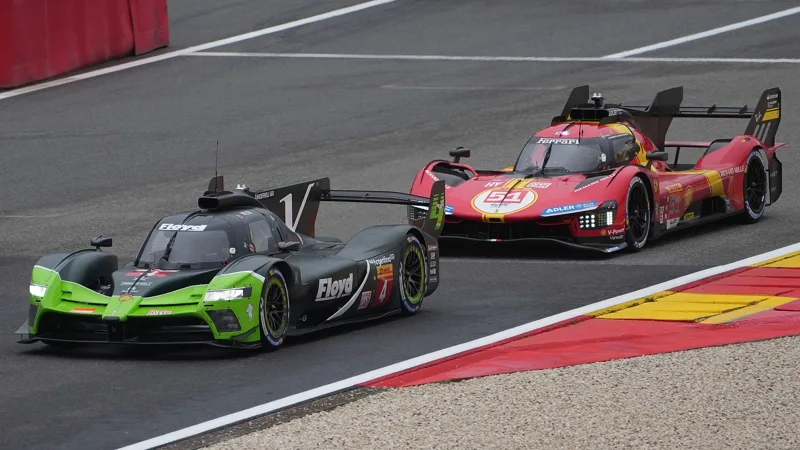
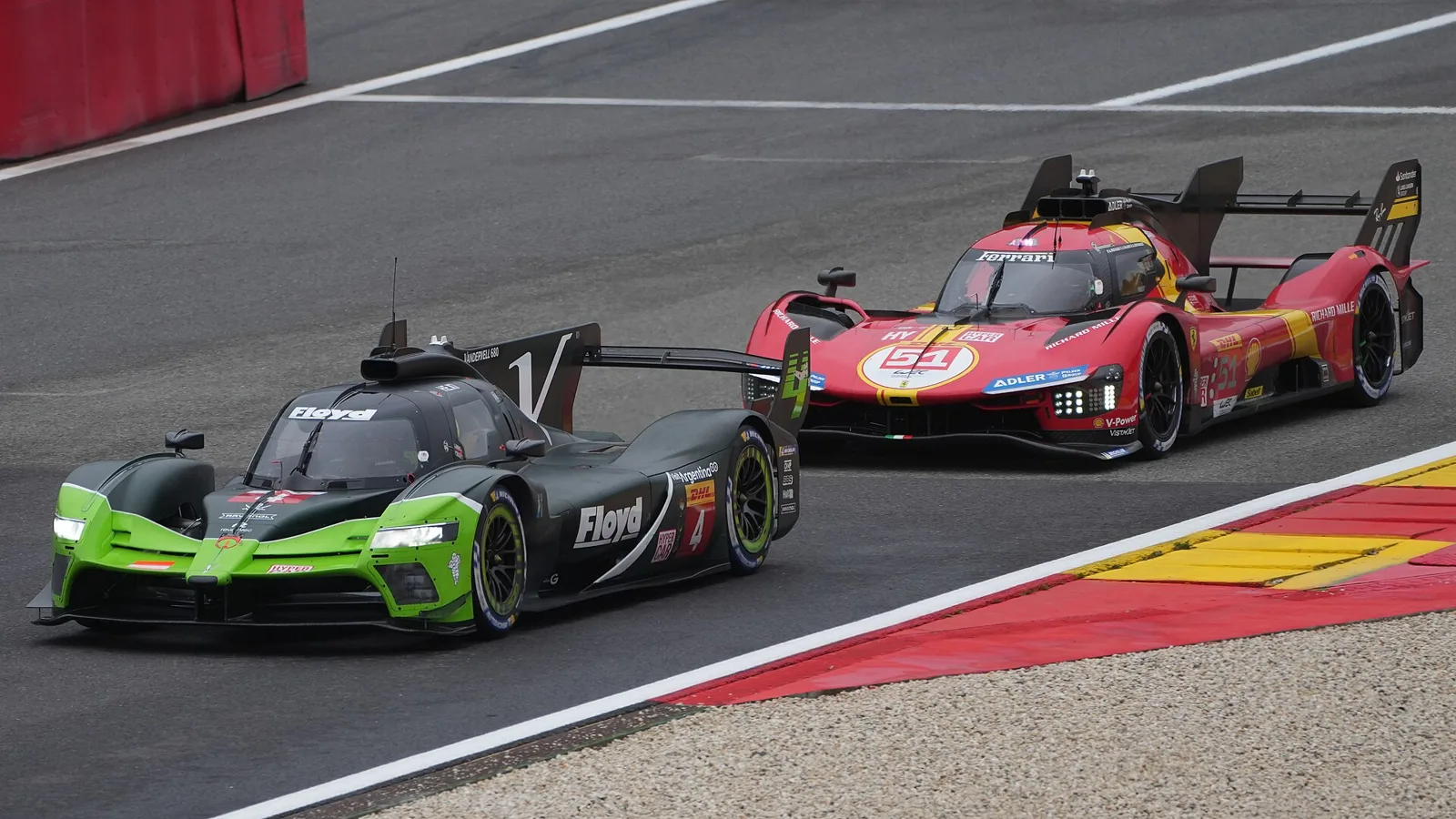
The World Endurance Championship launched its own top class, simply named Hypercar, in 2021. Its early field consisted of Le Mans Hypercar entries from Toyota, Glickenhaus and later Peugeot, together with an Oreca-built LMP1 car run by Alpine in its first two seasons. The FIA's governing council had said LMDh cars could enter individual races in 2022, but none appeared, so the class made its debut in 2023.
On the American side, the class debuted at the 2023 24 Hours of Daytona with four manufacturers entering nine cars. For the first two seasons it was LMDh cars only. The first Le Mans Hypercar to join them was the Aston Martin Valkyrie AMR-LMH, at the 2025 12 Hours of Sebring. In 2025 it was announced that the Asian Le Mans Series would open its doors to Hypercar entries, run by customer teams with pro-am line-ups, which makes LMDh cars eligible there from the 2026/27 season.
What classes race beneath GTP?
There are four classes in total, two prototype and two grand touring. Some races use only some of them: the Mosport round does not feature GTP, while the GT Challenge at VIR runs only the GT classes.
- LMP2 has run as its own class since 2019. It uses cars from the ACO's four licensed manufacturers to the 2017 global specification, with pro-am lineups, and only bronze-rated drivers may set qualifying laps. A team can have only one gold driver.
- GTD Pro uses FIA GT3 cars and replaced GTLM in 2022. It is open, with no driver rating restrictions.
- GTD, active since 2016, uses the same cars with stricter rules: at least one silver or bronze driver in a team and no more than one platinum driver per car.
Driver ratings shape the whole grid. GTP and GTD Pro have no restrictions, which is why they are filled with professionals. The GTP, LMP2 and GTD classes are all compatible with the regulations for the 24 Hours of Le Mans. Former classes include DPi, Prototype, Prototype Challenge, LMP3 and GTLM. LMP3 was removed after 2023 because grids had grown, and those cars now race in a support series.
How does the Rolex 24 at Daytona work?
The Rolex 24 at Daytona is a 24-hour race at Daytona International Speedway in Florida, run on a 3.56-mile (5.73 km) layout that uses most of the tri-oval and an infield road course. About 60 cars take the start. No other major car race in North America comes earlier in the year, and it opens the IMSA season. Together with Le Mans and the 12 Hours of Sebring it forms an informal Triple Crown of endurance racing.
Winning drivers in every class receive a watch from the title sponsor, a tradition that dates back to the 1964 Daytona Continental. That race began as a 3-hour event in 1962, and its first winner, Dan Gurney, had a lengthy lead before his Lotus 19 failed minutes from the end. He stopped near the line, waited for the clock, then turned the wheel and let gravity do the rest. That episode produced an international rule: a car must finish by its own propulsion to be classified. The race went to 2,000 km in 1964 and became a 24-hour race in 1966, when Ken Miles and Lloyd Ruby won in a Ford Mk. II.
Ferrari replied in 1967 with a side-by-side 1-2-3 parade at the finish, and the Ferrari 365 GTB/4 road car gained the unofficial name Ferrari Daytona in celebration. Porsche staged its own 1-2-3 in 1968, and in 1969 a Penske Lola T70-Chevrolet won with Mark Donohue and Chuck Parsons.
Running a 24-hour race takes people. By the 1970s crews had grown to three drivers, and teams typically use four today. In LMP2 and GTD, most teams must field at least one amateur driver. The fourth seat in a professional line-up often goes to a Daytona-only star who has won a major championship elsewhere, and names such as Fernando Alonso, Kyle Busch, Scott Dixon, Jeff Gordon and Shane van Gisbergen have filled that seat.
Daytona is unlike Le Mans in two ways. It takes place entirely within the speedway, with no public roads, and it is held in winter and closer to the equator, so more of the race is run in darkness. The main speedway lights are turned on to only 20%. Fog adds drama too: in 1989 the race was delayed by four hours, and in 2011 the delay was so long that the pace car had to stop for fuel.
Who wins the Rolex 24, and does a hybrid win?
No manufacturer has more overall wins than Porsche, which also took back-to-back wins in 2024 and 2025. General Motors has 10 wins as an engine maker across its Oldsmobile, Pontiac, Chevrolet and Cadillac brands.
In 2023 the Acura ARX-06 became the first hybrid car to win the race. IMSA sets energy usage regulations for hybrids and applies penalties to teams that break them. The electric motor and the petrol engine work together to add horsepower, an edge at certain moments of a race. By 2026 most GTP cars used hybrid power, and only the Aston Martin Valkyrie AMR-LMH ran on combustion alone.
What is the IMSA Endurance Cup?
The Endurance Cup ties together the five longest races of the IMSA season and awards titles to drivers, teams and manufacturers: the 24 Hours of Daytona, the 12 Hours of Sebring, the 6 Hours of Watkins Glen, the SportsCar Endurance Grand Prix and Petit Le Mans. It began in 2014, and its current title sponsor has been in place since 2019. Points are awarded at intervals that depend on race length. At the six-hour races, points are handed out at the halfway mark and at the flag, Petit Le Mans at four, eight and ten hours, Sebring every four hours and Daytona every six hours.
What does this mean for someone who buys or drives a car?
The GT classes are the closest to the road. GTD Pro and GTD use FIA GT3 cars with identical Balance of Performance rules, and such cars are nearer to road versions than the prototypes above them. Over the years Daytona entries have included BMW M3s, Porsche 911s, Chevrolet Camaros and Corvettes, and the Audi R8 and Ferrari 458 Italia made their debut in 2012. IMSA moved the whole GT category to GT3 in 2022 because of declining manufacturer interest in the GTE specification.
At the top, the hybrid story is the practical one. A hybrid won in 2023, and the majority of the 2026 GTP field used hybrid powertrains. For a buyer, that suggests a manufacturer can use the same race programme to learn about electrification and to compete in two championships.

.jpg)