Drawn with Red Bull's engineers around a 6.5-litre V12 that revs to 11,100 rpm, the Valkyrie grew from 275 road and track cars into a Hypercar.
The Aston Martin Valkyrie is a hybrid hypercar built with Red Bull Racing Advanced Technologies and designed with Adrian Newey. Its 6.5-litre V12 makes 1,000 hp alone and 1,160 hp with hybrid, and 275 cars were built from November 2021 to December 2024.
A V12 that revs to 11,100 rpm, a body drawn partly by a Formula One designer and doors that are barely more than roof hatches: the Aston Martin Valkyrie was conceived as a track car that would still work on the road. Aston Martin built it with Red Bull Racing Advanced Technologies, and 275 cars were made between November 2021 and December 2024. It later spawned a track-only AMR Pro, an open Spider and a Le Mans Hypercar.
Where did the Valkyrie name come from?
The project was conceived by Adrian Newey, Andy Palmer, Christian Horner and Simon Sproule, and Newey, then Red Bull Racing's Chief Technical Officer, worked directly on the design. The first codename was Nebula, an acronym for Newey, Red Bull and Aston Martin Lagonda. It gave way to AM-RB 001, with AM for Aston Martin, RB for Red Bull, and 001 possibly marking the first production car the two had made together.
In March 2017 Aston Martin said the car would be called Valkyrie, after the Norse mythological figures. Red Bull explained that the name continued the maker's habit of V names and marked the car out as a high-performance machine. The Valhalla, nicknamed "Son of Valkyrie", draws on the mythological location in the same way.
A road-legal car designed by Formula One engineers, with a naturally aspirated V12 and a hybrid boost that together pass 1,000 hp.
How was the Valkyrie shown to the public?
A non-working full-scale model appeared at Aston Martin's Gaydon headquarters in July 2016. In November 2016 the car featured in a private presentation at the Etihad Towers in Abu Dhabi on the eve of the Grand Prix, then at the Festival Automobile International in Paris from December 2016 to February 2017. It was the star car at the Canadian International Auto Show in Toronto in February 2017 and stood alongside the Vanquish S Volante, the Rapide S AMR and the V8 Vantage AMR-Pro at Geneva in March 2017.
Aston Martin revealed most of the specification in February 2017 and the final details later that year. The show car was close to production form. The interior leaked online on 20 June 2017, giving a first look at the screens and seats.
Who built the Valkyrie?
Many specialists contributed. Cosworth tuned the engine, while Integral Powertrain supplied the bespoke electric motor and Rimac the lightweight hybrid battery. Multimatic made the carbon fibre monocell, Bosch the ECU, traction control and ESP, and Alcon and Surface Transforms the brakes. Wipac made the lights and Michelin the tyres. Ricardo, HPL Prototypes, 3T Additive Manufacturing Polymers (Prototal UK) and Martins Rubber Company also took part.
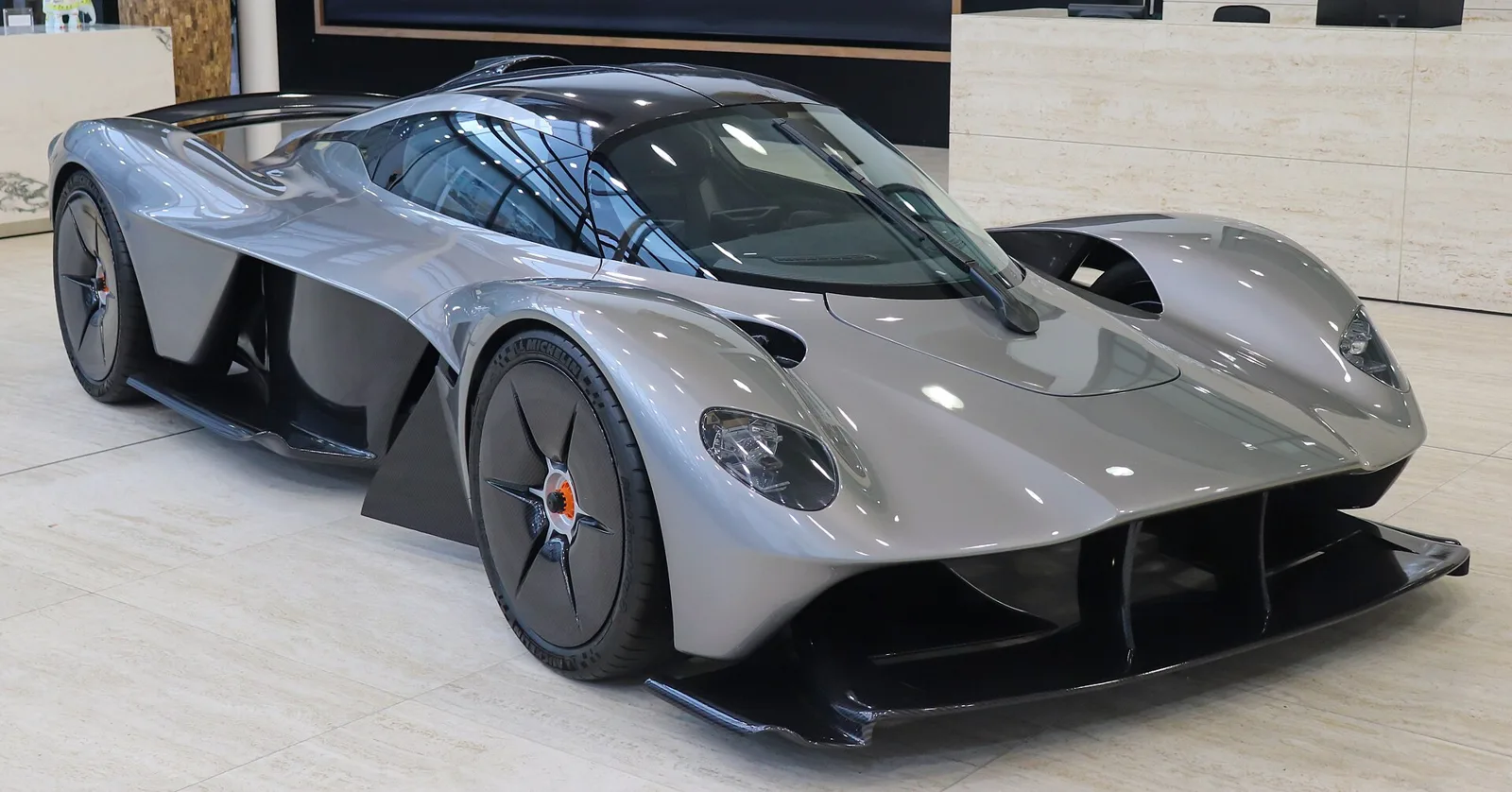
Red Bull Advanced Technologies drew the aerodynamic profile, while Aston Martin oversaw much of the exterior design under Miles Nurnberger. Newey put it this way for an early model: the green painted surfaces were effectively Aston's, and the black ones, including the canopy, rear wing and everything below the waistline, were Red Bull's.
How does the Valkyrie generate downforce?
An open underfloor working on Bernoulli and Venturi principles gives ground effect and up to 18 kN (1,800 kgf) of downforce at high speed. Gaps above the front axle and at the roof intake and a large front splitter help, and even the wheels are shaped to guide airflow while staying as light as possible. They are magnesium alloy, 20-inch at the front and 21-inch at the rear, with race-spec centre-lock nuts to cut mass. The Michelin Pilot Sport Cup 2 tyres measure 265/35-ZR20 at the front and 325/30-ZR21 at the rear.
The Valkyrie had its first shakedown at Silverstone alongside the Red Bull Racing RB16, with Max Verstappen and Alexander Albon driving.
How much power does the Valkyrie make?
The 6.5-litre naturally aspirated V12, tailored by Cosworth, produces around 746 kW and 1,014 PS (1,000 hp) at 10,500 rpm, with a redline of 11,100 rpm. Aston Martin described it as the most powerful naturally aspirated engine fitted to a production road car.
The hybrid system adds a KERS-style boost, as in Formula One. It contributes a further 120 kW and 160 PS (160 bhp) and 280 N.m, giving a certified maximum of 865 kW and 1,176 PS (1,160 hp) at 10,500 rpm and a peak torque of 900 N.m (664 lbf.ft) at 6,000 rpm.
When the output was published, the weight was given as 1,030 kg (2,271 lb), which beat the intended 1:1 power-to-weight ratio at 840 kW (1,142 PS) per ton. Aston Martin quoted 0-100 km/h (62 mph) in 2.6 seconds. The exhausts exit high on the car near the engine, as on Formula One cars and the Porsche 918 Spyder.
What is it like inside?
The brief was a track-oriented car that could be enjoyed fully on the road too, and the cabin shows how far the designers leaned toward the circuit. It is a racing cockpit first, with the usual road-car furniture reduced to a few screens and a handful of switches.
There is no gauge cluster, only screens: one in each outer corner for the camera mirrors, one on top of the centre console and one on the race-style wheel, which serves as the instrument display. Dials and switches sit beside the wheel so the driver can adjust things without interruption. The bucket seats are formed from hollow carbon fibre straight into the cabin perimeter, each with two seat belts.
Interior and doors are tiny, so each seat is shaped to its owner's body through 3D scanning, and the steering wheel can be removed for a little extra room when getting in and out. All the bodywork is carbon fibre.
How many Valkyries were built?
Production ran from November 2021 to December 2024, with 150 coupes, 85 Spiders and 40 AMR Pro cars, 275 in all. Only ten cars arrived in the last quarter of 2021, fewer than planned, and the company missed a profit target as a result. It said the problem affected timing only, since all production was sold, though not yet delivered.
On 4 July 2017 Andy Palmer announced in a Twitter post that any owner who "flipped" the car for a quick profit would not be offered further special editions. Ford's GT and the Mercedes-AMG ONE used the same rule.
What is the Valkyrie AMR Pro?
Introduced at Geneva in 2018, the AMR Pro is a track-only version, planned at 25 units and sold out before it was shown. It used the same V12 as the road car without the KERS system, modified to deliver up to 820 kW (1,100 hp), against an estimated 870 to 970 kW (1,160 to 1,300 hp) in some reports. It ran 18-inch wheels at both ends to take Michelin racing tyres based on LMP1 designs, with Formula One-inspired carbon-carbon brakes. The air-conditioning and infotainment screens gave way to racing equivalents, and the exhaust had very little silencing.
Aston Martin promised 3.3 G of lateral force in corners and 3.5 G under braking, with a target top speed of 402 km/h (250 mph). The production-intent car of 2021 was far more aggressive, with an LMP1-style rear fin, a large dual-element rear wing and a big diffuser. It looked closer to the regular, though elongated, Valkyrie than the original concept, and the run grew from 25 to 40 cars.
What is the Valkyrie Spider?
Announced in August 2021 for the 2023 model year, the Spider went into production in the second half of 2022, with 85 examples intended. It has a removable carbon fibre roof, and its front-hinged butterfly doors replace the coupe's gullwing doors. Orders for it were twice the number of cars on offer.
What is the Valkyrie LM?
Launched in June 2025, the LM is an unrestricted, track-only version of the AMR-LMH racer, created to celebrate Aston Martin's return to fighting for outright victory at Le Mans. It is nearly identical to the racing car, though the Cosworth V12 was reconfigured to run on standard fuels, and the ballast, muffler and the electronics mandated in the World Endurance Championship and IMSA were removed. It wears Pirelli P-Zero slicks. Only 10 will be made, and owners can join an Aston Martin programme that lets them drive the car at circuits worldwide with support from the company's engineers.
How did the Valkyrie fare in racing?
Aston Martin was among the first makers to commit to the Le Mans Hypercar class in 2019, planning at least two factory cars for the 2021 World Endurance Championship, run by Multimatic Motorsports, with two customer cars from R-Motorsport. The plan was to race without the hybrid system. In February 2020 the project was cancelled after the Automobile Club de l'Ouest allowed LMDh cars to run in the Hypercar class. Aston Martin had expected customer sales to fund much of the programme, and the company was also entering Formula One for the first time in 61 years. The car had nearly reached a working prototype, with testing set for that spring.
The project returned in October 2023. The Valkyrie AMR-LMH is based on the AMR Pro, developed by Aston Martin Racing and Multimatic for Hypercar in the World Endurance Championship and GTP in IMSA. It is the only car in its class derived from an existing production car, and the first V12 sports prototype in top-class endurance racing for 14 years, since the Peugeot 908 HDi FAP and Lola-Aston Martin B09/60 in 2011. Aston Martin kept to a no-hybrid plan, since the rules would have meant moving the hybrid from the rear axle to the front and adding cooling. The Cosworth RA V12 was set to run leaner, with a reduced redline, and an Xtrac 7-speed sequential gearbox was fitted. A "starternator" lets the car pull away without engine power.
The car was rolled out in summer 2024 and tested at Silverstone, Donington Park, Bahrain and Daytona by Darren Turner, Harry Tincknell and Mario Farnbacher. The Heart of Racing factory team chose race numbers #007 and #009, both taken from the Le Mans-winning DBR9. After skipping Daytona for more testing, the car debuted at the 2025 Qatar 1812 km, where the #007 retired with a transmission fault and the #009 finished 23 laps down.
Results improved. The car took top-10 finishes at every IMSA round in the first half of 2025, finished the 24 Hours of Le Mans without mechanical trouble and came 6th at the SportsCar Grand Prix. It qualified 3rd and finished 5th with the #009 at the 6 Hours of Fuji, and at Petit Le Mans it finished 2nd overall, five seconds behind the winning Cadillac, its first podium. In 2026 car #007 took two fourth places, at the 6 Hours of Spa-Francorchamps and Lone Star Le Mans. Pace did not improve much in the second season, when cars in both series mostly finished in the lower half of the top 10, though Mattia Drudi drove the AMR-LMH in the championship's post-season rookie test. In March 2022 an AMR Pro also ran two laps at the Bahrain opening round of the Formula One season.
Which Valkyrie is which?
Four cars can be confused. The coupe and the Spider are the road-going cars, with the hybrid system and a certified 865 kW, and they make up 150 coupes and 85 Spiders of the run. The AMR Pro is the 40-car track-only version with no hybrid, almost no exhaust silencing and a higher estimated output, and it took the run past 25 cars to 40. The AMR-LMH is the factory racing car, built to Hypercar rules with a leaner engine and without the hybrid. The Valkyrie LM brings that racer back to private owners as a 10-car run without the ballast and the mandated electronics, and with a V12 able to use standard fuels.
What are the Aston Martin Valkyrie specifications?
| Version | Built | Power | Notes |
|---|---|---|---|
| Valkyrie coupe | 150 | 865 kW; 1,176 PS (1,160 hp) with hybrid | 6.5-litre V12 of 746 kW; 1,030 kg; 0-100 km/h in 2.6 s |
| Valkyrie Spider | 85 | As coupe | Removable carbon roof, butterfly doors |
| Valkyrie AMR Pro | 40 | Up to 820 kW (1,100 hp), no hybrid | Track only, 18-inch wheels, target 402 km/h |
| Valkyrie AMR-LMH | Racing car | Leaner Cosworth RA V12, no hybrid | Xtrac 7-speed sequential, WEC and IMSA |
| Valkyrie LM | 10 | Cosworth V12 on standard fuels | Track only, Pirelli slicks |