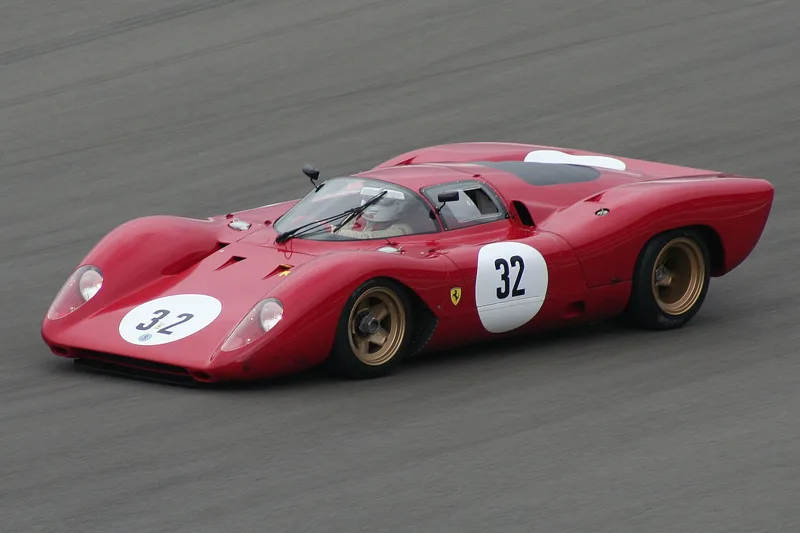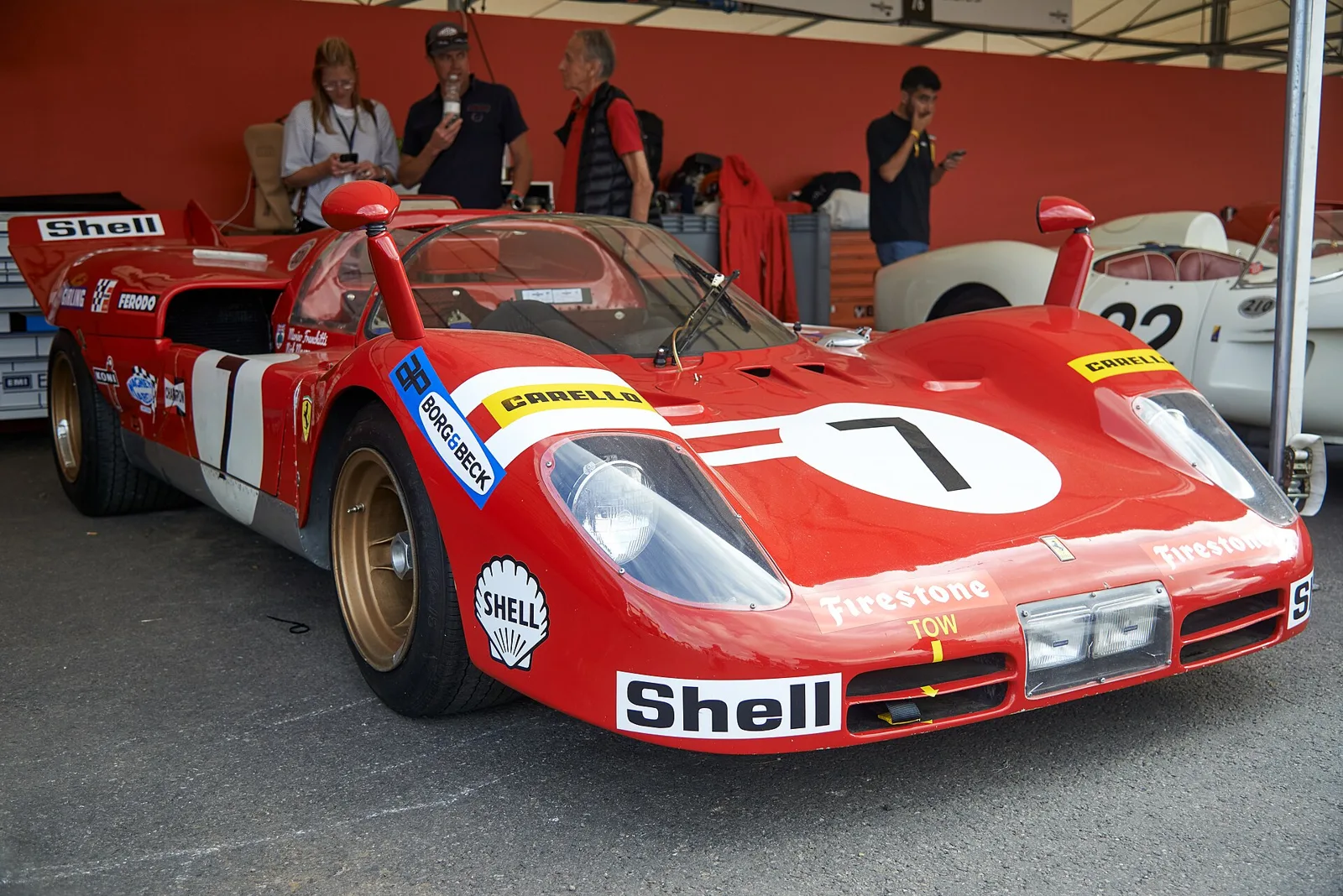
Ferrari's 1969-70 sports prototype, homologated in Group 5 with 25 cars, won the 1970 Sebring 12 Hours before the factory moved on to the 312 PB.
Ferrari's five-litre sports prototype was built between late 1969 and 1970 and homologated in Group 5 with 25 cars. Its one World Championship victory came at Sebring in 1970, after which the factory moved on to the 312 PB. The car was built as Ferrari's answer to Porsche's 917.
The Ferrari 512 S was a sports prototype built by the Italian manufacturer from late 1969 to 1970. Powered by a five-litre V12, it was homologated as a Group 5 sports car, which required 25 units to be built. It was Ferrari's answer to the Porsche 917, and its only World Championship race win came at the 1970 12 Hours of Sebring.
Why did Ferrari build the 512 S?
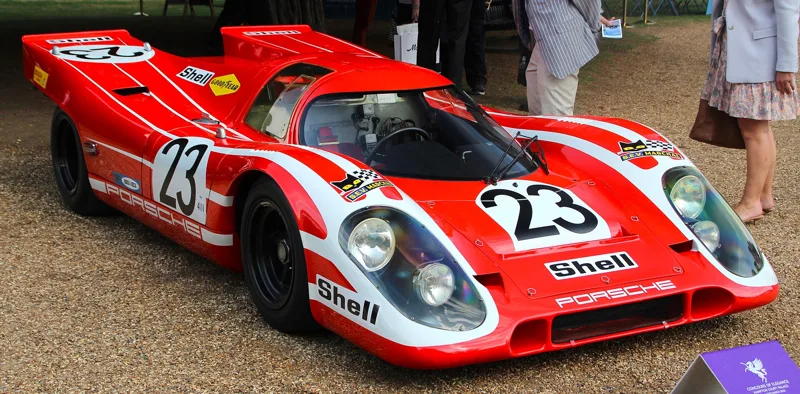
Porsche homologated its 917 in April 1969, and Ferrari needed a comparable five-litre car. Ferrari's P series of four-litre V12 cars had won Le Mans consecutively until 1965, but Ferrari had largely stepped back from sports car racing after 1967.
The GT40 Mk.II and Mk.IV took Le Mans in 1966 and 1967 on 7.0-litre engines, prompting the FIA to cap Group 6 prototypes at 3.0 litres from 1968. Ferrari sat out 1968 before returning in 1969 with the 312 P.
Porsche had built 25 examples of the 4.5-litre 917 in late 1968 for homologation. Enzo Ferrari diverted funds from the Fiat deal to match that investment, and the 512 S was the result.
Five litres, 560 PS and a single World Championship win at Sebring, built to answer Porsche's 917 and then left behind.
What was under the 512 S bodywork?
The 512 S used a new 60-degree V12 producing 560 PS (412 kW). Its steel chassis was reinforced with aluminium sheet, which made the car about 100 kg heavier than the aluminium-framed 917. The steel chassis and the heavy radiator were both part of that extra weight.
Set against Porsche's air-cooled flat-12, the Ferrari V12 required a tangle of cooling pipes and a heavy radiator. Notwithstanding the weight difference and a higher centre of gravity, the two cars seemed fairly evenly matched on paper.
Support also differed. Porsche provided loaned factory cars to JWA Gulf, Porsche Salzburg and Martini Racing, so those teams ran with direct factory backing. Ferrari did not adopt that scheme and entered its cars itself, under the Spa Ferrari SEFAC name.
Private teams such as Scuderia Filipinetti, NART, Francorchamps and Picchio Rosso received far less help from the factory. They were seen as field fillers rather than serious contenders for a win.
Early in 1970 the 512 S suffered predictable problems, including a weak suspension and transmission trouble. Porsche had already had six months of mixed experience with the 917 in 1969, and that head start proved decisive for the rest of the season.
| Specification | Detail |
|---|---|
| Type | Sports prototype, Group 5 homologation |
| Engine | five-litre 60-degree V12 |
| Output | 560 PS (412 kW) |
| Chassis | Steel, reinforced with aluminium sheet |
| Weight | About 100 kg more than the 917 |
| Homologation | 25 units required |
| Chassis numbers | 1002 to 1050, all even |
| Built | Late 1969 to 1970 |
How did the 512 S race in 1970?
Ferrari took the Sebring 12 Hours, while Porsche's 917 and 908/03 cars claimed the other nine championship wins that season. The 512 S could match the 917 on speed, yet the racing results did not follow. Ferrari's Formula One commitments meant the 512 S did not always receive full technical help.
At Le Mans in 1970, a wet race of attrition, all four factory cars retired. Vaccarella and Giunti were out after seven laps, Merzario and Regazzoni after 38 laps, and Bell and Peterson a lap later. Ickx and Schetty lasted until 142 laps.
Ferrari entered one 512 S at the Targa Florio, driven by Giunti and Vaccarella. Porsche did not run its 917K there and instead entered four 908/03s, which took a one-two finish.
Two customer 512s finished fourth and fifth behind three Porsches. On quick circuits like Le Mans, Spa, Monza and the Osterreichring, the cars carried an extra-long rear body panel.
The 512 M, a modified version that resembled the Porsche 917, proved fast late in 1970. It won the Kyalami 9 Hours in November.
Which 512 S cars were built?
Ferrari presented 25 512 S cars for homologation before the January 1970 Daytona race. Homologation officials approved 17 finished cars and eight kits, with chassis numbered 1002 to 1050 in even steps. The chassis were numbered in even steps, so the sequence is easy to follow.
19 cars were raced in 1970, five of them as spyders with an open roof. Chassis 1026 won at Sebring, the only World Championship race won by a 512 chassis.
Chassis 1010 became a 512 M and won the Kyalami 9 Hours. Chassis 1020 was converted to 512 M specification and sold to NART, which raced it in 1971.
Chassis 1036 was a test car for the factory racing division, and it was later sold to Solar Productions for Steve McQueen's film Le Mans. It was later reworked into an open-top car and entered in Can-Am in 1974.
Chassis 1032 was the subject of controversy in the 1980s, and Christie's became involved. Chassis 1012 was destroyed in practice for the Nurburgring 1000 km, and chassis 1026 was destroyed during the filming of Le Mans. Pininfarina also used one chassis and V12 for the Ferrari Modulo.
Penske developed an improved 512 M, chassis 1040, which ran in Sunoco livery in 1971. Mark Donohue drove it mainly, and it was fast on American circuits.
Who drove the 512 S?
Twelve different drivers drove factory 512 S cars in 1970. Giunti competed in nine of the ten rounds, Merzario and Vaccarella each made seven entries, and Ickx and Schetty made six. Several of the best drivers were tied up with Formula One, which limited their availability.
Endurance racing needs two drivers per car, so the factory had to find at least six more drivers to match Porsche's four factory entries. Regazzoni and Ickx had returned from Brabham as Ferrari's Formula One men for 1970, and Porsche's JWA Gulf, Salzburg and Martini teams kept stable pairings all season, while Ferrari changed its pairings repeatedly.
Jo Siffert, Brian Redman and Vic Elford were all-rounders who could handle both fast and twisty circuits. Derek Bell and Jackie Oliver were often unavailable because of Formula One duties at Brabham and BRM, and John Surtees returned for the Monza, Spa and Nurburgring rounds.
Ickx finished second in the 1970 Formula One championship with three wins, and Regazzoni finished third with one win. Both were Formula One drivers for Ferrari, which limited their availability for sports car races.
Giunti died after a crash at Buenos Aires in January 1971, at the wheel of the new 312 PB. Ronnie Peterson was hired only for Le Mans, and he died after the 1978 Italian Grand Prix start. Regazzoni was paralysed after the 1980 United States Grand Prix West before dying in 2006.
What became of the 512 S?
A regulation change saw the 512, like the 917, leave the world championship from 1972. Some privately owned 512s went on to race in Can-Am and Interserie events. Ferrari's programme was smaller in scale than Porsche's. Porsche's 917 programme ran for several seasons.
Ferrari dropped the 512 in 1971 to focus on the 312 PB, a new three-litre prototype. Porsche built more than 50 917s from 1969 to 1973, including Group 7 cars for Can-Am and Interserie, while Ferrari could not sell off all of its cars the way Porsche did. Only 25 homologated examples were made, and the factory's racing life for the car lasted about one season.