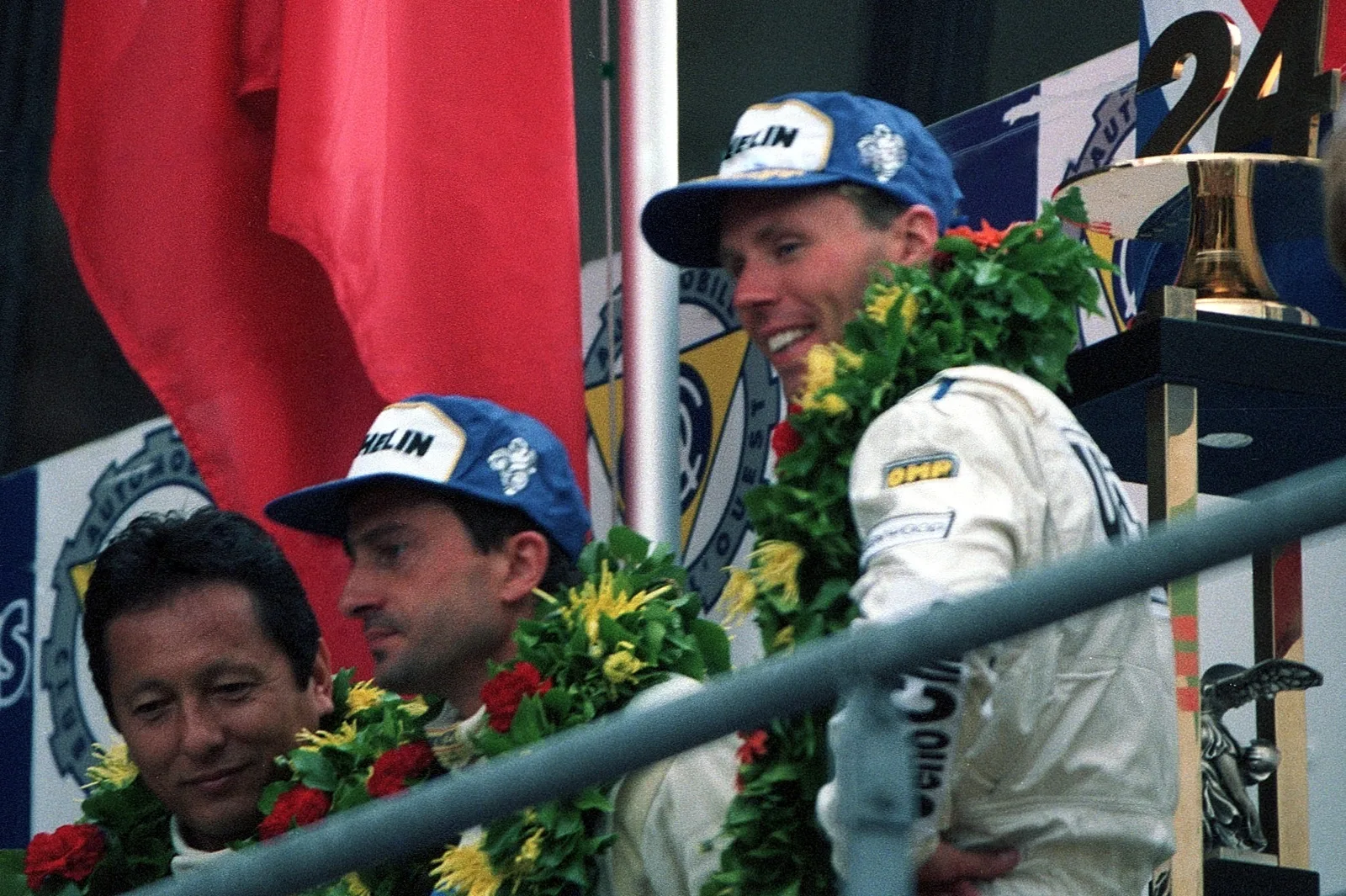
The McLaren F1 GTR of Lehto, Dalmas and Sekiya won through about 17 hours of rain, filling four of the first five places with a car that had never been tested over 24 hours.
The 1995 24 Hours of Le Mans was won by the McLaren F1 GTR of JJ Lehto, Yannick Dalmas and Masanori Sekiya, the 63rd Grand Prix of Endurance. It was run through about 17 hours of rain and gave McLaren its first Le Mans win.
The 1995 24 Hours of Le Mans, the 63rd Grand Prix of Endurance, was run on 17 and 18 June in one of the wettest races in the event's history. McLaren's F1 GTR, driven by JJ Lehto, Yannick Dalmas and Masanori Sekiya, won it. The cars had never been tested over 24 hours, yet four of them ended up in the first five places.
Why was McLaren's 1995 Le Mans win so significant?
McLaren won at its first attempt, a feat only Ferrari had managed in 1949. The F1 GTR led all but thirteen laps of the race, and four of the first five finishers were McLarens, which was unusual for a car that had never been tested over 24 hours.
The result was also a consecutive win for a GT car. The race had been expected to favour the lighter prototypes with better downforce, but the rain became the bigger equaliser. The slower conditions also eased the strain on the delicate McLaren drivetrains.
A careful Balance of Performance adjustment had been made to match the GT cars with the World Sportscar cars. Even so, the lighter prototypes with better downforce were expected to prove superior, and the rain took that advantage away.
Untested over 24 hours, McLaren's F1 GTR won the 1995 Le Mans race in almost constant rain.
Class rules for the 1995 race
| Class | Fuel tank | Minimum weight | Maximum tyre width |
|---|---|---|---|
| WSC | 80L | Graded by engine size and type | 18 inches |
| LM P2 | 80L | 620 kg with production engines | 12 inches |
| LM GT1 | 100L | 900 kg | 14 inches |
| LM GT2 | 100L | 900 kg | 12 inches |
The Automobile Club de l'Ouest (ACO) phased out its LM-P1 category and drew up regulations based closely on IMSA's new World Sportscar class, though it did not adopt them directly. Air-inlet restrictors balanced performance and were now linked to car weight as well as engine size, while the GT classes received smaller fuel tanks and reduced minimum weights.
IMSA agreed to let turbo-engined cars into WSC, given how many Group C chassis were still in circulation. A WSC car could use a 4.0-litre production engine, or a 3-litre unit for turbos, and its rev limit was 8500 rpm for a two-valve V8 or 10500 rpm for a four-valve V12.
The one-off model rule, which Porsche had exploited in the 1994 race, stayed in place for GT1. GT2 cars, however, had to be based on road cars in series production from February 1995. Two more pit bays raised the potential capacity to 48 cars.
Twenty significant teams received automatic entries. Another 50 went to pre-qualifying at the end of April, and from that run-off 34 more cars qualified for the race, including four reserves. A new tradition was a drivers' parade through the city from the Place des Jacobins beside the cathedral, where scrutineering took place. It drew a crowd of 40,000, who watched the drivers carried through the streets in classic cars.
How big was the entry for the 1995 race?
The ACO received 99 applications for the 1995 race, and 52 cars were present for race week. Most of them were in the two GT classes, and only 12 were prototypes. The BPR series had grown popular, often with more than 30 cars at each round.
The WSC class was expanding, with entries from Courage, Kremer and Mazda. The first Ferrari prototype seen at Le Mans since 1973 was among them. The Japanese manufacturers had a strong presence, with Mazda in WSC and Nissan, Toyota and Honda backing multi-car teams in LM-GT1.
Kremer had bought back the K8 Spyder that raced in 1994 and sold it on to Franz Konrad. A second chassis went to Daytona and won there unexpectedly, because faster cars dropped out one by one, and its flat-six engines, tuned at the Porsche factory, still produced 540 bhp. Jim Downing's Mazda team ran an open-top DG-3 limited by WSC rules to the R20B triple-rotor, which produced 465 bhp. Norbert Santos returned with an open-top Norma M14 powered by a 500 bhp Buick V6.
In LM-P2, Gerard Welter entered two cars with 1.9-litre Peugeot engines tuned to 400 bhp. Both were under 650 kg, which made them the lightest machines entered. The Debora LMP295 switched to a 2-litre Cosworth BDG engine, which with a Garrett turbocharger could put out 450 bhp. Its power-to-weight ratio was therefore comparable to the WSC cars, which made the small Welter entries more competitive than their engine sizes suggested.
What made the Courage team's 1995 effort important?
Yves Courage had long hoped to win Le Mans as an owner-driver, and his team entered a C34 spyder carrying his traditional number 13. The car ran a 3-litre Porsche flat-six twin-turbo, trimmed to 550 bhp by 34.5mm air restrictors, and it was driven by a line-up of experienced campaigners.
Bob Wollek was making his 25th Le Mans start, having raced at the event every year since 1973, and he was still looking for his first outright win. Mario Andretti was attempting the third leg of the Triple Crown of Le Mans, Indianapolis and the Formula One Championship, which only Graham Hill had achieved. Andretti had first raced at Le Mans in 1966, but he had joined the team only at the beginning of June.
The Courage C41 was a purpose-built WSC contender, with a carbon-fibre monocoque and a carbon and Kevlar bodyshell, designed to accept any engine. The first model had a 5-litre Chevrolet small-block V8 which, at the 8000rpm IMSA limit, produced 600 bhp. Eric van der Poele had posted the second fastest time at the test weekend, behind Wollek in the C34.
Why was the Ferrari 333 SP a surprise entry?
The Ferrari 333 SP had won five of the nine races in the 1994 IMSA WSC series, so its appearance at Le Mans was a surprise. Ferrari itself did not support the entry, because the car was unproven over 24 hours, but Antonio Ferrari's EuroInternational team had one of the first chassis and secured the entry. The Scandia Ferrari had won the Sebring 12-hour earlier that year, yet doubts about the 333 SP's endurance remained.
Work on the car began in 1993 for IMSA rules, and Tony Southgate later altered its design. It used a flat-bottom carbon-fibre monocoque, with bodywork fabricated by Dallara and Michelotto. The F310E V12 had five valves per cylinder and was related to Ferrari's Formula One engine, and with Weber-Marelli fuel injection it produced up to 630 bhp.
Running on European fuel meant modifying the V12, because its octane rating was lower than the American racing fuel, 98 against 103. Jay Cochran, who had given the marque its first WSC victory in April 1994, led the car, alongside co-owner Massimo Sigala and former Ferrari Formula One driver Rene Arnoux.
What happened to the prototypes once the rain came?
The light WR prototypes locked out the front row of the grid, but the rain changed the order. When it arrived at the end of the first hour, the WRs were delayed, and the McLarens moved forward, Jochen Mass in the DPR car running ahead of Courage.
In the fourth hour the race was paused when Patrick Gonin, in a recovering WR, aquaplaned off the Mulsanne Straight at speed and somersaulted. He was taken to hospital with several broken bones, and the race resumed after a half-hour stoppage. Soon afterwards Andretti spun the Courage while avoiding a backmarker and hit the barriers. Repairs cost six laps and dropped the car to 25th.
That left the McLarens running first, second, third and fifth, with the Larbre Porsche fourth and a privateer Porsche leading GT2 in seventh. The weather was taking a heavy toll on engines and causing accidents, including those that befell the two Porsches and the leading Gulf McLaren.
Mass and Nielsen then held the lead for more than eight hours, until a broken clutch stopped their car at 3am. The lead passed to the sister DPR car of Wallace and the Bells, father and son, with the KK McLaren in pursuit. The rain eased in the middle of the morning, and the Courage climbed back to third after hard driving by Wollek, Andretti and Helary, although the car was two laps down.
How did the 1995 race finish?
Yannick Dalmas brought the McLaren home to win by three-quarters of a lap, after Derek Bell's gearbox trouble let the leaders through. The best GT2 car was a privateer Honda NSX, which had lost six laps in the second hour after an engine fire in the warm-up.
Bell had been racing with a deteriorating gearbox. At the penultimate fuel stop, five minutes were lost trying to get the car into gear, and Dalmas swept past into the lead. Courage passed him soon afterwards. In the final hour Wollek returned to the lead lap but was unable to close the gap.
The Honda NSX had won a long tussle on the Sunday against the Callaway Corvettes. After the engine fire in the warm-up and the lost laps, better fuel economy and strong driving carried the team through to the chequered flag.
How was the McLaren F1 GTR built?
The F1 GTR was the racing version of the McLaren F1 road car, which cost 650,000 pounds sterling. Gordon Murray designed the road car, and it was the fastest production car in the world at the time. The racing car used a 6064cc BMW V12 that produced 625 bhp in its road form, and it was tuned to 635 bhp with the restrictors in place. Converting the road car to race specification needed relatively little work beyond upgraded suspension, carbon brakes and a roll cage.
The purpose-designed engine was a quad-cam V12 with variable valve timing, controlled by a TAGtronic management system, and it was mated to a six-speed Getrag gearbox. In 1994 gentlemen racers Ray Bellm and Thomas Bscher persuaded Ron Dennis to develop a racing version, and Jeff Hazell, a former Spice Engineering director, became the project manager.
The April test showed the cars were off the pace of the Ferraris, so a last-minute aero kit was produced. The carbon brakes were lighter but needed 50% extra cooling, and the front section was redesigned to redirect airflow. The dry-sump gearbox was unproven beyond four hours of racing, and that was a concern for the team.
Six cars went to customers, two each to Bellm and Bscher, and one each to Fabian Giroix and Noel del Bello. A seventh car replaced one wrecked at Jarama, and the original test car stayed with the company. The cars won six of the seven BPR Global GT Series races held before Le Mans.
For Le Mans, the Gulf team of Bellm and Maurizio Sandro Sala brought in 1992 winner Mark Blundell as the third driver. Lindsay Owen-Jones, chief executive of L'Oreal, ran the second car with Pierre-Henri Raphanel and Philippe Alliot. Bscher's two cars were run by David Price, who had been a team manager through much of the Group C era.