How a road-going supercar was reworked into a naturally aspirated GT racer that won the 1995 24 Hours of Le Mans and raced in four championships until 2005.
The McLaren F1 GTR was the racing version of the McLaren F1 road car, built from 1995 with a BMW V12. It won the 1995 Le Mans 24 Hours and raced in several GT series until 2005.
The McLaren F1 GTR was a racing derivative of the F1 road car, built from 1995 for grand touring events. It used the naturally aspirated BMW S70/2 V12, and its best-known result was winning the 1995 24 Hours of Le Mans outright, beating faster purpose-built prototypes in heavy rain. The GTR raced internationally until 2005, when the last race chassis was retired.
Why was the F1 GTR built at all?
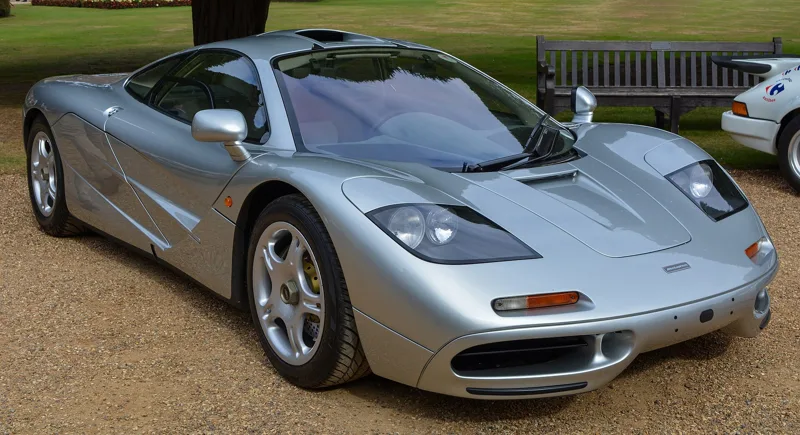
Gordon Murray, who designed the McLaren F1, saw the car as the ultimate road car and never planned to race it. Its creators had built racing technology into the design, but the car was meant to be a road car first, with no intention of converting it for competition.
That changed when the BPR Global GT Series was created in 1994. The series featured reworked sports cars, among them the Porsche 911 Turbo, the Venturi 600 LM and the Ferrari F40, and major manufacturers were watching it as a possible successor to the defunct World Sportscar Championship. Teams wanted faster cars for the top GT1 class, and several turned to Murray with the F1 in mind.
Le Mans winner John Nielsen was among those who approached Murray, and the persuasion worked. Murray agreed to build several racing chassis for the 1995 season. McLaren took an unused F1 chassis, intended to be number 019, and modified it as a development prototype for the programme.
A road-going supercar that was never meant to race, then won Le Mans overall in the rain with a naturally aspirated V12.
How did the 1995 car differ from the road car?
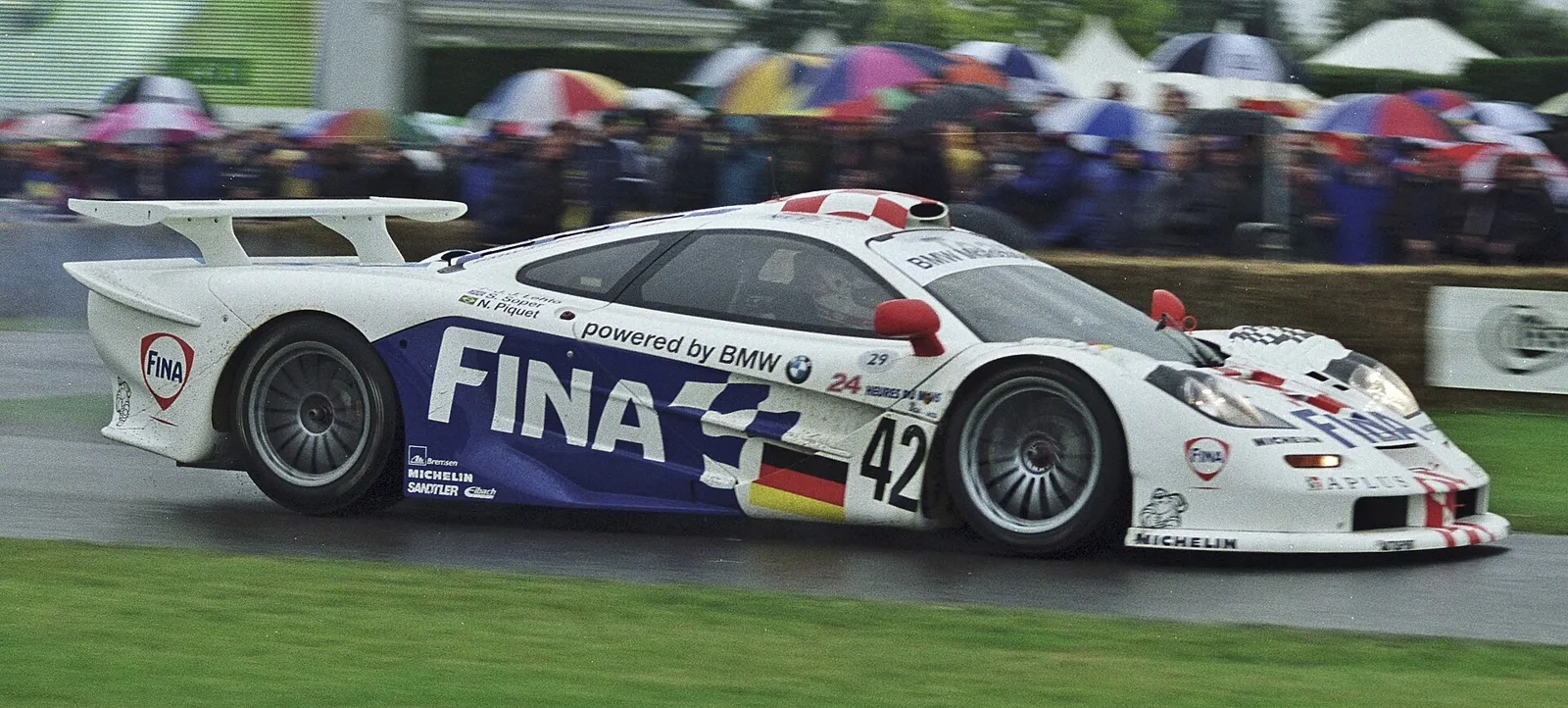
The conversion needed fewer changes than might be expected, because the road car already had much of what a racer needs. The bodywork gained large cooling ducts, most noticeably a big one in the centre of the nose, and two more where the side storage lockers had been.
A large adjustable fixed wing went on the tail, and the 1995 cars were said to generate enough downforce at 100 mph to run along the ceiling. Inside, the cabin was stripped of its luxuries and fitted with a full racing cage, and carbon brakes replaced the standard units. The BMW S70 V12 had to run an air restrictor, which limited output to around 600 PS, so the racer was less powerful than the road car. Lower weight made it faster and more nimble despite the lost power. The central seat, butterfly doors and standard gearbox were all kept.
McLaren ran a 24-hour test at Magny-Cours to find weak points and to develop upgrades for the teams. Nine chassis were built for 1995. Chassis 01R stayed with the factory as a test car, apart from a one-off appearance at Le Mans, and two cars went to GTC Racing, with a third built to replace a destroyed car. Four privateers, David Price Racing, BBA Competition, Mach One and Giroix, received one car each, and chassis 09R went to the Sultan of Brunei's collection.
| Specification | 1995 | 1996 | 1997 |
|---|---|---|---|
| Chassis built | Nine | Nine | Ten |
| Bodywork | Road-based, cooling ducts and rear wing | Extended front and rear, larger splitter | Long Tail with much longer nose and tail |
| Gearbox and weight | Standard gearbox | 38 kg lighter, magnesium gearbox housing | X-trac six-speed sequential gearbox |
| Ground clearance | Not given | 60 mm front, 80 mm rear | 70 mm front and rear |
| Engine | BMW S70 V12, air restrictor | BMW S70 V12, air restrictor | Stroke reduced to 5,990 cc |
| Mulsanne top speed | 281 km/h (174.605 mph) in practice | 330 km/h | 317 km/h (196.97 mph) |
How did the GTR win the 1995 Le Mans race?
The 1995 race was the first in which McLaren ran the car at Le Mans, with every one of the seven chassis built to date entered. Only six were being used in the BPR series, and chassis 01R was driven by the Kokusai Kaihatsu squad as well.
Before the race, most people expected a purpose-built prototype to win easily. The prototypes failed one after another, and the GT1 cars kept going. In the final hours five McLaren F1 GTRs were still running while only three prototypes remained. A close battle at the end saw the Kokusai Kaihatsu McLaren take the lead from a Courage Competition prototype, and the car crossed the line first in one of the shortest race distances seen in decades.
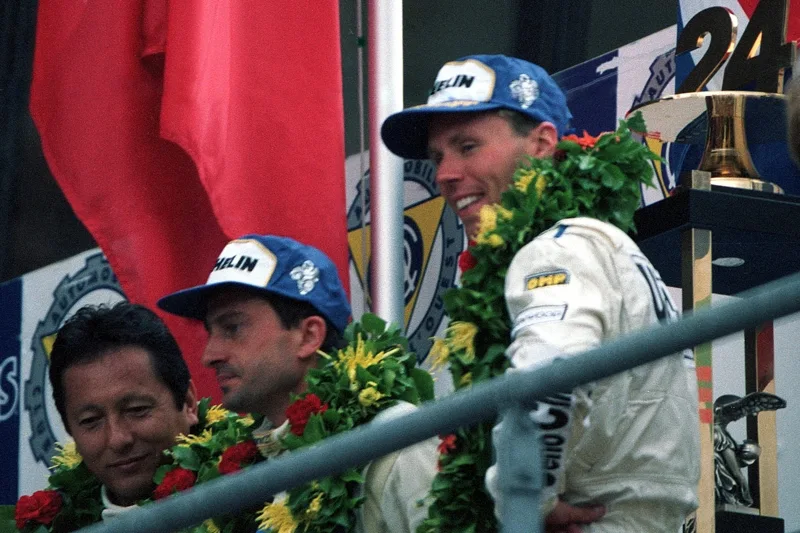
The winning crew was Yannick Dalmas, Masanori Sekiya and JJ Lehto. McLaren's other cars finished third, fourth, fifth and 13th, and only two of its F1 GTRs failed to finish. The company built five special F1 LM road cars to mark the five finishers, while the winning car stayed with McLaren and never raced again. The car had also recorded the year's fastest practice speed, 281 km/h on the Mulsanne Straight.
What changed for the 1996 and 1997 cars?
For 1996 McLaren upgraded the car to stay competitive against newer sports cars, notably the Ferrari F50 GT and the Porsche 911 GT1. The front and rear bodywork was extended, and a larger splitter went on the nose of the car.
The bodywork was made easier to remove for repairs, and the gearbox received a lighter magnesium housing with tougher internals, cutting 38 kg. Nine more GTRs were built to the new specification, and two older cars, 03R and 06R, were converted to match. The 1996 cars were the fastest in straight-line speed, hitting 330 km/h along the Mulsanne at Le Mans. That was 13 km/h quicker than the 1997 Long Tail and it also beat the 1996 Porsche GT1 by 6 km/h.
The 1997 season required a radical change, because the series had altered its rules and rivals such as the Porsche 911 GT1 and the Mercedes-Benz CLK-GTR were purpose-built racers. The F1 received a new, much longer nose and tail, a wider rear wing and wider wheel arches, while the monocoque stayed the same. Ground clearance rose to 70 mm at both ends, and the engine stroke was reduced to 5,990 cc, with the air restrictor still limiting output to 600 PS.
Ten more GTRs were built to the 1997 Long Tail specification. McLaren also had to build three F1 GT road cars using the Long Tail bodywork, as the rules required. At Le Mans in 1997 the Long Tail reached 317 km/h (196.97 mph) on the Mulsanne Straight. That was slower than the Porsche 911 GT1 Evo at 326 km/h (202.57 mph), the Nissan R390 GT1 at 319 km/h (198.22 mph) and the TWR Porsche Joest LMP at 320 km/h (198.84 mph).
How did the GTR perform in the BPR and FIA series?
The BPR series opened at Jerez in 1995, where three F1 GTRs qualified in the first three places, and the cars showed their pace from the first session. In the race Ray Bellm and Maurizio Sandro Sala won by 16 seconds from a Porsche 911 GT2 Evo.
BBA Competition added its own car at the next round, and the F1 GTRs kept winning, taking the final four races of the season. GTC Competition won the 1996 team championship in the series, with Bellm and James Weaver among its winners. Porsche then arrived with the 911 GT1 and took strong victories from Brands Hatch onwards. The series became the FIA GT Championship in 1997, and McLaren's advantage over the Porsches was gone.
In 1997 BMW Motorsport supported several McLaren-built cars. Mercedes-Benz arrived with the CLK-GTR and took pole at the opening round, but its car suffered mechanically in the race, and the new F1 GTRs took a 1-2-3 finish over six trailing Porsche 911 GT1s. Mercedes eventually overcame its problems and won most of the later rounds, and BMW Motorsport finished second in the teams championship while Team Davidoff was third.
Why did the GTR fall behind Mercedes?
The Mercedes-Benz CLK-GTR was a purpose-built racer, and the F1 could no longer keep up with it. BMW walked away at the end of 1997 to develop its own Le Mans prototype, the BMW V12 LM, and McLaren ended its factory support for 1998.
Team Davidoff and Parabolica Motorsports kept their ageing cars on track in 1998, with a best result of fifth in one race. The GT1 class was abolished after 1998 because of Mercedes-Benz's dominance, and McLaren F1s never raced in the FIA GT Championship again.
What did the F1 GTR achieve in Japan?
In 1996 Team Goh of Japan bought two 1996-spec cars, chassis 13R and 14R, to contest the GT500 class of the All Japan Grand Touring Car Championship, racing as Team Lark. The team took a 1-2 finish at the opening round at Suzuka, with Naoki Hattori and Ralf Schumacher winning, and David Brabham and John Nielsen won at Fuji.
Team Lark took four victories in the season and won the GT500 teams title, ahead of the factory Toyota and Nissan teams. It was only the second season in the series in which the GT500 class-winning car was not from a Japanese manufacturer. Team Lark did not return in 1997, and no McLarens raced in the series that year.
The car came back in 1999, when Team Take One bought chassis 19R, a 1997-spec car, for GT500. It achieved a best of ninth at Mine. Hitotsuyama Racing followed in 2000 with its own 1997-spec chassis, 25R, and in 2001 Team Take One scored an overall win at Mine, beating a works Nissan Skyline GT-R by a margin of just nine seconds.
Hitotsuyama's car achieved a best finish of third at Motegi in 2002, and it was retired at the end of 2003. It came back for two outings in 2005, retiring in the first race at Fuji and finishing 18th at the series' return to Fuji before its final withdrawal. That was the last time a McLaren F1 GTR raced anywhere in the world.
How did the car fare in British and other endurance racing?
In 1996 Lanzante Motorsports bought a former GTC Competition car for the British GT Championship. The car took six pole positions and a single race victory, and drivers Ian Flux and Jake Ulrich easily won the GT1 class drivers championship.
The team could not beat the GT2 and GT3 cars for the overall title and abandoned the McLaren after that season. Several GTRs also raced in other events. Bigazzi Team won at Curitiba and Brasilia in 1996 and then at the Mil Milhas in 1997. Team Davidoff took a 21-lap victory at the 6 Hours of Vallelunga and later raced the car in the GTR Euroseries, where it beat open-cockpit prototypes at Monza by eleven laps.
What happened to the GTRs after racing?
After most F1 GTRs finished racing in 1998, the chassis went to different homes. Le Mans winner 01R was shown at motor shows and in galleries. Private collectors bought the rest, to store or to run in historic track events such as the GT90s Revival Series, which brought together many former BPR competitors.
A few GTRs were also modified by McLaren to make them street-legal. Their ride heights were raised, a traditional fuel tank and cap replaced the racing items, and the air restrictor was removed so that the BMW engines could produce their full power. The production car's sound deadening and sometimes its passenger seats were left out, and these cars are considered the most extreme road versions of the F1 because they weigh far less than any other.
How many F1 GTR chassis were built?
Counting only cars built from scratch to each standard, the total is 28: nine of 1995 type, nine of 1996 type and ten of 1997 type. Some cars were also upgraded from one standard to another, and those conversions are not counted.