A central driving seat, a naturally aspirated BMW V12, gold foil around the engine and a 240.1 mph record: how Gordon Murray's road car took on the world.
The McLaren F1 is a road car McLaren built from 1992 to 1998, designed by Gordon Murray with a central driving seat, a carbon-fibre monocoque and a 6,064 cc BMW V12. A prototype set a 240.1 mph production-car record in 1998, and a racing version won Le Mans in 1995.
On 31 March 1998 a McLaren F1 prototype with a modified rev limiter reached 240.1 mph (386.4 km/h) and took the Guinness World Record for the fastest production car. It did so with a naturally aspirated engine, no turbocharger anywhere, a driver sitting in the middle of the cabin and an engine bay lined with gold foil.
What is the McLaren F1?
The McLaren F1 was the first type-approved road car made by the British Formula One team. It was recognised as the world's fastest production car when it launched, and in modified form it became the last road-legal, series-produced sports car to win the 24 Hours of Le Mans outright. Production ran from 1992 to 1998 and ended at 106 cars, counting some variations in the design.
The idea came from Gordon Murray, the technical designer who persuaded Ron Dennis, then head of McLaren, that the team should start building road cars. To build it, the team created McLaren Cars, which has since become McLaren Automotive, and the designer Peter Stevens was hired for the exterior and interior styling. Murray described the goal as the ultimate road-going sports car, echoing what Bruce McLaren had once planned with his M6 GT.
Murray wanted the ultimate road car, and he refused to bolt a turbocharger onto it.
How did Gordon Murray come up with the McLaren F1?
Murray was born in Durban on 18 June 1946 to Scottish immigrant parents. His father raced motorcycles and later prepared racing cars, and Murray studied mechanical engineering before moving to England in 1969. At Brabham he rose to Chief Designer under Bernie Ecclestone, producing cars such as the BT46B "fan car", the BT49 and the BT52. Between 1973 and 1985 his Brabhams scored 22 Grand Prix wins and gave Nelson Piquet the drivers' titles of 1981 and 1983.
In 1986 Dennis offered him the Technical Director's job at McLaren, taking over from John Barnard. The 1988 MP4/4 took 15 of that year's 16 races and handed Ayrton Senna his first championship, and over 1988 to 1991 the team took four consecutive Constructors' and Drivers' Championships.
A three-seat sports car had been in Murray's mind from his youth. Killing time at the airport after the 1988 Italian Grand Prix, he sketched one and pitched it to Dennis as the ultimate road car, shaped by McLaren's Formula One knowledge. From 1991 to 2004 he headed McLaren Cars, which produced the F1 as its first road-going supercar.
One drive reset his targets. Murray visited Honda's Tochigi Research Centre with Senna, and driving the Honda NSX there wiped out the Ferrari, Porsche and Lamborghini benchmarks he had been using. The F1 still had to be faster than the NSX, he said, but the Honda's ride quality and handling became his new design target.
Why does the McLaren F1 seat the driver in the middle?
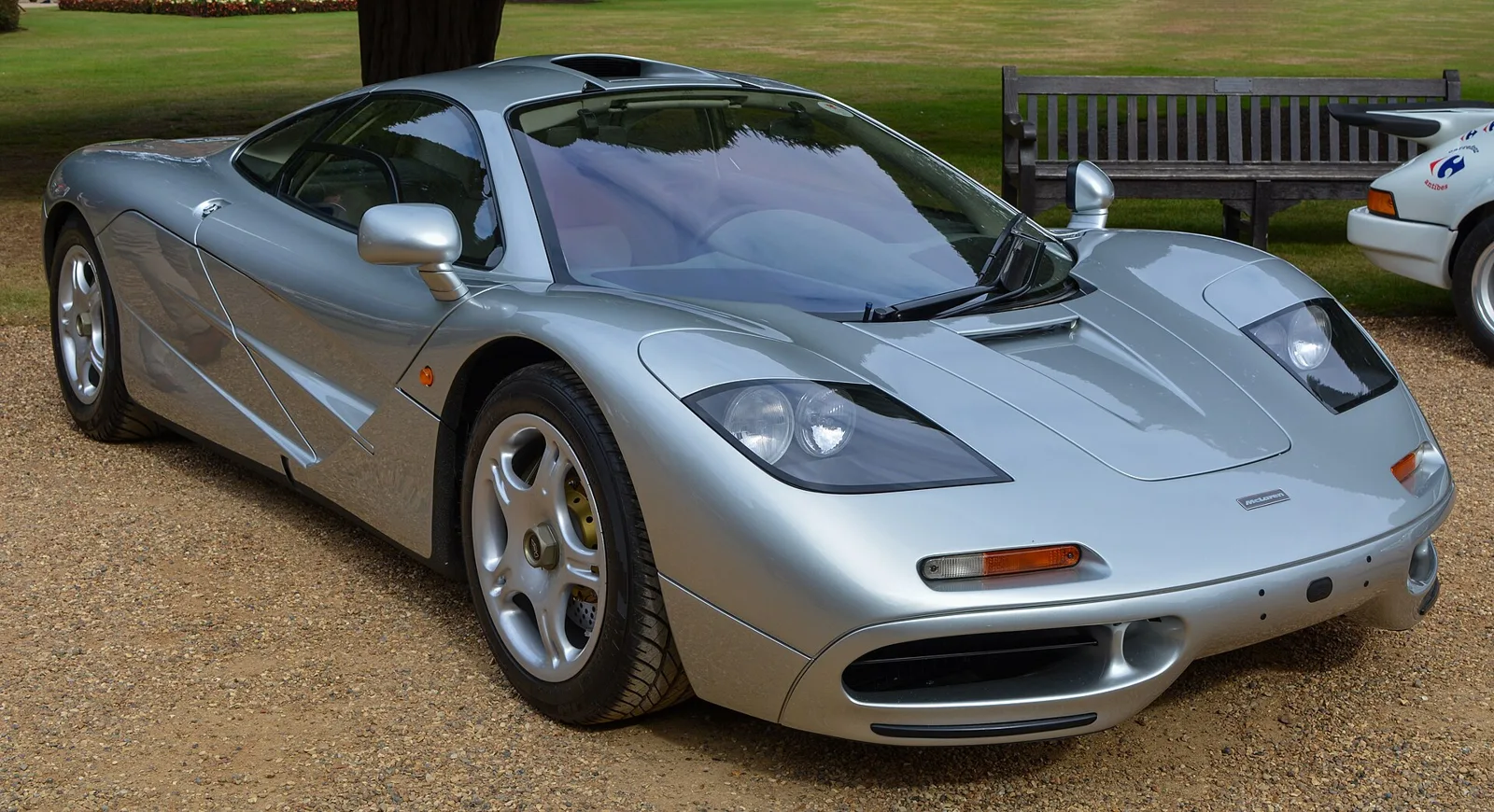
Because it gives the best view of the road. The driver's seat sits at the centre of the car, in front of both the fuel tank and the engine, with two passenger seats set slightly behind on either side. The layout gives the driver improved visibility, and the car still carries three adults.
The doors swing up and out in the butterfly or dihedral style, a design Murray took from the Toyota Sera. Before the first cars were built, McLaren tested components in two Ultima MK3 kit cars, nicknamed "Albert" and "Edward". One carried a 454 (7.4 L) Chevrolet V8 to test the gearbox, seats and brakes; the other tested the V12, exhaust and cooling system. McLaren destroyed both afterwards, to keep away specialist magazines and avoid any association with kit cars.
Why is the McLaren F1 engine bay lined with gold?
Heat. The engine of a fast car is a furnace, and the F1's carbon-fibre body panels and monocoque needed strong thermal insulation around it. Murray's answer was a highly efficient heat reflector: gold foil, about 16 g of it in every car.
The engine itself took some finding. Murray insisted on natural aspiration, arguing that turbochargers and superchargers add power but also complexity, lag and a loss of feedback that undermine reliability and the driver's control. He first approached Honda, asking for a unit rated at 410 kW (550 hp; 557 PS), 600 mm (23.6 in) long in the block and weighing 250 kg (551 lb), derived from the Formula One engine in the dominant McLaren-Honda cars. Honda refused, and Murray has said he also asked it, without success, for a 4.5-litre V10 or V12. Isuzu showed interest with a 3.5-litre V12 under test in a Lotus chassis, but the designers wanted a proven design with a racing pedigree.
That led to BMW. Its motorsport division, BMW M, headed by the engine expert Paul Rosche, designed and built the 6,064 cc 60-degree V12 called the BMW S70/2, an engine made specifically and exclusively for the F1. It produced 461 kW (618 hp; 627 PS) and weighed 266 kg (586 lb), which made it 14% more powerful and 16 kg (35 lb) heavier than Murray's brief, with the same block length. BMW first tried the engine in an E34 M5 Touring, a secret revealed years later by David Clark, McLaren's director of road and race cars from 1994 to 1998.
The details show how far the engineers went. The block and heads are aluminium alloy, the bore and stroke measure 86 mm by 87 mm, and there are four valves per cylinder with variable valve timing, then a fairly new technology. At higher revs the valve overlap grows to 42 degrees, against 25 degrees on the BMW M3 system it was based on. Each cylinder has two Lucas injectors, one near the inlet valve for low revs and one higher up the intake for high revs, with the engine computer handling the hand-over. The cylinder bores carry a Nikasil coating, the pistons are forged aluminium, and the cam carriers, covers and sump are magnesium castings. It runs a dry sump, and the engine has no knock sensor, because the expected combustion conditions would not call for one.
On the road, the engine runs an 11:1 compression ratio and produces its 461 kW (618 hp; 627 PS) at 7,400 rpm, with 650 N m (479 lb ft) arriving at 5,600 rpm. The rev limiter is set at 7,500 rpm. The standard car achieves 550 hp/ton (403 kW/tonne), and fuel consumption averages 15.2 mpg (15 L/100 km), ranging from 9.3 mpg (25 L/100 km) at worst to 23.4 mpg (10 L/100 km) at best.
What is a carbon-fibre monocoque, and why does it matter?
Think of a monocoque as a single hard shell that does the work of both frame and body, rather than a skeleton with panels hung on it. The F1 was among the first road cars to use a monocoque made wholly of carbon fibre reinforced polymer (CFRP). Aluminium and magnesium mounting points for the suspension were set directly into the carbon. Murray's recipe was the oldest one in performance cars, little weight and plenty of power, and it called for costly materials such as titanium, kevlar, magnesium and gold as well as carbon. The result is lighter and more streamlined than many later rivals, despite seating three adults.
The engine bay is the exception. CFRP becomes mechanically stressed over time by heat transfer, and an engine swings from cold to full load, so that part of the car was not made from carbon fibre.
Aerodynamics followed the same logic. The standard F1 has a drag coefficient of 0.32, against 0.36 for the faster Bugatti Veyron and 0.357 for the SSC Ultimate Aero TT, the fastest production car from 2007 to 2010. Its frontal area figure is 1.79 square metres (19.3 sq ft). Those numbers describe the most streamlined configuration, because the F1 has active aerodynamics. The road car has no fixed wing. Instead the underbody and a rear diffuser exploit ground effect, and two electric Kevlar fans pull the pressure under the car down further. A driver can switch a high downforce mode on and off. The fans' airflow is also routed through the engine bay to cool the engine and its computer.
How fast is the McLaren F1? McLaren F1 top speed
The XP5 prototype made the 240.1 mph (386.4 km/h) run on 31 March 1998, with its rev limiter modified. It beat the Jaguar XJ220's 217.1 mph (349.4 km/h) from 1992, a mark achieved with a raised rev limit and the catalytic converters removed.
The reviews were glowing. In its 1994 road test Autocar judged the F1 the best driver's machine ever made for public roads, and suggested nothing built for the road might ever beat it for speed. In 2005 Channel 4 put it at number one on its list of the 100 greatest cars. In April 2017 Top Gear ranked it with the quickest naturally aspirated cars on sale, level with newer machines like Ferrari's Enzo and Aston Martin's One-77, even though it was engineered 10 years before the Enzo and 17 before the One-77.
How safe was the McLaren F1, and what went wrong at its launch?
The car was first unveiled at The Sporting Club in Monaco on 28 May 1992. Production cars matched the XP1 prototype except for the wing mirror, which sat at the top of the A-pillar on the prototype. That version had no front indicators and was judged not road legal, so McLaren had to change it. The original mirrors incorporated indicators, a feature other makers adopted years later, and some cars, including Ralph Lauren's, went back to McLaren to be fitted with the prototype mirrors.
Safety was proved in dramatic fashion. In April 1993, during testing in Namibia, a driver in nothing but shorts and a T-shirt struck a rock and rolled the first prototype repeatedly, then climbed out unharmed. The second prototype, XP2, was built later that year purely for crash tests, and it came through with its front wheel arch intact.
How did the McLaren F1 win Le Mans?
Murray never meant it to race. He saw the F1 as a road car first, with no racing version intended. The BPR Global GT Series changed that, starting in the 1994 season. Teams run by Ray Bellm and Thomas Bscher saw potential in the road cars, and the Le Mans winner John Nielsen persuaded Murray to offer factory backing. Murray relented and agreed to build several chassis for 1995.
Because the F1 already resembled a race car, little needed changing. McLaren added cooling ducts, a large adjustable rear wing, a stripped interior with a full racing cage and carbon brakes. Series rules forced an air restrictor on the BMW engine, limiting output to around 600 PS (592 hp; 441 kW), so the racing car had less power than the road car, though lower weight made it faster and more nimble. Even the 1995 cars made enough downforce to run along a ceiling at 100 mph. Central seating, butterfly doors and the standard gearbox stayed.
Nine chassis were built for 1995. In the BPR season opener at Jerez, F1 GTRs took the first three qualifying places and won by 16 seconds. At Le Mans the Kokusai Kaihatsu car won overall in very wet conditions, beating faster purpose-built prototypes. West Competition took the teams championship that year.
The 1996 cars were upgraded with longer bodywork, a lighter magnesium gearbox housing and a weight cut of 38 kg. For 1997, with rules changed for the new FIA GT Championship, McLaren built the long-tail GTR, with a stroke reduction that took the V12 to 5,990 cc and a six-speed sequential gearbox. To be allowed to build such a radical car, the company had to make road cars with the same bodywork, known as the F1 GT, a run of just three. Porsche's 911 GT1 and then Mercedes-Benz's CLK-GTR overtook the McLaren, BMW left at the end of 1997, McLaren withdrew factory backing for 1998, and the GT1 class was abolished after that season. The last F1 GTR race chassis retired in 2005, ending its international career.
| Car at Le Mans | Year | Top speed on the Mulsanne Straight |
|---|---|---|
| McLaren F1 GTR | 1995 | 281 km/h (174.605 mph) |
| McLaren F1 GTR | 1996 | 330 km/h |
| McLaren F1 GTR Long Tail | 1997 | 317 km/h (196.97 mph) |
| Nissan R390 GT1 | 1997 | 319 km/h (198.22 mph) |
| TWR Porsche Joest LMP | 1997 | 320 km/h (198.84 mph) |
| Porsche 911 GT1 Evo | 1997 | 326 km/h (202.57 mph) |
Team Lark, running two 1996-spec cars in Japan's GT500 class, won four rounds and beat factory squads from Toyota and Nissan to the teams title.
Who owned a McLaren F1, and what is it like to own one?
The owners' list runs from Rowan Atkinson, Jay Leno and Nick Mason to Ralph Lauren, Elon Musk, Lewis Hamilton, George Harrison and the Sultan of Brunei, Hassanal Bolkiah. The Sultan also bought the last chassis of the 1995 GTR run, number 09R, for his collection.
Only 106 cars were made in total, and that includes the three F1 GT road cars. The ride quality target came from the NSX, the engine is naturally aspirated by choice, and the high downforce mode is under the driver's control.
Where this goes next
Murray left McLaren and founded the Gordon Murray Design consultancy, which was established in July 2007, and in 2017 the specialist car maker Gordon Murray Automotive, which now sits inside the Gordon Murray Group. The T.50 was announced by Gordon Murray Automotive on 4 August 2020, and the company calls it the "logical successor" to the McLaren F1. The car incorporates the fan car concept from the Brabham BT46B and, according to the company, went into production in 2022. On 27 January 2022 it announced the T.33, a twin-seater sports car with the same engine as the T.50, built on a new platform intended for three further cars.
The group added Gordon Murray Special Vehicles in 2025 and announced two supercars, called the Le Mans GTR and the S1 LM. In Las Vegas, at the Grand Prix on 21 November 2025, the first S1 LM went under the hammer for $20.63 million.
Murray himself has collected honours along the way: a CBE in the 2019 New Year Honours, the inaugural FIA President's Innovation Medal in 2022, and the BBC Top Gear Lifetime Achievement Award in 2024.