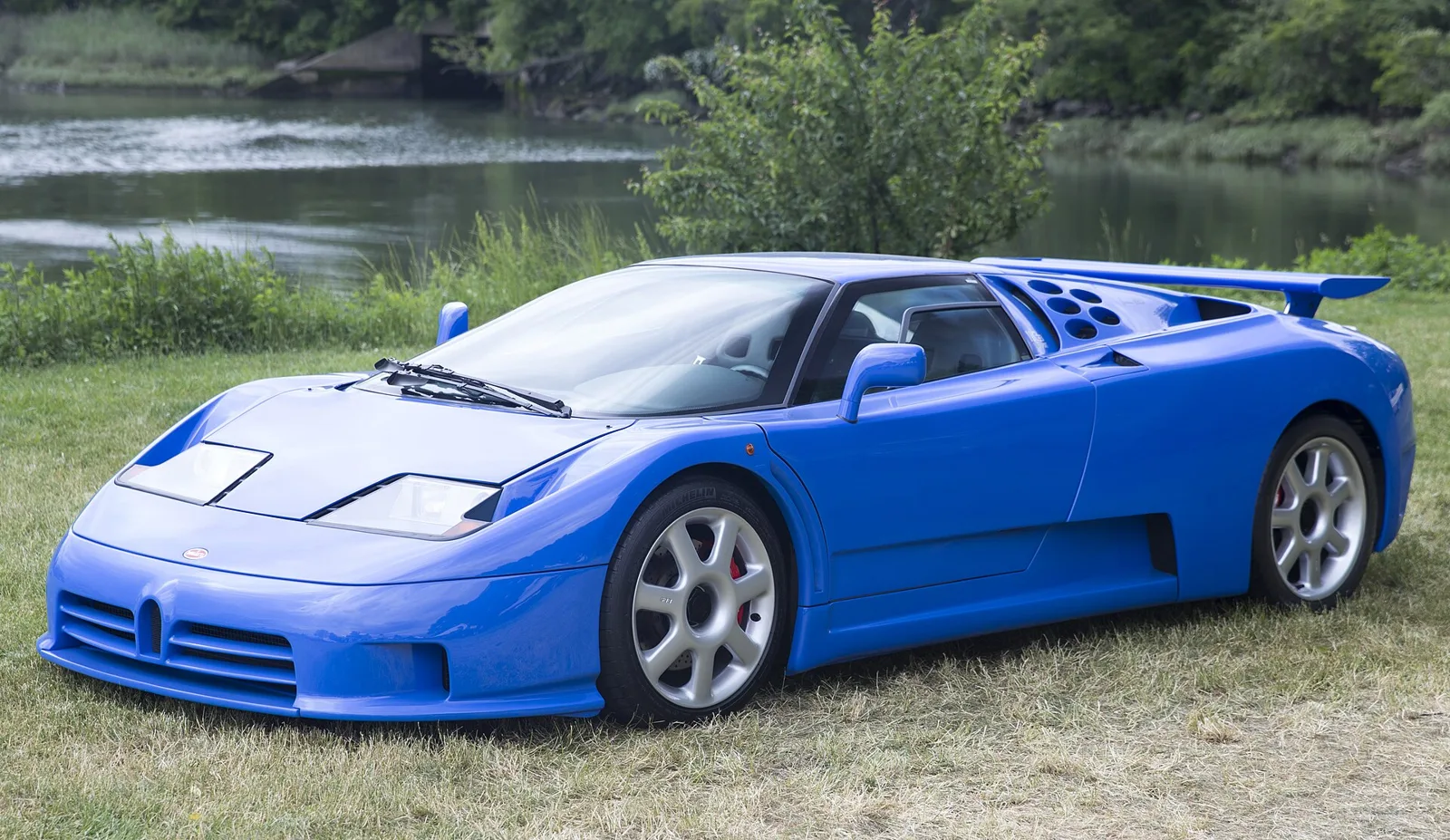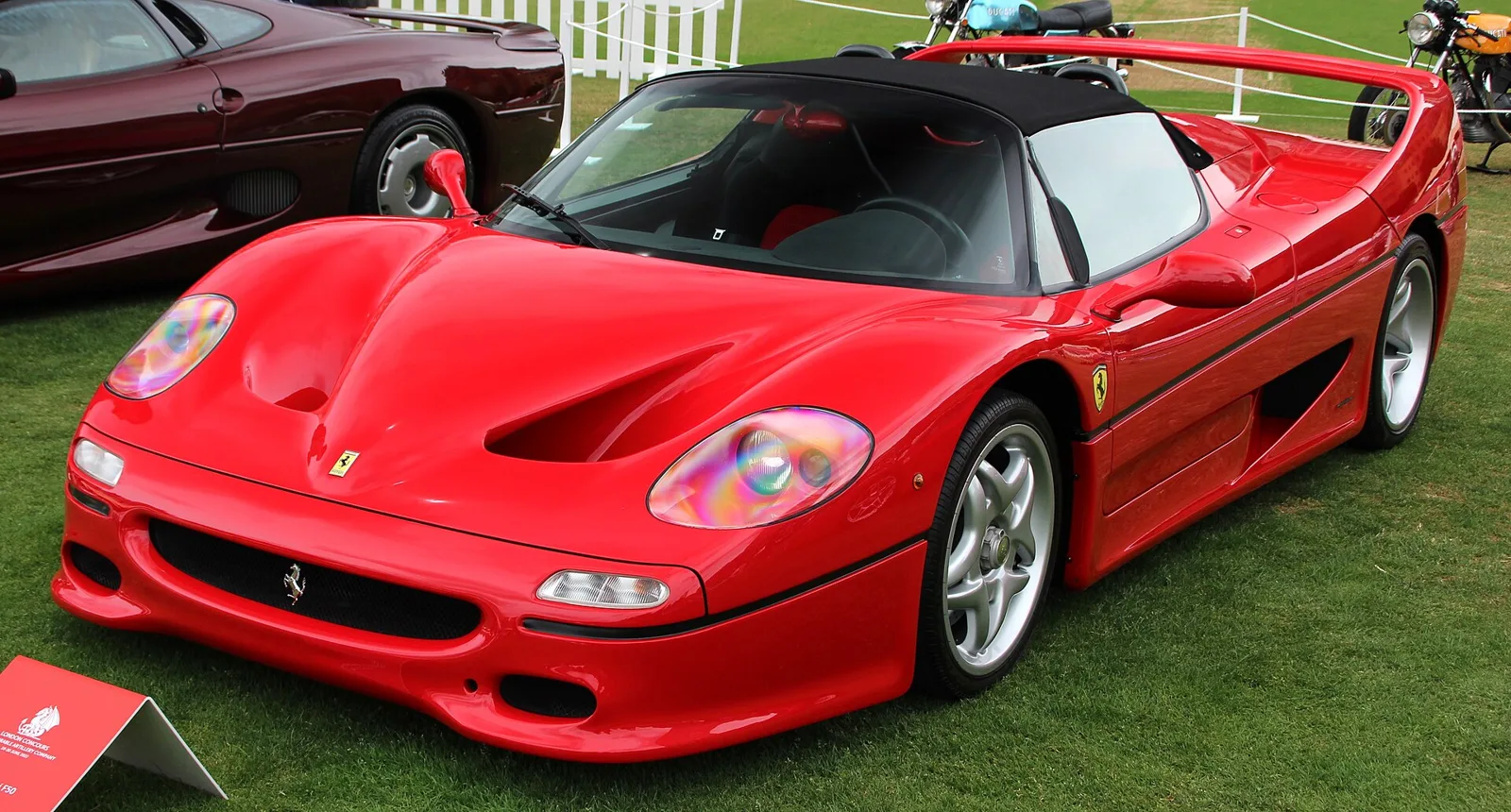
Both used V12 engines and Formula One thinking, but McLaren's F1 went further in weight, layout and speed records than Ferrari's limited-run F50.
The Ferrari F50 was a limited-production mid-engined V12 sports car built from 1995 to 1997, with 349 made. The McLaren F1 was a three-seat carbon-fibre sports car built from 1992 to 1998, with 106 cars and a 240.1 mph production speed record.
The Ferrari F50 and the McLaren F1 were both limited-production supercars that drew on Formula One thinking, and both used a naturally aspirated V12. The F50 was a targa-topped two-seater built in 349 examples, while the F1 was a three-seat carbon-fibre car built in 106 examples. Set side by side, they show two very different interpretations of what a 1990s road supercar should be.
How did the two cars come about?
The F50 grew out of the 1989 Ferrari Mythos concept car, and its design was an evolution of that show car. Pininfarina added cues from contemporary Formula One cars, particularly at the front, and the car was built from 1995 until July 1997.
The F1 began with a concept by Gordon Murray, the chief technical designer who had long imagined a three-seat sports car. He sketched the idea while waiting for a flight home from the 1988 Italian Grand Prix and pitched it to Ron Dennis, who backed the venture.
McLaren created a road car company to build the F1, which later became McLaren Automotive. The car was unveiled at a launch show in Monaco on 28 May 1992, and the production run ran until 1998.
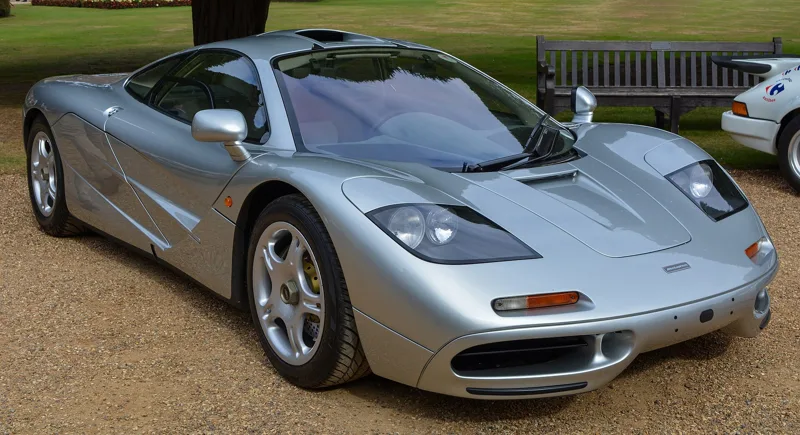
Two 1990s supercars with V12 power, one a Ferrari two-seater and one a McLaren three-seater that set the production speed record.
What engines did the two cars use?
The F50's 4.7-litre naturally aspirated V12 was developed from the 3.5-litre V12 of the 1990 Ferrari 641 Formula One car. It produced 382 kW (520 PS; 513 hp) at 8,500 rpm with torque of 471 N m (347 lb ft) peaking at 6,500 rpm.
The F50's engine had five valves per cylinder, with a variable-length intake manifold and variable exhaust valves controlled electronically. The engine had been used in the 333 SP for the IMSA GT Championship in 1994, which made it eligible for a stock-engine category.
The F1's 6,064 cc BMW S70/2 V12 produced 461 kW (618 hp; 627 PS) at 7,400 rpm and 650 N m (479 lb ft) of torque at 5,600 rpm. Murray insisted on naturally aspirated power for reliability and driver control, and he first approached Honda for an engine before BMW took up the task.
The F1's engine bay was lined with gold foil, which served as a heat reflector because the carbon fibre body could not tolerate the temperatures. Roughly 16 g of gold went into each car, which shows the scale of the thermal challenge.
How did the two cars handle and weigh?
The F50 had a central carbon fibre tub with light-alloy suspension mountings, a six-speed manual gearbox and electronic adaptive damping. Its front and rear wishbones were unequal length, and electronic height adjustment could raise or lower the car by up to 40 mm.
The F1 was among the first production cars with a complete carbon-fibre monocoque, which made it lighter and more streamlined than many later rivals. Its driver sat in the middle, with passenger seats slightly behind on each side, and its doors moved up and out in a dihedral action.
The F1's drag coefficient of 0.32 compared with 0.36 for the Bugatti Veyron, and its frontal area gave a streamlined figure. The car's low weight and shape were balanced carefully, and the result was a supercar that could be driven with precision.
How fast were the two cars?
The F50 was claimed to reach 325 km/h (202 mph). Its 0 to 60 mph time was 3.8 seconds, 0 to 100 mph took 8.5 seconds, and the quarter mile was covered in 12.1 seconds at 123 mph.
The F1 set the Guinness record for the fastest production car on 31 March 1998, when a modified prototype reached 240.1 mph (386.4 km/h). That surpassed the Jaguar XJ220's 217.1 mph (349.4 km/h) record from 1992.
The F50's braking from 70 mph to a stop took 176 ft (54 m), and its skidpad figure was 0.95 g. Its Fiorano lap of 1:27.00 was a benchmark for the car's handling on a familiar Ferrari track.
How did the two cars perform in competition?
The F50 GT was a racing derivative for the BPR Global GT Series, with a fixed roof, a large rear wing and a tuned V12 said to make around 750 bhp. Ferrari cancelled the project after the series folded and turned its attention to Formula One.
The F1 was not designed as a racing car, but modified racing versions won several races, including the 1995 24 Hours of Le Mans. It was the last road-legal series-production sports car to win Le Mans outright.
The F1's competition record is one of its most celebrated achievements, because it showed that a road car could win at the highest level of endurance racing. The F50 never reached the same level of outright achievement in competition.
How did critics and owners respond to the two cars?
Autocar's 1994 road test judged the F1 the finest driving machine yet built for the public road. Channel 4 placed the car first among its 100 greatest cars in 2005, and owners have included Lewis Hamilton, Elon Musk and Jay Leno.
The F50 is remembered mainly as a Ferrari showpiece, and its colour choices showed the pull of the marque's famous red. Of the 349 cars built, 302 were finished in Rosso Corsa.
The contrast in reception reflects the cars' different roles. The F1 was celebrated as a bold engineering statement, while the F50 was valued as the next step in a long line of Ferrari supercars.
How do the two cars compare side by side?
| Feature | Ferrari F50 | McLaren F1 |
|---|---|---|
| Production | 349 cars, 1995 to 1997 | 106 cars, 1992 to 1998 |
| Engine | 4.7 L naturally aspirated V12 | 6.1 L BMW S70/2 V12 |
| Output | 382 kW (520 PS; 513 hp) | 461 kW (618 hp; 627 PS) |
| Torque | 471 N m (347 lb ft) at 6,500 rpm | 650 N m (479 lb ft) at 5,600 rpm |
| Chassis | Carbon fibre central tub | Complete carbon-fibre monocoque |
| Seating | Two seats | Three seats, driver in the centre |
| 0 to 60 mph | 3.8 seconds | Not given |
| Top speed | 325 km/h (202 mph) claimed | 240.1 mph (386.4 km/h) prototype record |
| Drag coefficient | Not given | 0.32 |
How did the F50's chassis and electronics work?
The F50's central carbon fibre tub used a sandwich construction with a Nomex honeycomb core. The light-alloy suspension and engine-gearbox mounting points were bonded directly to the chassis, which kept the structure stiff without much weight.
Electronic adaptive damping responded to steering angle, body acceleration, brake pressure and speed. Its average reaction time from minimum to maximum damping was between 25 and 30 milliseconds, which made the car feel responsive on rough roads and smooth ones alike.
The steering was an unassisted TRW rack and pinion with 3.3 turns lock to lock, and the turning circle was 41 ft (12 m). The brakes were cross-drilled Brembo discs with aluminium calipers, and they were fitted without ABS.
What did the F1's aerodynamics and access add to its character?
The F1 used dihedral doors that moved up and out, a design inspired by the Toyota Sera. The arrangement allowed entry and exit in a compact cabin with three seats.
Its active aerodynamics were quoted in their most streamlined configuration, with a frontal area of 1.79 square metres (19.3 sq ft) and an S-Cd figure of 0.57. Those numbers show how carefully the body was shaped around the car's weight and cooling needs.
BMW's team considered variable intake geometry for the V12 but rejected it as unnecessary complication. That decision kept the engine simpler, although the engineers still used variable valve timing on the camshafts.
What did the F50 GT and the F1 GTR add to their families?
The F50 GT tuned its 4.7-litre V12 to around 750 bhp and carried a fixed roof and a large rear wing. The car was co-developed with Dallara and Michelotto, and it was built to compete in the BPR Global GT Series.
Ferrari planned six chassis for the F50 GT but only three were completed, and two of those had bodies fitted before they were sold. The remaining three tubs were reportedly destroyed.
A 1996 test showed the F50 GT to be quicker than the 333 SP, but the project was cancelled because the FIA allowed homologation specials such as the Porsche 911 GT1 into the new championship. Ferrari then focused on Formula One.
How did McLaren's approach to the F1 differ from Ferrari's?
McLaren's F1 was a clean-sheet car built around the racing team's experience. Gordon Murray set out to create the ultimate road-going sports car, and he drew on what the team had learned from its Formula One programme.
Ferrari's F50 was an evolution of an existing concept, and its engine was a road-going derivative of a racing unit. That kept its development closer to the factory's racing history than the F1's broader ambition.
McLaren built two Ultima MK3 kit cars as test mules before the first F1 was finished. One tested the gearbox with a Chevrolet V8 and the other tested the V12, and both were destroyed once the work was complete.
Which buyer suits each car?
On the facts given, the F50 suits a buyer who wanted a Ferrari V12 with Formula One influence and a targa-top body. The F1 suits a buyer who wanted an extreme, three-seat supercar with McLaren's racing heritage.
F50 owners had a car with a foam-filled fuel tank built around an aeronautical-style rubber bladder, and its fuel economy was modest at 8 mpg-US combined on the EPA cycle. The car's variable intake and exhaust valves gave it a strong, responsive powerband.
F1 buyers got a distinctive three-seat layout and butterfly doors, along with a carbon monocoque that was among the first in a production car. Its gold-lined engine bay and BMW V12 added to its reputation for extremes.
Neither car is shown to be better overall, and no direct price comparison is given. The choice depends on whether a buyer wants a Ferrari V12 with a racing lineage or a McLaren three-seater with a record-setting pedigree.