A naturally aspirated 4.7-litre V12, a carbon fibre chassis and a racing derivative that was cancelled before it could compete.
The Ferrari F50 was a limited production mid-engined two-seat targa built from 1995 to 1997. It used a naturally aspirated 4.7-litre V12 producing 382 kW (520 PS; 513 hp), a carbon fibre chassis and a six-speed manual. Only 349 cars were made.
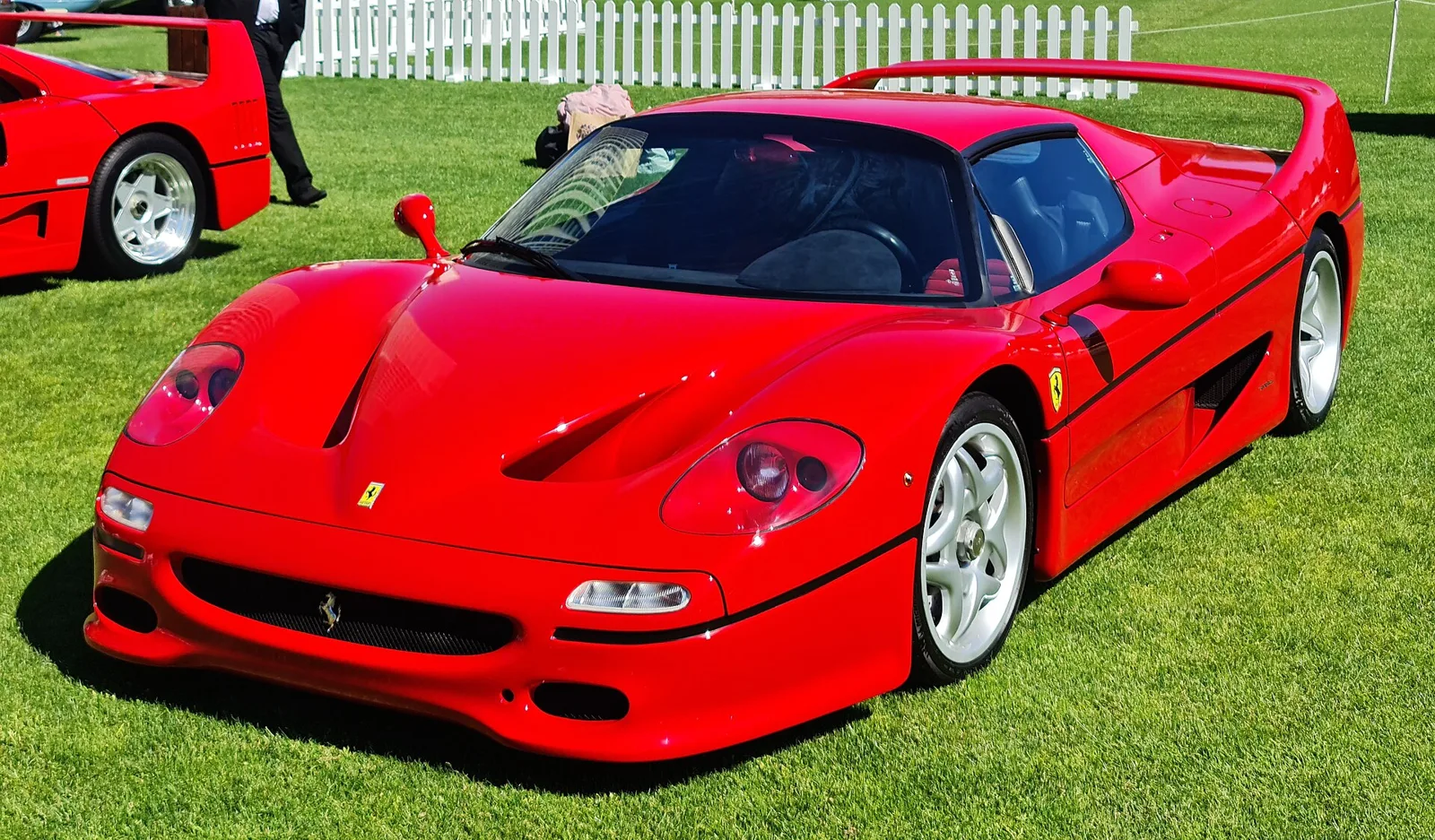
The Ferrari F50 is a two-seat, targa-top mid-engined sports car that Ferrari built in a limited run from 1995 to 1997. Its headline component is a naturally aspirated 4.7-litre (286.7 cu in) V12, and the chassis is built around a carbon fibre tub. Only 349 examples were produced, and the car is remembered as Formula One thinking applied to a road-going Ferrari.
Where did the Ferrari F50 come from?
The F50 grew out of the 1989 Mythos concept car, and its design evolved from that show car rather than starting from a blank sheet. Pininfarina added front-end cues borrowed from contemporary Formula One racecars. Production began in 1995, and the last car rolled off the line in July 1997.
Introduced in 1995 as a two-door, two-seat targa, the F50 was styled so that its nose carried a clear visual link to the racing cars of the day. The nose therefore reads as racing hardware, even on a public road.
The engine is older than the car. It was used first in the Ferrari 333 SP, which raced in the American IMSA GT Championship in 1994. That early use qualified the unit for the World Sports Car class with stock engines, and it gave Ferrari a proven base before the road car was launched.
The engine had roots in Formula One as well. It grew from the 3.5-litre unit that powered Ferrari's 641 F1 machine in 1990, which ties the road machine to the racing programme of the early 1990s.
A naturally aspirated 4.7-litre V12 in a carbon fibre chassis, and only 349 cars ever built.
What engine powered the F50?
The F50 used a 4.7-litre (286.7 cu in) naturally aspirated V12 with 60 valves, producing 520 PS (382 kW; 513 hp) at 8,500 rpm. Peak torque is 471 N-m (347 lb-ft), arriving at 6,500 rpm, and the engine redlined at 8,500 rpm. The unit was a development of the 3.5-litre V12 from the 1990 Formula One car.
The V12 is mounted longitudinally behind the seats with a 65 degree bank angle. Its bore and stroke measure 85 mm x 69 mm, which makes the engine oversquare at 1.23:1. The compression ratio is 11.3:1, and the displacement is 4,698.50 cc.
Engineers saved weight throughout the power unit. The connecting rods are forged titanium, the intake manifold is carbon fibre and the pistons are forged Mahle parts. The complete engine weighs 198 kg (437 lb), and its dry sump uses three scavenger pumps to keep oil moving through the unit at high revolutions.
Breathing was variable. A butterfly valve in the carbon fibre intake manifold changes the airflow with engine speed, and butterfly valves in the upper tailpipes do a similar job on the exhaust side. The exhaust valves open at high rpm, which lets the engine adjust its breathing across the rev range.
Taken as a unit, the engine pairs a high redline with an 11.3:1 compression ratio and a dry sump, which together describe a high-revving and carefully managed power unit.
Electronics handled the whole package. A Bosch Motronic 2.7 unit manages fuel feed, ignition timing and the variable intake, so the driver is not asked to make those decisions. The engine redlines at 8,500 rpm, and fuel is cut at 8,640 rpm if the driver keeps pushing past that point.
Each bank runs double overhead camshafts driven by a low-noise Morse chain.
How was the chassis and suspension built?
The F50 used a central carbon fibre tub with a Nomex honeycomb core, and light-alloy suspension mounting points were built into the structure. Torsional stiffness is rated at 25,500 lb-ft per degree, or 34,570 N-m for the metric figure. Electronic adaptive damping and height adjustment, up to 40 mm, completed the setup.
The body panels use the same construction. Carbon fibre is laid over a honeycomb core, which keeps them light.
Taken together, the tub, the suspension and the wheel package describe a car built as a single system. Each part was chosen to suit a mid-engined layout, and the figures for stiffness, damping and grip all point the same way.
Suspension damping is electronic. Bilstein gas monotube dampers adjust their force as conditions change, and the maximum change from minimum to maximum damping takes 140 milliseconds. The average change takes between 25 and 30 milliseconds, and the system also adjusts ride height by up to 40 mm.
Weight sits 42% at the front and 58% at the rear, so slightly more load falls on the rear wheels, as expected for a mid-engined car. Steering is an unassisted TRW rack and pinion, and the wheel needs 3.3 turns from lock to lock.
The wheels are Speedline magnesium alloys mounted on titanium hubs. The front tyres measure 245/35ZR-18 and the rears 335/30ZR-18, both made by Goodyear. Rear pressure is set at 30 psi (210 kPa).
Braking uses Brembo cross-drilled, ventilated discs with four-piston calipers. The car came without ABS.
Drive goes to the rear wheels through a six-speed manual with a limited-slip differential and a dry, twin-plate clutch. The final drive ratio is 3.70:1.
The fuel tank holds 105 L, which is 28 US gallons or 23 imperial gallons. It is foam filled and fitted with a Sekur rubber bladder.
How fast was the Ferrari F50?
The F50 took 3.8 seconds to reach 97 km/h (60 mph) and 8.5 seconds to reach 161 km/h (100 mph). Across the quarter mile the car needed 12.1 seconds, and its claimed top speed was 325 km/h (202 mph). The skidpad figure was 0.95 g.
Braking from 70 mph to a standstill covered 54 m (176 ft). The maximum roll angle is 1.5 degrees.
A skidpad reading of 0.95 g shows the grip the tyres could develop on a flat circle. Read alongside the braking distance, it gives a fair picture of how the car behaved at the limits of grip and under heavy braking.
Track times show a car that was at home on circuits. Recorded laps include 1:05.81 at Tsukuba, 1:38.573 at Sugo, 1:27.00 at Fiorano and 2:25.525 at Suzuka in 2000.
On the EPA combined cycle the car is rated at 29 L/100 km (8 miles per US gallon).
Each lap time was recorded on a different circuit, so the set is best read as a general measure of the car's pace rather than a direct ranking of one track against another.
What was the F50 GT?
The F50 GT was a racing derivative designed for the BPR Global GT Series, co-developed with Dallara and Michelotto. Its race engine was tuned to around 750 brake horsepower (760 metric hp; 559 kW), and the body swapped the targa roof for a fixed one. Ferrari cancelled the project for lack of funding after the series folded.
The racing version followed the motorsport theme that Ferrari had set with the F40 LM. Its 4.7-litre V12 was tuned for competition, peaking at 10,500 rpm, and its torque reached 520 N-m (380 lb-ft) only at 7,500 rpm.
The GT body also gained a large rear wing and a new front spoiler, changes that set it apart from the road car at a glance.
In testing in 1996, the GT proved quicker than the 333 SP, the sports prototype that had used the same V12 before the road car existed. The project was cancelled after the series folded, and funding was not available to compete.
Ferrari's frustration with the FIA played a part as well. The company objected to the Porsche 911 GT1 and similar homologation specials joining the GT Championship, and it chose to concentrate its effort on Formula One instead.
Six chassis were planned. The three complete chassis, numbered 001, 002 and 003, were sold, and chassis 002 and 003 were fitted with bodies before sale. The remaining three tubs were reportedly destroyed, so only a small number of racing F50s ever existed.
The GT story is a reminder of how closely Ferrari tied its road cars to its racing programmes. The same V12 began life in a sports prototype before it reached a road car, and the GT project was an attempt to run that process in the other direction.
How many F50s were built and in what colours?
A total of 349 F50s were built, with production running from 1995 until the final car left the line in July 1997. Rosso Corsa red was by far the most common choice at 302 cars. Giallo Modena yellow followed with 31, and the rest were split between Rosso Barchetta, Argento Nurburgring and Nero Daytona.
Rosso Barchetta, a dark red, was chosen for 8 cars. Argento Nurburgring silver and Nero Daytona black each accounted for 4 cars, which gives a neat total when the five colours are added together.
Each of the five finishes is listed separately in the production figures, so the colour split can be checked against the total. The five colour counts add up to the full run of 349 cars. Yellow was the second most popular choice, while the two rarest finishes each accounted for only 4 cars.
What are the Ferrari F50 specifications?
The table lists the core figures for the road-going F50, covering its V12, six-speed gearbox and claimed performance. The racing F50 GT is covered in the body text above, so its competition tune does not blend with the road car numbers.
| Specification | Detail |
|---|---|
| Type | F130, mid-engined two-seat targa |
| Built | 349 cars, 1995 to 1997 |
| Engine | 4.7-litre (4,698.50 cc) naturally aspirated V12 |
| Bore and stroke | 85 mm x 69 mm, oversquare at 1.23:1 |
| Compression ratio | 11.3:1 |
| Power | 520 PS (382 kW; 513 hp) at 8,500 rpm |
| Torque | 471 N-m (347 lb-ft), reached at 6,500 rpm |
| Engine weight | 198 kg (437 lb) |
| Gearbox | 6-speed manual, rear-wheel drive, limited-slip differential |
| Final drive | 3.70:1 |
| Sprint to 60 mph (97 km/h) | 3.8 seconds |
| Sprint to 100 mph (161 km/h) | 8.5 seconds |
| Quarter mile | 198 km/h (123 mph) at the line, in 12.1 seconds |
| Claimed top speed | 325 km/h (202 mph) |
| Combined fuel use | 29 L/100 km (8 miles per US gallon), EPA |
| Fuel tank | 105 L, or 28 US gallons and 23 imperial gallons |
Frequently asked questions
How much power did the F50 make?
Output is rated at 520 PS, or 382 kW and 513 hp, at 8,500 rpm. Torque is rated at 471 N-m (347 lb-ft), reached at 6,500 rpm. The engine is naturally aspirated, so no forced induction is involved.
How much does the F50 engine weigh?
The V12 weighs 198 kg (437 lb). Across the whole car, weight is split 42% to the front and 58% to the rear, which reflects where the engine sits.
Did the F50 have anti-lock brakes?
No. The Brembo discs are cross-drilled and ventilated, clamped by four-piston calipers, and the car was built without ABS.
How much fuel does the F50 carry?
Capacity is 105 L, or 23 imperial gallons. The tank is foam filled and uses a Sekur bladder.
How many F50 GT chassis were built?
Six chassis were planned. Three complete chassis were sold, and the remaining three tubs were reportedly destroyed.