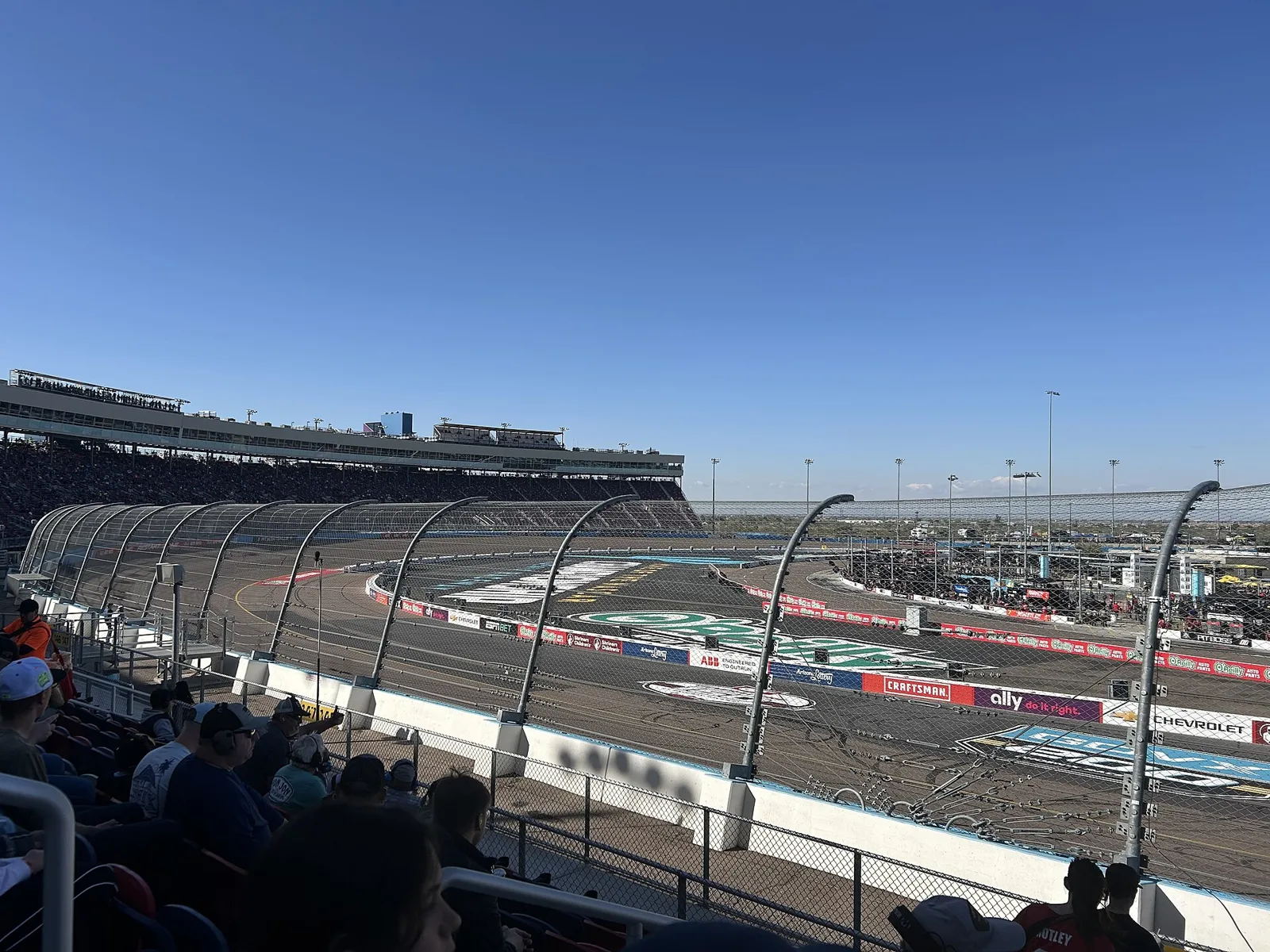
An Arizona venue that opened in 1964, kept its famous dogleg through several rebuilds and has been owned by NASCAR since 2019.
Avondale, Arizona is home to a 1 mi (1.6 km) dogleg oval that opened in January 1964. The track has hosted USAC, CART, IndyCar and NASCAR racing, and NASCAR has owned it since 2019. Its frontstretch kink, called the dogleg, is the best-known feature of the layout.
Phoenix Raceway is a 1 mi (1.6 km) dogleg oval in Avondale, Arizona, that opened in 1964 and has been through many owners. Its frontstretch kink, known as the dogleg, is the track's most recognisable feature. Today the facility hosts two NASCAR weekends a year and is owned by the sanctioning body itself.
Where is Phoenix Raceway and what is its shape?
Phoenix Raceway sits in Avondale, Arizona, and is served by Avondale Boulevard, an exit off Interstate 10. The oval is banked 9 degrees in its first two turns and 11 degrees in its last two, with 9 degrees on the frontstretch and 3 degrees on the backstretch.
A dogleg that caused arguments for decades is still the track's most recognisable feature.
Who first built Phoenix International Raceway?
In July 1963, a group led by businessman Richard Hogue bought 320 acres of former cotton land in the Estrella Mountains. The original plan was a $500,000 complex with a 1.000 mi (1.609 km) oval, a road course and a dragstrip, but Hogue was persuaded to add the oval by racing promoter J. C. Agajanian.
Groundbreaking took place on September 19, 1963. The complex cost about $1 million, and the opening was pushed back to January 4, 1964 because of construction delays. By the end of the year the facility had been approved for SCCA, USAC and National Hot Rod Association events.
When did Phoenix Raceway first open?
The track opened in January 1964 with informal Sports Car Club of America events, and the first formal events followed in February. A month later, Jack Hinkle won the first highlight race on the road course, and the oval's first race came 21 days after the drag strip opened on March 1.
The early reception was mixed. Amenities were praised, but fans complained about a 50-cent grandstand fee and about light poles that blocked the view.
What were the early years like?
The first decade brought serious accidents. The dragstrip recorded its first fatality when Robert Snyders crashed during a qualifying run on opening day for drag events. Bobby Marshman died of burns after a tire test crash in November 1964, and in 1967 a 13-year-old suffered major head injuries in a go-kart race on site.
Attendance was a constant struggle. Within a year the operators were replaced, and the facility invested in a refurbished grandstand and 2,000 new seats by the end of 1965.
Why does Phoenix Raceway have a dogleg?
The dogleg was added to fit the original road course, which used parts of the oval as well as specialised sections outside it. The corner was controversial from the start. In 1968 Agajanian called it dangerous, and a backstretch reconfiguration was announced, though a historian later disputed whether it was ever carried out.
The dogleg stayed. In 2003 it was widened for safety and to create more passing opportunities, and the turn two wall was extended to enclose the track. In 2011 the dogleg was pushed out by 95 feet (29 m) during a repave, and the apron beneath it was paved over.
How did ownership change over the years?
Richard Hogue and his wife Nancy owned the track in its early years, and Nancy became sole owner by 1967. Racing promoter Agajanian took over promotion, and a lawsuit followed over the duo's spending. In 1973 the track was rebranded FasTrack International Speedway under Malcolm Bricklin's General Vehicle, but the company fell into bankruptcy in 1976.
A group led by Bob Fletcher bought the facility that year and restored the name Phoenix International Raceway. The price was later given as about $400,000 by one of the buyers. Dennis Wood ran it under a lease from 1980, and Buddy Jobe bought the track in 1985 with a promise to expand seating from 10,400 to between 20,000 and 25,000.
When did NASCAR first race at Phoenix?
The first NASCAR-sanctioned race took place in 1977, when Cale Yarborough won a NASCAR Winston West Series event. NASCAR awarded the track a Cup Series date on November 30, 1987, and the first Cup race ran on November 6, 1988, won by Alan Kulwicki.
A second Cup weekend was added for 2005 after Arizona approved $5 million in state funding for roads near the track. A $5 million permanent lighting system was completed in March 2005, which made night racing possible.
What expansion and modernisation followed?
Jobe spent heavily through the late 1980s and 1990s. Seating grew to 30,000 for the 1988 race, reached nearly 60,000 by 1995 and passed 72,000 after a 5,000-seat grandstand named for Bobby Allison was announced in 1998. Jobe reportedly invested over $10 million in the facility by 1995.
In 2010 seating was reduced to 55,000 when the seats were widened, and capacity fell to 50,000 by 2014 as attendance declined. Redevelopment followed with a $178 million project approved in late 2016.
When did Phoenix Raceway get its 2011 and 2018 rebuilds?
The first major rebuild came in 2011. The frontstretch was widened by 10 feet (3.0 m) to 62 feet (19 m), the pit road was pushed back and the dogleg was moved out, and drivers including Tony Stewart and Carl Edwards praised the new surface.
The larger project came in 2018. Demolition of the frontstretch grandstands, an extension of the Allison Grandstand, a new infield and more suites were all part of it, and the work was finished in time for the 2018 Can-Am 500.
Who owns Phoenix Raceway now?
Ownership passed to NASCAR in 2019, when the sanctioning body bought out the International Speedway Corporation. Latasha Causey, who took over as president in November 2022, leads the track today, after earlier presidents including Brandon Igdalsky and Julie Giese. Under NASCAR the track has kept its two Cup weekends, and the fall race became the season finale in 2020.
Naming rights were held by Ingenuity Sun Media, which called the venue ISM Raceway from 2018, but the deal ended in 2020 and the track returned to the Phoenix Raceway name. Its current race weekends are the Straight Talk Wireless 500 and the Freeway Insurance 500.
How has the track's ownership and name changed?
| Period | Owner or operator | Name |
|---|---|---|
| 1963 to 1973 | Richard Hogue and Nancy Hogue | Phoenix International Raceway |
| 1973 to 1976 | General Vehicle, Malcolm Bricklin | FasTrack International Speedway |
| 1976 to 1985 | Bob Fletcher's group, later Dennis Wood | Phoenix International Raceway |
| 1985 to 1997 | Buddy Jobe | Phoenix International Raceway |
| 1997 to 2019 | International Speedway Corporation | Phoenix International Raceway |
| 2018 to 2020 | Naming rights holder | ISM Raceway |
| 2019 onward | NASCAR | Phoenix Raceway |
What happened with the dragstrip and special events?
The dragstrip, 0.250 mi (0.402 km) long, opened alongside the oval and held its first events on March 1, 1964. It also saw tragedy, including a 1965 fatality when 17-year-old Phil Miner lost control at approximately 160 miles per hour (260 km/h).
Special events have been a feature for decades. The Copper World Classic, a multi-division race weekend, ran from 1977 until 2009. From 1992 to 1995 the track held an annual IMSA GT Championship race, and the 1993 night race used temporary lights. Since the 2020s the venue has also hosted EDM music festivals, including Goldrush, Decadence Arizona and PHXLIGHTS.
How did the 1987 grandstand fires change the track?
Two fires hit the grandstands within weeks of each other in 1987. The first, on April 26, came from a lightning strike and burned around 40% of the frontstretch grandstands. The second came in June, when a blowtorch accident during construction damaged the frontstretch again.
Jobe responded by announcing a larger grandstand built from steel and aluminium, with a capacity of 10,000. The rebuild came as the track was preparing for its first Cup date, and the expanded seating reached 30,000 for the 1988 Checker 500.
Where is the infield road course and how did it come about?
The infield road course was planned in 1990 alongside a new 5,000-seat grandstand, and it was completed two years later as part of a period of expansion at the track. It measures 1.510 mi (2.430 km), with 11 turns, and it has been part of the layouts since 1992.
The original 1964 road course was far longer, at 2.700 mi (4.345 km), and drew on the oval and on separate sections beyond it. The shorter infield course gave the track a second road layout, alongside the oval and its dogleg. Its arrival meant that drivers and series could choose between several configurations on the same grounds.
How did the track handle traffic and changes in its first years?
Traffic was a problem from the first big events. A Bobby Ball Memorial event in November 1964 caused heavy jams, which contributed to the cancellation of a USAC stock car race early the next year. Traffic improvements came in March 1965, and the turns were widened that spring.
A US$10,000 renovation of the dragstrip followed in June 1965 to install better lighting. By the close of that year, more than US$100,000 had gone into the grounds, with a rebuilt main grandstand and 2,000 extra seats.
Surface problems also came up. In 1972, after complaints about a dangerous and slippery surface, track officials began putting down a traction compound, a fix that driver Bobby Unser received well.
How did the 1986 renovations and the 1992 fatality shape the venue?
After Buddy Jobe bought the track, he spent $400,000 on renovations between April and September 1986. These included a pedestrian bridge over the third and fourth turns that connected the infield to outside viewing areas, along with additional concrete barriers.
In 1991 Danny Milburn, a USAC Silver Crown Series driver, died in a crash, marking the venue's eighth fatality. The incident came as the track was still expanding, with a new 5,000-seat grandstand planned around that time.