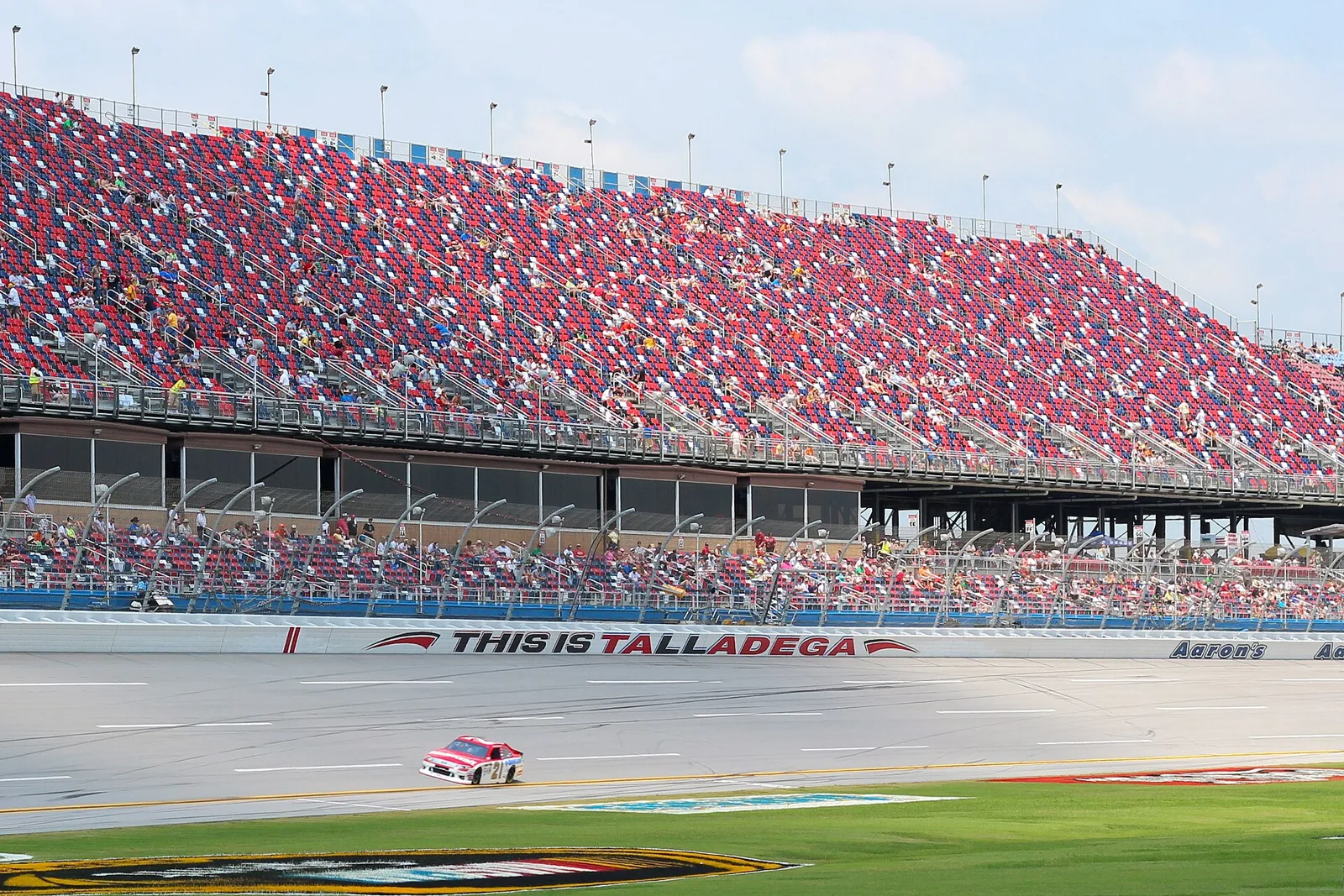
A 2.660-mile tri-oval that opened in 1969 with a boycott, set the first closed-course 200 mph laps and became the home of NASCAR's most chaotic pack races.
Talladega Superspeedway is a 2.660 mi (4.281 km) tri-oval in Lincoln, Alabama, owned by NASCAR. Built in 1969, it was known as Alabama International Motor Speedway until 1989. The track is famous for its record speeds and for the multi-car accidents of its restrictor plate era.
Talladega Superspeedway opened in 1969 as the Alabama International Motor Speedway, a banked tri-oval in Lincoln, Alabama, built by NASCAR founder Bill France Sr. Its opening was marred by a boycott, but within a few years its banking was producing closed-course speed records above 200 mph. Its reputation for close pack racing and large multi-car accidents has shaped NASCAR ever since.
Where did Talladega Superspeedway come from?
Bill France Sr. first planned a 1.500 mi (2.414 km) superspeedway in Spartanburg, South Carolina, in the early 1960s. The proposal was announced in February 1964 with plans for 50,000 seats and a budget near a million dollars. Local opposition over noise and other concerns led the city council to reject it, and France turned his attention to Alabama.
Fonty Flock encouraged France to look at the Anniston area in 1965. Negotiations moved from Eastaboga to Talladega, where state law changed in 1966 to let the city finance the track with its own credit. The budget rose to $6 million, and the track was expected to hold between 40 to 50 thousand seats.
Financing came from several sources. Pure Oil, a subsidiary of Union Oil, was rumoured to fund the whole project, and a party linked to France and Pure Oil was reported to have invested two-thirds of the money in 1967. The city of Talladega then gave France 2,000 acres at the former Anniston Air Force Base in April 1968.
A 1969 Alabama oval that set 200 mph records, drew boycotts and built a reputation for the Big One.
How was the track built?
On 16 May 1968 France announced the project at a projected cost of $5 million, with an opening date in September 1969. Groundbreaking came seven days later, and the facility was named the Alabama International Motor Speedway, or AIMS. Bill France Sr.'s son, Bill France Jr., was placed in charge.
Work on the grandstands began in October 1968 and involved bulldozing part of the Talladega Mountains. The track was advertised with banking steeper than Daytona's and with average speeds potentially above 200 mph (320 km/h). The only construction fatality was W. L. Harry, who died in August 1969 when a crane struck his head.
| Feature | Detail |
|---|---|
| Tri-oval length | 2.660 mi (4.281 km) |
| Road course | 4.000 mi (6.437 km) roval-style layout |
| Banking in turns | 33 degrees |
| Banking on tri-oval section | 16.5 degrees |
| Straights | 2 degrees |
| Infield | About 270 acres with around 2,700 RV spots |
| Complex | Around 3,000 acres, the largest on the NASCAR schedule |
What happened at the 1969 opening race?
The Talladega 500 was scheduled for 14 September 1969. LeeRoy Yarbrough and Donnie Allison ran the first tyre tests in early August and both claimed unofficial closed-circuit speed records. Drivers also complained of rough places in the surface, and France blamed holes on damage from Hurricane Camille before testing runs were made.
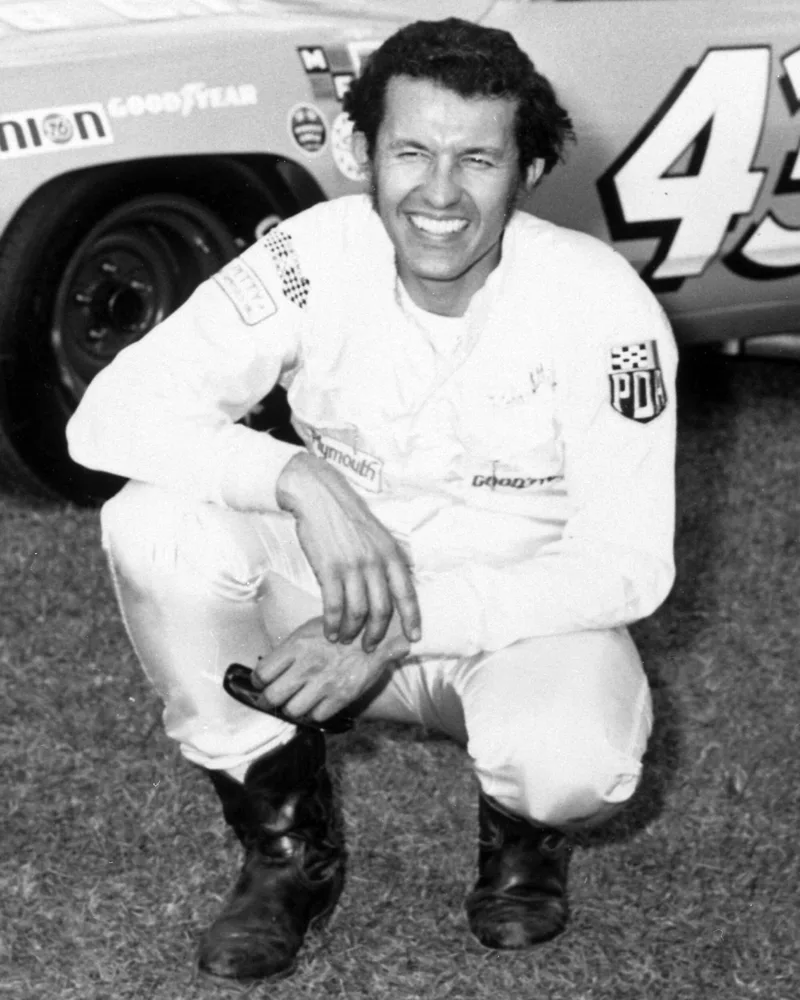
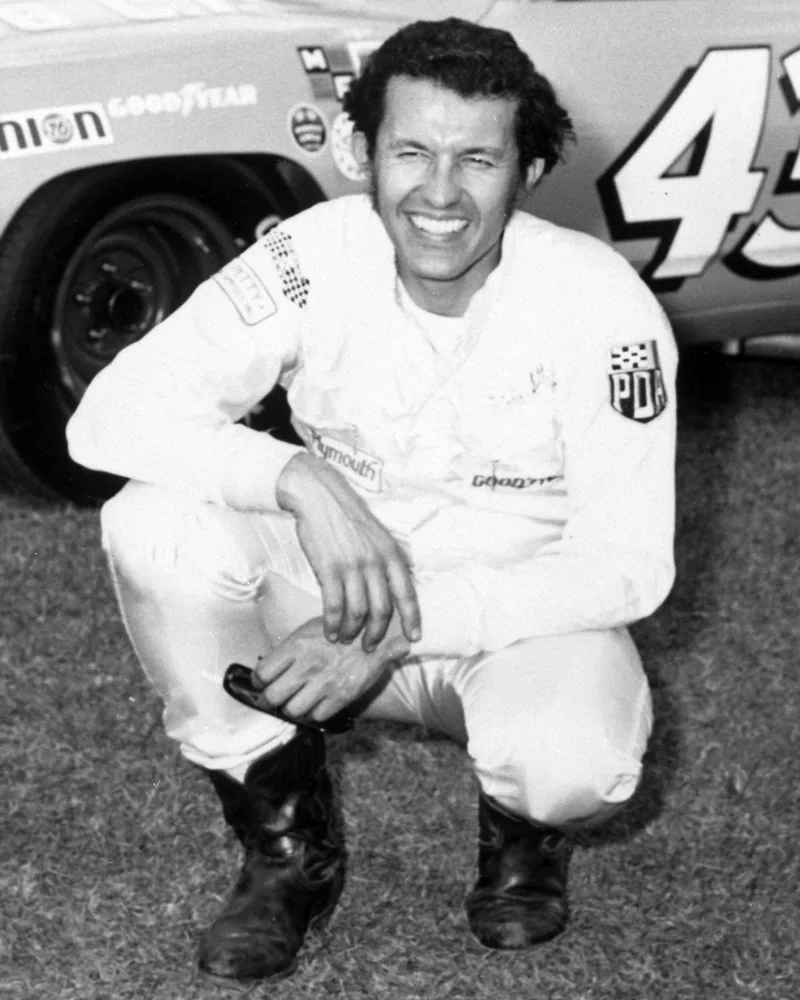
The track opened for practice on 9 September, and drivers from the newly formed Professional Drivers Association (PDA) found the surface rough. Cale Yarborough, Buddy Baker and Charlie Glotzbach reported heavy tyre wear, and tyres were said to last only four laps before shredding. Firestone pulled out of the event. A meeting of 36 PDA drivers almost unanimously agreed to withdraw, and only Tiny Lund and Bobby Isaac stayed in.
France refused to postpone, since he feared the cost of the track would bankrupt it if the race was delayed. He brought in non-PDA drivers and Grand American pony cars, and Richard Brickhouse replaced Bobby Allison in a Dodge Charger Daytona. Brickhouse won in front of a crowd of 64,000, which was lower than expected. Second-place finisher Jim Vandiver accused NASCAR of rigging the race, and the protests failed.
Did attendance recover in the early years?
Attendance fell in the track's second season. The 1970 Alabama 500 drew more than 10,000 fewer people than the 1969 race, and tarpaulins covered parts of the grandstands in June because there were too few spectators. Don Naman, who had promoted the Smoky Mountain Speedway in Tennessee, was appointed general manager in October 1970.
Naman's first project removed bumps from the track surface and renovated the press boxes and control tower. His first race drew 63,500 people, and by 1973 an Anniston Star reporter described the track's future as all sunshine. Expansion remained slow, with renovations of over $200,000 in 1975 and a 2,200-seat grandstand in 1977.
How fast did cars go at Talladega?
In March 1970 Buddy Baker became the first driver to break 200 mph on a closed course, with an average speed of 200.449 mph (322.591 km/h). Seven months later Bobby Isaac set a lap of 201.104 mph (323.646 km/h). Records kept falling through the 1970s, and the track became a benchmark for closed-circuit speed.
| Year | Driver | Speed |
|---|---|---|
| 1970 (March) | Buddy Baker | 200.449 mph (322.591 km/h) |
| 1970 (October) | Bobby Isaac | 201.104 mph (323.646 km/h) |
| 1971 | Paula Murphy, women's record | 171.499 mph (276.001 km/h) |
| 1974 (August) | A. J. Foyt | 217.315 mph (349.735 km/h) |
| 1975 | Mark Donohue | 221.160 mph (355.923 km/h) |
A. J. Foyt took the overall closed-circuit record from Mario Andretti in August 1974, and Mark Donohue broke it again a year later. In the 1980s the women's record was reset several times, with Lyn St. James becoming the first woman over 200 mph at 204.233 mph (328.681 km/h).
St. James broke her own record in October 1988, and Patty Moise took the women's record in December 1989. Moise broke her own mark a month later with a lap of 217.498 mph (350.029 km/h).
Why did the track get a reputation for big crashes?
Restrictor-plate racing made the cars slower, but it also produced tight pack racing. In those packs, one mistake could bring down many cars. These multi-car accidents became known as the Big One, and they became the track's defining feature.
The restrictor plate followed Bobby Allison's crash in the 1987 Winston 500, when a tyre blew at high speed on the frontstretch. His car went airborne into the catchfence and four spectators were injured. The plate became a requirement that lasted until 2019.
What were the worst accidents at Talladega?
The 1973 Winston 500 involved a 19-car crash that hospitalised four drivers, and Wendell Scott's injuries effectively ended his racing career. Larry Smith became the first driver to die at the track in the 1973 Talladega 500 after a blown tyre and a wall impact. In 1975 Randy Owens and Tiny Lund were killed in separate races.
At the 1974 Winston 500, ten of the top 11 qualifiers reported that their cars had been sabotaged by mechanical failures. The culprit was never found.
The 1993 DieHard 500 saw two major accidents. A seven-car crash left Stanley Smith with a basilar skull fracture that affected him for the rest of his life. Jimmy Horton's car also went over the protective wall, and Neil Bonnett's car tore a 20-foot gap in the catchfence later in the same race.
Later accidents followed a similar pattern. Mark Martin went through the infield in 1994, and Ricky Craven was caught in a 14-car accident in 1996 that stayed within the track after a new catchfence was added. The 2002 Aaron's 312 saw a 27-car pileup, and at the 2009 Aaron's 499 Carl Edwards's car went airborne into the catchfence and injured seven spectators.
Is there a Talladega curse?
A legend of a Talladega Curse grew up around the track. Publicity director Jim Hunter encouraged the belief, which linked the speedway's construction to indigenous American land taken as part of the Trail of Tears. Grant Lynch later said the idea was a marketing tactic meant to build the mystique of Talladega.
The track's wild reputation was also tied to its crowds and infield. By the 2000s officials had added a makeshift jail and worked to make the infield more orderly, after a scene that had been described as notoriously rowdy in the 1980s.
Who has run Talladega Superspeedway?
Mike Helton replaced Naman as general manager in October 1987, and on 30 January 1989 he became president, the same day the track was renamed Talladega Superspeedway. Helton added frontstretch upgrades, 2,000 seats for the Birmingham Tower and an infield campground in May 1992 before leaving for NASCAR at the end of 1993.
Grant Lynch took over as general manager in 1993. He added seats in 1994 and 1995, opened the 7,800-seat Gadsden Tower in 1997 and oversaw a red and blue recolouring of the seats. The 22,000-seat Allison Grandstand was completed in October 1999, and by 2003 grandstand capacity stood at 143,000.
The track was repaved in 2006 after a complete repave was announced in December 2005. The work began on 2 May 2006 and was completed on 25 September 2006. Attendance later fell from about 190,000 at the 2003 Aaron's 499 to 108,500 at the 2012 event, and capacity was cut to 80,000 in 2013.
Brian Crichton replaced Lynch after the 2019 1000Bulbs.com 500, following a $50 million infield renovation that ran from October 2018 to September 2019. Crichton announced his departure in February 2026, and Josh Harris took over temporarily.
Which series race at Talladega?
The track hosts two NASCAR Cup weekends each year, the spring Jack Link's 500 and the fall YellaWood 500. Support races include NASCAR O'Reilly Auto Parts Series and Craftsman Truck Series events such as the Ag-Pro 300, TPG 250 and Love's RV Stop 225.
The road course has hosted IMSA GT Championship racing, beginning in 1971, and the International Race of Champions has appeared there on several occasions. AMA Superbike raced at the circuit between 1980 and 1983. Talladega has also been a backdrop for film and television, including Talladega Nights: The Ballad of Ricky Bobby, released in August 2006.
The Legend of Hallowdega, a mockumentary released on Halloween in 2010, poked fun at the Talladega Curse as part of an energy drink advertising campaign. The track also appeared in the 1983 film Stroker Ace and in a 2005 episode of The Amazing Race.
The complex sits beside Interstate 20, and its infield holds around 2,700 RV spaces. Across roughly 3,000 acres, the complex is the largest on the NASCAR schedule, and the track has hosted food and culture events, including the Foodie's Food Culture Festival in 2024.