A tyre-test boycott, a car through the catch fence at 200 mph and a throttle-body plate that made packs: how NASCAR chose to slow its two fastest tracks.
NASCAR first used restrictor plates in 1970 during an engine transition, then mandated them at Daytona and Talladega from 1988 after Bobby Allison's car tore down almost 30 m (100 ft) of fence in the 1987 Winston 500. The plates ended with the 2019 Daytona 500 in favour of a tapered spacer.
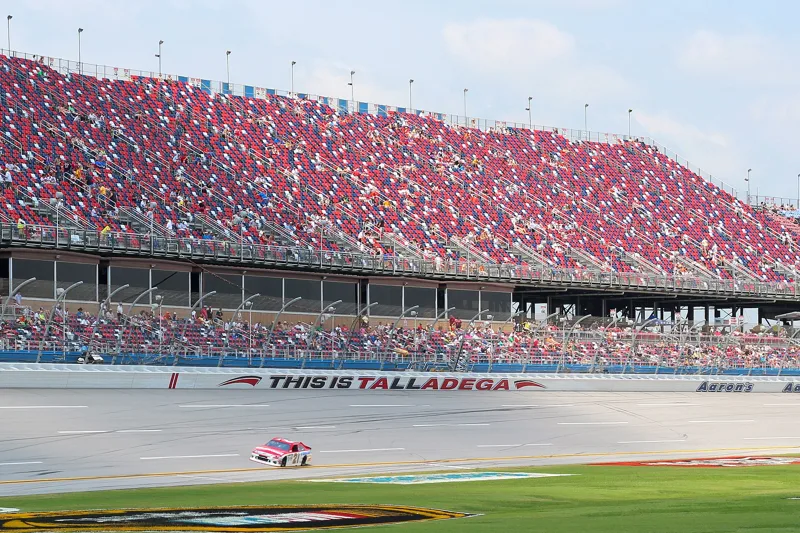
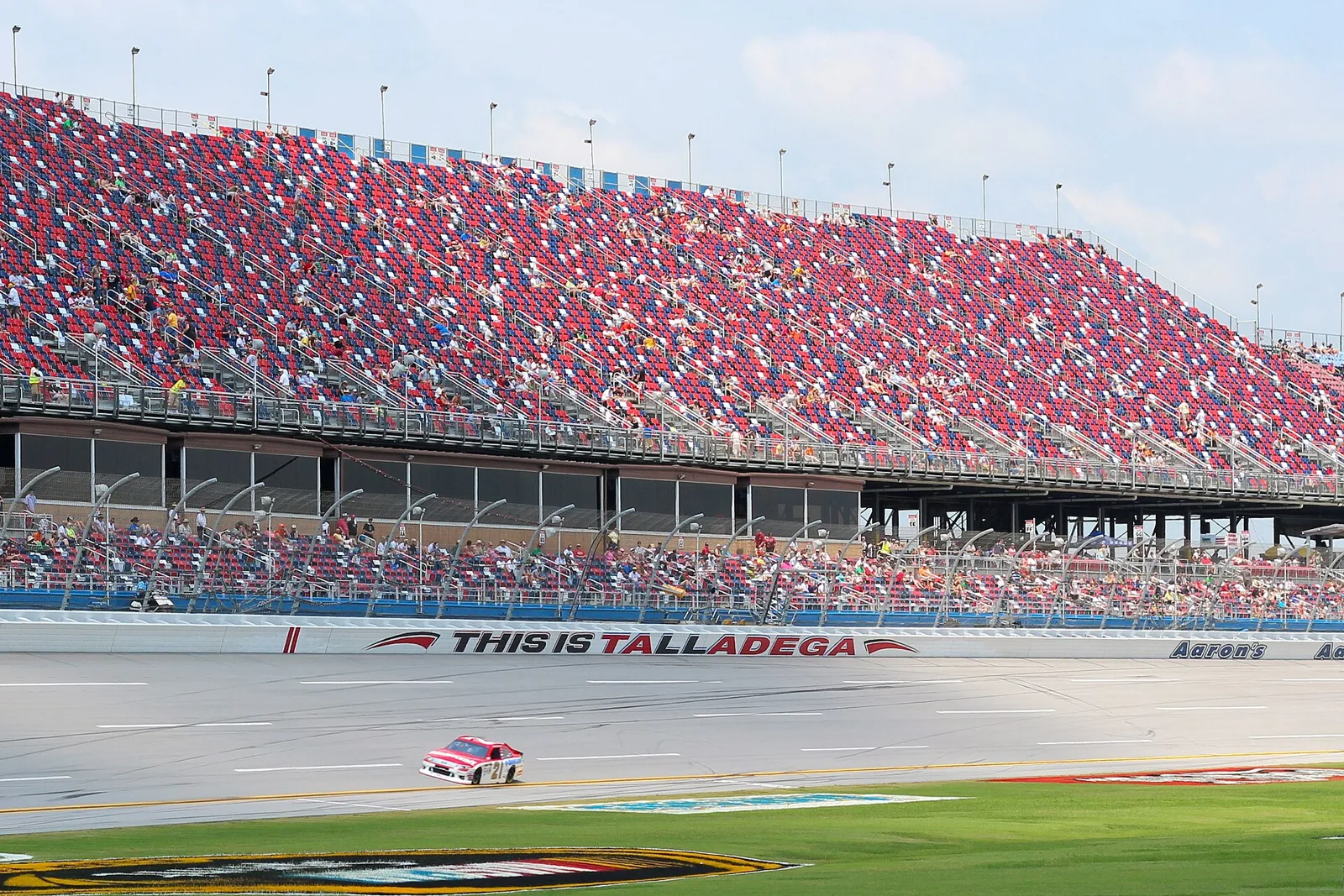
On lap 21 of the 1987 Winston 500, Bobby Allison's car went backwards and airborne at Talladega and tore down almost 30 m (100 ft) of the catch fence meant to protect the crowd. Within months NASCAR had decided to strangle its engines at its two fastest tracks, and the restrictor plate it chose changed how superspeedway racing looked from 1988 until 2019.
The plate's story begins earlier than 1987, and it touches another Talladega race from 1969 that has been called the worst in NASCAR history.
What is a restrictor plate?
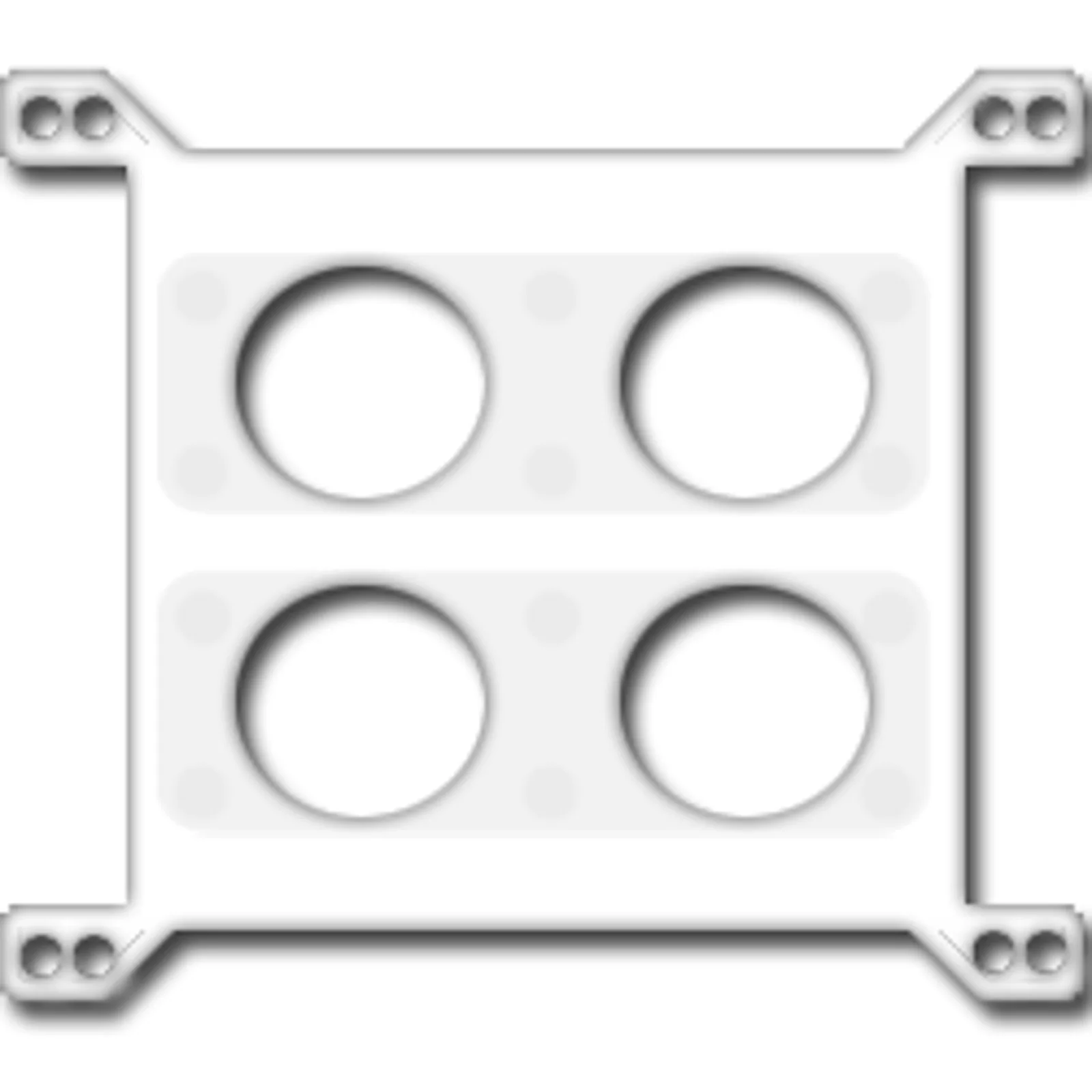
A restrictor plate sits in the intake of an engine and caps its output. Racing series use them mainly to cap top speed, give rivals an equal level of competition and hold down costs. Think of an engine breathing through a narrower straw: less air gets in, less fuel can burn, and power falls.
The idea is not unique to stock cars. In 2006 Scuderia Toro Rosso used air restrictors and rev limiters in Formula One to help it through a change of engine formula, and rallying brought in restrictors on turbocharged and supercharged engines after the Group B era. In NASCAR the plate is bolted beneath a throttle body in the spot where carburettors once sat.
A fence torn down at 200 mph in May 1987 gave NASCAR the plate that made pack racing.
When did NASCAR first use restrictor plates?
NASCAR first used restrictor plates in 1970, but not for the reason most fans associate with them. They were a stage in a planned step down from seven-litre (430 cubic inch) engines to six-litre (370 cubic inch) units, due to be complete by the end of the 1973 season.
Drivers David Pearson, Bobby Isaac and Bobby Allison advised NASCAR after testing, and the sanctioning body required a plate on the seven-litre big blocks. Smaller engines of about 358 cubic inches, which remain the standard, were exempt. Dick Brooks was the first to race a small block, in the 1971 Daytona 500, driving a 1969 Dodge Charger Daytona fitted with a five-litre (305 cubic inch) engine. The transition ran until 1974, when the 358 cubic inch limit arrived. Because not every car carried a plate and the whole thing was seen as a stepping stone, this is not what fans mean by restrictor plate racing. It resembles Formula One in 2006, when V10 teams ran restrictors while V8 teams did not.
What happened at the 1969 Talladega 500?
The inaugural Talladega 500, held on 14 September 1969, was overshadowed by a boycott: most of the leading drivers left over safety fears about the tyres, and a scoring dispute left the winner in doubt. The race is described as the worst in NASCAR history.
The France family's business, International Speedway Corporation, built the new track in the 1960s on land that had been Anniston Air Force Base. It was a 2.66-mile (4.28 km) tri-oval with steep banking. Tyre testing there went badly. Drivers reported handling problems, and their tyres were found destroyed throughout the garage. NASCAR was in the middle of a tyre war in which two manufacturers competed on grip and durability, and the makers of the time sacrificed safety for speed. Firestone and Goodyear flew in harder compounds, but the trouble continued the next day. Firestone then withdrew and released drivers from their contracts to use whichever tyre they liked. Goodyear stayed, hoping to prove its product was better.
The drivers turned to the Professional Driver Association, a union in all but name, led by Richard Petty. NASCAR president Bill France hated unions and had banned Curtis Turner in 1961 for trying to form one, so he simply never acknowledged the PDA. When it offered to postpone the race until a suitable tyre existed, France refused, partly because the speedway had barely been finished and he needed his money back. He tried to calm the garage by lapping in a slower pony car, about 160 mph, and asking why the drivers did not simply race at that pace. They took that as an insult. France then told Bobby Allison he thought he was afraid to race, and according to Allison, LeeRoy Yarbrough struck France and told the drivers to pack up. Most of the PDA left. Richard Brickhouse stayed, pushed by Chrysler to drive its new car. Jim Vandiver and Bobby Isaac did not belong to the PDA and also stayed.
Worried about attendance, France offered fans free entry to the 1970 Daytona 500 if they bought tickets for this race, and let drivers from the preliminary 400-mile race, in slower cars, enter the feature. About 62,000 people turned up. On race morning Goodyear flew in a new set of tyres, and they lasted the entire race.
Isaac won the pole, and the race saw the debut of the Dodge Charger Daytona. Brickhouse took the win, his only one in the Cup Series, though Vandiver protested that he had won. Ray Fox and Vandiver were convinced they had lapped Brickhouse, and the radio commentators thought Vandiver was in front. Vandiver is said to have believed to the day he died that he won. Conspiracy theorists point out that he drove an older Charger 500 while Brickhouse had the new winged Daytona, and claim Chrysler talked France into a scoring error. The PDA broke up soon afterwards, and no similar body appeared in NASCAR before the Race Team Alliance's formation in 2014.
How did the 1987 Winston 500 lead to restrictor plates?
Bobby Allison's crash on lap 21 of the 1987 Winston 500 convinced NASCAR to make restrictor plates mandatory for 1988 at Daytona and Talladega. The cars were considerably slower as a result, and the move, unplanned, opened the age of pack racing.
The race was the ninth of the 1987 Winston Cup season, run on 3 May before a crowd of 135,000. Bill Elliott had taken pole at 342.483 km/h (212.809 mph), the fastest qualifying lap on record by average speed, a mark that still stands. Davey Allison led 101 laps to take his first Cup win, with Terry Labonte second and Kyle Petty third, although the race was cut from 188 laps to 178 because a long stoppage while debris was cleared and the fence mended left too little daylight.
The cause of the crash is told two ways. Some versions have Allison's engine failing and pieces of it cutting his right rear tyre at about 340 km/h (210 mph); others have his Buick LeSabre blowing a tyre going into the tri-oval at 320 km/h (200 mph). Either way the car spun backwards, flew tail-first into the catch fence and tore down nearly 30 m (100 ft) of it, stopping the race for two hours. It did not reach the grandstands, but debris injured spectators: four, none seriously, by one tally. A newspaper writer described the car as spinning like an insane top, collecting others as it went.
NASCAR's first answer was smaller carburettors, 390 cubic feet per minute instead of 830, for the next two superspeedway races over the summer. They did not slow the cars enough. So the sanctioning body brought back the plate, this time for the two fastest circuits: Daytona for all of its races and Talladega for Cup events. The Automobile Racing Club of America applied it at both tracks too, and when the Busch Grand National series started racing at Talladega in 1992 it received plates as well.
| Year | Trigger | Where | Outcome |
|---|---|---|---|
| 1970 | Phased move from seven-litre to six-litre engines | Big-block cars | Plates until the 358 cubic inch limit in 1974 |
| 1988 | Bobby Allison's crash at the 1987 Winston 500 | Daytona and Talladega | Pack racing begins |
| 2000 | Fatal crashes at New Hampshire | New Hampshire, once for Cup | Dropped for the next Cup race |
| 2019 | Move to a tapered spacer | Daytona and Talladega | Original plates last used at the Daytona 500 |
Why does speed matter so much at Talladega?
Above the 310 km/h (190 mph) range used at Daytona and Talladega, cars risk turning over from aerodynamic forces alone. Rusty Wallace, among others, has cited data showing that the roof flaps fitted to the cars do not hold the cars down beyond 328 km/h (204 mph).
Crash severity rises with speed as well. Telemetry from wrecks such as Elliott Sadler's at Pocono and Michael McDowell's at Texas recorded readings far higher than any seen on restrictor plate tracks. In 2004 Wallace tested at Talladega without a plate and reached 390 km/h (240 mph) down the backstretch and averaged 356 km/h (221 mph) over a lap. He admitted the excitement, but said racing a pack of cars at those speeds would be insane.
Talladega restrictor plate racing and the Big One
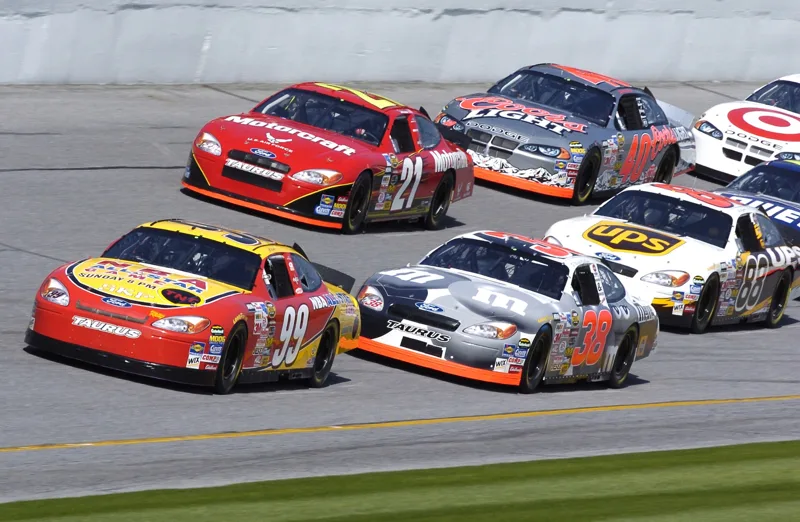
The cost of the plates was bigger packs. Cut power plus the drag of the cars keeps them bunched, and at both Daytona and Talladega nearly every race suffers a wreck of this kind, known as the Big One. Talladega is the more likely site because its track is wide enough for three or four lines of cars side by side. After Daytona was repaved, three-wide racing became far easier there and multi-car wrecks more common; the 2011 Daytona 500 had the most cautions ever seen, among them an early 17-car pile-up. Those crashes draw criticism even though multi-car accidents happen at other tracks and impacts there are often more severe. In 1988 to 1990, packs were much smaller until teams learned the new style of racing.
The packs did bring plenty of passing. Cup races at Talladega have passed 40 official lead changes sixteen times since 1988, including both 2010 races, which had 87 lead changes over the scheduled 188 laps. The Aaron's 499 that year had 88, but the 88th was Kevin Harvick's winning pass on the last lap of the third green-white-checkered attempt. Daytona has been less competitive, because its asphalt, repaved in 1978 and again in 2010, offers less grip and hampers overtaking.
Where else has NASCAR used plates?
NASCAR has used plates or similar devices well beyond the two big tracks. In 2000, after Adam Petty and Kenny Irwin Jr. died in crashes at New Hampshire, in the Busch race in May and the Winston Cup race in July, a plate was adopted to slow cars into the tight turns, as part of reforms aimed at stuck throttles that were said to be behind both fatal crashes. For the Cup race it was used once, at the Dura Lube 300, where Jeff Burton led all 300 laps. It was an emergency measure and was dropped for the next Cup race, although the Modifieds still use one there.
In 2008 the Nationwide and Truck series moved to tapered spacers, and both series now use a plate and spacer at Daytona and Talladega. In 2016 NASCAR tested a smaller plate with aerodynamic aids for the Xfinity Series at Indianapolis after uncompetitive races, imposed that package in 2017, and used it at Indianapolis, Michigan and Pocono in 2018 and in the Cup All-Star Race.
Where restrictor plate racing goes from here
The original plates ended with the 2019 Daytona 500. The Cup cars then switched to a variable-sized tapered spacer, with smaller holes than at other tracks, to keep speeds under 320 km/h (200 mph). NASCAR also added larger rear spoilers, larger front splitters and front-end aero ducts, which increased drag and offset the extra power. Racing quality noticeably improved and passing became easier, yet speeds rose past 320 km/h (200 mph) and into the 330 km/h (205 mph) range.
Plate rules also returned for Atlanta Motor Speedway starting in 2022, because of concerns over speed after the track was repaved and reconfigured with 28 degrees of banking.